Recognition: no theorem link
Microscopic Quantum Friction
Pith reviewed 2026-05-16 13:13 UTC · model grok-4.3
The pith
Quantum friction between two ground-state atoms arises from their relative motion coupled to dispersive response, appearing as odd-order terms in a velocity power series.
A machine-rendered reading of the paper's core claim, the machinery that carries it, and where it could break.
Core claim
The central claim is that the interplay between the dispersive response and the relative center-of-mass motion of two ground-state atoms produces a quantum force expandable in powers of velocity. Even-order contributions are reversible while odd-order contributions are irreversible and survive only with internal dissipation; the work performed by these terms satisfies model-independent relations for arbitrary scattering trajectories. This framework identifies the odd-parity terms as microscopic quantum friction and demonstrates that its characteristic velocity scalings, including the cubic law at zero temperature, hold universally at the atomic scale.
What carries the argument
The velocity power series expansion of the quantum force generated by coupling the atoms' dispersive response to their center-of-mass motion.
If this is right
- At room temperature the leading microscopic quantum friction is linear in velocity and exhibits strong quantum character.
- The cubic velocity dependence of quantum friction at zero temperature is already fixed at the atomic scale and does not require a macroscopic setting.
- Only terms of odd parity in velocity contribute to net dissipation and therefore to microscopic quantum friction.
- The work done by each term in the force series obeys general relations that hold for any scattering trajectory.
Where Pith is reading between the lines
- The same parity-based distinction may apply to friction in other dispersive systems such as moving nanoparticles or atoms near surfaces.
- Atomic-scale experiments with controlled velocities could directly test the predicted linear term at room temperature.
- The model-independent work relations might simplify calculations of energy loss in quantum-optomechanical setups.
Load-bearing premise
Odd-order terms in the force expansion survive only when an internal dissipation mechanism is active, and the derived work properties apply to arbitrary scattering trajectories without additional model dependence.
What would settle it
A measurement showing that the force between two ground-state atoms moving at constant low velocity lacks any odd-order velocity dependence, or that the cubic term at zero temperature disappears for a chosen atomic species and trajectory.
Figures
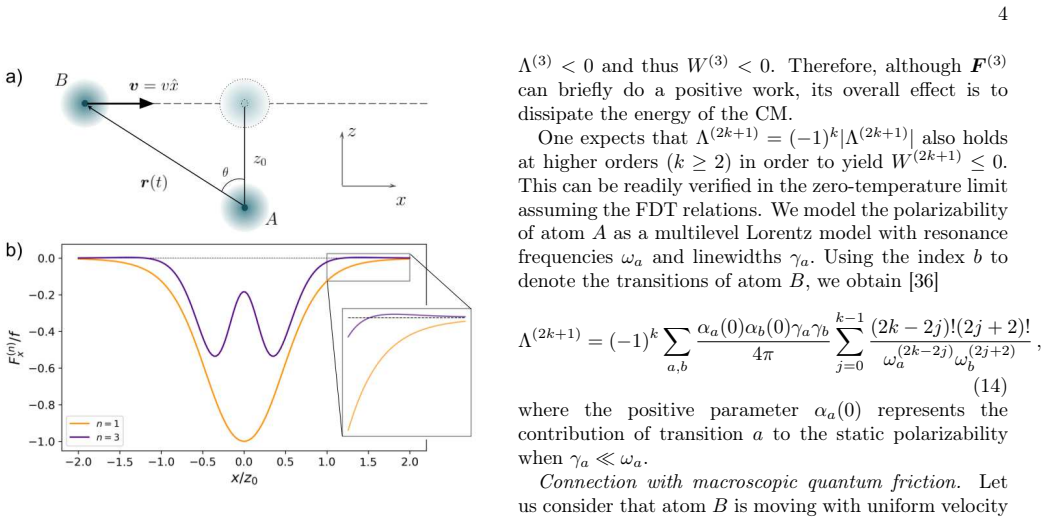
read the original abstract
We report on a microscopic theory of quantum friction. Our approach investigates the interplay between the dispersive response and the relative center-of-mass motion of two ground-state atoms. This coupling yields a quantum force, which can be expressed as a power series in the velocity. The significance of each contribution depends on its order parity: while even-order terms are reversible, odd-order terms are irreversible and only survive in the presence of an internal dissipation mechanism. In addition, we obtain general, model-independent properties for the work performed by these contributions for arbitrary scattering trajectories. These results enable an unambiguous identification of odd-parity terms with microscopic quantum friction. At room temperature, the dominant microscopic quantum friction is of first order in the velocity and presents a strong quantum character. Our microscopic theory reveals that several properties of quantum friction obtained in specific settings -- such as the cubic dependence on velocity at zero temperature -- are indeed universal features already present at the atomic scale.
Editorial analysis
A structured set of objections, weighed in public.
Referee Report
Summary. The paper develops a microscopic theory of quantum friction by coupling the dispersive response of two ground-state atoms to their relative center-of-mass motion. The resulting quantum force is expanded as a power series in velocity, with even-order terms identified as reversible and odd-order terms as irreversible, the latter surviving only when an internal dissipation mechanism is present. Model-independent expressions are derived for the work performed by these force contributions along arbitrary scattering trajectories, allowing unambiguous identification of odd-parity terms with microscopic quantum friction. The work claims that at room temperature the leading term is first-order in velocity with strong quantum character, and that features such as the cubic velocity dependence at zero temperature are universal already at the atomic scale.
Significance. If the derivations are valid, the manuscript supplies a microscopic foundation that unifies previously model-specific results on quantum friction and demonstrates their universality at the atomic level. This would strengthen the connection between Casimir-Polder physics, quantum optics, and dissipative forces, providing a route to falsifiable predictions for low-velocity friction in ground-state atomic systems without reliance on macroscopic response functions.
major comments (1)
- [§3 (velocity expansion and work expressions)] The central claim that odd-order terms yield model-independent work expressions for arbitrary trajectories (abstract and §3) rests on the specific insertion of dissipation via the imaginary part of the response function or bath spectral density. It is not shown that this insertion follows from the same microscopic Hamiltonian used for the dispersive part; if the dissipation is added phenomenologically, the claimed universality of the cubic term at T=0 for arbitrary scattering trajectories does not follow without additional assumptions on the low-velocity or weak-coupling regime.
minor comments (2)
- [Abstract] The abstract states that 'several properties... are indeed universal features' but does not specify which properties beyond the cubic velocity dependence; a brief enumeration in the introduction would improve clarity.
- [Introduction] Notation for the force power series (even/odd parity) is introduced without an explicit equation reference in the opening paragraphs; adding Eq. (X) early would aid readability.
Simulated Author's Rebuttal
We thank the referee for the careful reading and constructive feedback on our manuscript. We address the major comment below and will incorporate clarifications in the revised version.
read point-by-point responses
-
Referee: [§3 (velocity expansion and work expressions)] The central claim that odd-order terms yield model-independent work expressions for arbitrary trajectories (abstract and §3) rests on the specific insertion of dissipation via the imaginary part of the response function or bath spectral density. It is not shown that this insertion follows from the same microscopic Hamiltonian used for the dispersive part; if the dissipation is added phenomenologically, the claimed universality of the cubic term at T=0 for arbitrary scattering trajectories does not follow without additional assumptions on the low-velocity or weak-coupling regime.
Authors: We agree that the connection between the microscopic Hamiltonian and the dissipative (imaginary) part of the response must be made fully explicit to support the model-independent claims. In the manuscript, the atoms are modeled as two-level systems coupled to a common bath of harmonic oscillators (Section 2), from which both the real (dispersive) and imaginary (dissipative) parts of the polarizability are obtained via the same second-order perturbation theory and fluctuation-dissipation relation. The odd-order force terms then follow directly once the center-of-mass velocity is introduced. However, the referee is correct that the work expressions for arbitrary trajectories rely on the low-frequency form of the bath spectral density and the weak-coupling Markovian limit; these assumptions are stated but not derived in full detail from the Hamiltonian for general scattering paths. We will revise §3 to include an explicit derivation of the imaginary response from the microscopic Hamiltonian, add a dedicated paragraph on the required assumptions (ohmic bath, weak coupling, low velocity), and qualify the universality statement accordingly. This constitutes a partial revision. revision: partial
Circularity Check
No circularity: microscopic derivation of velocity power series and model-independent work properties stands independently
full rationale
The paper derives the quantum force explicitly as a power series in relative velocity by coupling the dispersive atomic response to center-of-mass motion. Even-order terms are identified as reversible and odd-order terms as irreversible, surviving only with an internal dissipation mechanism; general expressions for the work done by each contribution are then obtained for arbitrary scattering trajectories. These steps are presented as following directly from the microscopic Hamiltonian without reduction to fitted parameters, self-referential definitions, or load-bearing self-citations that collapse the universality claims (e.g., cubic velocity dependence at T=0) back to the inputs by construction. The model-independent character of the work expressions is asserted after the expansion, not presupposed, so the central identification of odd-parity terms with quantum friction remains non-circular on the evidence given.
Axiom & Free-Parameter Ledger
axioms (2)
- domain assumption Atoms remain in ground states whose dispersive response couples to center-of-mass motion
- domain assumption Internal dissipation mechanism must be present for odd-order terms to produce irreversible friction
Reference graph
Works this paper leans on
-
[1]
A. Manjavacas and F. J. García de Abajo, Vacuum friction in rotating particles, Phys. Rev. Lett. 105, 113601 (2010)
work page 2010
-
[2]
Z. Xu, Z. Jacob, and T. Li, Enhancement of rotational vacuum friction by surface photon tunneling, Nanophotonics 10, 537 (2021)
work page 2021
-
[3]
S. Sanders, W. J. M. Kort-Kamp, D. A. R. Dalvit, and A. Manjavacas, Nanoscale transfer of angular momentum mediated by the casimir torque, Commun.Phys. 2, 71 (2019)
work page 2019
- [4]
-
[5]
H. S. G. Amaral, P. P. Abrantes, F. Impens, P. A. M. Neto, and R. de Melo e Souza, Tailoring the van der waals interaction with rotation, Phys.Rev.Lett. 135, 243601 (2025)
work page 2025
- [6]
-
[7]
N. Kavokine, M.-L. Bocquet, and L. Bocquet, Fluctuation-induced quantum friction in nanoscale water flows, Nature 602, 84 (2022)
work page 2022
- [8]
-
[9]
M. I. Shaukat and M. G. Silveirinha, Impact of chiral transitions in quantum friction, Phys.Rev.A 111, 032202 (2022)
work page 2022
-
[10]
O. J. Franca, F. Spallek, S. M. Giesen, R. Berger, K. Singer, S. Aull, and S. Y. Buhmann, Spectroscopic footprints of quantum friction in nonreciprocal and chiral media, Phys.Rev.A 112, 012803 (2025)
work page 2025
-
[11]
X. Gao, Z. Gong, H. Li, Z. Liu, W. Yan, Q. Zheng, W. W. Kexin Ren and, and J. Zhang, Pseudo-landau levels splitting triggers quantum friction at folded graphene edge, Nature Communications 16, 5558 (2025)
work page 2025
-
[12]
J. B. Pendry, Quantum friction–fact or fiction?, New Journal of Physics 12, 033028 (2010)
work page 2010
-
[13]
T. G. Philbin and U. Leonhardt, No quantum friction between uniformly moving plates, New Journal of Physics 11, 033035 (2009)
work page 2009
-
[14]
A. I. Volokitin and B. N. J. Persson, Quantum friction, Phys. Rev. Lett. 106, 094502 (2011)
work page 2011
-
[15]
K. A. Milton, J. S. Høye, and I. Brevik, The reality of casimir friction, Symmetry 8, 29 (2016)
work page 2016
-
[16]
K. A. Milton, N. Pourtolami, and G. Kennedy, Perspectives on quantum friction, self-propulsion, and self-torque, Physics Letters A 545, 130475 (2025)
work page 2025
- [17]
-
[18]
F. C. Lombardo and P. I. Villar, Geometric phase corrections on a moving particle in front of a dielectric mirror, EPL 118, 50003 (2017)
work page 2017
-
[19]
M. B. Farias, W. J. M. Kort-Kamp, and D. A. R. Dalvit, Quantum friction in two-dimensional topological materials, Phys. Rev. B 97, 161407 (2018)
work page 2018
-
[20]
M. B. Farias, C. D. Fosco, F. C. Lombardo, and F. Mazzitelli, Motion induced radiation and quantum friction for a moving atom, Phys.Rev.D 100, 036013 (2019)
work page 2019
- [21]
-
[22]
M. B. Farias, F. C. Lombardo, A. Soba, P. I. Villar, and R. S. Decca, Towards detecting traces of non-contact quantum friction in the corrections of the accumulated geometric phase, npj Quantum Inf. 6, 25 (2020)
work page 2020
- [23]
- [24]
-
[25]
A. Fernández and C. D. Fosco, Quantum friction for a scalar model: Spatial dependence and higher orders, Annals of Physics 463, 169635 (2024)
work page 2024
-
[26]
D. Oue, J. B. Pendry, and M. G. Silveirinha, Stable-to-unstable transition in quantum friction, Phys.Rev.Research 6, 043074 (2024)
work page 2024
-
[27]
D. Oue, B. Shapiro, and M. G. Silveirinha, Quantum friction near the instability threshold, Phys.Rev. B 111, 075403 (2025)
work page 2025
-
[28]
S. Scheel and S. Y. Buhmann, Casimir-Polder forces on moving atoms, Phys. Rev. A 80, 042902 (2009). 6
work page 2009
-
[29]
M. Donaire and A. Lambrecht, Velocity-dependent dipole forces on an excited atom, Phys.Rev.A 93, 022701 (2016)
work page 2016
-
[30]
C. D. Fosco, F. C. Lombardo, and F. Mazzitelli, Motion- induced radiation due to an atom in the presence of a graphene plane, Universe 7, 158 (2021)
work page 2021
-
[31]
F. C. Lombardo, R. S. Decca, L. Viotti, and P. I. Villar, Detectable signature of quantum friction on a sliding particle in vacuum, Adv. Quant. Tech. 4, 2000155 (2021)
work page 2021
-
[32]
X. Guo, K. A. Milton, G. Kennedy, W. P. McNulty, N. Pourtolami, and Y. Li, Energetics of quantum vacuum friction: Field fluctuations, Phys. Rev. D 104, 116006 (2021)
work page 2021
-
[33]
X. Guo, K. A. Milton, G. Kennedy, W. P. McNulty, N. Pourtolami, and Y. Li, Energetics of quantum vacuum friction: Field fluctuations, Phys. Rev. D 106, 016008 (2022)
work page 2022
- [34]
-
[35]
J. N. Israelachvili, Intermolecular and Surface Forces (Academic Press, 2011)
work page 2011
-
[36]
See Supplemental Material at [URL will be inserted by publisher] for the calculation of the correlation between the fluctuatig dipoles, for the evaluation of the dynamical vector and the quantum-correlation factor and for the spatial angular average of the force in the connection with the macroscopic quantum friction
-
[37]
Supplemental Material: Microscopic Quantum Friction Pedro H
Although this integration involves pair of atoms at arbitrary distances, for ωz 0/c ≪ 1 the main contribution comes from a spatial region where the non-retarded regime applies. Supplemental Material: Microscopic Quantum Friction Pedro H. Pereira, 1 F. Impens, 2 C. Farina, 2 P. A. Maia Neto, 2 and R. de Melo e Souza 1, ∗ 1Instituto de F ´ ısica, Universida...
-
[38]
A. S. Santos, P. H. Pereira, P. P. Abrantes, C. Farina, P. A. Mai a Neto, and R. de Melo e Souza, Time-dependent effective Hamiltonians for light-matter interactions, Entropy 26, 527 (2024)
work page 2024
discussion (0)
Sign in with ORCID, Apple, or X to comment. Anyone can read and Pith papers without signing in.