Gradient flow for finding E-optimal designs
Pith reviewed 2026-05-16 12:20 UTC · model grok-4.3
The pith
A constrained steepest-ascent field in Wasserstein space produces a flow whose limit points are first-order stationary for the nonsmooth E-criterion.
A machine-rendered reading of the paper's core claim, the machinery that carries it, and where it could break.
Core claim
Working in the 2-Wasserstein space, the Wasserstein gradient for smooth criteria coincides with the Euclidean particle gradient up to a constant factor, with the approximation gap for equal-weight designs vanishing at an explicit rate. For the nonsmooth E-criterion we construct a constrained Wasserstein steepest-ascent field by maximizing feasible directional derivatives over the tangent cone of the design space. The resulting flow satisfies an exact energy identity and every limit point is first-order stationary. The particle ascent computation reduces to a convex semidefinite programme whose dimension equals the multiplicity of the smallest eigenvalue.
What carries the argument
The constrained Wasserstein steepest-ascent field obtained by maximizing feasible directional derivatives of the E-criterion over the tangent cone at the current empirical measure.
If this is right
- The flow satisfies an exact energy identity.
- Every limit point of the flow is first-order stationary for the E-criterion.
- Each particle ascent step reduces to a convex semidefinite program whose dimension equals the multiplicity of the smallest eigenvalue.
- The method extends directly to other nonsmooth minimax criteria in optimal design.
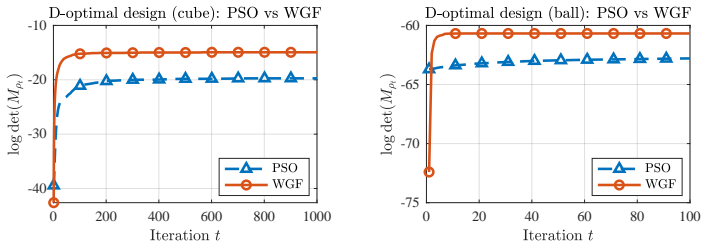
- Numerical tests on second-order response surface models and seven-dimensional logistic regression attain near-optimal E-values and outperform particle swarm optimization in higher dimensions.
Where Pith is reading between the lines
- The same constrained-ascent construction may apply to other nonsmooth criteria that arise in statistical optimal design.
- It supplies a concrete bridge between Wasserstein geometry and convex programming for non-differentiable objective functions.
- One could test the method on larger-scale design problems where traditional algorithms become unreliable.
- Mean-field analysis of the particle system might yield convergence rates beyond the stationarity result proved here.
Load-bearing premise
Directional derivatives of the E-criterion exist at the points of interest and the tangent cone of the design space admits a well-defined maximizer that supplies a feasible ascent direction.
What would settle it
A numerical simulation of the flow in which the claimed energy identity is violated, or a computed limit point that fails the first-order stationarity condition for the E-criterion.
Figures


read the original abstract
The $E$-optimality criterion for a regression model maximizes the smallest eigenvalue of the information matrix and becomes non-differentiable when this eigenvalue has multiplicity greater than one. Working in the $2$-Wasserstein space, we show that the Wasserstein gradient at an empirical measure coincides, up to a constant factor, with the Euclidean particle gradient for smooth criteria such as $D$- and $L$-optimality, and that the approximation gap for equal-weight $N$-particle designs vanishes at an explicit rate. The main challenge is the nonsmooth $E$-criterion, for which the Wasserstein gradient does not exist. We replace it with a constrained Wasserstein steepest-ascent field obtained by maximizing feasible directional derivatives over the tangent cone of the design space, and prove that the resulting flow satisfies an exact energy identity and that every limit point is first-order stationary. The particle ascent computation reduces to a convex semidefinite programme whose dimension equals the multiplicity of the smallest eigenvalue. In numerical comparisons on second-order response surface models and a seven-dimensional logistic regression model, the constrained Wasserstein steepest-ascent method attains near-optimal $E$-criterion values and is markedly more reliable than particle swarm optimization in higher-dimensional settings. The framework applies more broadly to other nonsmooth minimax criteria in optimal design, and a numerical experiment on the minimax-single-parameter criterion confirms that the method attains the theoretical optimum.
Editorial analysis
A structured set of objections, weighed in public.
Referee Report
Summary. The paper develops a gradient-flow method in the 2-Wasserstein space for E-optimal design of regression experiments. It shows that the Wasserstein gradient coincides with the Euclidean particle gradient for smooth criteria (D- and L-optimality) and that the gap for equal-weight N-particle designs vanishes at an explicit rate. For the nonsmooth E-criterion it replaces the gradient by a constrained steepest-ascent field obtained by maximizing directional derivatives over the tangent cone, proves that the resulting flow satisfies an exact energy identity, and shows that every limit point is first-order stationary. The particle update reduces to a convex SDP whose size equals the multiplicity of the smallest eigenvalue. Numerical comparisons on second-order response-surface and seven-dimensional logistic models demonstrate near-optimal performance and greater reliability than particle-swarm optimization.
Significance. If the central claims hold, the work supplies a theoretically justified, computationally tractable algorithm for a classically nonsmooth optimal-design problem, together with an energy identity and stationarity guarantee that are new for this setting. The reduction to a convex SDP of modest size and the extension to other minimax criteria are likely to be useful in both theory and practice, especially in moderate-to-high-dimensional models where existing heuristics are unreliable.
minor comments (2)
- [Abstract] Abstract: the explicit rate at which the approximation gap for equal-weight N-particle designs vanishes is stated to exist but not displayed; adding the rate (or its order) would improve immediate readability.
- [Section 3 (or wherever the steepest-ascent field is defined)] The manuscript would benefit from a short remark clarifying whether the tangent-cone maximization remains well-posed when the multiplicity of the smallest eigenvalue changes along the flow.
Simulated Author's Rebuttal
We thank the referee for the positive summary of our work and the recommendation to accept the manuscript. The referee's description accurately reflects the paper's contributions on the constrained Wasserstein steepest-ascent flow for E-optimal designs, the energy identity, stationarity results, SDP reduction, and numerical comparisons.
Circularity Check
No significant circularity; derivation is self-contained
full rationale
The paper defines the constrained Wasserstein steepest-ascent field by maximizing directional derivatives of the E-criterion over the tangent cone of the design space, then proves an energy identity and first-order stationarity for the resulting flow. These steps rely on standard properties of the 2-Wasserstein space, the variational characterization of the directional derivative of lambda_min, and convex semidefinite programming; none of the load-bearing claims reduce by the paper's own equations to a fitted parameter, self-referential definition, or self-citation chain. The coincidence of Wasserstein and Euclidean gradients for smooth criteria is shown directly from the metric definition, and the nonsmooth E-case replacement is justified by the tangent-cone maximization without importing uniqueness theorems or ansatzes from prior author work. The framework is therefore independent of its inputs and externally falsifiable via the stated SDP reduction.
Axiom & Free-Parameter Ledger
axioms (2)
- domain assumption Directional derivatives of the E-criterion exist and the tangent cone of the design space is well-defined
- standard math Standard properties of the 2-Wasserstein space on probability measures
Reference graph
Works this paper leans on
-
[1]
L. Ambrosio, N. Gigli, and G. Savar´ e.Gradient flows: in metric spaces and in the space of probability measures. Springer Science & Business Media, 2008
work page 2008
-
[2]
A. Atkinson, A. Donev, and R. Tobias.Optimum experimental designs, with SAS, volume 34. OUP Oxford, 2007
work page 2007
-
[3]
M. P. Berger and W. K. Wong.An introduction to optimal designs for social and biomedical research. John Wiley & Sons, 2009
work page 2009
-
[4]
R. Berkholz, D. R¨ ohlig, and R. Guthke. Data and knowledge based experimental design for fermentation process optimization.Enzyme and microbial technology, 27(10):784–788, 2000
work page 2000
-
[5]
D. P. Bertsekas.Nonlinear Programming. Athena Scientific, 2nd edi- tion, 1999
work page 1999
-
[6]
S. Boyd and L. Vandenberghe.Convex Optimization. Cambridge Uni- versity Press, 2004
work page 2004
-
[7]
K. Chaloner and K. Larntz. Optimal bayesian design applied to logistic regression experiments.Journal of Statistical Planning and Inference, 21(2):191–208, 1989
work page 1989
-
[8]
L. Chamon and A. Ribeiro. Approximate supermodularity bounds for experimental design. In I. Guyon, U. V. Luxburg, S. Bengio, H. Wal- lach, R. Fergus, S. Vishwanathan, and R. Garnett, editors,Advances in Neural Information Processing Systems, volume 30. Curran Associates, Inc., 2017
work page 2017
-
[9]
P. Y. Chen, R. B. Chen, and W. K. Wong. Particle swarm optimization for searching efficient experimental designs: A review.Wiley interdis- ciplinary reviews, 14, 2022. 38
work page 2022
-
[10]
P. Y. Chen, X. Fang, R. B. Chen, S. Zhou, J. J. Lee, and W. K. Wong. Swarm-based search procedure for finding multi-stage designs for phase ii clinical trials.Journal of Computational and Graphical Statistics. in press
-
[11]
H. Dette and Y. Grigoriev. E-optimal designs for second-order response surface models.The Annals of Statistics, 42(4):1635–1656, Aug. 2014
work page 2014
-
[12]
H. Dette and L. M. Haines. E-optimal designs for linear and nonlinear models with two parameters.Biometrika, 81(4):739–754, 1994
work page 1994
- [13]
- [14]
- [15]
-
[16]
H. Dette and W. J. Studden. Geometry of E-optimality.The Annals of Statistics, 21(1):416–433, 1993
work page 1993
-
[17]
H. Dette and W. K. Wong. E-optimal designs for the michaelis–menten model.Statistics & Probability Letters, 44(4):405–408, 1999
work page 1999
- [18]
-
[19]
J. Duan, W. Gao, and H. K. T. Ng. Efficient computational algorithm for optimal continuous experimental designs.Journal of Computational and Applied Mathematics, 350:98–113, 2019
work page 2019
-
[20]
B. P. M. Duarte and A. C. Atkinson. Optimum designs for clinical trials in personalized medicine when response variance depends on treatment. Journal of Biopharmaceutical Statistics, page 1–18, 2024
work page 2024
-
[21]
V. V. Fedorov.Theory of optimal experiments. Academic Press, 1972. English translation. 39
work page 1972
-
[22]
P. Flaherty, A. Arkin, and M. Jordan. Robust design of biological experiments. InAdvances in Neural Information Processing Systems, pages 363–370, 2005
work page 2005
-
[23]
N. Fournier and A. Guillin. On the rate of convergence in wasser- stein distance of the empirical measure.Probability Theory and Related Fields, 162(3-4):707–738, 2015
work page 2015
-
[24]
L. L. Gao, W.-K. Wong, and J. Zhou. Further insights into E-optimal re- gression designs with applications to biomedical problems. Manuscript, under review, 2025
work page 2025
- [25]
-
[26]
R. Jin, M. Guerra, Q. Li, and S. Wright. Optimal design for linear models via gradient flow, June 2024
work page 2024
-
[27]
J. Kennedy and R. Eberhart. Particle swarm optimization. InProceed- ings of ICNN’95-international conference on neural networks, volume 4, pages 1942–1948. IEEE, 1995
work page 1942
-
[28]
K. F. Kerr. Optimality criteria for the design of 2-color microarray stud- ies.Statistical applications in genetics and molecular biology, 11(1):Ar- ticle 10, 2012
work page 2012
-
[29]
J. Kiefer. Optimum experimental designs.Journal of the Royal Statis- tical Society. Series B (Methodological), pages 272–319, 1959
work page 1959
-
[30]
J. Kiefer. General equivalence theory for optimum designs (approximate theory).The annals of Statistics, pages 849–879, 1974
work page 1974
-
[31]
L. A. Labadi. Some refinements on fedorov’s algorithms for construct- ing d-optimal designs.Brazilian Journal of Probability and Statistics, 29(1):53–70, 2015
work page 2015
-
[32]
N. Lanzetti, S. Bolognani, and F. D”orfler. First-order conditions for optimization in the wasserstein space.SIAM Journal on Mathematics of Data Science, 7(1):274–300, 2025
work page 2025
-
[33]
X. Liu, R. Yue, Z. Zhang, and W. K. Wong. G-optimal designs for hi- erarchical linear models: an equivalence theorem and a nature-inspired meta-heuristic algorithm.Soft Computing, 25:13549–13565, 2021. 40
work page 2021
-
[34]
S. B. Love, S. Brown, C. J. Weir, C. Harbron, C. Yap, B. Gaschler- Markefski, J. Matcham, L. Caffrey, C. McKevitt, S. Clive, C. Craddock, J. Spicer, and V. Cornelius. Embracing model-based designs for dose- finding trials.British Journal of Cancer, 117(3):332–339, 2017
work page 2017
- [35]
-
[36]
V. B. Melas. Analytical theory of E-optimal designs for polynomial regression. In N. Balakrishnan, V. B. Melas, and S. Ermakov, editors, Advances in Stochastic Simulation Methods, Statistics for Industry and Technology, pages 85–115. Birkh¨ auser, Boston, MA, 2000
work page 2000
- [37]
- [38]
-
[39]
J. Nocedal and S. J. Wright.Numerical Optimization. Springer, 2nd edition, 2006
work page 2006
-
[40]
V. Parvu and J. Morgan. E-optimal designs for three treatments.Jour- nal of Statistical Planning and Inference, 138(3):642–653, 2008
work page 2008
-
[41]
A. J. Pazman.Foundations of Optimal Experimental Designs. Springer, New York, 1986
work page 1986
-
[42]
M. F. Rempel and J. Zhou. On exact k-optimal designs minimizing the condition number.Communications in Statistics - Theory and Methods, 43(6):1114–1131, 2014
work page 2014
-
[43]
S. Rosa and R. Harman. Optimal approximate designs for comparison with control in dose-escalation studies.Test, 26(3):638–660, 2017
work page 2017
-
[44]
J. Royle. Exchange algorithms for constructing large spatial designs. Journal of Statistical Planning and Inference, 100(2):121–134, 2002
work page 2002
-
[45]
N. Sahu and P. Babu. A new monotonic algorithm for theE-optimal ex- periment design problem.Statistics & Probability Letters, 174:109097, 2021. 41
work page 2021
-
[46]
T. J. Santner, B. J. Williams, and W. I. Notz.The design and analysis of computer experiments. Springer, 2018
work page 2018
-
[47]
R. Simon. Optimal two-stage designs for phase II clinical trials.Con- trolled clinical trials, 10(1):1–10, 1989
work page 1989
-
[48]
L. Smaga. E-optimal and highly e-efficient designs with (mod 4) corre- lated observations.Linear and Multilinear Algebra, 65(11):2293–2305, 2017
work page 2017
-
[49]
I. Y. Smets, K. J. Versyck, and J. F. Van Impe. Optimal control theory: A generic tool for identification and control of (bio-) chemical reactors. Annual Reviews in Control, 26(1):57–73, 2002
work page 2002
-
[50]
K. Smith. On the standard deviations of adjusted and interpolated values of an observed polynomial function and its constants and the guidance they give towards a proper choice of the distribution of obser- vations.Biometrika, 12:1–85, 1918
work page 1918
-
[51]
B. Smucker, M. Krzywinski, and N. Altman. Optimal experimental design.Nature Methods, 15(8):559–560, 2018
work page 2018
- [52]
- [53]
- [54]
-
[55]
K. C. Toh, M. J. Todd, and R. H. T¨ ut¨ unc¨ u. SDPT3 — a Matlab software package for semidefinite programming.Optimization Methods and Software, 11(1-4):545–581, Jan. 1999
work page 1999
-
[56]
R. H. Tutuncu, K. C. Toh, and M. J. Todd. Solving semidefinite- quadratic-linear programs using SDPT3.Mathematical Programming, 95(2):189–217, Feb. 2003
work page 2003
-
[57]
Villani.Optimal Transport: Old and New
C. Villani.Optimal Transport: Old and New. Grundlehren der mathe- matischen Wissenschaften. Springer, 2009. 42
work page 2009
-
[58]
J. M. Whitacre. Recent trends indicate rapid growth of nature-inspired optimization in academia and industry.Computing, 93:121–133, 2011
work page 2011
-
[59]
J. M. Whitacre. Survival of the flexible: explaining the recent popu- larity of nature-inspired optimization within a rapidly evolving world. Computing, 93(2):135–146, 2011
work page 2011
-
[60]
W. Wong, Y. Ryeznik, O. Sverdlov, P. Y. Chen, X. Fang, R. Chen, S. Zhou, and J. Lee. Nature-inspired metaheuristics for optimizing dose-finding and computationally challenging clinical trial designs.Clin Trials, 22:422–429, 2025
work page 2025
-
[61]
H. P. Wynn. The sequential generation ofd-optimum experimental designs.The Annals of Mathematical Statistics, 41(5):1655–1664, 1970
work page 1970
-
[62]
H. P. Wynn. Results in the theory and construction of d-optimum experimental designs.Journal of the Royal Statistical Society Series B: Statistical Methodology, 34(2):133–147, 1972
work page 1972
-
[63]
W. Xu, W. K. Wong, K. C. Tan, and J. X. Xu. Finding high- dimensional d-optimal designs for logistic models via differential evolu- tion.IEEE Access, 7(1):7133–7146, 2019
work page 2019
-
[64]
J. J. Ye and J. Zhou. Minimizing the condition number to construct design points for polynomial regression models.SIAM Journal on Op- timization, 23(1):666–686, 2013
work page 2013
-
[65]
Z. Yue, X. Zhang, P. V. D. Driessche, and J. Zhou. Constructing K- optimal designs for regression models.Statistical Papers, 64:205–226, 2023. 43
work page 2023
discussion (0)
Sign in with ORCID, Apple, or X to comment. Anyone can read and Pith papers without signing in.