QPO-Based Bayesian Constraints on Charged Particle Dynamics Around Magnetized Schwarzschild Black Holes
Pith reviewed 2026-05-16 10:47 UTC · model grok-4.3
The pith
Bayesian analysis of QPO data constrains black hole masses and magnetic field strengths via charged particle dynamics.
A machine-rendered reading of the paper's core claim, the machinery that carries it, and where it could break.
Core claim
The magnetic field strength and the coupling parameter exert opposing influences on the stability of circular orbits and on the epicyclic frequencies, enabling the use of QPO observations to derive parameter bounds through Bayesian inference for stellar-mass, intermediate-mass, and supermassive black holes.
What carries the argument
The dipole coupling interaction in the Hamiltonian, which accounts for the particle's magnetic moment interacting with the external magnetic field and alters the effective potential governing orbital and epicyclic motion.
If this is right
- Constraints on magnetic field strength are obtained consistently across black hole mass scales using the same model.
- The geometry of the magnetic field is fixed to paraboloidal in the fits.
- The QPO orbital radius is determined as a free parameter in the estimation.
- Competing effects of field strength and coupling must be accounted for to explain observed frequencies.
- Magnetospheric effects influence the timing signals from accreting black holes.
Where Pith is reading between the lines
- Similar modeling could be applied to other compact objects where magnetic fields play a role in particle dynamics.
- Higher resolution QPO data could distinguish between different field geometries.
- Ignoring magnetic dipole effects might lead to systematic errors in mass determinations from QPO modeling.
- The framework opens a path to probe black hole magnetospheres using timing observations.
Load-bearing premise
The chosen form of the dipole coupling is taken to represent the primary way the magnetosphere affects the epicyclic frequencies.
What would settle it
A mismatch between the predicted and observed frequency ratios in a black hole system with independently measured mass and magnetic field would falsify the applicability of this dipole coupling model.
Figures


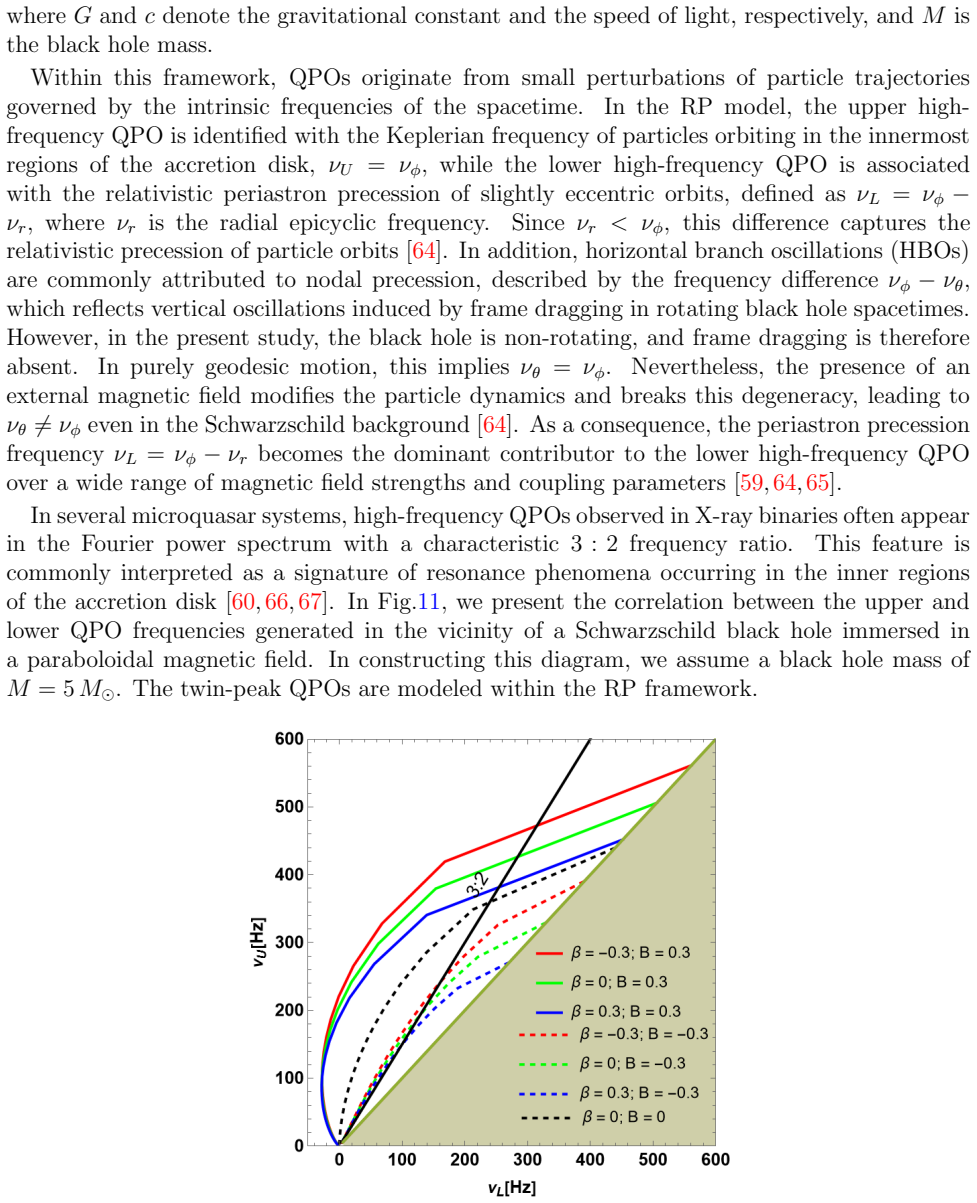


read the original abstract
We study the motion of charged particles with a magnetic dipole moment orbiting a Schwarzschild black hole immersed in an external paraboloidal magnetic field. The interaction between the particle's intrinsic magnetic moment and the black hole magnetosphere is modeled through a dipole coupling, and the equations of motion are derived using the Hamilton-Jacobi formalism. We analyze equatorial circular orbits, the innermost stable circular orbit, and epicyclic oscillations, showing that the magnetic field strength and coupling parameter produce competing effects on orbital stability and fundamental frequencies. These frequencies are applied to model high-frequency quasi-periodic oscillations within the relativistic precession framework. Using observational QPO data from stellar-mass, intermediate-mass, and supermassive black holes, we perform a Bayesian parameter estimation based on Markov Chain Monte Carlo techniques. The analysis constrains the black hole mass, magnetic field strength, field geometry, coupling parameter, and QPO orbital radius, highlighting the role of magnetospheric interactions in shaping both particle dynamics and timing properties of accreting black holes.
Editorial analysis
A structured set of objections, weighed in public.
Referee Report
Summary. The manuscript derives the motion of charged particles possessing a magnetic dipole moment in the spacetime of a Schwarzschild black hole immersed in an external paraboloidal magnetic field. Equations of motion are obtained via the Hamilton-Jacobi formalism; equatorial circular orbits, the ISCO, and epicyclic frequencies are analyzed, with the magnetic field strength and a dipole-coupling parameter shown to exert competing influences. These frequencies are inserted into the relativistic precession model for high-frequency QPOs. Observational QPO data from stellar-mass, intermediate-mass, and supermassive black holes are then used in an MCMC Bayesian analysis to constrain black-hole mass, magnetic-field strength, field geometry, coupling parameter, and orbital radius.
Significance. If the central modeling assumption is validated, the work supplies a concrete route to joint constraints on magnetospheric parameters and black-hole mass across three decades in mass scale, using only timing data. The explicit inclusion of a particle dipole moment and the paraboloidal field geometry distinguishes the approach from purely geodesic or test-particle treatments and could be tested against future multi-messenger observations.
major comments (1)
- [Derivation of effective potential and epicyclic frequencies] The functional form of the dipole-coupling term in the Hamilton-Jacobi effective potential is introduced without quantitative comparison to alternative contributions (higher multipoles, possible plasma back-reaction, or frame-dragging if spin were restored). Because the epicyclic frequencies that enter the MCMC likelihood are computed directly from this term, any incompleteness propagates directly into the reported posteriors on B, coupling parameter, and mass. A concrete test—e.g., recomputing frequencies with an added quadrupole term and showing that the shift remains sub-dominant over the quoted parameter ranges—would be required to support the central claim.
minor comments (2)
- [Abstract] The abstract states that 'field geometry' is constrained, yet the precise parameterization (e.g., the opening angle or radial index of the paraboloidal field) is not defined until later; an early equation or table listing all free parameters would improve readability.
- [Bayesian analysis] No error budget or convergence diagnostics for the MCMC chains are mentioned in the provided text; inclusion of Gelman-Rubin statistics or posterior predictive checks would strengthen the Bayesian section.
Simulated Author's Rebuttal
We thank the referee for their careful reading and constructive comments on our manuscript. We address the major comment below and have revised the manuscript to incorporate the requested validation.
read point-by-point responses
-
Referee: The functional form of the dipole-coupling term in the Hamilton-Jacobi effective potential is introduced without quantitative comparison to alternative contributions (higher multipoles, possible plasma back-reaction, or frame-dragging if spin were restored). Because the epicyclic frequencies that enter the MCMC likelihood are computed directly from this term, any incompleteness propagates directly into the reported posteriors on B, coupling parameter, and mass. A concrete test—e.g., recomputing frequencies with an added quadrupole term and showing that the shift remains sub-dominant over the quoted parameter ranges—would be required to support the central claim.
Authors: We agree that a quantitative assessment of neglected contributions strengthens the robustness of the reported posteriors. In the revised manuscript we have added a new subsection (Section 3.3) that introduces a perturbative quadrupole correction to the paraboloidal magnetic field, recomputes the effective potential and epicyclic frequencies, and demonstrates that the resulting shifts remain sub-dominant (well below observational uncertainties) over the full range of magnetic-field strengths and coupling parameters constrained by the data. This test directly supports the use of the dipole term in the MCMC analysis. Plasma back-reaction and frame-dragging effects lie outside the present vacuum, non-rotating framework and are identified as topics for future extensions rather than part of the current scope. revision: yes
Circularity Check
No significant circularity in derivation chain
full rationale
The paper derives equations of motion from the Hamilton-Jacobi formalism for a charged particle with magnetic dipole moment in an external paraboloidal magnetic field around a Schwarzschild black hole. Equatorial circular orbits, ISCO, and epicyclic frequencies are computed directly from this model. These frequencies are inserted into the relativistic precession framework to model QPOs, after which Bayesian MCMC is applied to external observational QPO data to constrain parameters. No prediction or central result reduces by construction to the inputs or to a fitted parameter renamed as output. The dipole coupling is stated as an explicit modeling assumption rather than derived from the data. No self-citations are load-bearing in the provided derivation chain. The procedure is a standard first-principles model plus external-data inference and is self-contained against external benchmarks.
Axiom & Free-Parameter Ledger
free parameters (3)
- magnetic field strength
- coupling parameter
- field geometry parameter
axioms (2)
- standard math Hamilton-Jacobi formalism yields the correct equations of motion in the combined gravitational plus magnetic background
- domain assumption Relativistic precession model correctly maps epicyclic frequencies to observed QPO peaks
invented entities (1)
-
dipole coupling term
no independent evidence
Lean theorems connected to this paper
-
IndisputableMonolith/Cost/FunctionalEquation.leanwashburn_uniqueness_aczel unclear?
unclearRelation between the paper passage and the cited Recognition theorem.
The interaction between the particle's intrinsic magnetic moment and the black hole magnetosphere is modeled through a dipole coupling... U(r, θ) =−β w √f(r) (|cos(θ)| −1) cscθ r^{w−2}
-
IndisputableMonolith/Foundation/DimensionForcing.leanalexander_duality_circle_linking unclear?
unclearRelation between the paper passage and the cited Recognition theorem.
The Keplerian frequency... radial and vertical epicyclic frequencies... relativistic precession model
What do these tags mean?
- matches
- The paper's claim is directly supported by a theorem in the formal canon.
- supports
- The theorem supports part of the paper's argument, but the paper may add assumptions or extra steps.
- extends
- The paper goes beyond the formal theorem; the theorem is a base layer rather than the whole result.
- uses
- The paper appears to rely on the theorem as machinery.
- contradicts
- The paper's claim conflicts with a theorem or certificate in the canon.
- unclear
- Pith found a possible connection, but the passage is too broad, indirect, or ambiguous to say the theorem truly supports the claim.
Reference graph
Works this paper leans on
-
[1]
First M87 Event Horizon Telescope Results
Kazunori Akiyama et al. First M87 Event Horizon Telescope Results. VII. Polarization of the Ring. Astrophys. J. Lett., 910(1):L12, 2021
work page 2021
-
[2]
First Sagittarius A* Event Horizon Telescope Results
Kazunori Akiyama et al. First Sagittarius A* Event Horizon Telescope Results. VII. Polarization of the Ring. Astrophys. J. Lett., 964(2):L25, 2024
work page 2024
-
[3]
Magnetic fields in astrophysical objects
LJ Silvers. Magnetic fields in astrophysical objects. Philosophical Transactions of the Royal Society A: Mathematical, Physical and Engineering Sciences, 366(1884):4453–4464, 2008
work page 2008
-
[4]
Richard Wielebinski and F Krause. Magnetic fields in galaxies. The Astronomy and Astrophysics Review, 4(4):449–485, 1993
work page 1993
-
[5]
Peter Goldreich and William H Julian. Pulsar electrodynamics. Astrophysical Journal, vol. 157, p. 869, 157:869, 1969
work page 1969
-
[6]
Electromagnetic extraction of energy from kerr black holes
Roger D Blandford and Roman L Znajek. Electromagnetic extraction of energy from kerr black holes. Monthly Notices of the Royal Astronomical Society, 179(3):433–456, 1977
work page 1977
-
[7]
Magnetic fields in spiral galaxies
Rainer Beck. Magnetic fields in spiral galaxies. The Astronomy and Astrophysics Review, 24(1):4, 2016
work page 2016
-
[8]
Christopher F McKee and Eve C Ostriker. Theory of star formation. Annu. Rev. Astron. Astrophys., 45(1):565–687, 2007
work page 2007
-
[9]
Magnetic fields in molecular clouds
Richard M Crutcher. Magnetic fields in molecular clouds. Annual Review of Astronomy and Astrophysics, 50(1):29–63, 2012
work page 2012
-
[10]
Acceleration of ultra high energy cosmic rays
RD Blandford. Acceleration of ultra high energy cosmic rays. Physica Scripta, 2000(T85):191, 2000
work page 2000
-
[11]
On the acceleration of ultra-high-energy cosmic rays
Federico Fraschetti. On the acceleration of ultra-high-energy cosmic rays. Philosophical Transactions of the Royal Society A: Mathematical, Physical and Engineering Sciences, 366(1884):4417–4428, 2008
work page 2008
-
[12]
Supermassive black holes as possible sources of ultrahigh-energy cosmic rays
Arman Tursunov, Zdenˇ ek Stuchl´ ık, Martin Koloˇ s, Naresh Dadhich, and Bobomurat Ahme- dov. Supermassive black holes as possible sources of ultrahigh-energy cosmic rays. The Astrophysical Journal, 895(1):14, 2020. 25
work page 2020
-
[13]
Shinji Koide, Kazunari Shibata, Takahiro Kudoh, and David L Meier. Extraction of black hole rotational energy by a magnetic field and the formation of relativistic jets. Science, 295(5560):1688–1691, 2002
work page 2002
-
[14]
A strong magnetic field in the jet base of a supermassive black hole
Ivan Marti-Vidal, Sebastien Muller, Wouter Vlemmings, Cathy Horellou, and Susanne Aalto. A strong magnetic field in the jet base of a supermassive black hole. Science, 348(6232):311–314, 2015
work page 2015
-
[15]
Magnetized particle motion and acceleration around a schwarzschild black hole in a magnetic field
Ahmadjon Abdujabbarov, Bobomurat Ahmedov, Ozodbek Rahimov, and Umar Sa- likhbaev. Magnetized particle motion and acceleration around a schwarzschild black hole in a magnetic field. Physica Scripta, 89(8):084008, 2014
work page 2014
-
[16]
Particle acceleration and plasma heating in the chromo- sphere
VV Zaitsev and AV Stepanov. Particle acceleration and plasma heating in the chromo- sphere. Solar Physics, 290(12):3559–3572, 2015
work page 2015
-
[17]
Magnetohydrodynamic turbulence
Dieter Biskamp. Magnetohydrodynamic turbulence. Cambridge University Press, 2003
work page 2003
-
[18]
Masaaki Yamada, Russell Kulsrud, and Hantao Ji. Magnetic reconnection. Reviews of modern physics, 82(1):603–664, 2010
work page 2010
-
[19]
Ruth A Daly. Black hole spin and accretion disk magnetic field strength estimates for more than 750 active galactic nuclei and multiple galactic black holes. The Astrophysical Journal, 886(1):37, 2019
work page 2019
-
[20]
A strong magnetic field around the supermassive black hole at the centre of the galaxy
RP Eatough, H Falcke, R Karuppusamy, KJ Lee, DJ Champion, EF Keane, G Desvignes, DHFM Schnitzeler, LG Spitler, M Kramer, et al. A strong magnetic field around the supermassive black hole at the centre of the galaxy. Nature, 501(7467):391–394, 2013
work page 2013
-
[21]
First m87 event horizon telescope results
Kazunori Akiyama, Juan Carlos Algaba, Antxon Alberdi, Walter Alef, Richard Anantua, Keiichi Asada, Rebecca Azulay, Anne-Kathrin Baczko, David Ball, Mislav Balokovi´ c, et al. First m87 event horizon telescope results. viii. magnetic field structure near the event horizon. The Astrophysical Journal Letters, 910(1):L13, 2021
work page 2021
-
[22]
Charged particle dynamics in parabolic magnetosphere around schwarzschild black hole
Martin Koloˇ s, Misbah Shahzadi, and Arman Tursunov. Charged particle dynamics in parabolic magnetosphere around schwarzschild black hole. The European Physical Journal C, 83(4):323, 2023
work page 2023
-
[23]
Magnetic Fields of Black Holes and the Variability Plane
M Yu Piotrovich, NA Silant’ev, Yu N Gnedin, and TM Natsvlishvili. Magnetic fields of black holes and the variability plane. arXiv preprint arXiv:1002.4948, 2010
work page internal anchor Pith review Pith/arXiv arXiv 2010
- [24]
-
[25]
L. Chakhchi, H. El Moumni, and K. Masmar. Signatures of the accelerating black holes with a cosmological constant from the Sgr A⋆and M87⋆shadow prospects. Phys. Dark Univ., 44:101501, 2024
work page 2024
-
[26]
Black hole in a uniform magnetic field
Robert M Wald. Black hole in a uniform magnetic field. Physical Review D, 10(6):1680, 1974
work page 1974
-
[27]
Charged particle motion around schwarzschild black hole with split monopole magnetosphere
Martin Koloˇ s, Dilshodbek Bardiev, and Bakhtinur Juraev. Charged particle motion around schwarzschild black hole with split monopole magnetosphere. Proceedings of RAGtime, pages 20–21, 2019. 26
work page 2019
-
[28]
Jaroslav Vrba, Martin Koloˇ s, and Zdenˇ ek Stuchl´ ık. Charged particles in dipole magneto- sphere of neutron stars: epicyclic oscillations in and off-equatorial plane. The European Physical Journal Plus, 140(2):1–25, 2025
work page 2025
-
[29]
Charged particle dynamics in magnetosphere generated by current loop around schwarzschild black hole
Martin Koloˇ s and David Kofroˇ n. Charged particle dynamics in magnetosphere generated by current loop around schwarzschild black hole. arXiv preprint arXiv:2509.11518, 2025
-
[30]
Martin Koloˇ s, Zdenˇ ek Stuchl´ ık, and Arman Tursunov. Quasi-harmonic oscillatory motion of charged particles around a schwarzschild black hole immersed in a uniform magnetic field. Classical and Quantum Gravity, 32(16):165009, 2015
work page 2015
-
[31]
Magnetic field of a current loop around a schwarzschild black hole
Jacobus A Petterson. Magnetic field of a current loop around a schwarzschild black hole. Physical Review D, 10(10):3166, 1974
work page 1974
-
[32]
Benjamin Crinquand, Benoˆ ıt Cerutti, Guillaume Dubus, Kyle Parfrey, and Alexander Philippov. Synthetic gamma-ray light curves of kerr black hole magnetospheric activity from particle-in-cell simulations. Astronomy & Astrophysics, 650:A163, 2021
work page 2021
-
[33]
Simulations of black hole accretion torus in various magnetic field configurations
Martin Koloˇ s and Agnieszka Janiuk. Simulations of black hole accretion torus in various magnetic field configurations. arXiv preprint arXiv:2004.07535, 2020
-
[34]
Parabolic jets from the spinning black hole in m87
Masanori Nakamura, Keiichi Asada, Kazuhiro Hada, Hung-Yi Pu, Scott Noble, Chihyin Tseng, Kenji Toma, Motoki Kino, Hiroshi Nagai, Kazuya Takahashi, et al. Parabolic jets from the spinning black hole in m87. The Astrophysical Journal, 868(2):146, 2018
work page 2018
-
[35]
The event horizon general relativistic magnetohydrodynamic code comparison project
Oliver Porth, Koushik Chatterjee, Ramesh Narayan, Charles F Gammie, Yosuke Mizuno, Peter Anninos, John G Baker, Matteo Bugli, Chi-kwan Chan, Jordy Davelaar, et al. The event horizon general relativistic magnetohydrodynamic code comparison project. The Astrophysical Journal Supplement Series, 243(2):26, 2019
work page 2019
-
[36]
Hai-Yang Zhang, Ya-Peng Hu, and Yu-Sen An. Curled orbit and epicyclic oscillation of charged particles around the weakly magnetized black hole in the presence of lorentz violation. The European Physical Journal C, 85(7):725, 2025
work page 2025
-
[37]
Misbah Shahzadi, Martin Koloˇ s, Zdenˇ ek Stuchl´ ık, and Yousaf Habib. Epicyclic oscillations in spinning particle motion around kerr black hole applied in models fitting the quasi- periodic oscillations observed in microquasars and agns. The European Physical Journal C, 81(12):1067, 2021
work page 2021
-
[38]
Circular motion and qpos near black holes in kalb–ramond gravity
Shokhzod Jumaniyozov, Saeed Ullah Khan, Javlon Rayimbaev, Ahmadjon Abdujabbarov, Sharofiddin Urinbaev, and Sardor Murodov. Circular motion and qpos near black holes in kalb–ramond gravity. The European Physical Journal C, 84(9):964, 2024
work page 2024
-
[39]
Orhan Donmez. Perturbing the stable accretion disk in kerr and 4d einstein–gauss–bonnet gravities: Comprehensive analysis of instabilities and dynamics. Research in Astronomy and Astrophysics, 24(8):085001, 2024
work page 2024
-
[40]
Orhan Donmez. Proposing a physical mechanism to explain various observed sources of qpos by simulating the dynamics of accretion disks around the black holes. The European Physical Journal C, 84(5):524, 2024
work page 2024
-
[41]
The comparison of alternative spacetimes using the spherical accretion around the black hole
Orhan Donmez. The comparison of alternative spacetimes using the spherical accretion around the black hole. Modern Physics Letters A, 39(16):2450076, 2024. 27
work page 2024
-
[42]
Qpos from charged particles around charged black holes in stvg
Isomiddin Nishonov, Sardor Murodov, Bobomurat Ahmedov, Saeed Ullah Khan, Javlon Rayimbaev, Inomjon Ibragimov, and Sardor Sabirov. Qpos from charged particles around charged black holes in stvg. The European Physical Journal C, 85(9):1029, 2025
work page 2025
-
[43]
X-ray properties of black-hole binaries
Ronald A Remillard and Jeffrey E McClintock. X-ray properties of black-hole binaries. Annu. Rev. Astron. Astrophys., 44(1):49–92, 2006
work page 2006
-
[44]
Radio pulsars in an electromagnetic universe
Javlon Rayimbaev, Shokhzod Jumaniyozov, Maksud Umaraliyev, and Ahmadjon Abdu- jabbarov. Radio pulsars in an electromagnetic universe. Universe, 8(10):496, 2022
work page 2022
-
[45]
A precise determination of black hole spin in gro j1655-40
Marek Artur Abramowicz and W Klu´ zniak. A precise determination of black hole spin in gro j1655-40. Astronomy & Astrophysics, 374(3):L19–L20, 2001
work page 2001
-
[46]
Black holes surrounded by pfdm in kalb-ramond gravity: from thermodynamics to qpo tests
Shokhzod Jumaniyozov, Sardor Murodov, Javlon Rayimbaev, Inomjon Ibragimov, Bekzod Madaminov, Sharofiddin Urinbaev, and Ahmadjon Abdujabbarov. Black holes surrounded by pfdm in kalb-ramond gravity: from thermodynamics to qpo tests. The European Physical Journal C, 85(7):797, 2025
work page 2025
-
[47]
Francois Bouchy and Fabien Carrier. P-mode observations on cen a. Astronomy & Astrophysics, 374(1):L5–L8, 2001
work page 2001
-
[48]
Abubakir Shermatov, Javlon Rayimbaev, Bekir Can L¨ utf¨ uolu, Ahmadjon Abdujabbarov, Sabirov Sardor, Inomjon Ibragimov, Murodbek Vapayev, and Bahrom Kuyliev. Qpos analyses and circular orbits of charged particles around magnetized black holes in bertotti– robinson geometry. The European Physical Journal C, 85(9):1017, 2025
work page 2025
-
[49]
Disc–jet coupling in black hole accretion systems–i
Jonathan C McKinney and Ramesh Narayan. Disc–jet coupling in black hole accretion systems–i. general relativistic magnetohydrodynamical models. Monthly Notices of the Royal Astronomical Society, 375(2):513–530, 2007
work page 2007
-
[50]
Black hole spin and the radio loud/quiet dichotomy of active galactic nuclei
Alexander Tchekhovskoy, Ramesh Narayan, and Jonathan C McKinney. Black hole spin and the radio loud/quiet dichotomy of active galactic nuclei. The Astrophysical Journal, 711(1):50, 2010
work page 2010
-
[51]
Shokhzod Jumaniyozov, Saeed Ullah Khan, Javlon Rayimbaev, Ahmadjon Abdujabbarov, and Bobomurat Ahmedov. Collisions and dynamics of particles with magnetic dipole moment and electric charge near magnetized rotating kerr black holes. The European Physical Journal C, 84(3):291, 2024
work page 2024
-
[52]
General relativistic dynamics of polarized particles in electromagnetic fields
Giovanni Preti. General relativistic dynamics of polarized particles in electromagnetic fields. Physical Review D, 70(2):024012, 2004
work page 2004
-
[53]
Spinning test particles in general relativity
Achille Papapetrou. Spinning test particles in general relativity. 1. Proc. Roy. Soc. Lond. A, 209:248–258, 1951
work page 1951
-
[54]
Sardor Murodov, Javlon Rayimbaev, Bobomurat Ahmedov, and Abdullo Hakimov. Dy- namics of particles with electric charge and magnetic dipole moment near schwarzschild- mog black hole. Symmetry, 15(11):2084, 2023
work page 2084
-
[55]
Javlon Rayimbaev, Bobomurat Ahmedov, and Zdenek Stuchlik. Particles with magnetic dipole moment orbiting magnetized schwarzschild black holes: Applications to orbits of hot-spots around sgr a. Physics of the Dark Universe, 45:101516, 2024. 28
work page 2024
-
[56]
Dynamics of charged particles and magnetic dipoles around magnetized quasi-schwarzschild black holes
Bakhtiyor Narzilloev, Javlon Rayimbaev, Ahmadjon Abdujabbarov, Bobomurat Ahme- dov, and Cosimo Bambi. Dynamics of charged particles and magnetic dipoles around magnetized quasi-schwarzschild black holes. The European Physical Journal C, 81(3):269, 2021
work page 2021
-
[57]
Magnetized black holes: ionized keplerian disks and acceleration of ultra-high energy particles
Zdenˇ ek Stuchl´ ık, Martin Koloˇ s, and Arman Tursunov. Magnetized black holes: ionized keplerian disks and acceleration of ultra-high energy particles. Multidisciplinary Digital Publishing Institute Proceedings, 17(1):13, 2019
work page 2019
-
[58]
Black hole flares: ejection of accreted magnetic flux through 3d plasmoid-mediated reconnection
Bart Ripperda, Matthew Liska, Koushik Chatterjee, Gibwa Musoke, Alexander A Philip- pov, Sera B Markoff, Alexander Tchekhovskoy, and Ziri Younsi. Black hole flares: ejection of accreted magnetic flux through 3d plasmoid-mediated reconnection. The Astrophysical Journal Letters, 924(2):L32, 2022
work page 2022
-
[59]
Luigi Stella, Mario Vietri, and Sharon M Morsink. Correlations in the quasi-periodic oscillation frequencies of low-mass x-ray binaries and the relativistic precession model. The Astrophysical Journal, 524(1):L63, 1999
work page 1999
-
[60]
The orbital reso- nance model for twin peak khz quasi periodic oscillations in microquasars
Gabriel T¨ or¨ ok, Marek A Abramowicz, W Klu´ zniak, and Z Stuchl´ ık. The orbital reso- nance model for twin peak khz quasi periodic oscillations in microquasars. Astronomy & Astrophysics, 436(1):1–8, 2005
work page 2005
-
[61]
The orbital resonance model for twin peak kHz QPOs
Marek A Abramowicz, Wlodek Kluzniak, Zdenek Stuchlik, and Gabriel Torok. The orbital resonance model for twin peak khz qpos. arXiv preprint astro-ph/0401464, 2004
work page internal anchor Pith review Pith/arXiv arXiv 2004
-
[62]
Krista Lynne Smith, Celia R Tandon, and Robert V Wagoner. Confrontation of observation and theory: high-frequency qpos in x-ray binaries, tidal disruption events, and active galactic nuclei. The Astrophysical Journal, 906(2):92, 2021
work page 2021
-
[63]
Dynamics of warped accretion discs
Scott Tremaine and Shane W Davis. Dynamics of warped accretion discs. Monthly Notices of the Royal Astronomical Society, 441(2):1408–1434, 2014
work page 2014
-
[64]
Modeling hf-qpos in microquasars and agns: charged particles around black holes with cdm halos
Zakaria Ahal, H El Moumni, and Karima Masmar. Modeling hf-qpos in microquasars and agns: charged particles around black holes with cdm halos. The European Physical Journal C, 85(10):1–36, 2025
work page 2025
-
[65]
Bidyut Hazarika, Mrinnoy M Gohain, and Prabwal Phukon. Signatures of ned on quasi periodic oscillations of a magnetically charged black hole.arXiv preprint arXiv:2504.07821, 2025
-
[66]
A Precise determination of angular momentum in the black hole candidate GRO J1655-40
Marek Artur Abramowicz and Wlodek Kluzniak. A Precise determination of angular momentum in the black hole candidate GRO J1655-40. Astron. Astrophys., 374:L19, 2001
work page 2001
-
[67]
S. E. Motta, T. Mu˜ noz Darias, A. Sanna, R. Fender, T. Belloni, and L. Stella. Black hole spin measurements through the relativistic precession model: XTE J1550-564. Mon. Not. Roy. Astron. Soc., 439:65, 2014
work page 2014
-
[68]
Ronald A Remillard, Michael P Muno, Jeffrey E McClintock, and Jerome A Orosz. Ev- idence for harmonic relationships in the high-frequency quasi-periodic oscillations of xte j1550–564 and gro j1655–40. The Astrophysical Journal, 580(2):1030, 2002
work page 2002
-
[69]
Rxte observations of qpos in the black hole candidate grs 1915+ 105
EH Morgan, RA Remillard, and J Greiner. Rxte observations of qpos in the black hole candidate grs 1915+ 105. The Astrophysical Journal, 482(2):993, 1997. 29
work page 1915
-
[70]
Tod E Strohmayer. Discovery of a 450 hz quasi-periodic oscillation from the microquasar gro j1655–40 with the rossi x-ray timing explorer. The Astrophysical Journal, 552(1):L49, 2001
work page 2001
-
[71]
Black hole quasi-periodic oscillations in the presence of gauss-bonnet trace anomaly
Rupam Jyoti Borah and Umananda Dev Goswami. Black hole quasi-periodic oscillations in the presence of gauss-bonnet trace anomaly. Physics Letters B, page 140124, 2025
work page 2025
-
[72]
The neutron star interior composition explorer (nicer): design and development
Keith C Gendreau, Zaven Arzoumanian, Phillip W Adkins, Cheryl L Albert, John F Anders, Andrew T Aylward, Charles L Baker, Erin R Balsamo, William A Bamford, Suyog S Benegalrao, et al. The neutron star interior composition explorer (nicer): design and development. In Space telescopes and instrumentation 2016: Ultraviolet to gamma ray, volume 9905, pages 42...
work page 2016
-
[73]
Fourier techniques in x-ray timing
M Van der Klis. Fourier techniques in x-ray timing. In Timing neutron stars, pages 27–69. Springer, 1989
work page 1989
-
[74]
Is m82 x-1 really an intermediate-mass black hole? x-ray spectral and timing evidence
Ralph Fiorito and Lev Titarchuk. Is m82 x-1 really an intermediate-mass black hole? x-ray spectral and timing evidence. The Astrophysical Journal, 614(2):L113, 2004
work page 2004
-
[75]
Zdenˇ ek Stuchl´ ık and Martin Koloˇ s. Mass of intermediate black hole in the source m82 x-1 restricted by models of twin high-frequency quasi-periodic oscillations. Monthly Notices of the Royal Astronomical Society, 451(3):2575–2588, 2015
work page 2015
-
[76]
Daniel Foreman-Mackey, David W Hogg, Dustin Lang, and Jonathan Goodman. emcee: the mcmc hammer. Publications of the Astronomical Society of the Pacific, 125(925):306, 2013. 30
work page 2013
discussion (0)
Sign in with ORCID, Apple, or X to comment. Anyone can read and Pith papers without signing in.