Entangled photon pair excitation and time-frequency filtered multidimensional photon correlation spectroscopy as a probe for dissipative exciton kinetics
Pith reviewed 2026-05-16 10:34 UTC · model grok-4.3
The pith
Non-classical correlations of entangled photon pairs prepare narrowband two-exciton populations in molecular aggregates.
A machine-rendered reading of the paper's core claim, the machinery that carries it, and where it could break.
Core claim
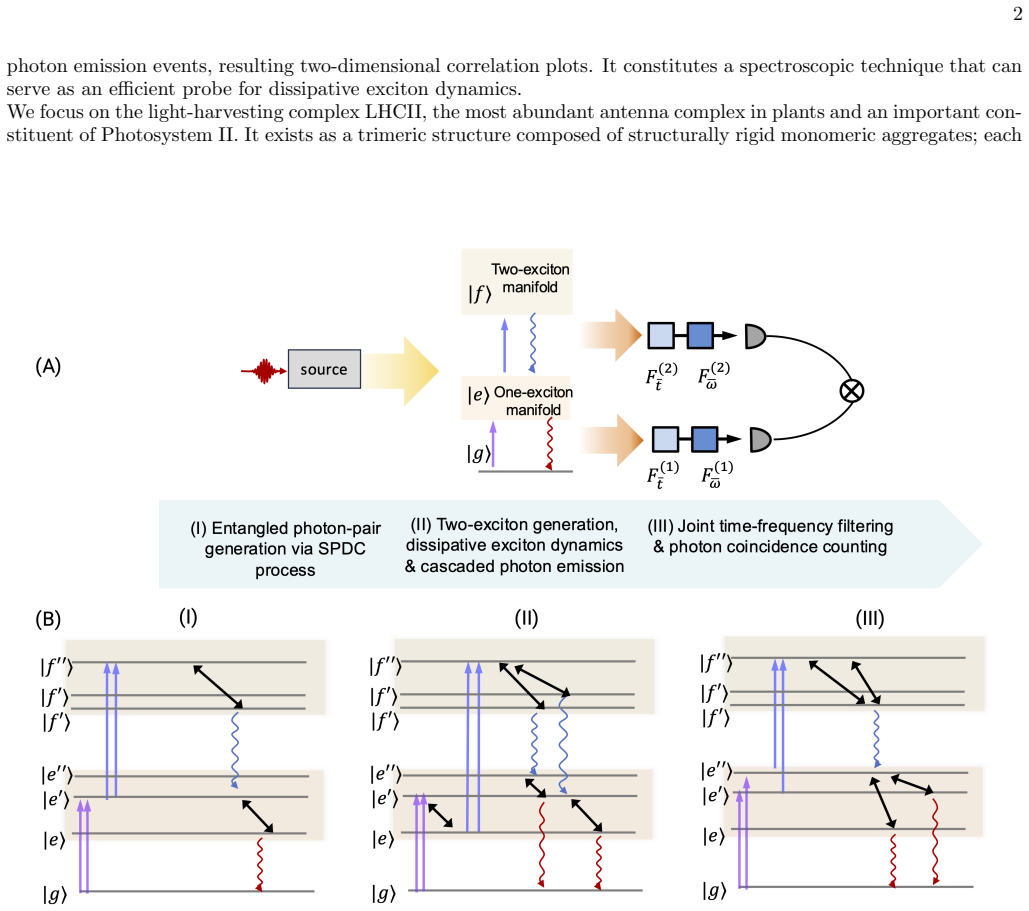
Non-classical correlations of entangled photon pairs can be used to prepare narrowband two-exciton population distributions, circumventing relaxation in mediating one-exciton states. The evolution of these population distributions and cascading optical transitions can be monitored using time-frequency-filtered two-photon coincidence counting. Numerical simulations for a light-harvesting aggregate highlight the ability of this protocol to suppress or amplify specific pathways.
What carries the argument
Entangled photon pair excitation combined with time-frequency filtered two-photon coincidence counting, which leverages non-classical photon correlations for selective preparation and detection of two-exciton states.
If this is right
- Prepares narrowband two-exciton populations without one-exciton relaxation.
- Suppresses or amplifies specific pathways in exciton kinetics.
- Monitors cascading optical transitions via filtered coincidence counts.
- Opens applications in spectroscopy and sensing of dissipative systems.
Where Pith is reading between the lines
- This method could be tested on actual photosynthetic complexes to compare with classical excitation.
- Connections to quantum information techniques might enhance control in other molecular systems.
- Broader use could impact studies of energy transfer in biological aggregates.
Load-bearing premise
Entangled photon pairs can excite narrowband two-exciton populations without significant relaxation through one-exciton states, as assumed in the simulations.
What would settle it
Detection of broad spectral distributions or strong one-exciton relaxation signals in an experiment using entangled photons on a real light-harvesting aggregate would contradict the claim.
Figures


read the original abstract
In molecular aggregates, multiple delocalized exciton states interact with phonons, making the state-resolved spectroscopic monitoring of dynamics challenging. We propose a protocol that combines photon-entanglement-enhanced narrowband excitation of two-exciton states with time-frequency-filtered two-photon coincidence counting. This approach alleviates bottlenecks associated with probing two-exciton dynamics spread across multiple spectral and temporal windows. We demonstrate that non-classical correlations of entangled photon pairs can be used to prepare narrowband two-exciton population distributions, circumventing relaxation in mediating one-exciton states. The evolution of these population distributions and cascading optical transitions can be monitored using time-frequency-filtered two-photon coincidence counting. Numerical simulations for a light-harvesting aggregate highlight the ability of this protocol to suppress or amplify specific pathways. Combining entangled photonic sources with multidimensional photon correlation spectroscopy allows promising applications in spectroscopy and sensing.
Editorial analysis
A structured set of objections, weighed in public.
Referee Report
Summary. The paper proposes a protocol combining entangled-photon-pair excitation with time-frequency-filtered two-photon coincidence counting to prepare narrowband two-exciton populations in molecular aggregates and monitor their dissipative evolution while circumventing relaxation through one-exciton intermediates. Numerical simulations on a light-harvesting aggregate are presented as demonstrating selective suppression or amplification of specific pathways.
Significance. If the numerical results hold under realistic conditions, the protocol would provide a new route to state-resolved spectroscopy of multi-exciton dynamics in complex aggregates, exploiting non-classical photon correlations to improve spectral and temporal selectivity beyond conventional methods.
major comments (1)
- Numerical simulations section: the central claim that entangled-pair excitation produces narrowband two-exciton populations that circumvent one-exciton relaxation rests entirely on these simulations, yet the manuscript supplies no Hamiltonian parameters, phonon spectral densities, dissipation rates, convergence checks, or comparison to known limiting cases, preventing independent assessment of the reported suppression.
minor comments (1)
- Abstract: the phrase 'alleviates bottlenecks associated with probing two-exciton dynamics spread across multiple spectral and temporal windows' is vague; a concrete example of the bottleneck being removed would improve clarity.
Simulated Author's Rebuttal
We thank the referee for their constructive review and for highlighting the need for greater transparency in the numerical simulations. We agree that the central claims rest on these results and have revised the manuscript to address this concern fully.
read point-by-point responses
-
Referee: Numerical simulations section: the central claim that entangled-pair excitation produces narrowband two-exciton populations that circumvent one-exciton relaxation rests entirely on these simulations, yet the manuscript supplies no Hamiltonian parameters, phonon spectral densities, dissipation rates, convergence checks, or comparison to known limiting cases, preventing independent assessment of the reported suppression.
Authors: We agree that the numerical section requires additional detail for independent verification. In the revised manuscript we have added a dedicated subsection (and supplementary appendix) that specifies: (i) the full Frenkel-exciton Hamiltonian parameters for the light-harvesting aggregate (site energies, inter-site couplings, and transition dipoles); (ii) the phonon spectral density (Ohmic form with cutoff frequency and reorganization energy); (iii) the Lindblad dissipation rates for exciton-phonon and radiative decay; (iv) numerical convergence tests with respect to time-step, basis truncation, and Monte-Carlo sampling; and (v) direct comparisons to the weak-coupling limit and to classical (separable) two-photon excitation. These additions allow quantitative reproduction of the reported pathway suppression and amplification. revision: yes
Circularity Check
No significant circularity; derivation is self-contained
full rationale
The paper proposes a spectroscopic protocol combining entangled-photon-pair excitation with time-frequency-filtered coincidence counting to monitor two-exciton dynamics in aggregates. The central claim—that non-classical correlations enable narrowband two-exciton populations that circumvent one-exciton relaxation—is supported by numerical simulations on a light-harvesting model rather than by any self-referential definition, fitted parameter renamed as prediction, or load-bearing self-citation chain. No equation reduces to its own input by construction, and the protocol description draws on standard quantum-optics concepts without smuggling ansatzes or renaming known results. The derivation chain therefore remains independent of the reported outcomes.
Axiom & Free-Parameter Ledger
axioms (1)
- domain assumption Standard quantum optical treatment of entangled photon pairs and exciton-phonon interactions in molecular aggregates
Reference graph
Works this paper leans on
-
[1]
In the above,E m andJ mn describes the on-site excitation and inter-site hopping, respectively
+ X m,j gm,j(b† j +b j)B† mBm (1) where the exciton creation (annihilation) operators,B † m (Bm), follow the commutation relation [B n, B† m] =δ mn(1− η(B † mBm)2) (withη= 3/2) and the phonon creation (annihilation) operators,b † j (bj), follow the commutation relation [bi, b† j] =δ ij. In the above,E m andJ mn describes the on-site excitation and inter-s...
work page 1968
-
[2]
Simulation: excitation of the full suite of two-exciton states using degenerate entangled photon pairs In this section, we monitor the final two-exciton population distribution following excitation by spectrally degenerate entangled photon pairs, i.e.,ω 1 =ω 2 =ω p/2 =E (2) target/2. For an SPDC source pumped by a finite-bandwidth laser, the generated pho...
-
[3]
Simulations: differential preparation of two-exciton populations via preselected mediating states and parametric dependence on photonic properties We focus on two specific two-exciton states among the full suite of target states previously monitored, namely,f 07 andf 83. These two-exciton states reside in the lower (E f07 = 30192.9 cm−1) and the higher (E...
-
[4]
Simulations: differential evolution of two-exciton populations and parametric dependence on photonic properties We monitor the differential evolution of the population following excitations targeted atf 07 (right column, Fig. 5) andf 83 (right column, Fig. 6), recorded at delays oft= 50 fs andt= 250 fs, respectively. Each of the three panels, upper, middl...
-
[5]
Simulations: differential redistribution of two-exciton populations In Fig. 7, we track the population redistribution by monitoring the snapshots taken at four different times, i.e., t= 50,100,250 and 1000 fs. The results in the left and right column represents the population evolution following excitations targeted atf 07 andf 83 respectively. The result...
-
[6]
Simulation: two-photon coincidence counting signal with variation in filtering parameter and different waiting times In Fig. 8, we present six two-dimensional correlation plots where centering times of the frequency filters, ¯ω j, are taken as the scanning parameters. The results explore the photon correlation signal for two cases, where widths,σ ¯tj), an...
-
[7]
H.-G. Duan, A. Jha, L. Chen, V. Tiwari, R. J. Cogdell, K. Ashraf, V. I. Prokhorenko, M. Thorwart, and R. D. Miller, Quantum coherent energy transport in the fenna–matthews–olson complex at low temperature, Proceedings of the National Academy of Sciences119, e2212630119 (2022). 19
work page 2022
-
[8]
D. Abramavicius, B. Palmieri, and S. Mukamel, Extracting single and two-exciton couplings in photosynthetic complexes by coherent two-dimensional electronic spectra, Chemical physics357, 79 (2009)
work page 2009
-
[9]
N. Lorenzoni, T. Lacroix, J. Lim, D. Tamascelli, S. F. Huelga, and M. B. Plenio, Full microscopic simulations uncover persistent quantum effects in primary photosynthesis, Science Advances11, eady6751 (2025)
work page 2025
-
[10]
S. Mueller and T. Brixner, Molecular coherent three-quantum two-dimensional fluorescence spectroscopy, The Journal of Physical Chemistry Letters11, 5139 (2020)
work page 2020
- [11]
-
[12]
M. Schr¨ oter, T. Pullerits, and O. K¨ uhn, Using fluorescence detected two-dimensional spectroscopy to investigate initial exciton delocalization between coupled chromophores, The Journal of Chemical Physics149(2018)
work page 2018
-
[13]
F. C. Spano, V. Agranovich, and S. Mukamel, Biexciton states and two-photon absorption in molecular monolayers, The Journal of chemical physics95, 1400 (1991)
work page 1991
-
[14]
F. C. Spano and S. Mukamel, Cooperative nonlinear optical response of molecular aggregates: crossover to bulk behavior, Physical review letters66, 1197 (1991)
work page 1991
-
[15]
E. Guti´ errez-Meza, R. Malatesta, H. Li, I. Bargigia, A. R. Srimath Kandada, D. A. Valverde-Ch´ avez, S.-M. Kim, H. Li, N. Stingelin, S. Tretiak,et al., Frenkel biexcitons in hybrid hj photophysical aggregates, Science Advances7, eabi5197 (2021)
work page 2021
- [16]
- [17]
-
[18]
S. Yu, Y. Geng, D. Liang, H. Li, and X. Liu, Double-quantum–zero-quantum 2d coherent spectroscopy reveals quantum coherence between collective states in an atomic vapor, Optics Letters47, 997 (2022)
work page 2022
-
[19]
A. Debnath, C. Meier, B. Chatel, and T. Amand, High-fidelity biexciton generation in quantum dots by chirped laser pulses, Physical Review B88, 201305 (2013)
work page 2013
-
[20]
F. Schlawin, K. E. Dorfman, B. P. Fingerhut, and S. Mukamel, Suppression of population transport and control of exciton distributions by entangled photons, Nature communications4, 1 (2013)
work page 2013
-
[21]
J. Javanainen and P. L. Gould, Linear intensity dependence of a two-photon transition rate, Physical Review A41, 5088 (1990)
work page 1990
-
[22]
B. E. Saleh, B. M. Jost, H.-B. Fei, and M. C. Teich, Entangled-photon virtual-state spectroscopy, Physical review letters 80, 3483 (1998)
work page 1998
-
[23]
J. Peˇ rina, B. E. Saleh, M. C. Teich,et al., Multiphoton absorption cross section and virtual-state spectroscopy for the entangled n-photon state, Physical Review A57, 3972 (1998)
work page 1998
-
[24]
K. E. Dorfman, F. Schlawin, and S. Mukamel, Nonlinear optical signals and spectroscopy with quantum light, Reviews of Modern Physics88, 045008 (2016)
work page 2016
-
[25]
A. Ishizaki, Probing excited-state dynamics with quantum entangled photons: Correspondence to coherent multidimen- sional spectroscopy, The Journal of Chemical Physics153(2020)
work page 2020
-
[26]
A. Debnath and A. Rubio, Entangled photon assisted multidimensional nonlinear optics of exciton–polaritons, Journal of Applied Physics128, 113102 (2020)
work page 2020
-
[27]
Y. Fujihashi and A. Ishizaki, Achieving two-dimensional optical spectroscopy with temporal and spectral resolution using quantum entangled three photons, The Journal of Chemical Physics155(2021)
work page 2021
-
[28]
Y. Fujihashi, K. Miwa, M. Higashi, and A. Ishizaki, Probing exciton dynamics with spectral selectivity through the use of quantum entangled photons, The Journal of Chemical Physics159(2023)
work page 2023
-
[29]
Y. Fujihashi, A. Ishizaki, and R. Shimizu, Pathway selectivity in time-resolved spectroscopy using two-photon coincidence counting with quantum entangled photons, The Journal of Chemical Physics160(2024)
work page 2024
-
[30]
M. G. Raymer, A. H. Marcus, J. R. Widom, and D. L. Vitullo, Entangled photon-pair two-dimensional fluorescence spectroscopy (epp-2dfs), The Journal of Physical Chemistry B117, 15559 (2013)
work page 2013
-
[31]
O. Varnavski, S. K. Giri, T.-M. Chiang, C. J. Zeman IV, G. C. Schatz, and T. Goodson III, Colors of entangled two-photon absorption, Proceedings of the National Academy of Sciences120, e2307719120 (2023)
work page 2023
-
[32]
R. Malatesta, L. Uboldi, E. J. Kumar, E. Rojas-Gatjens, L. Moretti, A. Cruz, V. Menon, G. Cerullo, and A. R. S. Kandada, Optical microcavities as platforms for entangled photon spectroscopy, arXiv preprint arXiv:2309.04751 (2023)
-
[33]
M. Cho, Quantum optical measurement with tripartite entangled photons generated by triple parametric down-conversion, The Journal of Chemical Physics148(2018)
work page 2018
-
[34]
G. Citeroni, M. Polini, M. Dapolito, D. Basov, and G. Mazza, Ultrafast dynamics of quantum matter driven by time-energy entangled photons, Physical Review B112, 224316 (2025)
work page 2025
-
[35]
M. G. Raymer and T. Landes, Theory of two-photon absorption with broadband squeezed vacuum, Physical Review A 106, 013717 (2022)
work page 2022
- [36]
- [37]
-
[38]
K. M. Parzuchowski, A. Mikhaylov, M. D. Mazurek, R. N. Wilson, D. J. Lum, T. Gerrits, C. H. Camp Jr, M. J. Stevens, and R. Jimenez, Setting bounds on entangled two-photon absorption cross sections in common fluorophores, Physical Review Applied15, 044012 (2021). 20
work page 2021
-
[39]
M. G. Raymer, T. Landes, M. Allgaier, S. Merkouche, B. J. Smith, and A. H. Marcus, How large is the quantum enhance- ment of two-photon absorption by time-frequency entanglement of photon pairs?, Optica8, 757 (2021)
work page 2021
-
[40]
A. Khan, F. Albarelli, and A. Datta, Does entanglement enhance single-molecule pulsed biphoton spectroscopy?, Quantum Science and Technology9, 035004 (2024)
work page 2024
-
[41]
F. Albarelli, E. Bisketzi, A. Khan, and A. Datta, Fundamental limits of pulsed quantum light spectroscopy: Dipole moment estimation, Physical Review A107, 062601 (2023)
work page 2023
- [42]
-
[43]
K. E. Dorfman, S. Asban, L. Ye, J. R. Rouxel, D. Cho, and S. Mukamel, Monitoring spontaneous charge-density fluctuations by single-molecule diffraction of quantum light, The journal of physical chemistry letters10, 768 (2019)
work page 2019
-
[44]
´A. Mart´ ınez-Tapia, S. Corona-Aquino, F. Triana-Arango, C. You, R.-B. Jin, O. S. Maga˜ na-Loaiza, S.-H. Dong, A. B. U’Ren, and R. d. J. Le´ on-Montiel, Witnessing entangled two-photon absorption via quantum interferometry, APL Photonics8 (2023)
work page 2023
- [45]
- [46]
-
[47]
K. E. Dorfman and S. Mukamel, Nonlinear spectroscopy with time-and frequency-gated photon counting: A superoperator diagrammatic approach, Physical Review A—Atomic, Molecular, and Optical Physics86, 013810 (2012)
work page 2012
-
[48]
K. E. Dorfman and S. Mukamel, Time-and-frequency-gated photon coincidence counting; a novel multidimensional spec- troscopy tool, Physica Scripta91, 083004 (2016)
work page 2016
-
[49]
C. S´ anchez Mu˜ noz and F. Schlawin, Photon correlation spectroscopy as a witness for quantum coherence, Physical Review Letters124, 203601 (2020)
work page 2020
-
[50]
V. Novoderezhkin, A. Marin, and R. van Grondelle, Intra-and inter-monomeric transfers in the light harvesting lhcii complex: the redfield–f¨ orster picture, Physical Chemistry Chemical Physics13, 17093 (2011)
work page 2011
-
[51]
V. I. Novoderezhkin, M. A. Palacios, H. Van Amerongen, and R. Van Grondelle, Energy-transfer dynamics in the lhcii complex of higher plants: modified redfield approach, The Journal of Physical Chemistry B108, 10363 (2004)
work page 2004
-
[52]
A. Debnath and A. Rubio, Entangled biphoton enhanced double quantum coherence signal as a probe for cavity polariton correlations in presence of phonon induced dephasing, Frontiers in Physics10, 879113 (2022)
work page 2022
-
[53]
F. Schlawin, K. E. Dorfman, and S. Mukamel, Entangled two-photon absorption spectroscopy, Accounts of chemical research51, 2207 (2018)
work page 2018
-
[54]
K. E. Dorfman and S. Mukamel, Multidimensional spectroscopy with entangled light: loop vs ladder delay scanning protocols, New journal of physics16, 033013 (2014)
work page 2014
-
[55]
S. Mukamel and M. Richter, Multidimensional phase-sensitive single-molecule spectroscopy with time-and-frequency-gated fluorescence detection, Physical Review A83, 013815 (2011)
work page 2011
- [56]
-
[57]
W. Mauerer, M. Avenhaus, W. Helwig, and C. Silberhorn, How colors influence numbers: Photon statistics of parametric down-conversion, Physical Review A—Atomic, Molecular, and Optical Physics80, 053815 (2009)
work page 2009
-
[58]
A. Debnath and R. Santra, Theory of high-energy correlated multiphoton x-ray diffraction for synchrotron-radiation sources, Physical review research5, 023158 (2023)
work page 2023
-
[59]
R. Pollmann, F. Roeder, C. Silberhorn, and B. Brecht, Limitations of entangled two-photon absorption detection, arXiv preprint arXiv:2512.19261 (2025)
-
[60]
M. Kizmann, H. K. Yadalam, V. Y. Chernyak, and S. Mukamel, Quantum interferometry and pathway selectivity in the nonlinear response of photosynthetic excitons, Proceedings of the National Academy of Sciences120, e2304737120 (2023)
work page 2023
- [61]
-
[62]
K. E. Dorfman, S. Asban, B. Gu, and S. Mukamel, Hong-ou-mandel interferometry and spectroscopy using entangled photons, Communications Physics4, 1 (2021)
work page 2021
-
[63]
S. Asban and S. Mukamel, Distinguishability and “which pathway” information in multidimensional interferometric spec- troscopy with a single entangled photon-pair, Science advances7, eabj4566 (2021)
work page 2021
-
[64]
A. Debnath,Dynamics and control of open quantum systems: applications to exciton dynamics in quantum dots and vibrational dynamics in carboxyhemoglobin, Ph.D. thesis, Toulouse 3 (2013)
work page 2013
discussion (0)
Sign in with ORCID, Apple, or X to comment. Anyone can read and Pith papers without signing in.