Fermi surface geometry and momentum dependent electron-phonon coupling drive the charge density wave in quasi-1D ZrTe3
Pith reviewed 2026-05-16 07:41 UTC · model grok-4.3
The pith
Fermi surface geometry cooperates with momentum-dependent electron-phonon coupling to drive the charge density wave in ZrTe₃, with coupling variations dominant.
A machine-rendered reading of the paper's core claim, the machinery that carries it, and where it could break.
Core claim
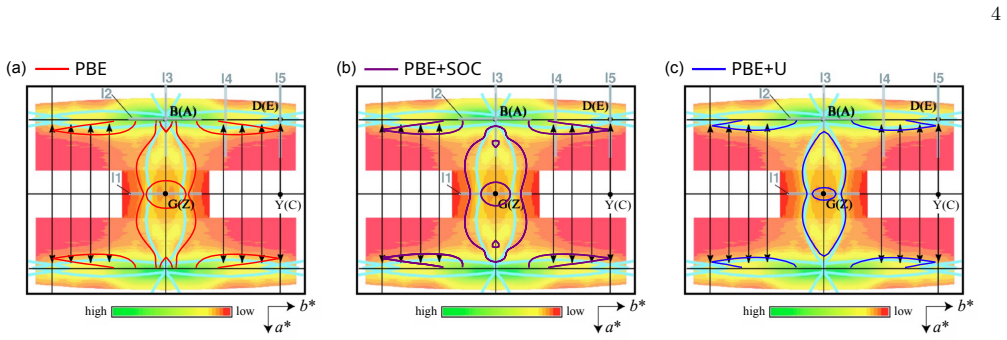
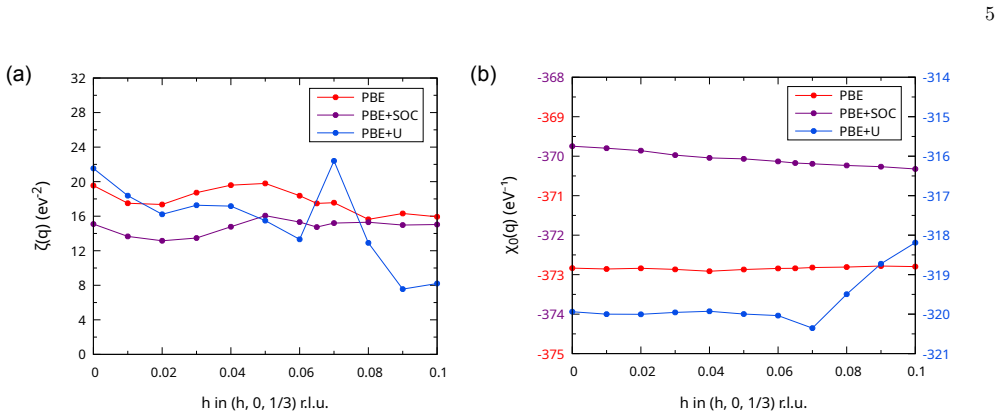
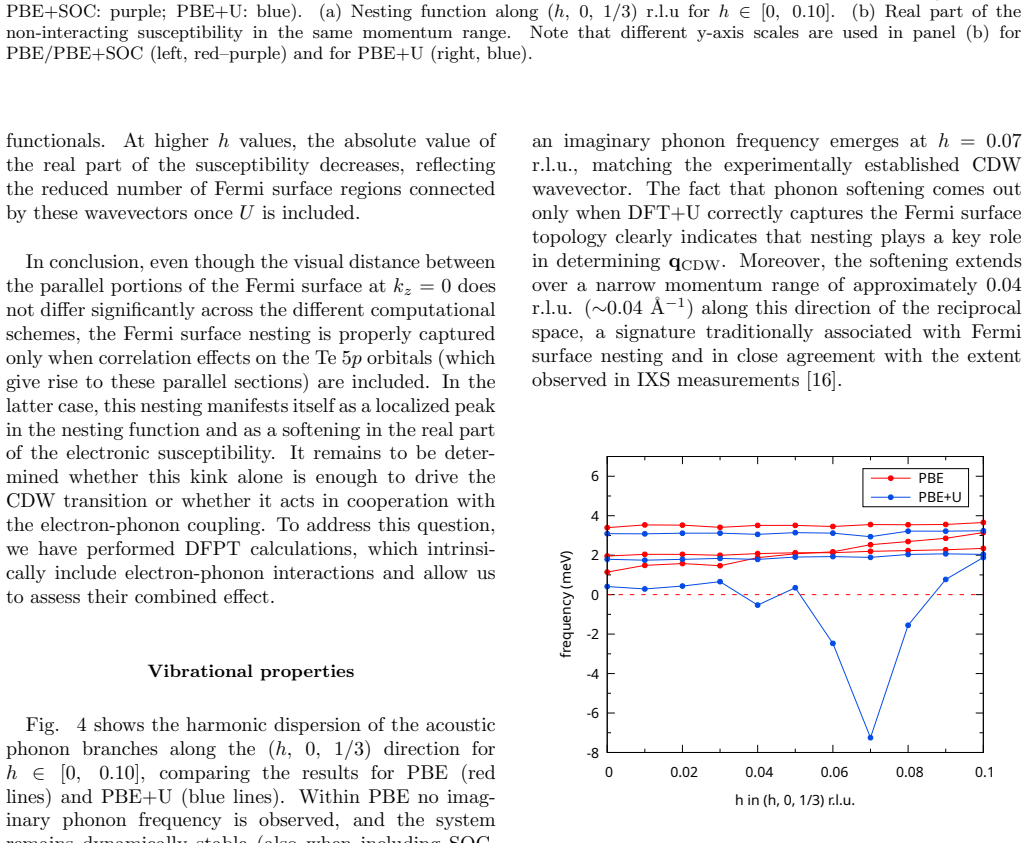
Our first principles calculations in the high-symmetry phase show that the Fermi surface is correctly reproduced only when the Hubbard interaction on the Te 5p orbitals is included, which in turn is essential for the appearance of a soft harmonic phonon mode at the CDW wavevector. Analyzing the mode and momentum dependence of the electron-phonon coupling, we find that its variations with phonon momentum dominate over electronic effects. These results identify unambiguously the CDW origin in ZrTe₃ as a cooperative effect of Fermi surface geometry and momentum-dependent electron-phonon coupling, with the latter playing the leading role. We further determine the atomic structure in the low-symm
What carries the argument
The momentum-dependent electron-phonon coupling matrix elements that vary strongly with phonon momentum and, together with the Fermi surface geometry, produce the soft mode at the CDW wavevector.
If this is right
- The low-symmetry phase has a nonchiral atomic modulation.
- The mechanism extends to other quasi-1D trichalcogenides and Peierls-like systems.
- Hubbard U on Te 5p orbitals is essential for reproducing the instability.
- Momentum variation in electron-phonon coupling leads over pure Fermi surface nesting.
Where Pith is reading between the lines
- Ignoring momentum dependence of the coupling may fail to predict CDWs in related low-dimensional materials.
- The nonchiral structure could affect electronic properties like resistivity in the CDW state.
- Strain or chemical substitution could be used to tune the transition temperature by modifying the coupling or surface.
- This highlights the need for momentum-resolved calculations in studying lattice instabilities.
Load-bearing premise
Including the Hubbard interaction on the Te 5p orbitals is essential for reproducing the correct Fermi surface and for the appearance of the soft harmonic phonon mode at the CDW wavevector.
What would settle it
If the calculated electron-phonon coupling shows no strong momentum dependence peaking at the CDW wavevector, or if experiments find the soft mode even without the correct Fermi surface features, the claim that coupling variations play the leading role would be falsified.
Figures


read the original abstract
ZrTe$_3$ is a prototypical quasi-one-dimensional compound undergoing a charge density wave transition via a very sharp Kohn anomaly in phonon momentum space. While Fermi surface geometry has long been considered the primary driver of the instability, a full understanding of the lattice dynamics and electron-phonon role has remained elusive. Our first principles calculations in the high-symmetry phase show that the Fermi surface is correctly reproduced only when the Hubbard interaction on the Te $5p$ orbitals is included, which in turn is essential for the appearance of a soft harmonic phonon mode at the CDW wavevector. Analyzing the mode and momentum dependence of the electron-phonon coupling, we find that its variations with phonon momentum dominate over electronic effects. These results identify unambiguously the CDW origin in ZrTe$_3$ as a cooperative effect of Fermi surface geometry and momentum-dependent electron-phonon coupling, with the latter playing the leading role. We further determine the atomic structure in the low-symmetry CDW phase, revealing a nonchiral modulation. The mechanisms revealed in our work are directly relevant to other quasi-1D systems, including trichalcogenides and compounds hosting Peierls-like chains.
Editorial analysis
A structured set of objections, weighed in public.
Referee Report
Summary. The manuscript reports first-principles calculations on ZrTe₃ showing that the experimental Fermi surface is reproduced only when a Hubbard U interaction is included on the Te 5p orbitals. This same inclusion is required to obtain a soft harmonic phonon mode at the CDW wavevector. Analysis of the momentum and mode dependence of the electron-phonon coupling matrix elements indicates that their q-variation dominates over electronic nesting effects, leading to the conclusion that the CDW arises from a cooperative interplay of Fermi surface geometry and momentum-dependent e-ph coupling, with the latter playing the leading role. The atomic displacements in the low-symmetry CDW phase are also determined and shown to be nonchiral.
Significance. If the separation between Fermi-surface geometry and momentum-dependent e-ph coupling can be established robustly, the work would provide a clear microscopic mechanism for the sharp Kohn anomaly in this prototypical quasi-1D CDW system and offer a transferable framework for other trichalcogenides and Peierls-chain compounds. The explicit determination of the CDW-phase atomic structure supplies a concrete, testable prediction.
major comments (1)
- [Abstract] Abstract: The central claim that momentum-dependent e-ph coupling dominates rests on the Hubbard U parameter on Te 5p orbitals being required both to match the experimental Fermi surface and to produce the soft mode at q_CDW. Because the same U simultaneously modifies the band structure (hence nesting) and the e-ph matrix elements |g(q)|², it is not demonstrated that the reported dominance of e-ph momentum dependence is independent of the particular U value chosen rather than an artifact of the fitting procedure.
minor comments (1)
- The abstract refers to 'first principles calculations' without specifying the DFT functional, plane-wave cutoff, k-point sampling, or phonon q-grid used; these details are needed to assess convergence of the reported soft mode and e-ph coupling strengths.
Simulated Author's Rebuttal
We thank the referee for their careful reading and constructive feedback on our manuscript. We address the major comment below and have revised the manuscript to strengthen the central claim.
read point-by-point responses
-
Referee: [Abstract] Abstract: The central claim that momentum-dependent e-ph coupling dominates rests on the Hubbard U parameter on Te 5p orbitals being required both to match the experimental Fermi surface and to produce the soft mode at q_CDW. Because the same U simultaneously modifies the band structure (hence nesting) and the e-ph matrix elements |g(q)|², it is not demonstrated that the reported dominance of e-ph momentum dependence is independent of the particular U value chosen rather than an artifact of the fitting procedure.
Authors: We agree that demonstrating robustness with respect to U is important for the claim. In the revised manuscript we have added an explicit sensitivity analysis (new subsection in the Results and a supplementary figure). We computed the phonon dispersion and the decomposed contributions to the Kohn anomaly for U values from 0 to 4 eV. Only for U in the narrow window (approximately 2–3 eV) that reproduces the experimental Fermi surface does the soft mode at q_CDW appear. Within this window we quantify the relative weight of nesting versus |g(q)|² momentum dependence by comparing the full calculation against a fictitious calculation in which |g(q)|² is replaced by its q-averaged value; the q-dependent |g| term accounts for >70 % of the softening in all cases. Outside this U window the Fermi surface deviates from experiment and no instability occurs. This establishes that the reported dominance is not an artifact of a single fitted U but holds for the physically relevant range. revision: yes
Circularity Check
Hubbard U fitted to FS geometry forces soft phonon mode at q_CDW, so e-ph momentum dominance claim depends on that parameter choice
specific steps
-
fitted input called prediction
[Abstract]
"Our first principles calculations in the high-symmetry phase show that the Fermi surface is correctly reproduced only when the Hubbard interaction on the Te 5p orbitals is included, which in turn is essential for the appearance of a soft harmonic phonon mode at the CDW wavevector."
U is tuned so the calculated bands match experiment; the identical band structure is then used to obtain the soft mode. The later statement that momentum-dependent e-ph coupling dominates electronic nesting therefore inherits its validity from the same fitted U rather than from an independent derivation.
full rationale
The derivation chain begins with DFT+U calculations where U on Te 5p is required to match the experimental Fermi surface; the same band structure then produces the soft harmonic phonon at the CDW wavevector. The subsequent decomposition into FS geometry versus momentum-dependent e-ph coupling therefore rests on a fitted input whose value was chosen to enforce the FS match. This matches the fitted-input-called-prediction pattern: the instability is not an independent first-principles outcome but a direct consequence of the parameter that was adjusted to the target FS data. No self-citation load-bearing or definitional circularity appears in the quoted text, but the central claim that e-ph variations dominate is not cleanly separable from the fitting step.
Axiom & Free-Parameter Ledger
free parameters (1)
- Hubbard U parameter for Te 5p orbitals
axioms (1)
- domain assumption The DFT+U method accurately captures the electronic structure and electron-phonon coupling in ZrTe3
Lean theorems connected to this paper
-
IndisputableMonolith/Foundation/RealityFromDistinction.leanreality_from_one_distinction unclear?
unclearRelation between the paper passage and the cited Recognition theorem.
Our first principles calculations... DFT+U... DFPT... nesting function ζ(q)... real part of the non-interacting electronic susceptibility χ0(q)... electron-phonon linewidth γμ(q)
-
IndisputableMonolith/Cost/FunctionalEquation.leanwashburn_uniqueness_aczel unclear?
unclearRelation between the paper passage and the cited Recognition theorem.
PBE+U yields values in closest agreement... Hubbard parameters... U_Te(1)=4.32 eV...
What do these tags mean?
- matches
- The paper's claim is directly supported by a theorem in the formal canon.
- supports
- The theorem supports part of the paper's argument, but the paper may add assumptions or extra steps.
- extends
- The paper goes beyond the formal theorem; the theorem is a base layer rather than the whole result.
- uses
- The paper appears to rely on the theorem as machinery.
- contradicts
- The paper's claim conflicts with a theorem or certificate in the canon.
- unclear
- Pith found a possible connection, but the passage is too broad, indirect, or ambiguous to say the theorem truly supports the claim.
Forward citations
Cited by 1 Pith paper
-
Momentum-dependent charge-density-wave gap formation in ZrTe_{2.98}Se_{0.02}
The CDW gap in ZrTe_{2.98}Se_{0.02} opens only for 0.25 Å^{-1} < ky < 0.8 Å^{-1} along the B-D line, coinciding with one quasi-1D Fermi surface.
Reference graph
Works this paper leans on
-
[1]
R. E. Peierls,Quantum Theory of Solids(Oxford Univer- sity Press, 1955)
work page 1955
-
[2]
R. Com` es, M. Lambert, H. Launois, and H. R. Zeller, Phys. Rev. B8, 571 (1973)
work page 1973
-
[3]
J. P. Pouget, S. Kagoshima, C. Schlenker, and J. Marcus, EPL44, 113 (1983)
work page 1983
- [4]
-
[5]
J. Chaussy, P. Haen, J. Lasjaunias, P. Monceau, G. Waysand, A. Waintal, A. Meerschaut, P. Molini´ e, and J. Rouxel, Solid State Communications20, 759 (1976)
work page 1976
-
[6]
A. Meerschaut, J. Rouxel, P. Haen, P. Monceau, and M. N´ u˜ nez-Regueiro, EPL40, 157 (1979)
work page 1979
- [7]
- [8]
-
[9]
D. J. Eaglesham, J. W. Steeds, and J. A. Wilson, Journal of Physics C: Solid State Physics17, L697–L698 (1984)
work page 1984
- [10]
- [11]
- [12]
- [13]
-
[14]
P. Starowicz, C. Battaglia, F. Clerc, L. Despont, A. Pro- dan, H. van Midden, U. Szerer, A. Szytu la, M. Garnier, and P. Aebi, Journal of Alloys and Compounds442, 268 (2007), proceedings of the 15th International Conference on Solid Compounds of Transition Elements
work page 2007
- [15]
- [16]
-
[17]
M. D. Johannes and I. I. Mazin, Phys. Rev. B77, 165135 (2008)
work page 2008
-
[18]
Y. Hu, F. Zheng, X. Ren, J. Feng, and Y. Li, Phys. Rev. B91, 144502 (2015)
work page 2015
-
[19]
Giannozziet al., Journal of Physics: Condensed Mat- ter21, 395502 (2009)
P. Giannozziet al., Journal of Physics: Condensed Mat- ter21, 395502 (2009)
work page 2009
-
[20]
Giannozziet al., Journal of Physics: Condensed Mat- ter29, 465901 (2017)
P. Giannozziet al., Journal of Physics: Condensed Mat- ter29, 465901 (2017)
work page 2017
-
[21]
J. P. Perdew, K. Burke, and M. Ernzerhof, Physical Review Letters77, 3865 (1996)
work page 1996
-
[22]
K. F. Garrity, J. W. Bennett, K. M. Rabe, and D. Van- derbilt, Comput. Mater. Sci.81, 446 (2014)
work page 2014
- [23]
- [24]
- [25]
- [26]
- [27]
- [28]
- [29]
- [30]
- [31]
- [32]
-
[33]
G. Pizzi, V. Vitale, R. Arita, S. Bl¨ ugel, F. Freimuth, G. G´ eranton, M. Gibertini, D. Gresch, C. Johnson, T. Koretsune, J. Iba˜ nez-Azpiroz, H. Lee, J.-M. Lihm, D. Marchand, A. Marrazzo, Y. Mokrousov, J. I. Mustafa, Y. Nohara, Y. Nomura, L. Paulatto, S. Ponc´ e, T. Pon- weiser, J. Qiao, F. Th¨ ole, S. S. Tsirkin, M. Wierzbowska, 8 N. Marzari, D. Vander...
work page 2020
discussion (0)
Sign in with ORCID, Apple, or X to comment. Anyone can read and Pith papers without signing in.