TSBOW -- Traffic Surveillance Benchmark for Occluded Vehicles Under Various Weather Conditions
Pith reviewed 2026-05-21 14:09 UTC · model grok-4.3
The pith
TSBOW introduces a dataset of over 32 hours of real urban traffic video with annotations for occluded vehicles across extreme weather.
A machine-rendered reading of the paper's core claim, the machinery that carries it, and where it could break.
Core claim
The TSBOW dataset supplies more than 32 hours of real-world urban traffic footage, over 48,000 manually annotated frames, and 3.2 million semi-labeled frames covering eight classes from large vehicles to pedestrians, collected under the full range of annual weather conditions to improve occluded vehicle detection.
What carries the argument
The TSBOW dataset, a collection of real-world CCTV traffic videos with bounding-box annotations for occluded participants under diverse weather.
If this is right
- Object detectors can be retrained to maintain performance when vehicles are partially hidden or when visibility is reduced by heavy weather.
- CCTV monitoring systems for intelligent transportation can operate more reliably across all seasons.
- Researchers gain a testbed for measuring how different weather types and occlusion levels affect detection of cars, trucks, bikes, and pedestrians.
- New algorithms that adapt to signal degradation or recover missing parts of vehicles can be developed and compared on the same data.
Where Pith is reading between the lines
- The dataset could be paired with weather simulation tools to create even larger training sets without new collection effort.
- It offers a way to quantify how much each weather factor hurts current detectors and to guide targeted improvements.
- Cities could use the data to decide where to add or upgrade cameras for year-round traffic oversight.
Load-bearing premise
That real urban footage gathered under extreme weather and occlusions will provide the variations needed to train detectors that generalize beyond what lighter-weather datasets already allow.
What would settle it
An experiment in which object detectors trained on TSBOW show no accuracy gain on occluded vehicles during heavy rain, snow, or fog compared with detectors trained only on earlier public datasets.
Figures




read the original abstract
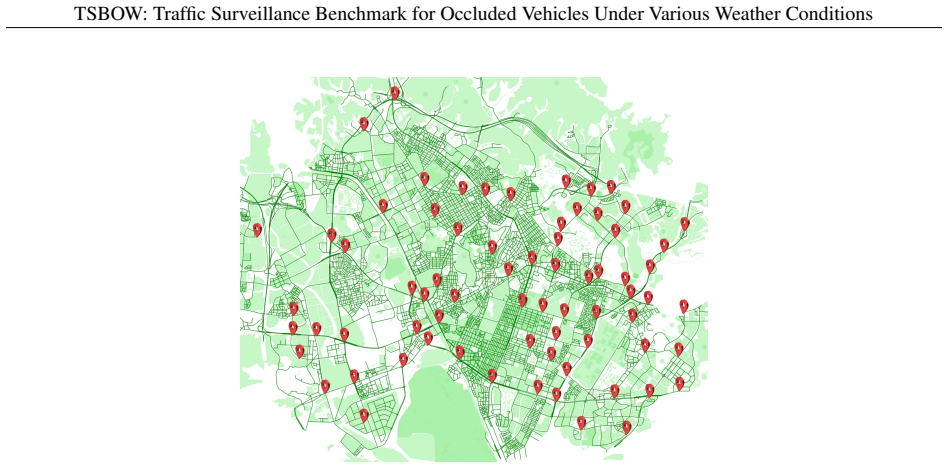
Global warming has intensified the frequency and severity of extreme weather events, which degrade CCTV signal and video quality while disrupting traffic flow, thereby increasing traffic accident rates. Existing datasets, often limited to light haze, rain, and snow, fail to capture extreme weather conditions. To address this gap, this study introduces the Traffic Surveillance Benchmark for Occluded vehicles under various Weather conditions (TSBOW), a comprehensive dataset designed to enhance occluded vehicle detection across diverse annual weather scenarios. Comprising over 32 hours of real-world traffic data from densely populated urban areas, TSBOW includes more than 48,000 manually annotated and 3.2 million semi-labeled frames; bounding boxes spanning eight traffic participant classes from large vehicles to micromobility devices and pedestrians. We establish an object detection benchmark for TSBOW, highlighting challenges posed by occlusions and adverse weather. With its varied road types, scales, and viewpoints, TSBOW serves as a critical resource for advancing Intelligent Transportation Systems. Our findings underscore the potential of CCTV-based traffic monitoring, pave the way for new research and applications. The TSBOW dataset is publicly available at: https://github.com/SKKUAutoLab/TSBOW.
Editorial analysis
A structured set of objections, weighed in public.
Referee Report
Summary. The paper introduces the TSBOW dataset for traffic surveillance, comprising over 32 hours of real-world urban CCTV footage under diverse weather conditions with occlusions. It includes more than 48,000 manually annotated frames and 3.2 million semi-labeled frames across eight traffic participant classes (from large vehicles to pedestrians and micromobility devices). The authors establish an object detection benchmark highlighting challenges from occlusions and adverse weather, and release the dataset publicly to support advances in intelligent transportation systems.
Significance. A dataset that demonstrably extends coverage to extreme weather conditions with reliable annotations and public availability would be a useful addition to the field, enabling better evaluation of robust detection methods for real-world traffic monitoring where existing resources are limited to milder conditions. The scale and multi-class coverage are positive aspects if the collection and labeling quality can be verified.
major comments (2)
- [Dataset description] Dataset description section: The central claim that TSBOW fills a gap by capturing extreme weather (beyond light haze, rain, and snow in prior datasets) relies on categorical descriptions without quantitative severity metrics such as visibility ranges, precipitation rates, or side-by-side comparison tables. This leaves the comprehensiveness assertion unsupported by objective evidence.
- [Annotation and collection protocol] Annotation and collection protocol subsection: No details are supplied on the data collection protocol (camera specs, locations, time spans), inter-annotator agreement, or validation steps for the 48,000 manual annotations. These omissions are load-bearing for the reliability of the established benchmark and the claim of a comprehensive resource.
minor comments (2)
- [Abstract] The abstract mentions 'diverse annual weather scenarios' but does not list the specific weather categories used; adding an explicit enumeration would improve clarity.
- [Benchmark results] Figure captions for the benchmark results could more explicitly note the evaluation metrics and any baseline methods compared.
Simulated Author's Rebuttal
We thank the referee for the constructive feedback on our manuscript introducing the TSBOW dataset. We address each major comment in turn below, indicating where revisions will be made to improve the presentation of the dataset and its supporting details.
read point-by-point responses
-
Referee: [Dataset description] Dataset description section: The central claim that TSBOW fills a gap by capturing extreme weather (beyond light haze, rain, and snow in prior datasets) relies on categorical descriptions without quantitative severity metrics such as visibility ranges, precipitation rates, or side-by-side comparison tables. This leaves the comprehensiveness assertion unsupported by objective evidence.
Authors: We agree that the current description would benefit from quantitative support. In the revised version, we will augment the Dataset description section with available quantitative severity metrics drawn from the collection period, such as measured visibility ranges and precipitation rates for the captured conditions. We will also insert a side-by-side comparison table against prior datasets to make the extension to more extreme weather conditions explicit and evidence-based. revision: yes
-
Referee: [Annotation and collection protocol] Annotation and collection protocol subsection: No details are supplied on the data collection protocol (camera specs, locations, time spans), inter-annotator agreement, or validation steps for the 48,000 manual annotations. These omissions are load-bearing for the reliability of the established benchmark and the claim of a comprehensive resource.
Authors: We concur that these protocol details are essential for establishing benchmark reliability. We will expand the Annotation and collection protocol subsection to include the camera specifications (model, resolution, and frame rate), the specific urban locations and time spans of footage collection, inter-annotator agreement statistics (e.g., percentage overlap and Cohen’s kappa), and the multi-stage validation process applied to the 48,000 manual annotations. revision: yes
Circularity Check
No circularity in dataset introduction paper
full rationale
This manuscript is a dataset release paper whose central contribution is the collection, annotation, and public release of the TSBOW traffic surveillance data (32 hours of urban footage, 48k manual + 3.2M semi-labeled frames, eight classes). No derivation chain, equations, fitted parameters, or predictive modeling appears in the provided text; the claims about filling gaps in extreme-weather coverage rest on the empirical description of the collection process itself rather than any self-referential definition, fitted-input prediction, or load-bearing self-citation. The work is therefore self-contained against external benchmarks and receives the default non-circularity finding.
Axiom & Free-Parameter Ledger
axioms (1)
- domain assumption Urban traffic footage collected under real conditions adequately represents the range of occlusion and weather challenges for general traffic surveillance
Reference graph
Works this paper leans on
-
[1]
doi:10.1109/CVPR.2009.5206848. Zhengxia Zou, Keyan Chen, Zhenwei Shi, Yuhong Guo, and Jieping Ye. Object detection in 20 years: A survey. Proceedings of the IEEE, 111(3):257–276,
-
[2]
Tsung-Yi Lin, Michael Maire, Serge Belongie, James Hays, Pietro Perona, Deva Ramanan, Piotr Dollár, and C. Lawrence Zitnick. Microsoft coco: Common objects in context. In David Fleet, Tomas Pajdla, Bernt Schiele, and Tinne Tuytelaars, editors,Computer Vision – ECCV 2014, pages 740–755, Cham,
work page 2014
-
[3]
Lvis: A dataset for large vocabulary instance segmentation
Agrim Gupta, Piotr Dollár, and Ross Girshick. Lvis: A dataset for large vocabulary instance segmentation. In 2019 IEEE/CVF Conference on Computer Vision and Pattern Recognition (CVPR), pages 5351–5359,
work page 2019
-
[4]
doi:10.1109/CVPR.2019.00550. Daquan Zhou, Kai Wang, Jianyang Gu, Xiangyu Peng, Dongze Lian, Yifan Zhang, Yang You, and Jiashi Feng. Dataset quantization. InProceedings of the IEEE/CVF International Conference on Computer Vision, pages 17205–17216,
-
[5]
doi:https://doi.org/10.1016/j.cviu.2020.102907
ISSN 1077-3142. doi:https://doi.org/10.1016/j.cviu.2020.102907. URL https://www.sciencedirect.com/science/article/pii/S1077314220300035. Zhihong Sun, Guoheng Wei, Wei Fu, Mang Ye, Kui Jiang, Chao Liang, Tingting Zhu, Tao He, and Mithun Mukherjee. Multiple pedestrian tracking under occlusion: A survey and outlook.IEEE Transactions on Circuits and Systems f...
-
[6]
ISBN 9798400706868. doi:10.1145/3664647.3681153. URL https://doi.org/10.1145/3664647.3681153. 11 TSBOW: Traffic Surveillance Benchmark for Occluded Vehicles Under Various Weather Conditions Aayush Atul Verma, Bharatesh Chakravarthi, Arpitsinh Vaghela, Hua Wei, and Yezhou Yang. Etram: Event-based traffic monitoring dataset. InProceedings - 2024 IEEE/CVF Co...
-
[7]
doi:10.1109/CVPR52733.2024.02136. Mark Weber, Jun Xie, Maxwell D. Collins, Yukun Zhu, Paul V oigtlaender, Hartwig Adam, Bradley Green, Andreas Geiger, Bastian Leibe, Daniel Cremers, Aljosa Osep, Laura Leal-Taixé, and Liang-Chieh Chen. STEP: segmenting and tracking every pixel.CoRR, abs/2102.11859,
-
[8]
URL https://arxiv.org/abs/2102.11859. Haiji Liang and Ruize Han. Ovt-b: A new large-scale benchmark for open-vocabulary multi-object tracking. In A. Glober- son, L. Mackey, D. Belgrave, A. Fan, U. Paquet, J. Tomczak, and C. Zhang, editors,Advances in Neural Information Processing Systems, volume 37, pages 14849–14863. Curran Associates, Inc.,
-
[9]
URL https://proceedings.neurips. cc/paper_files/paper/2024/file/1adeeac24ce6168e20bcee85645720e9-Paper-Datasets_and_Benchmarks_Track.pdf. Carlos A. Diaz-Ruiz, Youya Xia, Yurong You, Jose Nino, Junan Chen, Josephine Monica, Xiangyu Chen, Katie Luo, Yan Wang, Marc Emond, Wei-Lun Chao, Bharath Hariharan, Kilian Q. Weinberger, and Mark Campbell. Ithaca365: Da...
work page 2024
-
[10]
URL https://proceedings.neurips.cc/paper_files/paper/2022/file/ 58168e8a92994655d6da3939e7cc0918-Paper-Datasets_and_Benchmarks.pdf. Canon. Canon eos 500d. https://www.canon.co.uk/for_home/product_finder/cameras/digital_slr/eos_550d/,
work page 2022
-
[11]
ISSN 1524-9050. doi:10.1109/TITS.2018.2872502. Ross Girshick. Fast r-cnn. InProceedings of the IEEE international conference on computer vision, pages 1440–1448,
-
[12]
YOLOv8 to YOLO11: A Comprehensive Architecture In-depth Comparative Review
ISSN 2075-1702. doi:10.3390/machines11070677. URL https://www.mdpi.com/2075-1702/11/7/677. Priyanto Hidayatullah, Nurjannah Syakrani, Muhammad Rizqi Sholahuddin, Trisna Gelar, and Refdinal Tubagus. Yolov8 to yolo11: A comprehensive architecture in-depth comparative review.arXiv preprint arXiv:2501.13400,
work page internal anchor Pith review Pith/arXiv arXiv doi:10.3390/machines11070677 2075
-
[13]
Salman Khan, Muzammal Naseer, Munawar Hayat, Syed Waqas Zamir, Fahad Shahbaz Khan, and Mubarak Shah
URL https://arxiv.org/abs/2502.14740. Salman Khan, Muzammal Naseer, Munawar Hayat, Syed Waqas Zamir, Fahad Shahbaz Khan, and Mubarak Shah. Transformers in vision: A survey.ACM computing surveys (CSUR), 54(10s):1–41,
-
[14]
13 TSBOW: Traffic Surveillance Benchmark for Occluded Vehicles Under Various Weather Conditions Figure 1: Comparison with other datasets about weather conditions and scales Supplementary Materials 1 Related Works Fig. 1 compares weather conditions and scales across the TSBOW dataset and other datasets, including UA VDT, UA-DETRAC, and AAURainSnow. UA-DETR...
work page 2023
discussion (0)
Sign in with ORCID, Apple, or X to comment. Anyone can read and Pith papers without signing in.