Optimal wind farm energy and reserve scheduling incorporating wake interactions
Pith reviewed 2026-05-16 06:38 UTC · model grok-4.3
The pith
Wake-aware scheduling for wind farms cuts power overestimation by 12-13% and raises revenue 3% over conventional bids.
A machine-rendered reading of the paper's core claim, the machinery that carries it, and where it could break.
Core claim
The authors demonstrate that embedding the FLORIS wake model inside a stochastic scheduling framework yields power estimates 12-13% lower than conventional power-curve methods, eliminating imbalance penalties and delivering 3% higher revenue; active wake steering then supplies an extra 1-2% income relative to the wake-aware baseline.
What carries the argument
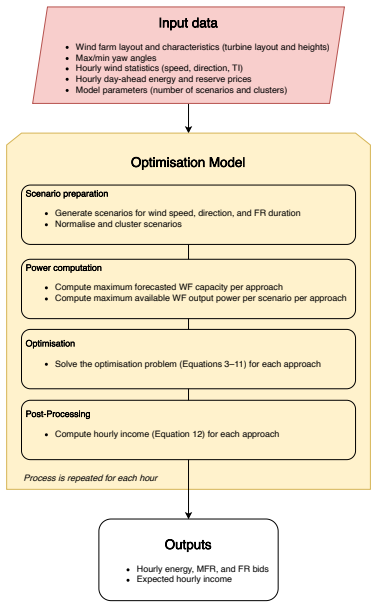
Two-stage stochastic programming framework that calls the FLORIS wake simulator to produce site-specific power and reserve scenarios for day-ahead energy and frequency restoration reserve bidding.
If this is right
- Wind farm operators can submit lower, more reliable bids and avoid paying imbalance penalties when actual wind is reduced by wakes.
- Wake steering becomes an additional revenue stream through ancillary-service participation rather than a pure loss-mitigation tactic.
- Market designs that reward accurate day-ahead forecasts will favor farms that model internal flow interactions explicitly.
- Grid operators gain more predictable aggregate wind output, reducing the volume of fast-response reserves they must procure.
Where Pith is reading between the lines
- The same framework could be extended to onshore farms where terrain-induced wakes add further spatial coupling.
- Regulators might introduce market products that explicitly compensate for wake-management actions to accelerate adoption.
- Coupling the scheduler with real-time turbine control loops could turn wake steering into a dynamic ancillary service.
Load-bearing premise
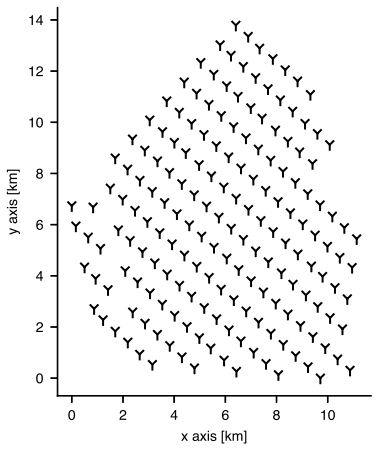
The FLORIS model, given the chosen wind and atmospheric inputs for the London Array site, generates power estimates close enough to reality that the reported 12-13% and 3% differences are not artifacts of model bias.
What would settle it
Run the same optimization cases with measured London Array turbine output substituted for FLORIS predictions; if the revenue gap between conventional and wake-aware schedules shrinks below statistical significance, the claimed advantage is not robust.
Figures




read the original abstract
This paper proposes a novel approach for optimal energy and reserve scheduling of wind farms by explicitly modelling wake interactions to enhance market participation and operational efficiency. Conventional methods often neglect wake effects, relying on power curve estimations that represent an upper limit and reduce market performance. To address this, a two-stage stochastic programming framework is developed, integrating a wake-aware power estimation model within the FLORIS simulation software. Wind and reserve uncertainties are addressed through scenario generation and reduction, enabling wind power producers to optimise participation in day-ahead energy and ancillary services markets, with particular focus on the Frequency Restoration Reserve (FRR). The wake-aware model provides more realistic power output predictions based on site-specific wind and atmospheric conditions, improving scheduling accuracy and reducing imbalance penalties. Wake steering is further employed to mitigate wake-induced losses and increase income through participation in ancillary services. The proposed approach is evaluated through a case study of the London Array offshore wind farm participating in the Great Britain (GB) electricity markets. Results show that conventional methods estimate production 12-13% higher, leading to imbalance penalties and 3% lower revenue compared with the wake-aware approach accounting for wake interactions. Moreover, the steering-enhanced approach yields an additional 1-2% increase in income relative to the wake-aware baseline. These findings underscore the value of accounting for wake interactions in wind farm scheduling and demonstrate the economic and operational benefits of active wake management, offering insights for improving grid stability and profitability as wind penetration continues to rise.
Editorial analysis
A structured set of objections, weighed in public.
Referee Report
Summary. The manuscript develops a two-stage stochastic programming framework for day-ahead energy and frequency restoration reserve (FRR) scheduling of a wind farm. It integrates the FLORIS wake model to generate site-specific power estimates that replace conventional power-curve approximations, applies scenario reduction for wind and reserve uncertainty, and evaluates the approach on the London Array layout participating in the GB electricity market. The central claim is that conventional methods overestimate production by 12-13 %, incurring imbalance penalties that reduce revenue by 3 % relative to the wake-aware schedule, while wake steering provides an additional 1-2 % revenue gain.
Significance. If the FLORIS-derived power estimates prove accurate for the specific site and conditions, the work would quantify the market value of explicit wake modeling and active wake control in ancillary-service participation. This is a timely contribution given rising wind penetration and the increasing role of reserve markets.
major comments (2)
- [Case study / Results] Case-study results (abstract and §4): the reported 12-13 % production overestimate and 3 % revenue gap are generated entirely by substituting FLORIS power outputs for conventional power-curve estimates inside the stochastic program. No validation of these FLORIS predictions against London Array SCADA data (for the same wind speeds, directions, or turbulence intensities) is presented, so any systematic bias in wake recovery or stability modeling directly propagates into the claimed economic deltas.
- [Methods] Methods (§3): the two-stage stochastic formulation itself follows standard practice; the claimed improvement therefore rests solely on the fidelity of the FLORIS power curves. Without reported calibration metrics, out-of-sample error, or sensitivity to FLORIS parameters (e.g., wake expansion coefficients), the quantitative revenue differences cannot be treated as robust.
minor comments (2)
- [Abstract] Abstract: the 12-13 % and 3 % figures are stated without accompanying uncertainty ranges or sensitivity checks on scenario reduction; adding these would improve clarity.
- [Methods] Notation: the distinction between the wake-aware power estimate P_wake and the conventional power-curve estimate P_conv should be defined explicitly in the first methods subsection rather than only in the results.
Simulated Author's Rebuttal
We thank the referee for the constructive comments, which highlight important aspects of model fidelity and robustness. We address each major comment below and outline revisions that strengthen the presentation without altering the core contribution of embedding FLORIS-based wake modeling in the stochastic scheduling framework.
read point-by-point responses
-
Referee: Case-study results (abstract and §4): the reported 12-13 % production overestimate and 3 % revenue gap are generated entirely by substituting FLORIS power outputs for conventional power-curve estimates inside the stochastic program. No validation of these FLORIS predictions against London Array SCADA data (for the same wind speeds, directions, or turbulence intensities) is presented, so any systematic bias in wake recovery or stability modeling directly propagates into the claimed economic deltas.
Authors: We agree that direct SCADA validation for the exact conditions would increase confidence in the absolute numbers. The manuscript's focus is the relative difference between power-curve and FLORIS-based inputs inside an otherwise identical stochastic program; the 12-13 % gap simply reflects the aggregate wake losses that FLORIS computes for the London Array layout under the chosen inflow conditions. FLORIS has been validated in multiple independent studies against SCADA and lidar data (typical power errors 5-10 %), and we will add a short literature summary of these benchmarks plus a note that the economic deltas should be interpreted as indicative rather than site-calibrated. We will also report the specific FLORIS parameter set used. revision: partial
-
Referee: Methods (§3): the two-stage stochastic formulation itself follows standard practice; the claimed improvement therefore rests solely on the fidelity of the FLORIS power curves. Without reported calibration metrics, out-of-sample error, or sensitivity to FLORIS parameters (e.g., wake expansion coefficients), the quantitative revenue differences cannot be treated as robust.
Authors: The referee correctly notes the absence of new calibration or sensitivity results. We will add a dedicated subsection in the revised Methods that (i) states the default FLORIS parameters employed, (ii) performs a one-at-a-time sensitivity sweep on the wake expansion coefficient and turbulence intensity over ranges reported in the FLORIS literature, and (iii) shows that the revenue advantage of the wake-aware schedule remains between 2.5 % and 4.2 % across this range. This demonstrates that the qualitative conclusion is not driven by a single parameter choice. revision: yes
- Direct validation of FLORIS power predictions against London Array SCADA data for the precise wind-speed, direction, and turbulence conditions used in the case study.
Circularity Check
No significant circularity; derivation uses external FLORIS model and standard stochastic optimization
full rationale
The paper's central results (12-13% production overestimate, 3% revenue gap, 1-2% steering gain) are generated by feeding FLORIS-derived wake-affected power estimates into a two-stage stochastic program and comparing against a conventional power-curve baseline inside the same optimization. No equation, parameter fit, or self-citation reduces the reported revenue deltas to the inputs by construction. FLORIS is treated as an external simulation engine; the optimization framework follows standard stochastic programming without uniqueness theorems or ansatzes imported from the authors' prior work. The derivation chain is therefore self-contained against external benchmarks.
Axiom & Free-Parameter Ledger
Reference graph
Works this paper leans on
-
[1]
Leão, R., Barroso, G., Sampaio, R., Almada, J., Lima, C., Rego, M. & Antunes, F. The fu- ture of low voltage networks: Moving from passive to active. International Journal Of Elec- trical Power & Energy Systems. 33, 1506-1512 (2011). doi:10.1016 /j.ijepes.2011.06.036
work page 2011
-
[2]
Muneer, T., Jadraque Gago, E. & Etxebarria Berrizbeitia, S. Wind energy and solar pv de- velopments in the EU. The Coming Of Age Of Solar And Wind Power . pp. 139-177 (2022). doi:10.1007/978-3-030-92010-4. 29
-
[3]
WindEurope, Wind Energy in Europe, Scenarios for 2030, https: //windeurope.org/; 2017 [accessed 18 April 2024]
work page 2030
-
[4]
Global Wind Energy Council, Global Wind Report 2023, https://gwec.net/globalwindreport2023/; 2023 [accessed 22 January 2024]
work page 2023
-
[5]
Abbasi, M., Taki, M., Rajabi, A., Li, L. & Zhang, J. Coordinated operation of electric vehicle charging and wind power generation as a virtual power plant: A multi-stage risk constrained approach. Applied Energy . 239 pp. 1294-1307 (2019). doi:10.1016/j.apenergy.2019.01.238
-
[6]
Y uan, X., Su, C., Umar, M., Shao, X. & Lobon, O. The race to zero emissions: Can renew- able energy be the path to carbon neutrality? Journal Of Environmental Management. 308 pp. 114648 (2022). doi:10.1016 /j.jenvman.2022.114648
-
[7]
Gao, W., Darvishan, A., Toghani, M., Mohammadi, M., Abedinia, O. & Ghadimi, N. Different states of multi-block based forecast engine for price and load prediction. In- ternational Journal Of Electrical Power & Energy Systems . 104 pp. 423-435 (2019). doi:10.1016/j.ijepes.2018.07.014
-
[8]
Banshwar, A., Sharma, N., Sood, Y . & Shrivastava, R. Renewable energy sources as a new participant in ancillary service markets. Energy Strategy Reviews. 18 pp. 106-120 (2017). doi:10.1016/j.esr.2017.09.009
-
[9]
Tsimopoulos, E. & Georgiadis, M. Optimal strategic o fferings for a conventional producer in jointly cleared energy and balancing markets under high penetration of wind power pro- duction. Applied Energy. 244 pp. 16-35 (2019). doi:10.1016 /j.apenergy.2019.03.161
work page 2019
-
[10]
World Wind Energy Association World Wind Energy Report 2010. (Proc. 10th World Wind Energy Conference, 2011)
work page 2010
-
[11]
Li, D., Li, P ., Cai, W., Song, Y . & Chen, H. Adaptive Fault-Tolerant Control of Wind Turbines With Guaranteed Transient Performance Considering Active Power Control of Wind Farms. IEEE Transactions On Industrial Electronics . 65, 3275-3285 (2017). doi:10.1109/TIE.2017.2748036
-
[12]
Siniscalchi-Minna, S., Bianchi, F., De-Prada-Gil, M. & Ocampo-Martinez, C. A wind farm control strategy for power reserve maximization. Renewable Energy. 131 pp. 37-44 (2019). doi:10.1016/j.renene.2018.06.112
-
[13]
Aho, J., Buckspan, A., Laks, J., Fleming, P ., Y unho Jeong, Dunne, F., Churchfield, M., Pao, L. & Johnson, K. A tutorial of wind turbine control for supporting grid frequency through active power control. 2012 American Control Conference (ACC) . pp. 3120-3131 (2012). doi:10.1109/ACC.2012.6315180
-
[14]
Porté-Agel, F., Bastankhah, M. & Shamsoddin, S. Wind-Turbine and Wind-Farm Flows: A Review. Boundary-Layer Meteorology. 174, 1-59 (2020). doi:10.1007 /s10546-019-00473- 0
work page 2020
-
[15]
Njiri, J. & Sö ffker, D. State-of-the-art in wind turbine control: Trends and challenges. Renewable And Sustainable Energy Reviews . 60 pp. 377-393 (2016). doi:10.1016/j.rser.2016.01.110. 30
-
[16]
Burton, T., Jenkins, N., Bossanyi, E., Sharpe, D. & Graham, M. Wind energy handbook. (Wiley, 2021)
work page 2021
-
[17]
Are Deep Neural Networks Adequate Be- havioral Models of Human Visual Perception?
Stevens, R. & Meneveau, C. Flow Structure and Turbulence in Wind Farms. An- nual Review Of Fluid Mechanics . 49, 311-339 (2017), Publisher: Annual Reviews. doi:10.1146/annurev-fluid-010816-060206
-
[18]
Meyers, J., Bottasso, C., Dykes, K., Fleming, P ., Gebraad, P ., Giebel, G., Göçmen, T. & V an Wingerden, J. Wind farm flow control: prospects and challenges. Wind Energy Science. 7, 2271-2306 (2022). doi:10.5194 /wes-7-2271-2022
work page 2022
-
[19]
Review of wake management techniques for wind turbines
Houck, D. Review of wake management techniques for wind turbines. Wind Energy. 25, 195-220 (2022). doi:10.1002 /we.2668
work page 2022
-
[20]
Shafie-khah, M., De La Nieta, A., Catalao, J. & Heydarian-Forushani, E. Optimal self- scheduling of a wind power producer in energy and ancillary services markets using a multi-stage stochastic programming. 2014 Smart Grid Conference (SGC) . pp. 1-5 (2014). doi:10.1109/SGC.2014.7150712
-
[21]
Kirschen, D. & Strbac, G. Fundamentals of power system economics. (John Wiley & Sons, 2004)
work page 2004
-
[22]
Botterud, A., Wang, J., Miranda, V . & Bessa, R. Wind Power Forecasting in U.S. Electricity Markets. The Electricity Journal. 23, 71-82 (2010). doi:10.1016 /j.tej.2010.03.006
work page 2010
-
[23]
The potential of wind power on the Swedish ancillary service markets
Wiklund, H. The potential of wind power on the Swedish ancillary service markets. (KTH, 2021)
work page 2021
-
[24]
Botterud, A., Wang, J., Bessa, R., Keko, H. & Miranda, V . Risk management and op- timal bidding for a wind power producer. IEEE PES General Meeting . pp. 1-8 (2010). doi:10.1109/PES.2010.5589535
-
[25]
Canizes, B., Soares, J., Faria, P . & V ale, Z. Mixed integer non-linear programming and Arti- ficial Neural Network based approach to ancillary services dispatch in competitive electric- ity markets. Applied Energy. 108 pp. 261-270 (2013). doi:10.1016 /j.apenergy.2013.03.031
work page 2013
-
[26]
Holttinen, H., Kiviluoma, J., Cutululis, N., Gubina, A., Keane, A. & V an Hulle, F. Ancillary services: technical specifications, system needs and cost. (REserviceS,2012,)
work page 2012
-
[27]
Kayedpour, N., De Kooning, J., Samani, A., Kayedpour, F., V andevelde, L. & Crevecoeur, G. An Optimal Wind Farm Operation Strategy for the Provision of Frequency Containment Reserve Incorporating Active Wake Control. IEEE Transactions On Sustainable Energy . pp. 1-14 (2023). doi:10.1109 /TSTE.2023.3288130
-
[28]
Attya, A. & Luis Dominguez-Garcia, J. Provision of Ancillary Services by Wind Power Generators. Advances In Modelling And Control Of Wind And Hydrogenerators . pp. 22 (2020). doi:10.5772/intechopen.90235
-
[29]
Edmunds, C., Martín-Martínez, S., Browell, J., Gómez-Lázaro, E. & Galloway, S. On the participation of wind energy in response and reserve markets in Great Britain and Spain. Renewable And Sustainable Energy Reviews . 115 pp. 109360 (2019). doi:10.1016/j.rser.2019.109360. 31
-
[30]
Attya, A., Dominguez-Garcia, J. & Anaya-Lara, O. A review on frequency support pro- vision by wind power plants: Current and future challenges. Renewable And Sustainable Energy Reviews. 81 pp. 2071-2087 (2018). doi:10.1016 /j.rser.2017.06.016
work page 2071
- [31]
-
[32]
Altin, M., Hansen, A., Barlas, T., Das, K. & Sakamuri, J. Optimization of Short-Term Over- production Response of V ariable Speed Wind Turbines.IEEE Transactions On Sustainable Energy. 9, 1732-1739 (2018). doi:10.1109 /TSTE.2018.2810898
-
[33]
Liu, Wang, Wang, Zhu & Lio Active Power Dispatch for Supporting Grid Frequency Regulation in Wind Farms Considering Fatigue Load. Energies. 12, 1508 (2019). doi:10.3390/en12081508
-
[34]
Kim, M. Optimal Control and Operation Strategy for Wind Turbines Contributing to Grid Primary Frequency Regulation. Applied Sciences. 7, 927 (2017). doi:10.3390 /app7090927
work page 2017
- [35]
- [36]
-
[37]
(Australian Energy Market Operator, 2013)
AEMO Wind Turbine Plant Capabilities Report. (Australian Energy Market Operator, 2013)
work page 2013
-
[38]
Wingrid, Researching the wind farm of grid interactions, https: //www.wingrid.org/; 2021 [accessed 22 January 2024]
work page 2021
-
[39]
Nedd, M., Browell, J., Egea, A., Bell, K., Hamilton, R., Wang, S. & Brush, S. Operating a Zero Carbon GB Power System in 2025 : Frequency and Fault Current [Annexes - Review of System and Network Issues, Frequency Stability, Power Electronic Devices and Fault Current, & Market Needs]. (University of Strathclyde, 2020). doi:10.17868 /74793
work page 2025
-
[40]
Ramboll Ancillary Services From New Technologies - Technical Potentials and Market Integration. (Ramboll, 2019 )
work page 2019
-
[41]
Schipper, J., Wood, A., Edwards, C. & Miller, A. Recommendations for Ancillary Ser- vice Markets under High Penetrations of Wind Generation in New Zealand. (GREEN Grid, 2019)
work page 2019
-
[42]
Ela, E., Gevorgian, V ., Fleming, P ., Zhang, Y ., Singh, M., Muljadi, E., Scholbrook, A., Aho, J., Buckspan, A., Pao, L., Singhvi, V ., Tuohy, A., Pourbeik, P ., Brooks, D. & Bhatt, N. Active Power Controls from Wind Power: Bridging the Gaps. (National Renewable Energy Laboratory, 2014)
work page 2014
- [43]
-
[44]
Faiella, M., Hennig, T., Cutululis, N. & V an Hulle, F. Capabilities and costs for ancillary services provision by wind power plants. (REserviceS, 2013)
work page 2013
-
[45]
In: 2023 American Control Conference (ACC)
Starke, G., Meneveau, C., King, J. & Gayme, D. Y aw-Augmented Control for Wind Farm Power Tracking. 2023 American Control Conference (ACC) . pp. 184-191 (2023). doi:10.23919/ACC55779.2023.10156444
-
[46]
Hosseini, S., Toubeau, J., De Grève, Z. & V allée, F. An advanced day-ahead bidding strat- egy for wind power producers considering confidence level on the real-time reserve provi- sion. Applied Energy. 280 pp. 115973 (2020). doi:10.1016 /j.apenergy.2020.115973
-
[47]
Morales, J., Conejo, A. & Perez-Ruiz, J. Short-Term Trading for a Wind Power Producer. IEEE Transactions On Power Systems. 25, 554-564 (2010,2)
work page 2010
- [48]
-
[49]
Rahimiyan, M., Morales, J. & Conejo, A. Evaluating alternative o ffering strate- gies for wind producers in a pool. Applied Energy . 88, 4918-4926 (2011). doi:10.1016/j.apenergy.2011.06.038
-
[50]
Soares, T., Pinson, P ., Jensen, T. & Morais, H. Optimal Offering Strategies for Wind Power in Energy and Primary Reserve Markets. IEEE Transactions On Sustainable Energy . 7, 1036-1045 (2016). doi:10.1109 /TSTE.2016.2516767
-
[51]
Vilim, M. & Botterud, A. Wind power bidding in electricity markets with high wind pene- tration. Applied Energy. 118 pp. 141-155 (2014). doi:10.1016 /j.apenergy.2013.11.055
work page 2014
-
[52]
Liang, J., Grijalva, S. & Harley, R. Increased Wind Revenue and System Security by Trad- ing Wind Power in Energy and Regulation Reserve Markets. IEEE Transactions On Sus- tainable Energy. 2, 340-347 (2011). doi:10.1109 /TSTE.2011.2111468
-
[53]
Soares, T., Jensen, T., Mazzi, N., Pinson, P . & Morais, H. Optimal o ffering and allocation policies for wind power in energy and reserve markets. Wind Energy. 20, 1851-1870 (2017). doi:10.1002/we.2125
-
[54]
Abedinia, O., Zareinejad, M., Doranehgard, M., Fathi, G. & Ghadimi, N. Optimal o ffer- ing and bidding strategies of renewable energy based large consumer using a novel hybrid robust-stochastic approach. Journal Of Cleaner Production . 215 pp. 878-889 (2019). 878-
work page 2019
-
[55]
doi:10.1016/j.jclepro.2019.01.085
-
[56]
Khodaei, H., Hajiali, M., Darvishan, A., Sepehr, M. & Ghadimi, N. Fuzzy-based heat and power hub models for cost-emission operation of an industrial consumer us- ing compromise programming. Applied Thermal Engineering . 137 pp. 395-405 (2018). doi:10.1016/j.applthermaleng.2018.04.008
-
[57]
Bay, C., Fleming, P ., Doekemeijer, B., King, J., Churchfield, M. & Mudafort, R. Addressing deep array effects and impacts to wake steering with the cumulative-curl wake model. Wind Energy Science. 8, 401-419 (2023). doi:10.5194 /wes-8-401-2023. 33
work page 2023
-
[58]
Bastankhah, M., Welch, B., Martínez-Tossas, L., King, J. & Fleming, P . Analytical solution for the cumulative wake of wind turbines in wind farms. Journal Of Fluid Mechanics . 911 pp. A53 (2021,3)
work page 2021
-
[59]
FLORIS Wake Modeling & Wind Farm Controls, https: //nrel.github.io/floris/; 2023 [ac- cessed 20 December 2023]
work page 2023
-
[60]
Boersma, S., Doekemeijer, B., Siniscalchi-Minna, S. & V an Wingerden, J. A constrained wind farm controller providing secondary frequency regulation: An LES study. Renewable Energy. 134 pp. 639-652 (2019). doi:10.1016 /j.renene.2018.11.031
work page 2019
-
[61]
Shapiro, C., Bauweraerts, P ., Meyers, J., Meneveau, C. & Gayme, D. Modelbased receding horizon control of wind farms for secondary frequency regulation. Wind Energy. 20, 1261- 1275 (2017). doi:10.1002 /we.2093
work page 2017
- [62]
-
[63]
Ørsted. DONG Energy wind farm demonstrates frequency response capabil- ity, https://orsted.co.uk/media/newsroom/news/2016/09/dong-energy-wind-farm- demonstrates-frequency-response-capability; 2016 [accessed 22 January 2024]
work page 2016
-
[64]
National Energy System Operator. Mandatory Frequency Response (MFR), https://www.neso.energy/industry-information/balancing-services/frequency-response- services; 2024 [accessed 29 December 2024]
work page 2024
-
[65]
National Energy System Operator. Fast Reserve (FR), https: //www.neso.energy/industry- information/balancing-services/reserve-services/fast-reserve; 2024 [accessed 29 December 2024]
work page 2024
-
[66]
Hodge, B., Lew, D., Milligan, M., Holttinen, H., Sillanpää, S., Gómez-Lázaro, E., Schar ff, R., Söder, L., Larsén, X., Giebel, G., Flynn, D. & Dobschinski, J. Wind Power Forecasting Error Distributions: An International Comparison. (NREL,2012,11)
work page 2012
- [67]
- [68]
-
[69]
Bholowalia, P . & Kumar, A. EBK-Means: A Clustering Technique based on Elbow Method and K-Means in WSN. International Journal Of Computer Applications . 105 pp. 17-24 (2014)
work page 2014
-
[70]
Scikit-learn-extra. Documentation, https://scikit-learn- extra.readthedocs.io/en/stable/index.html; 2023 [accessed 01 May 2024]
work page 2023
-
[71]
Focus GB, https: //www.epexspot.com/en/focus-gb; 2024 [accessed 29 December 2024]
EPEX spot market. Focus GB, https: //www.epexspot.com/en/focus-gb; 2024 [accessed 29 December 2024]. 34
work page 2024
-
[72]
Bottieau, J., Hubert, L., De Greve, Z., V allee, F. & Toubeau, J. V ery-Short- Term Probabilistic Forecasting for a Risk-Aware Participation in the Single Price Im- balance Settlement. IEEE Transactions On Power Systems . 35, 1218-1230 (2020). doi:10.1109/TPWRS.2019.2940756
-
[73]
National Energy System Operator. Balancing Mechanism (BM), https://www.neso.energy/what-we-do/systems-operations/what-balancing-mechanism; 2024 [accessed 29 December 2024]
work page 2024
-
[74]
Documentation, https: //coin-or.github.io/Ipopt/; 2020 [accessed 06 January 2024]
Ipopt. Documentation, https: //coin-or.github.io/Ipopt/; 2020 [accessed 06 January 2024]
work page 2020
-
[75]
Pyomo, http://www.pyomo.org; 2024 [accessed 06 January 2024]
work page 2024
-
[76]
Documentation, https: //pyomo.readthedocs.io/en/stable/; 2024 [accessed 06 Jan- uary 2024]
Pyomo. Documentation, https: //pyomo.readthedocs.io/en/stable/; 2024 [accessed 06 Jan- uary 2024]
work page 2024
-
[77]
Ahmadyar, A. & V erbic, G. Coordinated Operation Strategy of Wind Farms for Frequency Control by Exploring Wake Interaction. IEEE Transactions On Sustainable Energy. 8, 230- 238 (2017). doi:10.1109 /TSTE.2016.2593910
-
[78]
Lanzilao, L. & Meyers, J. A new wakemerging method for windfarm power prediction in the presence of heterogeneous background velocity fields. Wind Energy. 25, 237-259 (2022). doi:10.1002/we.2669
-
[79]
TNO O ffshore Wind Measurements. MeteoMast IJmuiden, https: //offshorewind- measurements.tno.nl/en/measurement-locations/meteomast-ijmuiden-mmij/; 2016 [accessed 12 April 2025]
work page 2016
-
[80]
Liu, X., Lin, Z. & Feng, Z. Short-term o ffshore wind speed forecast by seasonal ARIMA - A comparison against GRU and LSTM. Energy. 227 pp. 120492 (2021). doi:10.1016/j.energy.2021.120492
discussion (0)
Sign in with ORCID, Apple, or X to comment. Anyone can read and Pith papers without signing in.