REVIEW 2 major objections 4 minor 57 references
The slow-time extended KdV equation produces resonant radiation that the parent Serre system does not; the eKdV–Whitham equation suppresses it and matches the parent at moderate amplitude.
Reviewed by Pith at T0; open to challenge. T0 means a machine referee read the full paper against a public rubric. the ladder, T0–T4 →
Replacing the extended KdV equation's linear dispersion with the parent Serre system's dispersion — the new eKdVW equation — eliminates spurious resonant radiation and closely reproduces the full system in the tested moderate-amplitude scenarios.
T0 review reviewed 2026-08-03 challenge →
load-bearing objection A useful new reduced model (eKdVW) and a solid numerical comparison, but the convexity argument for the slow-space eKdV is wrong as written and needs fixing. the 2 major comments →
Solitary waves of moderate amplitude and dispersive radiation in the Serre equations: the extended KdV-Whitham approximation
The pith
A machine-rendered reading of the paper's core claim, the machinery that carries it, and where it could break.
The reading
Core claim
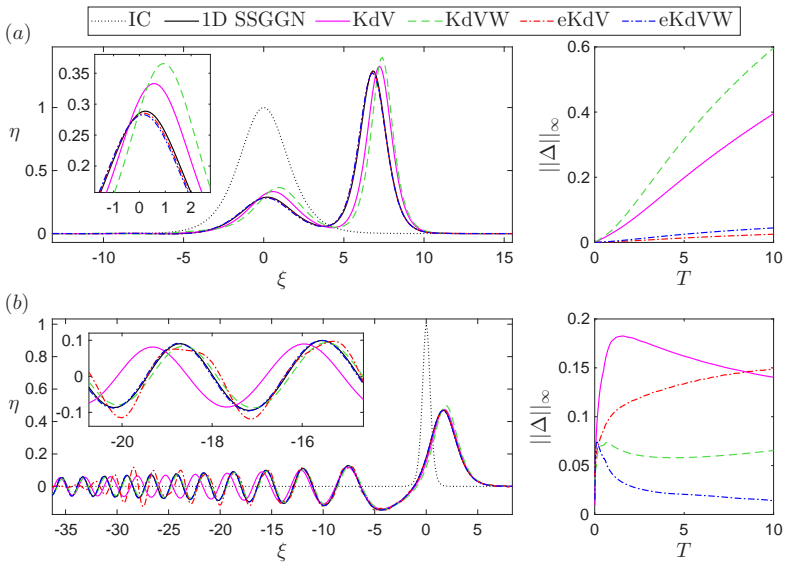
At the centre is the slow-time eKdV equation (22), whose linear dispersion omega = -beta k^3 + epsilon beta1 k^5 is non-convex for the surface-water coefficients beta=1/6, beta1=1/24, creating a resonance between short and long waves. The parent 1D Serre system has the convex dispersion omega = k(-1 + sqrt(3/(3 + epsilon k^2)))/epsilon, and the paper argues no such resonance occurs there. Replacing the eKdV dispersive terms with the Serre dispersion via the convolution kernel (33) yields the eKdVW equation (35), which is the paper's recommended regularisation: long-time numerical comparisons show no forward resonant radiation, near-perfect agreement with Serre for negative localised data, an
What carries the argument
The key object is the extended KdV–Whitham (eKdVW) equation (35): one writes eKdV in integro-differential form eta_T + integral K(xi-zeta) eta d zeta + N[eta] = 0, keeps the full eKdV nonlinear terms N[eta] = alpha eta eta_xi + epsilon(alpha1 eta^2 eta_xi + gamma1 eta eta_xixixi + gamma2 eta_xi eta_xixi), and sets the kernel K to the Fourier transform of the Serre system's linear dispersion (29). That single substitution removes the spurious resonance because the parent dispersion curve is convex. Supporting pieces: the slow-space eKdV formulation (24) as a second regularisation; the near-identity transformation (37)–(50) that grafts a KdV soliton into an O(epsilon^2) eKdV solitary wave; and
Load-bearing premise
The claim that eKdV radiation is spurious presumes the 1D Serre system is the right ground truth; the additional convexity argument for slow-space eKdV is not validated by Table 1's negative beta1.
What would settle it
Compute the slow-space eKdV dispersion (27) with Table 1 coefficients (beta=1/6, beta1=-1/24, epsilon=0.2) and check d^2 omega/dk^2 for a sign change; then run the slow-space eKdV equation from the positive and negative initial data of Section 5.1 and look for a forward resonant wavetrain. For the eKdVW claim, run the same negative-localised-data experiment at epsilon=0.2 with the eKdVW equation and the Serre system: any forward oscillatory discrepancy at the reported observation times beyond plotting accuracy would falsify the 'indistinguishable' conclusion.
If this is right
- For positive localised initial data and epsilon between 0.1 and 0.4, the eKdVW equation removes the resonant wavetrain while keeping the amplitude and phase accuracy of eKdV, so it is a drop-in replacement in slow-time simulations.
- For negative localised data, where only dispersive radiation forms, the eKdVW solution is numerically indistinguishable from the Serre system while being far cheaper than solving the parent equations.
- The slow-space eKdV equation is a second working regularisation: it improves on KdV for both positive and negative data, though its accuracy decreases for large wavenumbers where its dispersion departs from Serre's.
- The near-identity-transformed KdV soliton is a better initial condition for Serre-system simulations than the KdV, Gardner, or improved-Gardner solitons across the tested amplitude range.
- The IST-based rule — estimate the radiation fraction of mass, momentum, and energy from the KdV initial data — selects the best reduced model in advance: eKdVW for radiation-dominated evolutions, eKdV for soliton-dominated ones.
Where Pith is reading between the lines
- The same dispersion-replacement trick should transfer to other higher-order KdV-type equations (internal waves, plasma waves, ice-covered flows): any parent system with a bounded monotone dispersion can serve as the kernel, and the success here suggests the swap is worth testing where eKdV-type resonance appears.
- The paper's convexity proof for the slow-space eKdV equation uses inequality (28), which requires 10 beta1 >= 3 beta^2, but Table 1 lists beta1 = -1/24 for that equation; recomputing the dispersion with the actual coefficient gives an inflection point, so the resonance-free status of the slow-space form currently rests on numerical evidence rather than the stated formula — a point the authors do n
- The IST-based selection rule can be automated into a practical procedure: compute the three KdV conserved quantities of any proposed initial condition, evaluate the radiation fractions (74), and choose the model accordingly; this is directly testable in numerical wave channels.
- Because the eKdVW equation carries the parent's exact linear phase speeds, it should also improve predictions of dispersive shock waves and wave-train phase errors beyond the solitary-wave cases shown, a consequence the paper leaves implicit.
Editorial analysis
A structured set of objections, weighed in public.
Referee Report
Summary. The paper studies the extended KdV (eKdV) equation as a model for moderately nonlinear surface water waves. It derives slow-time and slow-space eKdV coefficients from the 1D SSGGN and 1D Boussinesq–Peregrine systems, analyses the linear dispersion, and introduces the extended KdV–Whitham (eKdVW) equation (35), in which the eKdV dispersive terms are replaced by the SSGGN linear dispersion, as a regularisation of the spurious resonant radiation of the slow-time eKdV equation. It constructs an O(ε^2) solitary-wave approximation via a Kodama–Fokas–Liu NIT to KdV, and compares it against KdV, Gardner, improved-Gardner, KdVW and eKdVW in numerical simulations of positive and negative localised initial conditions. It further proposes an IST-based criterion using KdV conserved quantities to predict whether eKdV or eKdVW will be the better reduced model.
Significance. If the claims hold, the paper gives practical guidance for choosing a reduced model for moderate-amplitude waves: eKdVW is robust in radiation-dominated scenarios, and the slow-space eKdV offers an alternative regularisation. The multiple-scales derivations are clean and were independently spot-checked; the NIT velocity reparametrization (49) checks out; the numerical solver is validated to machine precision; and the IST diagnostic is a falsifiable prediction rule. These are genuine strengths, and the central numerical claims appear defensible once the sign issue in Section 3 is corrected.
major comments (2)
- [Section 3, Eq. (27)-(28), Table 1] The convexity proof for the slow-space eKdV dispersion uses β1>0 in Eq. (27), but Table 1 reports the signed coefficient β1=-1/24 for both X,ξ rows. Substituting the signed value into Eq. (27) gives ω=-k^3(β-εk^2/24)/(1+3εβk^2), which changes sign at finite k and is not convex; inequality (28) is then inapplicable. If β1 in Eq. (27) was intended to be |β1^ss| or the negative of the Table 1 coefficient, that convention is not stated and conflicts with Eq. (26), where β1 is the signed coefficient. Because the slow-space regularisation claim is explicitly based on this convexity argument, the proof needs correction. The numerical absence of resonance in Fig. 6 may still hold, but the stated theoretical explanation is not supported as written.
- [Section 5.1, Fig. 6] The slow-space regularisation claim is demonstrated at a single final value X=10. Although the L∞ error is plotted for X∈[5,15], the spatial profiles are only shown at one X slice. To convincingly show that no resonant radiation develops over the whole slow-space evolution, please provide snapshots at several X values or a space-time plot, or explicitly state that the final slice is representative and justify this.
minor comments (4)
- [Section 3, terminology] The text uses 'convex' to mean 'no inflection point' while the displayed second derivative is negative. Please define the criterion precisely, e.g. d^2ω/dk^2 of one sign, to avoid confusion.
- [Section 5, Fig. 5 and Conclusions] For ǫ=0.2 the eKdVW L∞ error in Fig. 5(b) is O(0.2-0.3), so 'largely indistinguishable' in the abstract and Conclusions overstates the quantitative agreement. Please qualify this phrase or provide a tighter error metric.
- [Section 5.2, Eq. (74)] For b=2 the computed radiation mass M_r is negative (∼ -0.55M_0). This is possible because the IST soliton carries more mass than the initial condition, but the text should explain that 'significant radiation' is measured by the magnitudes of P_r and E_r, not by the sign of M_r.
- [Section 2, Eq. (23) and Figure 3] Typo: '1D SSGGGN equations' has an extra G. Also, the panels in Fig. 3 are hard to read; larger labels and separation would help.
Circularity Check
No significant circularity: eKdVW's linear-dispersion agreement is disclosed by construction, and the informative comparisons are benchmarked against the SSGGN system; only minor non-load-bearing self-citations appear. A §3 sign/clarification issue is a correctness risk, not circularity.
full rationale
The derivation chain is largely self-contained. The eKdV equation (22) is derived from the SSGGN system by explicit multiple-scale asymptotics in §2, with coefficients listed in Table 1; the slow-space version (24) is obtained by an explicit change of variables. The NIT solitary-wave solution (43)–(50) is constructed by the Kodama–Fokas–Liu transformation, and its accuracy is then compared with the exact SSGGN soliton (36) in Figure 3. No parameter appearing in that comparison is fitted to the data being predicted. The eKdVW equation (35) is introduced by explicitly replacing the eKdV linear dispersion operator with the SSGGN dispersion relation through the kernel (33), following Whitham's published method. Thus its linear dispersion agreement with the parent system is a disclosed modelling construction, not a hidden prediction. The nontrivial claims — absence of resonance, amplitude and phase errors, and the superiority of eKdVW for radiating initial data — come from solving the fully nonlinear SSGGN system (appendix B, with conservative benchmark errors O(10^-15)) and comparing full waveforms, so those results are externally supported rather than definitional. The IST-based model-selection rule of §5.2 is computed from KdV conservation laws and Schrödinger spectral data, not fitted to the numerical outcomes. The paper does contain self-citations, notably to Sidorovas et al. [2024, 2025] and Martin et al. [2025], but these are context or recapitulated derivations; none is load-bearing in the sense of an unverified same-author result that forces the conclusion. One non-circular weakness should be flagged: §3's convexity argument uses 'β, β1 > 0' and the inequality (28) even though Table 1 lists β1 = -1/24 for the slow-space SSGGN-derived eKdV equation; this creates a sign-convention ambiguity in equations (26)–(28) that needs clarification. That is a mathematical-consistency/correctness concern, not a circular reduction, and it does not raise the circularity score beyond the minor-self-citation level.
Axiom & Free-Parameter Ledger
free parameters (3)
- soliton speed V (test scenarios) =
0.5 (all runs)
- sponge-layer parameters σ, κ, ξspan =
σ=750, κ=1, ξspan=|domain|/20
- IST test parameters a, b =
a=1, b=1/2 and b=2
axioms (6)
- domain assumption Multiple-scales ordering ǫ = O(δ²) with ǫ → 0; the eKdV equation is a second-order expansion and is formally small-amplitude.
- domain assumption The 1D SSGGN system is an accurate benchmark for surface gravity waves of moderate amplitude.
- standard math Near-identity transformation remainder (39) vanishes under decay conditions ξ₀ → −∞.
- standard math KdV soliton-counting criterion (65) and eigenvalue/eigenfunction formulas (66)–(71) from the Schrödinger spectral problem.
- domain assumption Convex linear dispersion implies no resonant radiation for these wave equations.
- domain assumption Pseudospectral/RK4 numerics with 2/3 dealiasing and sponge layers resolve the phenomena without numerical reflection.
invented entities (1)
-
extended KdV–Whitham (eKdVW) equation (35)
independent evidence
Cite this review
Pith. "Pith review of Solitary waves of moderate amplitude and dispersive radiation in the Serre equations: the extended KdV-Whitham approximation." pith.science (2026). https://pith.science/paper/DJDQSX6C
@misc{pith2026260209266,
  author       = {Pith},
  title        = {Pith review of: Solitary waves of moderate amplitude and dispersive radiation in the Serre equations: the extended KdV-Whitham approximation},
  year         = {2026},
  howpublished = {\url{https://pith.science/paper/DJDQSX6C}},
  note         = {Machine review of arXiv:2602.09266}
}
read the original abstract
We consider the extended Korteweg-de Vries (eKdV) equation as a model for long moderately nonlinear surface water waves and use it to describe the evolution of initial conditions generating solitary waves with and without significant dispersive radiation, as well as cases of pure dispersive radiation without any solitary waves. In the slow time formulation for the modelled solutions this equation also generates fast propagating resonant forward radiation due to the non-convexity of its linear dispersion curve, which is not present in the direct numerical simulations of the strongly nonlinear Serre parent system (also known as the Su-Gardner and Green-Naghdi equations). We show that the extended KdV-Whitham approximation and the slow space formulation of the eKdV equation are suitable regularisations of the eKdV equation in several cases of interest. Importantly, unlike the KdV-type equations, it can be used to model waves of moderate amplitude. Numerical comparisons are made between the Serre system and several respective reduced models, where simulations are initiated with an approximate soliton solution of the eKdV equation, constructed by use of Kodama-Fokas-Liu near-identity transformation to the KdV equation, as well as a generic localised initial condition.
Figures



Reference graph
Works this paper leans on
-
[1]
G. Whitham . Linear and Nonlinear Waves. Wiley Interscience Publications. John Wiley and Sons, 1974
1974
-
[2]
Ablowitz and H
M. Ablowitz and H. Segur . Solitons and the Inverse Scattering Transform. Society for Industrial and Applied Mathematics, 1981
1981
-
[3]
Drazin and R
P. Drazin and R. Johnson . Solitons: An Introduction. Cambridge Texts in Applied Mathematics. Cambridge University Press, 1989
1989
-
[4]
R. Johnson . A Modern Introduction to the Mathematical Theory of Water Waves. Cambridge Texts in Applied Mathematics. Cambridge University Press, 1997
1997
-
[5]
Moldabayev , H
D. Moldabayev , H. Kalisch , and D. Dutykh . The whitham equation as a model for surface water waves. Physica D: Nonlinear Phenomena, 309: 0 99--107, 2015
2015
-
[6]
Trillo , M
S. Trillo , M. Klein , G. Clauss , and M. Onorato . Observation of dispersive shock waves developing from initial depressions in shallow water. Physica D: Nonlinear Phenomena, 333: 0 276--284, 2016
2016
-
[7]
Frantzeskakis , T
T Horikis , D. Frantzeskakis , T. Marchant , and N. Smyth . Higher-dimensional extended shallow water equations and resonant soliton radiation. Physical Review Fluids, 6: 0 104401, 2021
2021
-
[8]
Carter , D
J. Carter , D. Henderson , and P. Panayotaros . The spatial whitham equation. Journal of Fluid Mechanics, 996: 0 A42, 2024
2024
-
[9]
Martin , D
B. Martin , D. Tseluiko , and K. Khusnutdinova . Evolution of perturbed long nonlinear plane, ring, and hybrid surface waves. Journal of Fluid Mechanics, 1025: 0 A37, 2025
2025
-
[10]
Osborne and T
A. Osborne and T. Burch . Internal solitons in the andaman sea. Science, 208: 0 451–460, 1980
1980
-
[11]
Grimshaw
R. Grimshaw . Nonlinear Waves in Fluids: Recent Advances and Modern Applications. CISM International Centre for Mechanical Sciences. Springer Vienna, 2005
2005
-
[12]
R. Johnson . On the development of a solitary wave moving over an uneven bottom. Mathematical Proceedings of the Cambridge Philosophical Society, 73: 0 183–203, 1973
1973
-
[13]
Khusnutdinova and A
K. Khusnutdinova and A. Samsonov . Fission of a longitudinal strain solitary wave in a delaminated bar. Physical Review E, 77: 0 066603, 2008
2008
-
[14]
Gardner , J
C. Gardner , J. Greene , M. Kruskal , and R. Miura . Method for solving the korteweg-devries equation. Physical Review Letters, 19: 0 1095–1097, 1967
1967
-
[15]
Gardner , J
C. Gardner , J. Greene , M. Kruskal , and R. Miura . Korteweg-devries equation and generalizations. vi. methods for exact solution. Communications on Pure and Applied Mathematics, 27: 0 97–133, 1974
1974
-
[16]
D. Benney . Long non-linear waves in fluid flows. Journal of Mathematics and Physics, 45: 0 52–63, 1966
1966
-
[17]
Marchant and N
T. Marchant and N. Smyth . The extended korteweg-de vries equation and the resonant flow of a fluid over topography. Journal of Fluid Mechanics, 221: 0 263–287, 1990
1990
-
[18]
Horikis , D
T. Horikis , D. Frantzeskakis , and N. Smyth . Extended shallow water wave equations. Wave Motion, 112: 0 102934, 2022
2022
-
[19]
Lamb and L
K. Lamb and L. Yan . The evolution of internal wave undular bores: Comparisons of a fully nonlinear numerical model with weakly nonlinear theory. Journal of Physical Oceanography, 26: 0 2712–2734, 1996
1996
-
[20]
Sidorovas , D
N. Sidorovas , D. Tseluiko , W. Choi , and K. Khusnutdinova . Internal solitary and cnoidal waves of moderate amplitude in a two-layer fluid: the extended kdv equation approximation. Physica D: Nonlinear Phenomena, 481: 0 134723, 2025
2025
-
[21]
Abramyan and Y
A. Abramyan and Y. Stepanyants . The structure of two-dimensional solitons in media with anomalously small dispersion. Soviet Physics – Journal of Experimental and Theoretical Physics, 61, 1985
1985
-
[22]
Hunter and J
J. Hunter and J. Scheurle . Existence of perturbed solitary wave solutions to a model equation for water waves. Physica D: Nonlinear Phenomena, 32: 0 253–268, 1988
1988
-
[23]
J. Boyd . Weakly non-local solutions for capillary-gravity waves: fifth-degree korteweg-de vries equation. Physica D: Nonlinear Phenomena, 48: 0 129–146, 1991
1991
-
[24]
Kakutani and H
T. Kakutani and H. Ono . Weak non-linear hydromagnetic waves in a cold collision-free plasma. Journal of the Physical Society of Japan, 26: 0 1305–1318, 1969
1969
-
[25]
Guyenne and E
P. Guyenne and E. Părău . Finite-depth effects on solitary waves in a floating ice sheet. Journal of Fluids and Structures, 49: 0 242–262, 2014
2014
-
[26]
Hooper , P
C. Hooper , P. Ruiz , J. Huntley , and K. Khusnutdinova . Undular bores generated by fracture. Physical Review E, 104: 0 044207, 2021
2021
-
[27]
Sidorovas , D
N. Sidorovas , D. Tseluiko , W. Choi , and K. Khusnutdinova . Nonlinear concentric water waves of moderate amplitude. Wave Motion, 128: 0 103295, 2024
2024
-
[28]
Garbuzov , Y
F. Garbuzov , Y. Beltukov , and K. Khusnutdinova . Longitudinal bulk strain solitons in a hyperelastic rod with quadratic and cubic nonlinearities. Theoretical and Mathematical Physics, 202: 0 319--333, 2020
2020
-
[29]
Benilov , R
E. Benilov , R. Grimshaw , and E. Kuznetsova . The generation of radiating waves in a singularly-perturbed korteweg-de vries equation. Physica D: Nonlinear Phenomena, 69: 0 270–278, 1993
1993
-
[30]
Baqer and N
S. Baqer and N. Smyth . Whitham shocks and resonant dispersive shock waves governed by the higher order korteweg–de vries equation. Proceedings of the Royal Society A, 479: 0 20220580, 2023
2023
-
[31]
Baqer , T
S. Baqer , T. Horikis , and D. Frantzeskakis . On shallow water non-convex dispersive hydrodynamics: The extended kdv model. Water Waves, 7: 0 225--262, 2025
2025
-
[32]
Sprenger and M
P. Sprenger and M. Hoefer . Shock waves in dispersive hydrodynamics with nonconvex dispersion. SIAM Journal on Applied Mathematics, 77: 0 26–50, 2017
2017
-
[33]
Hoefer , N
M. Hoefer , N. Smyth , and P. Sprenger . Modulation theory solution for nonlinearly resonant, fifth-order korteweg–de vries, nonclassical, traveling dispersive shock waves. Studies in Applied Mathematics, 142: 0 219–240, 2019
2019
-
[34]
Afanasjev , Y
V. Afanasjev , Y. Kivshar , and C. Menyuk . Effect of third-order dispersion on dark solitons. Optics Letters, 21: 0 1975–1977, 1996
1975
-
[35]
F. Serre . Contribution à l'étude des écoulements permanents et variables dans les canaux. La Houille Blanche, 39: 0 374–388, 1953
1953
-
[36]
Su and C
C. Su and C. Gardner . Korteweg‐de vries equation and generalizations. iii. derivation of the korteweg‐de vries equation and burgers equation. Journal of Mathematical Physics, 10: 0 536--539, 1969
1969
-
[37]
Green and P
A. Green and P. Naghdi . A derivation of equations for wave propagation in water of variable depth. Journal of Fluid Mechanics, 78: 0 237–246, 1976
1976
-
[38]
Hornick , D
J. Hornick , D. Pelinovsky , and G. Schneider . On the long-wave approximation of solitary waves in cylindrical coordinates. Nonlinear Differential Equations and Applications, 32: 0 50, 2025
2025
-
[39]
G. Whitham . Variational methods and applications to water waves. Proceedings of the Royal Society London A, 299: 0 6–25, 1967
1967
-
[40]
Fornberg and G Whitham
B. Fornberg and G Whitham . Numerical and theoretical study of certain nonlinear wave phenomena. Philosophical Transactions of the Royal Society of London, 289: 0 373–404, 1978
1978
-
[41]
J. Carter . Bidirectional whitham equations as models of waves on shallow water. Wave Motion, 82: 0 51--61, 2018
2018
-
[42]
Y. Kodama . On integrable systems with higher order corrections. Physics Letters A, 107: 0 245--249, 1985 a
1985
-
[43]
Y. Kodama . Normal forms for weakly dispersive wave equations. Physics Letters A, 112: 0 193--196, 1985 b
1985
-
[44]
Fokas and Q
A. Fokas and Q. Liu . Asymptotic integrability of water waves. Physical Review Letters, 77: 0 2347--2351, 1996
1996
-
[45]
Peregrine
D. Peregrine . Long waves on a beach. Journal of Fluid Mechanics, 27: 0 815–827, 1967
1967
-
[46]
Marchant and N
T. Marchant and N. Smyth . Soliton interaction for the extended korteweg-de vries equation. IMA Journal of Applied Mathematics, 56: 0 157--176, 1996
1996
-
[47]
Marchant and N
T. Marchant and N. Smyth . An undular bore solution for the higher-order korteweg–de vries equation. Journal of Physics A: Mathematical and General, 39: 0 L563, 2006
2006
-
[48]
Marchant
T. Marchant . Asymptotic solitons of the extended korteweg--de vries equation. Physical Review E, 59: 0 3745--3748, 1999
1999
-
[49]
Dutykh , D
D. Dutykh , D. Clamond , P. Milewski , and D. Mitsotakis . Finite volume and pseudo-spectral schemes for the fully nonlinear 1d serre equations. European Journal of Applied Mathematics, 24: 0 761–787, 2013
2013
-
[50]
Mitsotakis , D
D. Mitsotakis , D. Dutykh , and J. Carter . On the nonlinear dynamics of the traveling-wave solutions of the serre system. Wave Motion, 70: 0 166--182, 2017
2017
-
[51]
Berezin and V
Y. Berezin and V. Karpman . Nonlinear evolution of disturbances in plasmas and other dispersive media. Soviet Physics – Journal of Experimental and Theoretical Physics, 24: 0 1049--1056, 1967
1967
-
[52]
Landau and E
L. Landau and E. Lifshitz . Quantum mechanics. Pergamon Press, 1959
1959
-
[53]
Klein and K
C. Klein and K. Roidot . Fourth order time-stepping for kadomtsev--petviashvili and davey-- stewartson equations. SIAM Journal on Scientific Computing, 33: 0 3333–3356, 2011
2011
-
[54]
Duchêne and C
V. Duchêne and C. Klein . Numerical study of the serre-green-naghdi equations and a fully dispersive counterpart. Discrete and Continuous Dynamical Systems - B, 27: 0 5905–5933, 2022
2022
-
[55]
Trefethen
L. Trefethen . Spectral Methods in MATLAB. Software, environments, tools. Society for Industrial and Applied Mathematics, 2000
2000
-
[56]
S. Orszag . On the elimination of aliasing in finite-difference schemes by filtering high-wavenumber components. Journal of Atmospheric Science, 28: 0 1074--1074, 1971
1971
-
[57]
Saad and M
Y. Saad and M. Schultz . Gmres: A generalized minimal residual algorithm for solving nonsymmetric linear systems. SIAM Journal on Scientific and Statistical Computing, 7: 0 856--869, 1986
1986
This paper was first reviewed by deepseek-v4-flash on August 3, 2026.
discussion (0)
Sign in with ORCID, Apple, or X to comment. Anyone can read and Pith papers without signing in.