REVIEW 4 major objections 5 minor 2 cited by
Rigorous no-go theorems for heralded linear-optical state generation tasks
T0 review · 4 major / 5 minor · reviewed 2026-08-03 · deepseek-v4-flash
Pith's one-line read Applying the Nullstellensatz Linear Algebra algorithm to the polynomial equations of heralded photon circuits yields rigorous impossibility proofs and certified lower bounds on photon resources.
desk verdict A useful NulLA-based method for rigorous photonic resource lower bounds; Lemma 1 is under-proved but the reduction is likely salvageable. read the letter →
The pith
A machine-rendered reading of the paper's core claim, the machinery that carries it, and where it could break.
The reading
What carries the argument
The central object is the Nullstellensatz certificate: polynomials β_i such that 1 = Σ β_i f_i over the polynomial ring in the entries of the transformation matrix A. By Hilbert's Nullstellensatz, existence of such a certificate is equivalent to the system f_1=...=f_s=0 having no solution over the complex numbers. NulLA turns the search for a certificate of a fixed degree d into a linear algebra problem, and the paper's Lemma 1 reduces the search space: to rule out all separable n-photon inputs and all m-photon heralding patterns, it suffices to test the input |1,1,...,1> and the herald (1,1,...,1). The polynomial encoding of state generation follows an existing construction: the input Fock
What would settle it
Find an explicit linear-optical network that heralds a Bell state from a three-photon separable input (contradicting the degree-9 certificate), or a CNOT gate from a single ancilla photon (contradicting the degree-6 certificate). Alternatively, construct a separable n-photon input distribution with more than one photon in some mode that can be heralded to produce a target state even though the single-photon-per-mode configuration with the same n is infeasible; that would disprove Lemma 1.
Extended reading notes
Core claim
The discovery is that the NulLA algorithm, a standard tool from algebraic geometry for proving polynomial systems infeasible, applies directly to heralded linear optics. The state-generation condition — that the heralded output equals the target up to scaling — is rewritten as γG = Q, where G and Q are homogeneous polynomials in creation operators with coefficients depending on the unknown linear transformation A. Equating monomial coefficients gives a system of polynomial equations in the entries of A; if these equations have no solution, the task is impossible. NulLA searches for a Nullstellensatz certificate of increasing degree, and finding one is a rigorous proof of infeasibility. The p
Load-bearing premise
The fan-out argument in Lemma 1, which asserts that any incorrect photon distribution must have fewer photons than the target herald pattern in at least one mode, assumes that detection outcomes with too many photons are excluded; if that step fails, the no-go theorems apply only to the tested configurations, not to all configurations with the same photon numbers.
Editorial extensions
If this is right
- Bell-state generation from three separable photons is impossible; the known four-photon schemes are resource-optimal.
- A heralded CNOT gate needs at least two ancilla (heralding) photons; single-ancilla versions are ruled out.
- Vacuum-heralded NOON states cannot work if any input mode contains more than one photon; the standard single-photon-per-mode inputs are therefore necessary.
- For families of random two-photon target states, infeasibility certificates appear at fixed low degrees, suggesting that low-degree certificates are typical rather than exceptional.
- The method extends from fixed Fock inputs to probabilistic sources by treating each photon-number sector as a separate task that a single transformation must satisfy.
Reading between the lines
- If Lemma 1's fan-out proof is completed (the written argument leaves the case of outcomes with more than the herald photon count implicit), the lower bounds would rigorously cover all separable inputs with the same total photon number; as written they cover the canonical configuration plus whatever the reduction genuinely establishes.
- The same certificate machinery could be applied to other resource questions, such as the minimum photon number for fusion gates or for post-selected state generation, by writing the appropriate polynomial systems; the paper does not address these.
- The observation that certificate degrees stay low across random targets hints at a general phenomenon — the effective Nullstellensatz degree for these photonic systems may be far below Kollár's bound — which, if true, would make NulLA a practical decision procedure for a wide range of photonic tasks.
- A repaired or strengthened Lemma 1 would also open the door to classifying tasks by photon number alone, effectively creating a lookup table of feasible vs infeasible state-generation tasks; the current paper stops at demonstrating examples.
Editorial analysis
A structured set of objections, weighed in public.
Referee Report
Summary. This paper proposes to use the Nullstellensatz Linear Algebra (NulLA) algorithm to prove infeasibility of heralded linear-optical state generation. Following the polynomial formulation of Ref. [17], the state generation task is encoded as a system of polynomial equations in the entries of an unknown linear transformation A and a scaling parameter gamma; a NulLA certificate 1=sum beta_i f_i definitively proves that no such transformation exists. The authors introduce a simplification lemma (Lemma 1) claiming that, for fixed total photon numbers, only the single-photon-per-mode input and the all-ones heralding pattern need be tested. They report infeasibility certificates for Bell state generation with three input photons, for random two-photon target states, for vacuum-heralded NOON states from non-single-photon inputs, and for a one-ancilla-photon CNOT gate, and hence claim lower bounds on resource requirements such as at least four photons for a Bell state and at least two ancilla photons for a heralded CNOT.
Significance. If the central reduction and the certificates are valid, the paper offers a genuinely useful tool: NulLA provides rigorous, machine-checkable no-go statements where previous work often relied on numerical search, and the reported low certificate degrees relative to worst-case bounds are encouraging. The authors also correctly avoid the equivalence-class shortcut that can cause false infeasibility (Appendix A), and they make code available. The specific results--Bell state requiring four photons, CNOT requiring two ancilla photons, and NOON states requiring single-photon-per-mode inputs for vacuum-heralded generation--would be valuable lower bounds for photonic resource analysis. However, the generality of these results currently depends on Lemma 1, whose proof is incomplete; as written, the certificates are rigorous only for the precise test configurations, not for the advertised all-configuration theorems.
major comments (4)
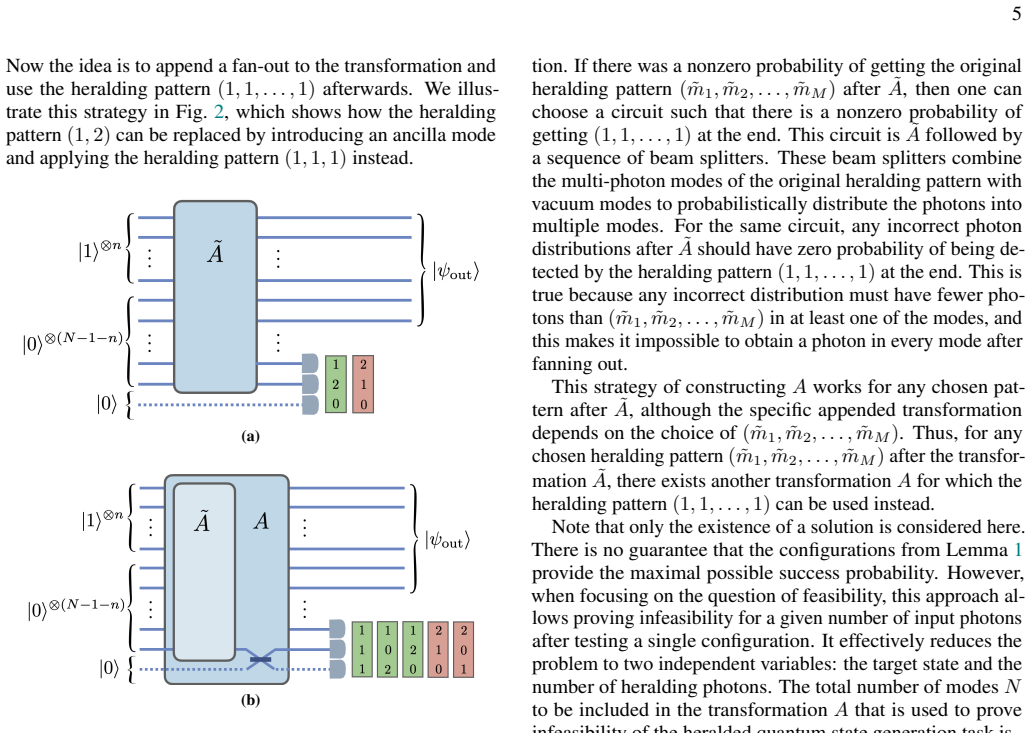
- [Section III.A, Lemma 1 and Theorem 2] The herald-pattern reduction is not proven. The proof asserts that any incorrect distribution has fewer photons than (m_1,...,m_M) in at least one mode; this is false for outcomes whose total photon number exceeds m, e.g. desired (1,2) and incorrect (2,3). Such outcomes could still trigger the all-ones pattern after fan-out unless extra total-photon-number or PNR conditions are imposed. More importantly, the fan-out construction cannot map a heralding pattern with a zero-photon mode (e.g. (0,1), or the m=0 vacuum-heralded case in Sec. IV.C) to the all-ones pattern, because passive linear optics cannot create a photon from vacuum. The input-reduction step itself produces vacuum-herald events, and these are not handled. Consequently Theorem 2 and the lower bounds for all separable n-photon inputs and all m-photon heralding patterns are not established; the certificates are rigorous only fo
- [Section II.A (after Eq. 2.4)] The treatment of non-unitary transformations is under-specified. The text states that a general solution A can be rescaled so that ||A||<=1 and then embedded in a larger unitary, but it does not explain what happens to the additional modes in the heralded setting. If the dilation leaves photons in the added modes, they must be measured or postselected, typically to vacuum, which adds herald modes that are absent from the polynomial system (2.8). This matters because the added vacuum conditions interact with the unproven zero-mode part of Lemma 1. Please either give the standard embedding argument for heralded generation, with the fate of the extra modes, or cite the precise result in Refs. [17,25].
- [Section IV.D.1 (CNOT)] The tested system is described as the three-photon, five-mode transformation derived from the original scheme when one input photon is removed. If this is only a specific ansatz obtained by deleting a photon from the known two-ancilla scheme, the certificate rules out that ansatz, not all one-heralding-photon CNOT gates. The text should clarify that the polynomial system solved is the fully general 3-photon, 5-mode herald-one transformation with the four logical-basis input-output pairs; otherwise the conclusion that two ancilla photons are necessary is not supported.
- [Sections IV.A-IV.D and Ref. [44]] The no-go results are computer-assisted, but the actual Nullstellensatz certificates (the polynomials beta_i) are not included; only the certificate degrees are reported. For a rigorous, checkable proof, the certificates or a permanent, versioned data/code release that verifies the identities 1=sum beta_i f_i should be provided. The informal GitHub URL is not sufficient for peer review. This is a reproducibility issue, not an issue with the NulLA method itself.
minor comments (5)
- [Section III.A] The phrase 'all separable n-photon input states' should be narrowed to 'all product Fock states with n photons' or explicitly defined, to avoid confusion with superpositions of Fock states.
- [Section III.B, Eq. (3.3)] Please define V and s in the displayed Kollar bound; currently they are introduced only in the following sentence.
- [Table I] In the row with no certificate, replace the dash in the 'Computed degree' column with 'none up to d=9'.
- [Ref. [44]] The URL contains spaces and is not stable; provide a permanent repository identifier such as a DOI or a specific commit hash.
- [Figures 1 and 2] The captions should state what the detector patterns represent (photon-number-resolving outcomes) and explain the dashed modes; the green/red colour coding is hard to decode from the current captions alone.
Circularity Check
No material circularity: NulLA certificates are computed proofs; self-citations are prior independent results.
full rationale
The paper's central derivation is self-contained as a proof system: it maps a heralded linear-optical state-generation task to polynomial equations (Eqs. (2.3)-(2.8)), then applies the NulLA algorithm, where a found certificate is a witness for the Nullstellensatz identity 1 = Σ β_i f_i. By Theorem 1, existence of such a certificate is a rigorous proof of infeasibility; it is not an assumption of the desired conclusion. The lower bounds for Bell states, CNOT gates, and NOON states are obtained as outputs of this algorithm, with code made available, and they are checked against known feasible constructions, giving the results external content. The self-citations to Refs. [17] and [25], which include overlapping authors, are not circularly load-bearing: they cite prior published mathematical tools (the polynomial mapping and unitary-embedding result), and the present text sketches or relies on these as independent, checkable statements rather than as unverified assertions unique to this paper. No parameter is fitted to the target answers, and no 'prediction' is identified with a fitted input. The only substantive concern is the completeness of the proof sketch for Lemma 1's optimal-configuration reduction; if that reduction fails, the no-go theorems would cover only the tested configurations, not all configurations with the same photon numbers. That is a correctness risk, not a circularity, because Lemma 1 is a substantive reduction claim rather than a definitional equivalence or a fitted assumption. Overall, the derivation chain does not reduce to its inputs by construction.
Assumptions & free parameters
assumptions (5)
- standard math Weak Nullstellensatz (Hilbert's Nullstellensatz for algebraically closed fields)
- domain assumption Faithfulness of the polynomial encoding of the state-generation problem
- ad hoc to paper Lemma 1 optimal-configuration reduction
- domain assumption Pure product Fock input states
- standard math Effective Nullstellensatz bounds of Kollar and Sombra
Cite this review
Pith. "Pith review of Rigorous no-go theorems for heralded linear-optical state generation tasks." pith.science (2026). https://pith.science/paper/Z5YK77SB
@misc{pith2026260209495,
  author       = {Pith},
  title        = {Pith review of: Rigorous no-go theorems for heralded linear-optical state generation tasks},
  year         = {2026},
  howpublished = {\url{https://pith.science/paper/Z5YK77SB}},
  note         = {Machine review of arXiv:2602.09495}
}
read the original abstract
A major challenge in photonic quantum technologies is developing strategies to prepare suitable discrete-variable quantum states using simple input states, linear optics, and auxiliary photon measurements to identify successful outcomes. Fundamentally, this challenge arises from the lack of strong non-linearities on the single-photon level, meaning that photonic state preparation based on linear optics cannot benefit from the deterministic gate-based approach available to other physical platforms. Instead, the preparation of quantum states can be probabilistically implemented using single photons, linear-optical networks, and photon detection. However, determining whether an input state can be transformed into a target state using a specific measurement pattern - a problem that can be mapped to deciding the feasibility of a system of polynomial equations - is a complex problem in general. To solve it, we apply the Nullstellensatz Linear Algebra algorithm from algebraic geometry to quantum state generation; this can provide definitive no-go results by proving infeasibility when the state preparation task in question has no solution. We demonstrate this capability to validate and establish lower bounds on the physical resource requirements for the realization of several ubiquitous optical states and gates.
Figures

Forward citations
Cited by 2 Pith papers
-
Optimal stellar rank approximation of squeezed cat states with photon catalysis
Photon catalysis protocols are shown to be provably optimal in some cases for approximating squeezed cat states, with identified parameter regimes achieving high fidelity using minimal non-Gaussian resources while ben...
-
Local controllability of heralded quantum linear optics
Jacobian rank analysis quantifies how heralding enlarges the locally accessible state space in photonic linear optics and identifies resources for full local controllability.
Reference graph
Works this paper leans on
-
[17]
L. S. Madsen, F. Laudenbach, M. F. Askarani, F. Rortais, T. Vin- cent, J. F. F. Bulmer, F. M. Miatto, L. Neuhaus, L. G. Helt, M. J. Collins, A. E. Lita, T. Gerrits, S. W. Nam, V . D. Vaidya, M. Menotti, I. Dhand, Z. Vernon, N. Quesada, and J. Lavoie, Quantum computational advantage with a programmable pho- tonic processor, Nature606, 75–81 (2022)
2022
-
[1]
Example: Minimal resource requirements for the heralded CNOT gate We demonstrate the above approach on the CNOT gate, a cornerstone of quantum information processing. When used on dual-rail-encoded photonic qubits—and in the ab- sence of additional heralding photons—a CNOT gate is a two-photon, four-mode transformation that maps the logical basis as |1,0,...
-
[2]
J. L. O’Brien, A. Furusawa, and J. Vuˇckovi´c, Photonic quantum technologies, Nat. Photonics3, 687 (2009)
2009
-
[3]
Gisin and R
N. Gisin and R. Thew, Quantum communication, Nat. Photonics 1, 165 (2007)
2007
-
[4]
Pirandola, U
S. Pirandola, U. L. Andersen, L. Banchi, M. Berta, D. Bunandar, R. Colbeck, D. Englund, T. Gehring, C. Lupo, C. Ottaviani, J. L. Pereira, M. Razavi, J. S. Shaari, M. Tomamichel, V . C. Usenko, G. Vallone, P. Villoresi, and P. Wallden, Advances in quantum cryptography, Adv. Opt. Photon.12, 1012 (2020)
2020
-
[5]
Flamini, N
F. Flamini, N. Spagnolo, and F. Sciarrino, Photonic quantum information processing: a review, Rep. Prog. Phys.82, 016001 (2018)
2018
-
[6]
P. V . Parellada, V . Gimeno i Garcia, J. J. Moyano-Fern´andez, and J. C. Garcia-Escartin, No-go theorems for photon state trans- formations in quantum linear optics, Results Phys.54, 107108 (2023)
2023
-
[7]
Slussarenko and G
S. Slussarenko and G. J. Pryde, Photonic quantum informa- tion processing: A concise review, Appl. Phys. Rev.6, 041303 (2019)
2019
Show all 45 references
-
[8]
A. P. Lund, Classes of two-photon states defined by linear inter- actions and destructive two-photon quantum interference in a single mode, Phys. Rev. A92, 053844 (2015)
2015
-
[9]
The above proof via the NulLA algorithm is consistent with a result in Ref
This proves that generating a Bell state from a separable three-photon input state is impossible, thereby confirming that the known solutions utilizing four photons are optimal in terms of the number of required input photons. The above proof via the NulLA algorithm is consist...
-
[10]
Migdał, J
P. Migdał, J. Rodr´ıguez-Laguna, M. Oszmaniec, and M. Lewen- stein, Multiphoton states related via linear optics, Phys. Rev. A 89, 062329 (2014)
2014
-
[11]
Knill, R
E. Knill, R. Laflamme, and G. J. Milburn, A scheme for efficient quantum computation with linear optics, Nature409, 46 (2001)
2001
-
[12]
D. E. Browne and T. Rudolph, Resource-efficient linear optical 10 quantum computation, Phys. Rev. Lett.95, 010501 (2005)
2005
-
[13]
C. M. Dawson, H. L. Haselgrove, and M. A. Nielsen, Noise thresholds for optical quantum computers, Phys. Rev. Lett.96, 020501 (2006)
2006
-
[14]
Gross, K
D. Gross, K. Kieling, and J. Eisert, Potential and limits to cluster- state quantum computing using probabilistic gates, Phys. Rev. A 74, 042343 (2006)
2006
-
[15]
Bartolucci, P
S. Bartolucci, P. Birchall, H. Bomb ´ın, H. Cable, C. Dawson, M. Gimeno-Segovia, E. Johnston, K. Kieling, N. Nickerson, M. Pant, F. Pastawski, T. Rudolph, and C. Sparrow, Fusion- based quantum computation, Nat. Commun.14, 912 (2023)
2023
-
[16]
F. H. B. Somhorst, R. van der Meer, M. C. Anguita, R. Schadow, H. J. Snijders, M. de Goede, B. Kassenberg, P. Venderbosch, C. Taballione, J. P. Epping, H. H. van den Vlekkert, J. F. F. Bulmer, J. Lugani, I. A. Walmsley, P. W. H. Pinkse, J. Eisert, N. Walk, and J. J. Renema, Qu...
2023
-
[18]
Forbes, F
I. Forbes, F. Ghafari, E. C. R. Deacon, S. P. Singh, E. Lavie, P. Yard, R. D. Shaw, A. Laing, and N. Tischler, Heralded genera- tion of entanglement with photons, Rep. Prog. Phys.88, 086002 (2025)
2025
-
[19]
N. M. VanMeter, P. Lougovski, D. B. Uskov, K. Kieling, J. Eisert, and J. P. Dowling, General linear-optical quantum state genera- tion scheme: Applications to maximally path-entangled states, Phys. Rev. A76, 063808 (2007)
2007
-
[20]
Z. He, V . Vaikuntanathan, A. Wills, and R. Y . Zhang, Asymp- totically good quantum codes with addressable and transversal non-Clifford gates (2025), arxiv:2507.05392
2025 arXiv
-
[21]
Rolnick and G
D. Rolnick and G. Spencer, On the robust hardness of Gr¨obner basis computation, J. Pure Appl. Algebra223, 2080 (2019)
-
[22]
J. A. De Loera, J. Lee, P. N. Malkin, and S. Margulies, Comput- ing infeasibility certificates for combinatorial problems through Hilbert’s Nullstellensatz, J. Symb. Comput.46, 1260 (2011)
2011
-
[23]
S. A. Fldzhyan, M. Y . Saygin, and S. P. Kulik, Compact linear optical scheme for Bell state generation, Phys. Rev. Res.3, 043031 (2021)
2021
-
[25]
F. V . Gubarev, Fock space perspective on optimal heralding schemes (2021), arXiv:2108.09336
2021 arXiv
-
[26]
K. Lemr, A. ˇCernoch, J. Soubusta, K. Kieling, J. Eisert, and M. Duˇsek, Experimental implementation of the optimal linear- optical controlled phase gate, Phys. Rev. Lett.106, 013602 (2011)
2011
-
[27]
Tischler, C
N. Tischler, C. Rockstuhl, and K. Słowik, Quantum optical realization of arbitrary linear transformations allowing for loss and gain, Phys. Rev. X8, 021017 (2018)
2018
-
[28]
D. A. Cox, J. Little, and D. O’Shea,Ideals, varieties, and algo- rithms: An introduction to computational algebraic geometry and commutative algebra, Undergraduate Texts in Mathematics (Springer, Berlin, 2015)
2015
-
[29]
Tao, Hilbert’s Nullstellensatz (2007)
T. Tao, Hilbert’s Nullstellensatz (2007)
2007
-
[30]
P. Kok,State Preparation and Some Applications in Quantum Optics within the context of Quantum Information Theory, PhD dissertation, University of Wales, Bangor (2001), e-print: http s://arxiv.org/abs/quant-ph/0102070
2001 arXiv
-
[31]
Koll´ar, Sharp effective Nullstellensatz, J
J. Koll´ar, Sharp effective Nullstellensatz, J. Am. Math. Soc.1, 963 (1988)
1988
-
[32]
Sombra, A sparse effective Nullstellensatz, Adv
M. Sombra, A sparse effective Nullstellensatz, Adv. Appl. Math. 22, 271 (1999)
1999
-
[33]
event-ready
Q. Zhang, X.-H. Bao, C.-Y . Lu, X.-Q. Zhou, T. Yang, T. Rudolph, and J.-W. Pan, Demonstration of a scheme for the generation of “event-ready” entangled photon pairs from a single-photon source, Phys. Rev. A77, 062316 (2008)
2008
-
[34]
Carolan, C
J. Carolan, C. Harrold, C. Sparrow, E. Mart´ın-L´opez, N. J. Rus- sell, J. W. Silverstone, P. J. Shadbolt, N. Matsuda, M. Oguma, M. Itoh, G. D. Marshall, M. G. Thompson, J. C. F. Matthews, T. Hashimoto, J. L. O’Brien, and A. Laing, Universal linear optics, Science349, 711 (2015)
2015
-
[35]
F. V . Gubarev, I. V . Dyakonov, M. Y . Saygin, G. I. Struchalin, S. S. Straupe, and S. P. Kulik, Improved heralded schemes to generate entangled states from single photons, Phys. Rev. A102, 012604 (2020)
2020
-
[36]
Stanisic, N
S. Stanisic, N. Linden, A. Montanaro, and P. S. Turner, Gener- ating entanglement with linear optics, Phys. Rev. A96, 043861 (2017)
2017
-
[37]
De Gliniasty, P
G. De Gliniasty, P. Bagourd, S. Draux, and B. Bourdoncle, Sim- ple rules for two-photon state preparation with linear optics, in 2024 IEEE International Conference on Quantum Computing and Engineering (QCE), V ol. 01 (2024) pp. 706–711
2024
-
[38]
J. J. Bollinger, W. M. Itano, D. J. Wineland, and D. J. Heinzen, Optimal frequency measurements with maximally correlated states, Phys. Rev. A54, R4649 (1996)
1996
-
[39]
Dorner, R
U. Dorner, R. Demkowicz-Dobrzanski, B. J. Smith, J. S. Lun- deen, W. Wasilewski, K. Banaszek, and I. A. Walmsley, Optimal quantum phase estimation, Phys. Rev. Lett.102, 040403 (2009)
2009
-
[40]
Demkowicz-Dobrza´nski, J
R. Demkowicz-Dobrza´nski, J. Kołody´nski, and M. Gut ¸˘a, The elusive Heisenberg limit in quantum-enhanced metrology, Nat. Commun.3, 1063 (2012)
2012
-
[41]
Fiur´aˇsek, Conditional generation of n-photon entangled states of light, Phys
J. Fiur´aˇsek, Conditional generation of n-photon entangled states of light, Phys. Rev. A65, 053818 (2002)
2002
-
[42]
S.-Y . Lee, T. Paterek, H. S. Park, and H. Nha, Linear optical scheme for producing polarization-entangled NOON states, Opt. Commun.285, 307 (2012)
2012
-
[43]
G. J. Pryde and A. G. White, Creation of maximally entangled photon-number states using optical fiber multiports, Phys. Rev. A68, 052315 (2003)
2003
-
[44]
H. F. Hofmann, Generation of highly nonclassical n-photon polarization states by superbunching at a photon bottleneck, Phys. Rev. A70, 023812 (2004)
2004
-
[45]
Kieling, T
K. Kieling, T. Rudolph, and J. Eisert, Percolation, renormaliza- tion, and quantum computing with nondeterministic gates, Phys. Rev. Lett.99, 130501 (2007)
2007
-
[46]
https://github.com/noratischler/infeasibility certificates for state generation
Reviewed August 3, 2026 · model on record in the stance chip above.
Discussion (0). Sign in to comment.