Statistical Effort Modelling of Game Resource Localisation Attacks
Pith reviewed 2026-05-21 12:34 UTC · model grok-4.3
The pith
An automatable method yields statistical models of the effort needed for game resource localisation attacks on protected software.
A machine-rendered reading of the paper's core claim, the machinery that carries it, and where it could break.
Core claim
The central claim is that the proposed method for obtaining statistical effort models can be instantiated in detail for human-interactive game resource localisation attacks, with results from two use cases confirming its feasibility and utility for decision support in software protection.
What carries the argument
The full instantiation of the automatable statistical effort modelling method, which breaks down attacks into measurable steps and fits models to effort data.
Load-bearing premise
That the derived statistical models accurately capture and predict the real-world effort required for humans to perform these interactive attacks.
What would settle it
An experiment where human attackers perform the resource localisation on the two games and the observed efforts are compared to the model's predictions for accuracy.
Figures


read the original abstract
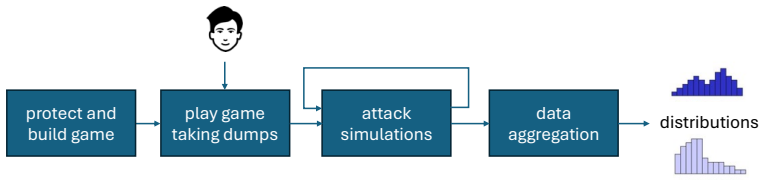
Evidence on the effectiveness of Man-At-The-End (MATE) software protections, such as code obfuscation, has mainly come from limited empirical research. Recently, however, an automatable method was proposed to obtain statistical models of the required effort to attack (protected) software. The proposed method was sketched for a number of attack strategies but not instantiated, evaluated, or validated for those that require human interaction with the attacked software. In this paper, we present a full instantiation of the method to obtain statistical effort models for game resource localisation attacks, which represent a major step towards creating game cheats, a prime example of MATE attacks. We discuss in detail all relevant aspects of our instantiation and the results obtained for two game use cases. Our results confirm the feasibility of the proposed method and its utility for decision support for users of software protection tools. These results open up a new avenue for obtaining models of the impact of software protections on reverse engineering attacks, which will scale much better than empirical research involving human participants.
Editorial analysis
A structured set of objections, weighed in public.
Referee Report
Summary. The manuscript instantiates a previously sketched automatable method for deriving statistical effort models of game resource localisation attacks (a key step in creating game cheats as MATE attacks on protected software). It applies the method in full detail to two concrete game use cases, covering attack strategy decomposition, parameterisation, model fitting, and reports results that confirm feasibility and utility for decision support in software protection tool selection.
Significance. If the instantiation and derived models hold, the work supplies a scalable, automatable route to quantitative effort estimates for human-interactive reverse-engineering attacks, addressing the scalability limits of prior empirical studies with human participants. The paper ships a complete technical instantiation with usable outputs for two cases and thereby strengthens the foundation for statistical modeling of MATE protection impact.
minor comments (2)
- The abstract states that results 'confirm the feasibility ... and its utility' yet does not preview any quantitative metrics (e.g., model fit statistics, effort estimates, or validation error); a brief summary sentence in the abstract would improve accessibility.
- Section 5 (or equivalent results section) should explicitly state whether the fitted statistical models were validated on held-out attack traces or only on the same data used for parameterisation; a short paragraph on this point would remove any residual ambiguity about independence.
Simulated Author's Rebuttal
We thank the referee for the positive summary, significance assessment, and recommendation of minor revision. Our manuscript provides a full instantiation of the previously sketched automatable method for statistical effort models of game resource localisation attacks, with detailed application to two concrete use cases including strategy decomposition, parameterisation, model fitting, and results confirming feasibility and utility for MATE attack analysis and software protection decisions. As no specific major comments are listed in the report, we have no individual points to address.
Circularity Check
No significant circularity in derivation chain
full rationale
The paper presents a full instantiation of a previously proposed automatable method for deriving statistical effort models, applied specifically to game resource localisation attacks on two concrete use cases. It supplies technical details on attack strategy decomposition, parameterisation, and model fitting, then reports feasibility and decision-support utility. No load-bearing step reduces by the paper's own equations or self-citation to its inputs by construction; the central claim rests on the completeness of the instantiation and the resulting outputs rather than on re-deriving or fitting the underlying method itself. The work is therefore self-contained against external benchmarks for its stated purpose.
Axiom & Free-Parameter Ledger
Lean theorems connected to this paper
-
IndisputableMonolith/Cost/FunctionalEquation.leanwashburn_uniqueness_aczel unclear?
unclearRelation between the paper passage and the cited Recognition theorem.
while (true) activity, artefacts = decision(knowledge, totalEffort) ... statistical distribution ϕPvA
-
IndisputableMonolith/Foundation/AlexanderDuality.leanalexander_duality_circle_linking unclear?
unclearRelation between the paper passage and the cited Recognition theorem.
greedy vs statistical pruning logics ... RNC encoding
What do these tags mean?
- matches
- The paper's claim is directly supported by a theorem in the formal canon.
- supports
- The theorem supports part of the paper's argument, but the paper may add assumptions or extra steps.
- extends
- The paper goes beyond the formal theorem; the theorem is a base layer rather than the whole result.
- uses
- The paper appears to rely on the theorem as machinery.
- contradicts
- The paper's claim conflicts with a theorem or certificate in the canon.
- unclear
- Pith found a possible connection, but the passage is too broad, indirect, or ambiguous to say the theorem truly supports the claim.
Reference graph
Works this paper leans on
-
[1]
Nethammer: Inducing rowhammer faults through network requests
Abrath, B., Coppens, B., Nevolin, I., De Sutter, B.: Resilient self-debugging software protection. In: 2020 IEEE European Symposium on Security and Privacy Workshops (EuroSPW). pp. 606–615. IEEE Computer Society (2020). https://doi.org/10.1109/EuroSPW51379.2020.00088
-
[2]
Abrath, B., Coppens, B., Volckaert, S., Wijnant, J., De Sutter, B.: Tightly-coupled self-debugging software protection. In: Proc. of the 6th Workshop on Software Secu- rity, Protection, and Reverse Engineering. pp. 7:1–7:10. SSPREW ’16, ACM (2016). https://doi.org/10.1145/3015135.3015142
-
[3]
Anckaert, B., Madou, M., De Sutter, B., De Bus, B., De Bosschere, K., Preneel, B.: Program obfuscation: a quantitative approach. In: Proc. ACM Workshop on Quality of protection. pp. 15–20 (2007). https://doi.org/10.1145/1314257.1314263 26
-
[4]
Computers & Security132, 103321 (2023)
Basile, C., De Sutter, B., Canavese, D., Regano, L., Coppens, B.: De- sign, implementation, and automation of a risk management approach for man-at-the-end software protection. Computers & Security132, 103321 (2023). https://doi.org/https://doi.org/10.1016/j.cose.2023.103321
-
[5]
Cannell, J.: Obfuscation: Malware’s best friend (March 2013),http: //blog.malwarebytes.org/intelligence/2013/03/obfuscation-malwares- best-friend/
work page 2013
-
[6]
Cano, N.: Game hacking: developing autonomous bots for online games. No Starch Press (2016)
work page 2016
-
[7]
In: IEEE 17th International Conference on Program Comprehension (ICPC)
Ceccato, M., Di Penta, M., Nagra, J., Falcarin, P., Ricca, F., Torchiano, M., Tonella, P.: The effectiveness of source code obfuscation: An experimental assessment. In: IEEE 17th International Conference on Program Comprehension (ICPC). pp. 178– 187 (May 2009). https://doi.org/10.1109/ICPC.2009.5090041
-
[8]
Ceccato, M., Tonella, P., Basile, C., Coppens, B., De Sutter, B., Falcarin, P., Torchi- ano, M.: How professional hackers understand protected code while performing at- tack tasks. In: Proc. ICPC (2017). https://doi.org/10.1109/ICPC.2017.2
-
[9]
Empirical Software Engineering (EMSE)24, 240–286 (2019)
Ceccato, M., Tonella, P., Basile, C., Falcarin, P., Torchiano, M., Coppens, B., De Sutter, B.: Understanding the behaviour of hackers while performing attack tasks in a professional setting and in a public challenge. Empirical Software Engineering (EMSE)24, 240–286 (2019). https://doi.org/10.1007/s10664-018-9625-6
-
[10]
Cheat Engine (2024),https://www.cheatengine.org/
work page 2024
-
[11]
Christian Collberg: The Tigress C obfuscator (2025),https://tigress.wtf/
work page 2025
-
[12]
Collberg, C., Thomborson, C., Low, D.: Ataxonomyofobfuscatingtransformations. Tech. Rep. 148, University of Auckland (07 1997)
work page 1997
-
[13]
https://doi.org/10.4230/DagRep.9.8.1
De Sutter, B., Collberg, C., Preda, M.D., Wyseur, B.: Software Protection Decision SupportandEvaluationMethodologies(DagstuhlSeminar19331).DagstuhlReports 9(8), 1–25 (2019). https://doi.org/10.4230/DagRep.9.8.1
-
[14]
De Sutter, B., Schrittwieser, S., Coppens, B., Kochberger, P.: Evaluation method- ologies in software protection research. ACM Comput. Surv.57(4) (Dec 2024). https://doi.org/10.1145/3702314
-
[15]
In: 2015 IEEE/ACM 1st International Workshop on Software Pro- tection
Demissie, B.F., Ceccato, M., Tiella, R.: Assessment of data obfuscation with residue number coding. In: 2015 IEEE/ACM 1st International Workshop on Software Pro- tection. pp. 38–44 (2015). https://doi.org/10.1109/SPRO.2015.15
-
[16]
Faingnaert, T., Zhang, T., Van Iseghem, W., Everaert, G., Coppens, B., Collberg, C., De Sutter, B.: Tools and models for software reverse engineering research. In: Proc. CheckMATE Workshop. p. 44–58 (2024). https://doi.org/10.1145/3689934.3690817 27
-
[17]
SIGPLAN Not.24(1), 112–123 (Nov 1988)
Feldman, S.I., Brown, C.B.: Igor: a system for program debugging via reversible execution. SIGPLAN Not.24(1), 112–123 (Nov 1988). https://doi.org/10.1145/69215.69226
-
[18]
Journal of Systems and Software162, 110492 (2020)
Fellin, R., Ceccato, M.: Experimental assessment of XOR-masking data obfuscation based on k-clique opaque constants. Journal of Systems and Software162, 110492 (2020). https://doi.org/10.1016/j.jss.2019.110492
-
[19]
Electronic Computers, IRE Transactions onEC-8(2), 140–147 (June 1959)
Garner, H.L.: The residue number system. Electronic Computers, IRE Transactions onEC-8(2), 140–147 (June 1959). https://doi.org/10.1109/TEC.1959.5219515
-
[20]
https://doi.org/10.1007/3-540- 45619-8_3
Goto, H., Mambo, M., Matsumura, K., Shizuya, H.: An approach to the objective and quantitative evaluation of tamper-resistant software. In: Third Int. Workshop on Information Security. pp. 82–96. Springer (2000). https://doi.org/10.1007/3-540- 44456-4_7
-
[21]
Halstead, M.H.: Elements of Software Science (Operating and programming systems series). Elsevier Science Inc. (1977)
work page 1977
-
[22]
Hex-Rays: IDA Pro.https://hex-rays.com/ida-pro(2025)
work page 2025
-
[23]
Josefsson, S.: Rfc 4648 - the base16, base32, and base64 data encodings (October 2006),http://tools.ietf.org/html/rfc4648
work page 2006
-
[24]
IEEE Transactions on software Engineering SE-2(4), 308–320 (1976)
McCabe, T.J.: A complexity measure. IEEE Transactions on software Engineering SE-2(4), 308–320 (1976). https://doi.org/10.1109/TSE.1976.233837
-
[25]
Nagra, J., Collberg, C.: Surreptitious Software: Obfuscation, Watermarking, and Tamperproofing for Software Protection. Pearson Education (2009)
work page 2009
-
[26]
National Security Agency: Ghidra (2025),https://ghidra-sre.org/
work page 2025
-
[27]
Scanmem (2024),https://github.com/scanmem/scanmem
work page 2024
-
[28]
Schrittwieser, S., Katzenbeisser, S., Kinder, J., Merzdovnik, G., Weippl, E.: Protect- ing software through obfuscation: Can it keep pace with progress in code analysis? ACM Comput. Surv.49(1) (apr 2016). https://doi.org/10.1145/2886012
-
[29]
Computers & Security25(3), 221–228 (2006)
Sutherland, I., Kalb, G.E., Blyth, A., Mulley, G.: An empirical examination of the reverse engineering process for binary files. Computers & Security25(3), 221–228 (2006). https://doi.org/10.1016/j.cose.2005.11.002
-
[30]
Talukder, M., Islam, S., Falcarin, P.: Analysis of obfuscated code with program slicing. In: 2019 International Conference on Cyber Security and Protection of Digital Services (Cyber Security). pp. 1–7. IEEE (Jun 2019). https://doi.org/10.1109/cybersecpods.2019.8885094
-
[31]
International Journal of Security & Its Applications 7(2) (2013) 28
Visaggio, C.A., Pagin, G.A., Canfora, G.: An empirical study of metric-based meth- ods to detect obfuscated code. International Journal of Security & Its Applications 7(2) (2013) 28
work page 2013
-
[32]
In: Proceedings of the 2016 ACM Workshop on Software PROtection
Viticchié, A., Basile, C., Avancini, A., Ceccato, M., Abrath, B., Coppens, B.: Reac- tive attestation: Automatic detection and reaction to software tampering attacks. In: Proceedings of the 2016 ACM Workshop on Software PROtection. p. 73–84. SPRO ’16, ACM (2016). https://doi.org/10.1145/2995306.2995315
-
[33]
Viticchié, A., Regano, L., Basile, C., Torchiano, M., Ceccato, M., Tonella, P.: Empirical assessment of the effort needed to attack programs protected with client/server code splitting. Empir. Softw. Eng.25(1), 1–48 (2020). https://doi.org/10.1007/s10664-019-09738-1
-
[34]
Viticchié, A., Regano, L., Torchiano, M., Basile, C., Ceccato, M., Tonella, P., Tiella, R.: Assessment of source code obfuscation techniques. In: Int’l Working Conf. Source Code Analysis and Manipulation (SCAM). pp. 11–20. IEEE (2016). https://doi.org/10.1109/SCAM.2016.17
-
[35]
In: The IASTED International Conference on Communication, Network and Information Security, CNIS
Zhu, W., Thomborson, C.: A provable scheme for homomorphic obfuscation in software security. In: The IASTED International Conference on Communication, Network and Information Security, CNIS. vol. Vol. 5. (2005) 29 Appendices A. Experiment Encoding Details Table 3: Overview of the parameters of the encodings used in the experiments Parameters Encoding Supe...
work page 2005
discussion (0)
Sign in with ORCID, Apple, or X to comment. Anyone can read and Pith papers without signing in.