Fast X-ray Transients produced by Off-axis Jet-Cocoons from Long Gamma-Ray Bursts
Pith reviewed 2026-05-15 13:19 UTC · model grok-4.3
The pith
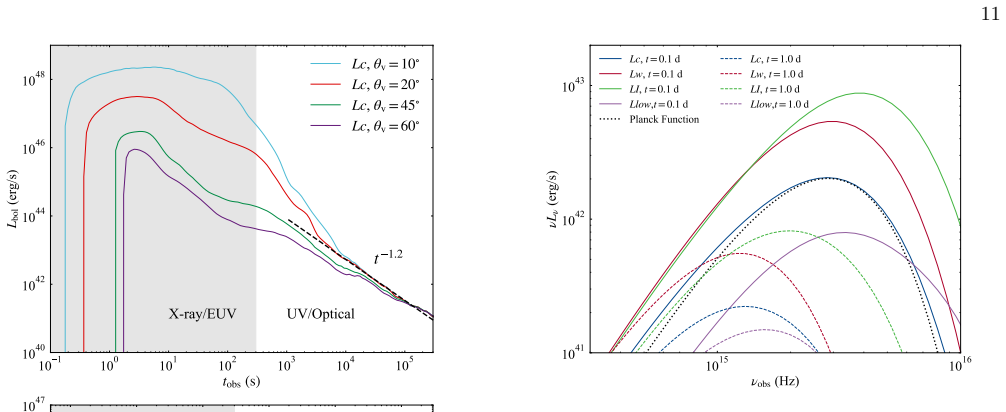
Off-axis cocoon cooling from long gamma-ray burst jets produces fast X-ray transients with luminosities of 10^47-48 erg/s.
A machine-rendered reading of the paper's core claim, the machinery that carries it, and where it could break.
Core claim
By simulating the long-term evolution of a relativistic jet inside its progenitor star up to the photon diffusion radius of the cocoon and post-processing the hydrodynamic results, the paper shows that for viewing angles of 10-20 degrees the cocoon produces X-ray emission with luminosity approximately 10^{47-48} erg s^{-1}, duration 10-100 s, and peak energy around 0.8 keV. These properties explain a fraction of observed fast X-ray transients, including their high luminosity, soft spectra, and absence of gamma-ray counterparts. The model further predicts a simultaneous early UV flash from the Rayleigh-Jeans tail and a bright optical plateau lasting roughly one day with temperature (1-3) x 10
What carries the argument
Hydrodynamic simulation of jet propagation through the star followed by post-processing to compute the cooling radiation from the expanding cocoon viewed at off-axis angles.
If this is right
- FXTs produced this way will show no detectable gamma-ray emission.
- Their X-ray spectra will be quasi-thermal with a peak near 0.8 keV.
- An early UV flash will appear simultaneously with the X-ray signal.
- A bright optical plateau with luminosity 10^{41-42} erg/s and temperature 1-3 x 10^4 K will follow for about one day.
- The model supplies diagnostics for distinguishing cocoon-origin FXTs from other possible sources.
Where Pith is reading between the lines
- The fraction of FXTs explained by this channel should roughly match the solid-angle fraction corresponding to 10-20 degree viewing angles.
- Multi-wavelength follow-up of FXTs could test for the predicted UV flash and optical plateau to confirm or rule out a cocoon origin.
- Differences in progenitor structure or jet power could account for the range of observed FXT durations and luminosities.
- This mechanism may reduce the need for entirely separate progenitor channels for some fraction of FXTs.
Load-bearing premise
The hydrodynamic simulation accurately captures the cocoon's energy distribution and expansion dynamics up to the photon diffusion radius without major numerical artifacts or missing effects such as magnetic fields.
What would settle it
A fast X-ray transient with the predicted luminosity and duration but a clearly non-thermal spectrum or a bright gamma-ray counterpart detected at the same time would falsify the model for that event.
Figures




read the original abstract
Fast X-ray transients (FXTs) have been detected for over a decade, yet their origins are still enigmatic. The observed association between FXTs and broad-lined Type Ic supernovae (SNe Ic-BL) suggests that some may share the same progenitor with Long Gamma-Ray Bursts. In this work, we numerically simulate the long-term evolution of a relativistic jet propagating from inside the progenitor star up to the photon diffusion radius of the cocoon. Then we post-process the hydrodynamic results and calculate the cocoon cooling emission for various viewing angles from the jet axis. We find that, for viewing angles $\theta_{\rm v}=10^{\circ}$-$20^{\circ}$, the off-axis cocoon emission can produce FXTs with luminosity $L_{\rm X}\simeq 10^{47-48} {\rm\, erg\,s^{-1}}$ and duration $t_{\rm X}\simeq 10$-$100\,$s. The observed spectra are quasi-thermal with the peak energy $E_{\rm peak}\simeq0.8$ keV. These properties naturally explain observational features of { a fraction of FXTs}, including their high luminosity, soft spectra, and lack of gamma-ray counterparts. The Rayleigh-Jeans tail of the FXT spectra extends to the UV, producing an early UV flash simultaneously. As the cocoon expands and cools, the emission peak shifts to UV and optical bands, resulting in a bright optical plateau lasting for $\sim1$ day with color temperature $T_{\rm UV/opt} \simeq (1{-}3)\times10^{4}\,$K and bolometric luminosity $L_{\rm bol}\simeq10^{41-42} {\rm\, erg\,s^{-1}}$, before the emergence of supernova emission. Although our model underpredicts the UV/optical luminosity at $\sim1$ day for some events (e.g. EP 240414a), it still provides useful diagnostics for identifying the origins of FXTs.
Editorial analysis
A structured set of objections, weighed in public.
Referee Report
Summary. The manuscript numerically simulates a relativistic jet propagating through a stellar progenitor to the cocoon's photon diffusion radius, then post-processes the hydrodynamic results to compute off-axis cooling emission. It claims that for viewing angles θ_v=10°-20°, this produces FXTs with L_X ≃ 10^{47-48} erg s^{-1}, t_X ≃ 10-100 s, and quasi-thermal spectra with E_peak ≃ 0.8 keV, explaining a fraction of observed FXTs (including lack of gamma-ray counterparts) while also predicting an early UV flash and a ~1-day optical plateau before supernova emergence.
Significance. If the hydrodynamical results hold, the work supplies a physically grounded, first-principles channel connecting some FXTs to long-GRB progenitors via off-axis cocoon emission, with falsifiable multi-wavelength predictions (UV tail, optical plateau luminosity and temperature). The absence of parameter tuning to match data is a strength.
major comments (3)
- [Hydrodynamic simulation] Hydrodynamic evolution section: the central claim for θ_v=10°-20° rests on the cocoon's angular energy distribution and expansion velocity at the photon diffusion radius. No resolution study, convergence test, or quantification of numerical diffusion is reported; without these, it is unclear whether the quoted L_X, t_X, and E_peak are robust or affected by artifacts in the long-term jet-cocoon run.
- [Post-processing and radiation calculation] Radiation post-processing: the quasi-thermal spectrum and E_peak ≃ 0.8 keV are obtained after post-processing, yet the manuscript provides no explicit description of the radiative transfer method, optical-depth calculation, or temperature profile extraction at off-axis angles. This step is load-bearing for the spectral claim and the Rayleigh-Jeans UV extension.
- [Discussion and comparison] Comparison with observations: the model underpredicts UV/optical luminosity at ~1 day for EP 240414a. A quantitative exploration of the allowed ranges in jet energy, opening angle, and progenitor density (listed as free parameters) is needed to determine whether the discrepancy can be resolved within the model's scope or indicates a limitation.
minor comments (2)
- [Abstract] Abstract: the phrase 'a fraction of FXTs' is used without defining the selection criteria or the fraction of the observed population that the model is intended to cover.
- [Throughout] Notation consistency: ensure θ_v and related angles are uniformly defined and labeled in all figures and text.
Simulated Author's Rebuttal
We thank the referee for the constructive and detailed review. The comments highlight important aspects of numerical robustness, methodological clarity, and observational comparison that will improve the manuscript. We address each major comment below and will incorporate revisions as indicated.
read point-by-point responses
-
Referee: [Hydrodynamic simulation] Hydrodynamic evolution section: the central claim for θ_v=10°-20° rests on the cocoon's angular energy distribution and expansion velocity at the photon diffusion radius. No resolution study, convergence test, or quantification of numerical diffusion is reported; without these, it is unclear whether the quoted L_X, t_X, and E_peak are robust or affected by artifacts in the long-term jet-cocoon run.
Authors: We agree that explicit convergence tests strengthen confidence in the hydrodynamic results. Our simulations follow the same numerical setup and resolution criteria validated in prior jet-propagation studies, where the cocoon energy distribution and velocity profiles were shown to converge. In the revised manuscript we will add a new subsection presenting resolution studies (factor of 2 lower and higher grid resolution) and a direct comparison of the angular energy distribution and expansion velocity at the photon diffusion radius, confirming convergence to within ~15% for the quantities used to compute L_X, t_X, and E_peak. We will also discuss the level of numerical diffusion by comparing the simulated cocoon width with analytic expectations. revision: yes
-
Referee: [Post-processing and radiation calculation] Radiation post-processing: the quasi-thermal spectrum and E_peak ≃ 0.8 keV are obtained after post-processing, yet the manuscript provides no explicit description of the radiative transfer method, optical-depth calculation, or temperature profile extraction at off-axis angles. This step is load-bearing for the spectral claim and the Rayleigh-Jeans UV extension.
Authors: We acknowledge that a clear description of the post-processing pipeline is necessary. The procedure extracts the density and temperature profiles from the hydrodynamic snapshot at the photon diffusion surface for each line of sight, computes the frequency-dependent optical depth by integrating the opacity along the ray, and constructs the emergent spectrum under the assumption of local thermodynamic equilibrium with a diluted blackbody. In the revised manuscript we will expand the methods section with the explicit equations for optical-depth integration, the criterion used to locate the diffusion surface, and the extraction of E_peak from the resulting spectrum, including how the Rayleigh-Jeans tail is obtained. revision: yes
-
Referee: [Discussion and comparison] Comparison with observations: the model underpredicts UV/optical luminosity at ~1 day for EP 240414a. A quantitative exploration of the allowed ranges in jet energy, opening angle, and progenitor density (listed as free parameters) is needed to determine whether the discrepancy can be resolved within the model's scope or indicates a limitation.
Authors: We appreciate the referee pointing out the specific comparison with EP 240414a. The manuscript already notes that the fiducial parameters underpredict the ~1-day optical luminosity and suggests that higher jet energy or denser progenitors can increase it. In the revised version we will add a quantitative parameter exploration (jet energy 10^52–10^53 erg, opening angle 5°–15°, progenitor density varied by a factor of 3) showing the resulting range of optical-plateau luminosities and temperatures. This study will demonstrate that the observed luminosity of EP 240414a lies within the model’s plausible parameter space while preserving the FXT X-ray properties, thereby clarifying the model’s scope rather than indicating a fundamental limitation. revision: yes
Circularity Check
No significant circularity: results from first-principles hydrodynamics and post-processing
full rationale
The paper's central claims follow from numerical integration of relativistic hydrodynamics for jet propagation through a stellar envelope, followed by post-processing to compute cocoon cooling emission at various viewing angles. No parameters are fitted to observed FXT luminosities, durations, or spectra; jet energy, progenitor structure, and viewing angles are selected from physically motivated ranges. The derivation chain (hydro equations → cocoon energy/angular distribution at diffusion radius → radiative transfer) is self-contained and does not reduce to a self-definition, fitted input renamed as prediction, or load-bearing self-citation. External benchmarks (observed FXT properties) are used only for comparison, not as inputs.
Axiom & Free-Parameter Ledger
free parameters (2)
- jet energy and opening angle
- progenitor density structure
axioms (2)
- standard math Relativistic hydrodynamics accurately describes the jet-cocoon interaction inside the star
- domain assumption Cocoon emission is dominated by photon diffusion cooling after breakout
Forward citations
Cited by 3 Pith papers
-
XRF 241001A/SN 2024aiiq: A Faint Soft X-ray Transient Detected by SVOM with a Broad-Line Type Ic Supernova Revealed by JWST
XRF 241001A is a low-luminosity collapsar event with a broad-line Type Ic supernova, supporting XRFs as the faint end of the long GRB population observed on-axis by a weak jet.
-
An extremely bright slow-rising afterglow from an off-axis jet in GRB 260310A
Multi-wavelength data on GRB 260310A support an off-axis jet model explaining weak prompt emission and bright delayed afterglow, including reverse-shock signatures and late X-ray rebrightening.
-
Magnetar Engines in Broad-lined Type Ic Supernovae and a Unified Picture for Magnetar-powered Stripped-envelope Supernovae
Broad-lined Type Ic supernovae are powered by magnetar engines, showing a universal ejecta-mass versus initial-spin correlation across stripped-envelope supernova types that supports a common progenitor framework.
Reference graph
Works this paper leans on
-
[1]
2020, ApJ, 896, 39, doi: 10.3847/1538-4357/ab91ba
Alp, D., & Larsson, J. 2020, ApJ, 896, 39, doi: 10.3847/1538-4357/ab91ba
-
[2]
Amati, L., Frontera, F., Tavani, M., et al. 2002, A&A, 390, 81, doi: 10.1051/0004-6361:20020722
-
[3]
E., Treister, E., Schawinski, K., et al
Bauer, F. E., Treister, E., Schawinski, K., et al. 2017, MNRAS, 467, 4841, doi: 10.1093/mnras/stx417
-
[4]
2020, MNRAS, 492, 2847, doi: 10.1093/mnras/staa070
Beniamini, P., Duque, R., Daigne, F., & Mochkovitch, R. 2020, MNRAS, 492, 2847, doi: 10.1093/mnras/staa070
-
[5]
Bright, J. S., Carotenuto, F., Fender, R., et al. 2025, ApJ, 981, 48, doi: 10.3847/1538-4357/adaaef
-
[6]
2011, ApJ, 740, 100, doi: 10.1088/0004-637X/740/2/100
Bromberg, O., Nakar, E., Piran, T., & Sari, R. 2011, ApJ, 740, 100, doi: 10.1088/0004-637X/740/2/100
-
[7]
Cenko, S. B., Frail, D. A., Harrison, F. A., et al. 2010, ApJ, 711, 641, doi: 10.1088/0004-637X/711/2/641 De Colle, F., Kumar, P., & Hoeflich, P. 2022, MNRAS, 512, 3627, doi: 10.1093/mnras/stac742 De Colle, F., Lu, W., Kumar, P., Ramirez-Ruiz, E., &
-
[8]
2018, MNRAS, 478, 4553, doi: 10.1093/mnras/sty1282
Smoot, G. 2018, MNRAS, 478, 4553, doi: 10.1093/mnras/sty1282
-
[9]
Fujibayashi, S., Sekiguchi, Y., Shibata, M., & Wanajo, S. 2023, ApJ, 956, 100, doi: 10.3847/1538-4357/acf5e5 16 /uni00000014/uni00000013/uni00000014 /uni00000014/uni00000013/uni00000013 r/R /uni00000014/uni00000013/uni00000019 /uni00000014/uni00000013/uni00000018 /uni00000014/uni00000013/uni00000017 /uni00000014/uni00000013/uni00000016 /uni00000014/uni000...
-
[10]
2004, title The Swift Gamma-Ray Burst Mission , , 611, 1005, 10.1086/422091
Gehrels, N., Chincarini, G., Giommi, P., et al. 2004, ApJ, 611, 1005, doi: 10.1086/422091
-
[11]
Pretorius, M. L. 2015, MNRAS, 450, 3765, doi: 10.1093/mnras/stv801
-
[12]
2025, , 992, L3, 10.3847/2041-8213/ae09af
Gottlieb, O. 2025, ApJL, 992, L3, doi: 10.3847/2041-8213/ae09af
-
[13]
Gottlieb, O., Bromberg, O., Singh, C. B., & Nakar, E. 2020, MNRAS, 498, 3320, doi: 10.1093/mnras/staa2567
-
[14]
2025, ApJL, 986, L4, doi: 10.3847/2041-8213/add99d
Hamidani, H., Sato, Y., Kashiyama, K., et al. 2025, ApJL, 986, L4, doi: 10.3847/2041-8213/add99d
-
[15]
2018, MNRAS, 477, 2128, doi: 10.1093/mnras/sty760
Harrison, R., Gottlieb, O., & Nakar, E. 2018, MNRAS, 477, 2128, doi: 10.1093/mnras/sty760
-
[16]
Hjorth, J., & Bloom, J. S. 2012, in Chapter 9 in ”Gamma-Ray Bursts, ed. C. Kouveliotou, R. A. M. J. Wijers, & S. Woosley (Cambridge University Press), 169–190, doi: 10.48550/arXiv.1104.2274 in ’t Zand, J. J. M., Guidorzi, C., Heise, J., et al. 2025, arXiv e-prints, arXiv:2512.16845, doi: 10.48550/arXiv.2512.16845
work page internal anchor Pith review Pith/arXiv arXiv doi:10.48550/arxiv.1104.2274 2012
-
[17]
2019, Nature, 565, 324, doi: 10.1038/s41586-018-0826-3
Izzo, L., de Ugarte Postigo, A., Maeda, K., et al. 2019, Nature, 565, 324, doi: 10.1038/s41586-018-0826-3
-
[18]
G., Glennie, A., Heida, M., et al
Jonker, P. G., Glennie, A., Heida, M., et al. 2013, ApJ, 779, 14, doi: 10.1088/0004-637X/779/1/14
-
[19]
2005, ApJ, 629, 341, doi: 10.1086/431354
Kohri, K., Narayan, R., & Piran, T. 2005, ApJ, 629, 341, doi: 10.1086/431354
-
[20]
2000, ApJL, 541, L51, doi: 10.1086/312905
Kumar, P., & Panaitescu, A. 2000, ApJL, 541, L51, doi: 10.1086/312905
-
[21]
Levan, A. J., Jonker, P. G., Saccardi, A., et al. 2024, arXiv e-prints, arXiv:2404.16350, doi: 10.48550/arXiv.2404.16350
-
[22]
Li, W. X., Zhu, Z. P., Zou, X. Z., et al. 2025, arXiv e-prints, arXiv:2504.17034, doi: 10.48550/arXiv.2504.17034
-
[23]
2025, Nature Astronomy, 9, 564, doi: 10.1038/s41550-024-02449-8
Liu, Y., Sun, H., Xu, D., et al. 2025, Nature Astronomy, 9, 564, doi: 10.1038/s41550-024-02449-8
-
[24]
Luo, B., Brandt, W. N., Xue, Y. Q., et al. 2017, ApJS, 228, 2, doi: 10.3847/1538-4365/228/1/2
-
[25]
2007, The Astrophysical Journal Supplement Series, 170, 228, doi: 10.1086/513316
Mignone, A., Bodo, G., Massaglia, S., et al. 2007, ApJS, 170, 228, doi: 10.1086/513316
-
[26]
2013, ApJ, 777, 162, doi: 10.1088/0004-637X/777/2/162
Mizuta, A., & Ioka, K. 2013, ApJ, 777, 162, doi: 10.1088/0004-637X/777/2/162
-
[27]
2015, , 807, 172, 10.1088/0004-637X/807/2/172
Nakar, E. 2015, ApJ, 807, 172, doi: 10.1088/0004-637X/807/2/172
-
[28]
2017, ApJ, 834, 28, doi: 10.3847/1538-4357/834/1/28
Nakar, E., & Piran, T. 2017, ApJ, 834, 28, doi: 10.3847/1538-4357/834/1/28 Pe’Er, A., & Ryde, F. 2017, International Journal of Modern Physics D, 26, 1730018, doi: 10.1142/S021827181730018X
-
[29]
Piro, A. L., & Kollmeier, J. A. 2018, ApJ, 855, 103, doi: 10.3847/1538-4357/aaaab3
-
[30]
J.] 10.3847/1538-4357/abf24d , 913, 60
Poolakkil, S., Preece, R., Fletcher, C., et al. 2021, ApJ, 913, 60, doi: 10.3847/1538-4357/abf24d Quirola-V´ asquez, J., Bauer, F. E., Jonker, P. G., et al. 2022, A&A, 663, A168, doi: 10.1051/0004-6361/202243047 Quirola-V´ asquez, J., Bauer, F. E., Jonker, P. G., et al. 2023, A&A, 675, A44, doi: 10.1051/0004-6361/202345912 17 Quirola-V´ asquez, J., Jonker...
-
[31]
Ramirez-Ruiz, E., Celotti, A., & Rees, M. J. 2002, MNRAS, 337, 1349, doi: 10.1046/j.1365-8711.2002.05995.x
-
[32]
Rastinejad, J. C., Levan, A. J., Jonker, P. G., et al. 2025, ApJL, 988, L13, doi: 10.3847/2041-8213/ade7f9
-
[33]
2025, PhRvD, 111, 123017, doi: 10.1103/msy2-fwhx
Shibata, M., Fujibayashi, S., Wanajo, S., et al. 2025, PhRvD, 111, 123017, doi: 10.1103/msy2-fwhx
-
[34]
2024, , 964, 74, 10.3847/1538-4357/ad2704
Shvartzvald, Y., Waxman, E., Gal-Yam, A., et al. 2024, ApJ, 964, 74, doi: 10.3847/1538-4357/ad2704
-
[35]
Singer, L. P., Criswell, A. W., Leggio, S. C., et al. 2025, PASP, 137, 074501, doi: 10.1088/1538-3873/adcfc6
-
[36]
Soderberg, A. M., Berger, E., Page, K. L., et al. 2008, Nature, 453, 469, doi: 10.1038/nature06997
-
[37]
Srivastav, S., Chen, T.-W., Gillanders, J. H., et al. 2025, ApJL, 978, L21, doi: 10.3847/2041-8213/ad9c75
-
[38]
2025, Nature Astronomy, 9, 1073, doi: 10.1038/s41550-025-02571-1
Sun, H., Li, W.-X., Liu, L.-D., et al. 2025, Nature Astronomy, 9, 1073, doi: 10.1038/s41550-025-02571-1 van Dalen, J. N. D., Levan, A. J., Jonker, P. G., et al. 2025, ApJL, 982, L47, doi: 10.3847/2041-8213/adbc7e
-
[39]
Annual Review of Astronomy and Astrophysics , author=
Woosley, S. E., & Bloom, J. S. 2006, ARA&A, 44, 507, doi: 10.1146/annurev.astro.43.072103.150558
-
[40]
Woosley, S. E., & Heger, A. 2006, ApJ, 637, 914, doi: 10.1086/498500
-
[41]
Xue, Y. Q., Zheng, X. C., Li, Y., et al. 2019, Nature, 568, 198, doi: 10.1038/s41586-019-1079-5
-
[42]
2025, arXiv e-prints, arXiv:2505.08781, 10.48550/arXiv.2505.08781
Yadav, M., Troja, E., Ricci, R., et al. 2025, arXiv e-prints, arXiv:2505.08781, doi: 10.48550/arXiv.2505.08781
-
[43]
Yang, G., Brandt, W. N., Zhu, S. F., et al. 2019, MNRAS, 487, 4721, doi: 10.1093/mnras/stz1605
-
[44]
I., Zhang, B.-B., Yang, J., et al
Yin, Y.-H. I., Zhang, B.-B., Yang, J., et al. 2024, ApJL, 975, L27, doi: 10.3847/2041-8213/ad8652
-
[45]
2023, Low-Mass X-ray Binaries, doi: 10.1007/978-981-16-4544-0 94-1
Yuan, W., Zhang, C., Chen, Y., & Ling, Z. 2022, in Handbook of X-ray and Gamma-ray Astrophysics, ed. C. Bambi & A. Sangangelo (Springer), 86, doi: 10.1007/978-981-16-4544-0 151-1
-
[46]
Zhang, W., Woosley, S. E., & MacFadyen, A. I. 2003, ApJ, 586, 356, doi: 10.1086/367609
-
[47]
2025, ApJL, 987, L38, doi: 10.3847/2041-8213/ade0aa
Zhang, Y.-Q., Xue, W.-C., Zhang, J.-P., et al. 2025, ApJL, 987, L38, doi: 10.3847/2041-8213/ade0aa
-
[48]
2025, ApJ, 985, 21, doi: 10.3847/1538-4357/adc993
Zheng, J.-H., Zhu, J.-P., Lu, W., & Zhang, B. 2025, ApJ, 985, 21, doi: 10.3847/1538-4357/adc993
-
[49]
2025, MNRAS, 544, L139, doi: 10.1093/mnrasl/slaf114
Zhu, J.-P., Zheng, J.-H., & Zhang, B. 2025, MNRAS, 544, L139, doi: 10.1093/mnrasl/slaf114
discussion (0)
Sign in with ORCID, Apple, or X to comment. Anyone can read and Pith papers without signing in.