Recognition: unknown
Magnetar Engines in Broad-lined Type Ic Supernovae and a Unified Picture for Magnetar-powered Stripped-envelope Supernovae
Pith reviewed 2026-05-09 20:35 UTC · model grok-4.3
The pith
All broad-lined Type Ic supernovae lightcurves are consistent with magnetar spin-down plus nickel decay, supporting a single progenitor framework for stripped-envelope events.
A machine-rendered reading of the paper's core claim, the machinery that carries it, and where it could break.
Core claim
The multi-band lightcurves of 80 broad-lined Type Ic supernovae are all consistent with a magnetar central engine plus 56Ni decay, yielding high-quality fits across the sample with median parameters P_i approximately 2.04 ms, B_p approximately 3.96 times 10^15 G, M_ej approximately 2.30 solar masses, and M_Ni approximately 0.18 solar masses. Strong correlations exist between M_ej and P_i (anti-correlation) and between M_Ni and M_ej (positive correlation). The GRB-associated subsample shows no significant parameter differences from the non-GRB subsample, though it is slightly brighter. SNe Ic-BL share similar nickel and ejecta masses with ordinary SNe Ic, while a universal M_ej-P_i relation,
What carries the argument
Magnetar spin-down luminosity combined with 56Ni radioactive decay, which supplies the energy for the lightcurves and produces the observed parameter correlations.
If this is right
- Every event in the 80-SN sample yields a high-quality fit under the magnetar plus nickel model.
- No statistically significant parameter differences separate the GRB-associated and non-GRB SNe Ic-BL subsamples.
- A universal anti-correlation between ejecta mass and initial spin period holds across all magnetar-powered stripped-envelope supernovae.
- SNe Ic-BL magnetars rotate faster and possess stronger fields than those inferred for superluminous Type Ic events.
- A single physical classification scheme can encompass both magnetar-powered and ordinary stripped-envelope supernovae through differences in progenitor rotation and magnetic field.
Where Pith is reading between the lines
- Ordinary SNe Ic may arise from the same progenitors as SNe Ic-BL but without a rapidly rotating, strongly magnetized neutron star remnant.
- Binary population synthesis calculations can now be tested against the observed distribution of ejecta masses and spin periods to predict the fraction of events that produce magnetars.
- Fast blue optical transients with ejecta masses above 0.5 solar masses would occupy the same parameter space as SNe Ic-BL and should be searched for in current and future surveys.
Load-bearing premise
The observed lightcurves are powered solely by magnetar spin-down and nickel decay with no significant contribution from other energy sources or viewing-angle effects.
What would settle it
Discovery of even one broad-lined Type Ic supernova whose multi-band lightcurve cannot be reproduced by any combination of magnetar period, magnetic field strength, ejecta mass, and nickel mass.
Figures


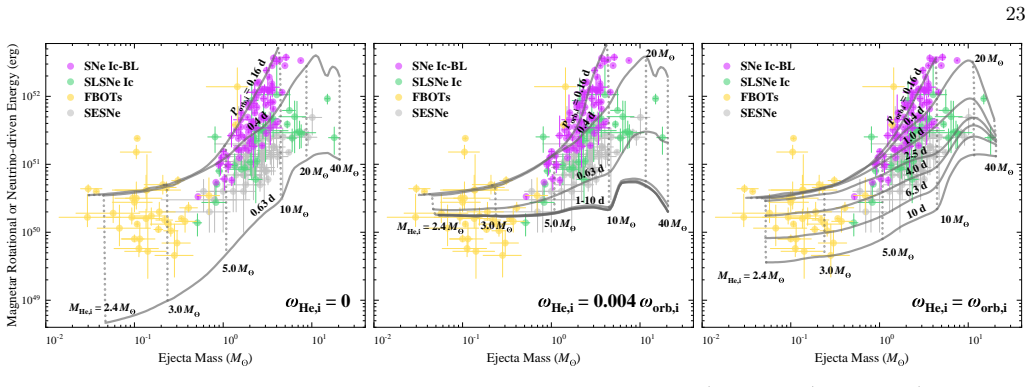

read the original abstract
We model the multi-band lightcurves of 80 SNe Ic-BL, including 11 associated with lGRBs, using a magnetar engine model with $^{56}$Ni decay. We find that the data are all consistent with a magnetar central engine, and such a model yields high-quality fits across the sample. The medians with $1\sigma$ regions of the key parameters are $P_{\rm{i}}\sim2.04^{+1.84}_{-0.96}\,{\rm{ms}}$, $B_{\rm{p}}\sim3.96^{+3.28}_{-1.40}\times10^{15}\,{\rm{G}}$, $M_{\rm{ej}}\sim2.30^{+1.48}_{-1.02}\,M_\odot$, and $M_{\rm{Ni}}\sim0.18^{+0.14}_{-0.09}\,M_\odot$, with strong and statistically significant correlations observed for both $M_{\rm{ej}}-P_{\rm{i}}$ (anti-correlation) and $M_{\rm{Ni}}-M_{\rm{ej}}$ (correlation). Comparing the SN Ic-BL samples with and without lGRB association using fitting parameters, we find no significant difference between them, although the GRB-associated sample is slightly brighter, possibly due to an observational bias. Relative to ordinary SNe Ic, SNe Ic-BL have similar $^{56}$Ni and ejecta masses, suggesting comparable pre-SN progenitor properties, with differences possibly arising from the presence of a magnetar engine. In comparison with other possible magnetar-powered SESNe, including SLSNe Ic and FBOTs, we confirm a strong universal $M_{\rm{ej}}-P_{\rm{i}}$ correlation, indicating a common origin. SNe Ic-BL and SLSNe Ic have similar ejecta mass distributions, typically $M_{\rm ej}\gtrsim0.5\,M_\odot$, while FBOTs mostly lie below this value. Differences between SNe Ic-BL and SLSNe Ic may arise from magnetar properties, with SN Ic-BL magnetars rotating faster and having stronger fields. Moreover, the $P_{\rm{i}}-B_{\rm{p}}$ distribution of lGRB magnetars largely overlaps with that of SN Ic-BL magnetars. In connection with binary simulation results, we propose a unified physical classification and progenitor framework for magnetar-powered and ordinary SESNe.
Editorial analysis
A structured set of objections, weighed in public.
Referee Report
Summary. The manuscript models the multi-band lightcurves of 80 SNe Ic-BL (including 11 lGRB-associated events) with a semi-analytic magnetar spin-down plus 56Ni decay model. It reports that all events yield high-quality fits, with median parameters Pi ≈ 2.04 ms, Bp ≈ 3.96×10^15 G, Mej ≈ 2.30 M⊙, MNi ≈ 0.18 M⊙, statistically significant Mej-Pi anti-correlation and MNi-Mej correlation, no significant parameter differences between GRB and non-GRB subsamples, and a unified progenitor framework for magnetar-powered SESNe by comparison to SLSNe Ic and FBOTs.
Significance. If the parameter inferences are robust to degeneracies, this would be a significant contribution to understanding stripped-envelope supernovae, providing evidence that magnetar engines operate across SNe Ic-BL and linking them to SLSNe and FBOTs via a common Mej-Pi relation and binary progenitor channels. The large sample size, multi-band coverage, and cross-class comparisons are strengths that could guide future progenitor modeling and observations.
major comments (3)
- [§3] §3 (fitting procedure): The four parameters (Pi, Bp, Mej, MNi) are fitted directly to each lightcurve, yet no covariance matrices, corner plots, or degeneracy analysis are presented. Because rise time and peak luminosity constrain combinations of spin-down timescale and diffusion time, the reported Mej-Pi anti-correlation may be partly induced by parameter trade-offs rather than independent physics; this is load-bearing for the unified classification and the claim that all data are consistent with a magnetar engine.
- [§4.2] §4.2 (correlations and sample comparisons): The abstract and results state 'strong and statistically significant correlations' for Mej-Pi and MNi-Mej, but supply neither correlation coefficients with uncertainties nor quantitative tests (e.g., Spearman rank with p-values or bootstrap errors). Without these, and absent model-comparison metrics such as AIC/BIC against pure-Ni or CSM-interaction models, the evidence for a universal framework and lack of difference between GRB and non-GRB samples rests on an insecure statistical foundation.
- [§5] §5 (unified framework): The placement of Ic-BL relative to SLSNe Ic and FBOTs, and the conclusion of similar progenitor properties to ordinary SNe Ic, relies on the fitted parameter distributions. No Kolmogorov-Smirnov tests, selection-bias corrections, or discussion of possible viewing-angle effects in lGRB events are provided, weakening the load-bearing claim of a common origin.
minor comments (2)
- The 1σ intervals on median parameters are reported without specifying whether they derive from MCMC posteriors, grid searches, or bootstrap resampling; this notation should be clarified in the methods.
- Figure captions and axis labels for lightcurve fits would benefit from explicit residual panels and consistent band labeling to improve clarity of the 'high-quality fits' claim.
Simulated Author's Rebuttal
We thank the referee for the constructive and detailed comments, which have helped improve the statistical rigor and clarity of our analysis. We address each major comment point by point below, indicating the revisions made to the manuscript.
read point-by-point responses
-
Referee: [§3] §3 (fitting procedure): The four parameters (Pi, Bp, Mej, MNi) are fitted directly to each lightcurve, yet no covariance matrices, corner plots, or degeneracy analysis are presented. Because rise time and peak luminosity constrain combinations of spin-down timescale and diffusion time, the reported Mej-Pi anti-correlation may be partly induced by parameter trade-offs rather than independent physics; this is load-bearing for the unified classification and the claim that all data are consistent with a magnetar engine.
Authors: We acknowledge the importance of assessing parameter degeneracies, as the spin-down timescale and diffusion timescale (dependent on Mej) can trade off in shaping the light-curve rise and peak. In the revised manuscript we have added a dedicated discussion of these degeneracies in §3, including physical arguments from binary progenitor models that independently predict an Mej-Pi anti-correlation. We have also included representative corner plots and covariance summaries for a subset of events in a new appendix to illustrate the posterior distributions and convergence. Full degeneracy mapping for all 80 events remains computationally demanding, but we performed additional robustness checks by refitting with varied initial conditions and confirmed that the reported correlation persists. revision: partial
-
Referee: [§4.2] §4.2 (correlations and sample comparisons): The abstract and results state 'strong and statistically significant correlations' for Mej-Pi and MNi-Mej, but supply neither correlation coefficients with uncertainties nor quantitative tests (e.g., Spearman rank with p-values or bootstrap errors). Without these, and absent model-comparison metrics such as AIC/BIC against pure-Ni or CSM-interaction models, the evidence for a universal framework and lack of difference between GRB and non-GRB samples rests on an insecure statistical foundation.
Authors: We agree that quantitative statistical measures strengthen the claims. The revised manuscript now reports Spearman rank correlation coefficients together with p-values and bootstrap-derived uncertainties for both the Mej-Pi anti-correlation and the MNi-Mej correlation. We have also added two-sample Kolmogorov-Smirnov tests comparing the parameter distributions of the GRB-associated and non-GRB subsamples, confirming the lack of significant differences. For model comparison we include a direct chi-squared comparison between the magnetar-plus-Ni model and a pure-Ni model, showing the former is statistically preferred for the large majority of events. A complete AIC/BIC analysis against all alternative models for every event would require substantial additional modeling and is identified as future work. revision: partial
-
Referee: [§5] §5 (unified framework): The placement of Ic-BL relative to SLSNe Ic and FBOTs, and the conclusion of similar progenitor properties to ordinary SNe Ic, relies on the fitted parameter distributions. No Kolmogorov-Smirnov tests, selection-bias corrections, or discussion of possible viewing-angle effects in lGRB events are provided, weakening the load-bearing claim of a common origin.
Authors: We have revised §5 to include Kolmogorov-Smirnov tests that quantitatively compare the Mej and Pi distributions across SNe Ic-BL, SLSNe Ic, and FBOTs, reinforcing the reported similarities and differences. We have expanded the text to discuss observational selection biases, noting that while the sample favors brighter events the universal Mej-Pi trend remains consistent across classes. A new paragraph addresses viewing-angle effects for lGRB events, explaining that the derived magnetar parameters for on-axis lGRBs overlap with the broader Ic-BL population, suggesting orientation does not strongly bias the engine properties. Full population-synthesis-based selection-bias corrections lie beyond the present scope but are now flagged as a valuable direction for follow-up studies. revision: yes
Circularity Check
No significant circularity; parameter correlations derived from data fits, not by construction
full rationale
The paper applies a magnetar spin-down plus 56Ni decay model to fit multi-band lightcurves of 80 observed SNe Ic-BL events. Key parameters (Pi, Bp, Mej, MNi) are obtained via fitting to external photometric data, and the reported Mej-Pi anti-correlation and MNi-Mej correlation are statistical features of the resulting posterior distributions across the sample. The unified progenitor framework is an interpretive synthesis of these data-derived parameters compared against other SESN classes and binary simulations. No equation or step reduces the central claims (consistency with magnetar engine, lack of difference between GRB-associated and non-GRB samples, or unified classification) to the inputs by definition, self-citation, or renaming. The derivation chain remains self-contained against the observational inputs and does not invoke load-bearing self-citations or ansatzes from prior author work.
Axiom & Free-Parameter Ledger
free parameters (4)
- Initial spin period Pi
- Surface magnetic field Bp
- Ejecta mass Mej
- Nickel mass MNi
axioms (2)
- domain assumption Magnetar rotational energy is injected via magnetic dipole radiation with standard braking index of 3.
- domain assumption Observed lightcurves are produced only by magnetar energy plus 56Ni decay with no other power sources.
Forward citations
Cited by 1 Pith paper
-
The jet-shaped pipe morphology in planetary nebulae and core-collapse supernova remnants
Morphological similarity between pipe structures in planetary nebulae and supernova remnants, plus a jet simulation, indicates that jittering jets shaped both.
Reference graph
Works this paper leans on
-
[1]
Afsariardchi, N., Drout, M. R., Khatami, D. K., et al. 2021, ApJ, 918, 89, doi: 10.3847/1538-4357/ac0aeb
-
[2]
2018, ApJ, 858, 115, doi: 10.3847/1538-4357/aabfc1
Schootemeijer, A. 2018, ApJ, 858, 115, doi: 10.3847/1538-4357/aabfc1
-
[3]
R., M¨ uller, B., Antoniadis, J., et al
Aguilera-Dena, D. R., M¨ uller, B., Antoniadis, J., et al. 2023, A&A, 671, A134, doi: 10.1051/0004-6361/202243519
-
[4]
2024, ApJ, 962, 68, doi: 10.3847/1538-4357/ad11df
Anand, S., Barnes, J., Yang, S., et al. 2024, ApJ, 962, 68, doi: 10.3847/1538-4357/ad11df
-
[5]
1996, Supernovae and Nucleosynthesis: An Investigation of the History of Matter from the Big Bang to the Present (Princeton: Princeton University Press)
Arnett, D. 1996, Supernovae and Nucleosynthesis: An Investigation of the History of Matter from the Big Bang to the Present (Princeton: Princeton University Press)
1996
-
[6]
Arnett, W. D. 1982, ApJ, 253, 785, doi: 10.1086/159681
-
[7]
Barkov, M. V., & Komissarov, S. S. 2008, MNRAS, 385, L28, doi: 10.1111/j.1745-3933.2008.00427.x
-
[8]
S., Fragos, T., Zevin, M., et al
Bavera, S. S., Fragos, T., Zapartas, E., et al. 2022, A&A, 657, L8, doi: 10.1051/0004-6361/202141979
-
[9]
Bethe, H. A., & Wilson, J. R. 1985, ApJ, 295, 14, doi: 10.1086/163343
-
[10]
K., Berger , E., Nicholl , M., & Villar , V
Blanchard, P. K., Berger, E., Nicholl, M., & Villar, V. A. 2020, ApJ, 897, 114, doi: 10.3847/1538-4357/ab9638
-
[11]
Blandford, R. D., & Znajek, R. L. 1977, MNRAS, 179, 433, doi: 10.1093/mnras/179.3.433
-
[12]
Bogomazov, A. I., & Popov, S. B. 2009, Astronomy Reports, 53, 325, doi: 10.1134/S1063772909040052
-
[13]
Bright, J. S., Carotenuto, F., Fender, R., et al. 2025, ApJ, 981, 48, doi: 10.3847/1538-4357/adaaef
-
[14]
2014, MNRAS, 443, 1532, doi: 10.1093/mnras/stu995
Bromberg, O., Granot, J., Lyubarsky, Y., & Piran, T. 2014, MNRAS, 443, 1532, doi: 10.1093/mnras/stu995
-
[15]
Campana, S., Mangano, V., Blustin, A. J., et al. 2006, Nature, 442, 1008, doi: 10.1038/nature04892
-
[16]
Cano, Z., Johansson Andreas, K. G., & Maeda, K. 2016, MNRAS, 457, 2761, doi: 10.1093/mnras/stw122
-
[17]
2011, ApJ, 740, 41, doi: 10.1088/0004-637X/740/1/41
Cano, Z., Bersier, D., Guidorzi, C., et al. 2011, ApJ, 740, 41, doi: 10.1088/0004-637X/740/1/41
-
[18]
2015, MNRAS, 452, 1535, doi: 10.1093/mnras/stv1327
Cano, Z., de Ugarte Postigo, A., Perley, D., et al. 2015, MNRAS, 452, 1535, doi: 10.1093/mnras/stv1327
-
[19]
2017, A&A, 605, A107, doi: 10.1051/0004-6361/201731005
Cano, Z., Izzo, L., de Ugarte Postigo, A., et al. 2017, A&A, 605, A107, doi: 10.1051/0004-6361/201731005
-
[20]
Cantiello, M., Yoon, S. C., Langer, N., & Livio, M. 2007, A&A, 465, L29, doi: 10.1051/0004-6361:20077115
-
[21]
Cao, Y., Kasliwal, M. M., Arcavi, I., et al. 2013, ApJL, 775, L7, doi: 10.1088/2041-8205/775/1/L7
-
[22]
Cardelli, J. A., Clayton, G. C., & Mathis, J. S. 1989, ApJ, 345, 245, doi: 10.1086/167900
-
[23]
Chatzopoulos, E., Wheeler, J. C., & Vinko, J. 2012, ApJ, 746, 121, doi: 10.1088/0004-637X/746/2/121
-
[24]
Chatzopoulos, E., Wheeler, J. C., Vinko, J., Horvath, Z. L., & Nagy, A. 2013, ApJ, 773, 76, doi: 10.1088/0004-637X/773/1/76
-
[25]
2024, Nature, 625, 253, doi: 10.1038/s41586-023-06787-x
Chen, P., Gal-Yam, A., Sollerman, J., et al. 2024, Nature, 625, 253, doi: 10.1038/s41586-023-06787-x
-
[26]
H., Yan, L., Kangas, T., et al
Chen, Z. H., Yan, L., Kangas, T., et al. 2023, ApJ, 943, 42, doi: 10.3847/1538-4357/aca162
-
[27]
, archivePrefix = "arXiv", eprint =
Chevalier, R. A., & Irwin, C. M. 2011, ApJL, 729, L6, doi: 10.1088/2041-8205/729/1/L6
-
[28]
Chevalier, R. A., & Soker, N. 1989, ApJ, 341, 867, doi: 10.1086/167545
-
[29]
Chrimes, A. A., Stanway, E. R., & Eldridge, J. J. 2020, MNRAS, 491, 3479, doi: 10.1093/mnras/stz3246
-
[30]
Clocchiatti, A., Suntzeff, N. B., Covarrubias, R., & Candia, P. 2011, AJ, 141, 163, doi: 10.1088/0004-6256/141/5/163
-
[31]
Colgate, S. A., & McKee, C. 1969, ApJ, 157, 623, doi: 10.1086/150102
-
[32]
Corsi, A., Ofek, E. O., Frail, D. A., et al. 2011, ApJ, 741, 76, doi: 10.1088/0004-637X/741/2/76
-
[33]
Dai, Z. G., & Lu, T. 1998, A&A, 333, L87, doi: 10.48550/arXiv.astro-ph/9810402
work page internal anchor Pith review doi:10.48550/arxiv.astro-ph/9810402 1998
-
[34]
Dai, Z. G., Wang, S. Q., Wang, J. S., Wang, L. J., & Yu, Y. W. 2016, ApJ, 817, 132, doi: 10.3847/0004-637X/817/2/132
-
[35]
G., De Simone, B., Mohideen Malik, R
Dainotti, M. G., De Simone, B., Mohideen Malik, R. F., et al. 2024, MNRAS, 533, 4023, doi: 10.1093/mnras/stae1484 de Mink, S. E., Langer, N., Izzard, R. G., Sana, H., & de
-
[36]
2013, ApJ, 764, 166, doi: 10.1088/0004-637X/764/2/166
Koter, A. 2013, ApJ, 764, 166, doi: 10.1088/0004-637X/764/2/166
-
[37]
2005, ApJ, 624, 898, doi: 10.1086/429284
Nomoto, K. 2005, ApJ, 624, 898, doi: 10.1086/429284
-
[38]
Dessart, L., Yoon, S.-C., Aguilera-Dena, D. R., & Langer, N. 2020, A&A, 642, A106, doi: 10.1051/0004-6361/202038763
-
[39]
G., Langer, N., Podsiadlowski, P., & Izzard, R
Detmers, R. G., Langer, N., Podsiadlowski, P., & Izzard, R. G. 2008, A&A, 484, 831, doi: 10.1051/0004-6361:200809371
-
[40]
2023, ApJ, 951, 61, doi: 10.3847/1538-4357/acd848
Dong, X.-F., Liu, L.-D., Gao, H., & Yang, S. 2023, ApJ, 951, 61, doi: 10.3847/1538-4357/acd848
-
[41]
R., Chornock, R., Soderberg, A
Drout, M. R., Chornock, R., Soderberg, A. M., et al. 2014, ApJ, 794, 23, doi: 10.1088/0004-637X/794/1/23
-
[42]
Eiden, K., & Kasen, D. 2025, arXiv e-prints, arXiv:2510.13741, doi: 10.48550/arXiv.2510.13741
work page internal anchor Pith review Pith/arXiv arXiv doi:10.48550/arxiv.2510.13741 2025
-
[43]
Crockett, R. M. 2013, MNRAS, 436, 774, doi: 10.1093/mnras/stt1612
-
[44]
Eldridge, J. J., Langer, N., & Tout, C. A. 2011, MNRAS, 414, 3501, doi: 10.1111/j.1365-2966.2011.18650.x 36
-
[45]
Ertl, T., Woosley, S. E., Sukhbold, T., & Janka, H. T. 2020, ApJ, 890, 51, doi: 10.3847/1538-4357/ab6458
-
[46]
Eyles-Ferris, R. A. J., Jonker, P. G., Levan, A. J., et al. 2025, ApJL, 988, L14, doi: 10.3847/2041-8213/ade1d9
-
[47]
2019, Nature Astronomy, 3, 434, doi: 10.1038/s41550-019-0710-6
Gal-Yam, A. 2019, Nature Astronomy, 3, 434, doi: 10.1038/s41550-019-0710-6
-
[48]
Filippenko, A. V. 1997, ARA&A, 35, 309, doi: 10.1146/annurev.astro.35.1.309
-
[49]
2025, A&A, 700, A200, doi: 10.1051/0004-6361/202453047
Finneran, G., Cotter, L., & Martin-Carrillo, A. 2025, A&A, 700, A200, doi: 10.1051/0004-6361/202453047
-
[50]
Foley, R. J., Papenkova, M. S., Swift, B. J., et al. 2003, PASP, 115, 1220, doi: 10.1086/378242
-
[51]
Foreman-Mackey, D., Hogg, D. W., Lang, D., & Goodman, J. 2013, PASP, 125, 306, doi: 10.1086/670067
-
[52]
Fox, O. D., Van Dyk, S. D., Williams, B. F., et al. 2022, ApJL, 929, L15, doi: 10.3847/2041-8213/ac5890
-
[53]
Fryer, C. L., & Heger, A. 2005, ApJ, 623, 302, doi: 10.1086/428379
-
[54]
2022, MNRAS, 511, 3951, doi: 10.1093/mnras/stac317
Fuller, J., & Lu, W. 2022, MNRAS, 511, 3951, doi: 10.1093/mnras/stac317
-
[55]
Fuller, J., Piro, A. L., & Jermyn, A. S. 2019, MNRAS, 485, 3661, doi: 10.1093/mnras/stz514
-
[56]
2012, Science, 337, 927, 10.1126/science.1203601
Gal-Yam, A. 2012, Science, 337, 927, doi: 10.1126/science.1203601
-
[57]
2019, ARA&A, 57, 305, doi: 10.1146/annurev-astro-081817-051819
Gal-Yam, A. 2019, ARA&A, 57, 305, doi: 10.1146/annurev-astro-081817-051819
-
[58]
Galama, T. J., Vreeswijk, P. M., van Paradijs, J., et al. 1998, Nature, 395, 670, doi: 10.1038/27150
-
[59]
Gangopadhyay, A., Misra, K., Sahu, D. K., et al. 2020, MNRAS, 497, 3770, doi: 10.1093/mnras/staa1821
-
[60]
2013, MNRAS, 428, 1410, doi: 10.1093/mnras/sts128
Ghirlanda, G., Ghisellini, G., Salvaterra, R., et al. 2013, MNRAS, 428, 1410, doi: 10.1093/mnras/sts128
-
[61]
Ghodla, S., Eldridge, J. J., Stanway, E. R., & Stevance, H. F. 2023, MNRAS, 518, 860, doi: 10.1093/mnras/stac3177
-
[62]
2021, ApJ, 913, 143, doi: 10.3847/1538-4357/abf5e3
Gomez, S., Berger, E., Hosseinzadeh, G., et al. 2021, ApJ, 913, 143, doi: 10.3847/1538-4357/abf5e3
-
[63]
2024, ApJL, 976, L13, doi: 10.3847/2041-8213/ad8563
Cantiello, M. 2024, ApJL, 976, L13, doi: 10.3847/2041-8213/ad8563
-
[64]
Greiner, J., Mazzali, P. A., Kann, D. A., et al. 2015, Nature, 523, 189, doi: 10.1038/nature14579
-
[65]
2007, The Astrophysical Journal, 657, L73, doi: 10.1086/511417
Guetta, D., & Della Valle, M. 2007, ApJL, 657, L73, doi: 10.1086/511417
-
[66]
Haensel, P., Zdunik, J. L., Bejger, M., & Lattimer, J. M. 2009, A&A, 502, 605, doi: 10.1051/0004-6361/200811605
-
[67]
2025a, ApJ, 988, 30, doi: 10.3847/1538-4357/addd13
Hamidani, H., Ioka, K., Kashiyama, K., & Tanaka, M. 2025a, ApJ, 988, 30, doi: 10.3847/1538-4357/addd13
-
[68]
2025b, ApJL, 986, L4, doi: 10.3847/2041-8213/add99d
Hamidani, H., Sato, Y., Kashiyama, K., et al. 2025b, ApJL, 986, L4, doi: 10.3847/2041-8213/add99d
-
[69]
2025, ApJ, 995, 55, doi: 10.3847/1538-4357/ae172e
Hirai, R., Podsiadlowski, P., Hoeflich, P., et al. 2025, ApJ, 995, 55, doi: 10.3847/1538-4357/ae172e
-
[70]
Hjorth,et al., A very energetic supernova associated with the𝛾-ray burst of 29 March 2003
Hjorth, J., Sollerman, J., Møller, P., et al. 2003, Nature, 423, 847, doi: 10.1038/nature01750
-
[71]
Ho, A. Y. Q., Kulkarni, S. R., Perley, D. A., et al. 2020, ApJ, 902, 86, doi: 10.3847/1538-4357/aba630
-
[72]
Hosseinzadeh, G., Berger, E., Metzger, B. D., et al. 2022, ApJ, 933, 14, doi: 10.3847/1538-4357/ac67dd
-
[73]
2026, ApJ, 999, 102, doi: 10.3847/1538-4357/ae3fa3
Hu, R.-C., & Zhang, B. 2026, ApJ, 999, 102, doi: 10.3847/1538-4357/ae3fa3
-
[74]
2023, arXiv e-prints, arXiv:2301.06402, doi: 10.48550/arXiv.2301.06402
Hu, R.-C., Zhu, J.-P., Qin, Y., et al. 2023, arXiv e-prints, arXiv:2301.06402, doi: 10.48550/arXiv.2301.06402
-
[75]
2019, Nature Astronomy, 3, 697, doi: 10.1038/s41550-019-0854-4
Inserra, C. 2019, Nature Astronomy, 3, 697, doi: 10.1038/s41550-019-0854-4
-
[76]
Inserra, C., Smartt, S. J., Jerkstrand, A., et al. 2013, ApJ, 770, 128, doi: 10.1088/0004-637X/770/2/128
-
[77]
Iwamoto, K., Mazzali, P. A., Nomoto, K., et al. 1998, Nature, 395, 672, doi: 10.1038/27155
-
[78]
2004, MNRAS, 351, 1379, doi: 10.1111/j.1365-2966.2004.07876.x
Izzard, R. G., Ramirez-Ruiz, E., & Tout, C. A. 2004, MNRAS, 348, 1215, doi: 10.1111/j.1365-2966.2004.07436.x
-
[79]
2020, A&A, 639, L11, doi: 10.1051/0004-6361/202038152
Izzo, L., Auchettl, K., Hjorth, J., et al. 2020, A&A, 639, L11, doi: 10.1051/0004-6361/202038152
-
[80]
Izzo, L., de Ugarte Postigo, A., Maeda, K., et al. 2019, Nature, 565, 324, doi: 10.1038/s41586-018-0826-3
discussion (0)
Sign in with ORCID, Apple, or X to comment. Anyone can read and Pith papers without signing in.