REVIEW 3 major objections 6 minor 31 references
Ambipolar diffusion reshapes Rayleigh–Taylor mixing by redistributing gravity-driven energy between magnetic tension and ion–neutral drift, not by simply rescaling classical growth rates.
Reviewed by Pith at T0; open to challenge. T0 means a machine referee read the full paper against a public rubric. the ladder, T0–T4 →
T0 review · grok-4.5
2026-07-14 23:30 UTC pith:LJUKTKAW
load-bearing objection Solid controlled two-fluid RT survey with clean linear validation and a real nonlinear message; the gn=0 idealization is load-bearing and untested, so treat the IC morphology/drag peak as setup-specific until checked. the 3 major comments →
The Rayleigh Taylor instability in partially ionized plasmas: ambipolar diffusion effects in the non linear phase
The pith
A machine-rendered reading of the paper's core claim, the machinery that carries it, and where it could break.
Core claim
Ambipolar diffusion does not merely rescale Rayleigh–Taylor growth rates; it reshapes the nonlinear, multi-scale dynamics by altering how gravity-driven kinetic energy is redistributed through magnetic tension and ion–neutral drift. In multi-wavelength magnetized runs the smoothest interface morphologies occur at intermediate coupling, where drag dissipation peaks and large-scale coalescence is reorganized rather than simply suppressed.
What carries the argument
Morphology-based synchronization at fixed normalized mixing height h/λ (or Δh/Lx), combined with a minimal two-fluid slip model that yields an analytic mixing-height law containing both quadratic and transient linear terms, and global energy pathways that partition gravitational injection between ion–neutral drag dissipation and magnetic work.
Load-bearing premise
Gravity is applied only to the charged fluid; neutrals feel gravity solely through collisions. If both species felt gravity directly, the slip velocity, the peak in drag dissipation, and the non-monotonic morphology ordering could change.
What would settle it
Repeat the multi-wavelength magnetized suite with gravity applied to both fluids (or with a controlled gravity ratio gn/gc) and check whether the intermediate-coupling regime still produces the smoothest interface and the maximum drag-to-gravitational energy conversion at fixed Δh/Lx.
If this is right
- Classical quadratic mixing-layer scalings cannot be used as-is in partially ionized media; growth laws become coupling- and time-dependent.
- Intermediate ion–neutral coupling is the regime of strongest morphological departure from both pure hydrodynamics and ideal MHD.
- Magnetic tension still suppresses small-scale corrugations, but ambipolar drift weakens that constraint by allowing partial decoupling, producing non-monotonic smoothness with coupling strength.
- Energy diagnostics that track gravitational injection versus drag dissipation provide a clearer physical ranking of regimes than density power spectra alone.
- Any model of mixing or structure formation in the cold neutral medium or similar environments must treat ambipolar diffusion as a dynamical participant, not a passive rescaling.
Where Pith is reading between the lines
- The same intermediate-coupling sweet spot that maximizes drag dissipation may also set the scale at which observed magnetic-field-aligned anisotropy appears in cold neutral gas.
- Three-dimensional mixed and interchange modes could either erase or amplify the non-monotonic morphology reported here, making controlled 3D two-fluid runs the natural next test.
- If cooling or cosmic-ray pressure is added, the energy-partition diagnostics developed here would immediately show whether the intermediate-coupling peak survives or shifts.
Editorial analysis
A structured set of objections, weighed in public.
Referee Report
Summary. The manuscript studies the Rayleigh–Taylor instability in a two-fluid (ion–neutral) plasma with an oblique magnetic field, focusing on how ambipolar diffusion modifies linear growth and, especially, nonlinear mixing-layer evolution. Using high-resolution 2D MPI-AMRVAC simulations across uncoupled to strongly coupled regimes, the authors revise the linear dispersion of Paper I to allow density-dependent collision frequencies across the interface, validate growth rates with multi-wavelength collapse of a finger–bubble height diagnostic, and then compare nonlinear stages at fixed normalized mixing thickness. They report that ambipolar coupling induces sub-quadratic, time-dependent growth of the mixing layer; in multi-mode hydrodynamics intermediate coupling enhances fragmentation, while magnetized runs show non-monotonic interface reorganization with the smoothest morphologies at intermediate coupling, correlated with a peak in ion–neutral drag dissipation relative to magnetic stresses.
Significance. If the nonlinear results hold under the stated idealizations, the paper provides a controlled, mechanism-level bridge between bi-fluid linear RT theory and nonlinear mixing morphology that is still scarce in the partially ionized literature. Strengths include a physically consistent revision of the interface matching (Appendix A), clean multi-wavelength linear validation (Fig. 2), a morphology-based synchronization that enables fair cross-regime comparison, and complementary spectral, force-map, and energy-pathway diagnostics. The non-monotonic intermediate-coupling behaviour in MHD is a concrete, falsifiable prediction for how ambipolar diffusion can reorganize buoyancy-driven interfaces without simply rescaling classical αAg t² growth. The work is relevant to molecular ISM and related stratified, weakly ionized media, provided the idealizations (especially one-sided gravity and 2D geometry) are kept in view.
major comments (3)
- Sect. 2.1, Eqs. (4)–(7) and the local model Eqs. (20)–(25): gravitational acceleration is applied only to the charged fluid (gn = 0), so neutrals are accelerated solely by drag. This choice is load-bearing for the claimed intermediate-coupling (IC) drag peak and the non-monotonic morphology ordering. Buoyancy power is injected exclusively into charges (Pg ∝ ρc vc,z g; Fig. 10), so maximal slip and Dkin at IC is partly built into the forcing. In real stratified media both species feel gravity; relative acceleration then depends on density contrast and ionization fraction. The manuscript never tests or systematically bounds the symmetric-gravity case. Either a comparison run with gn = gc (or a reduced model of that limit) or a clear, quantitative discussion of how the IC drag peak and smoothest-MHD-morphology claim would change is needed before the strongest abstract/conclusion statements
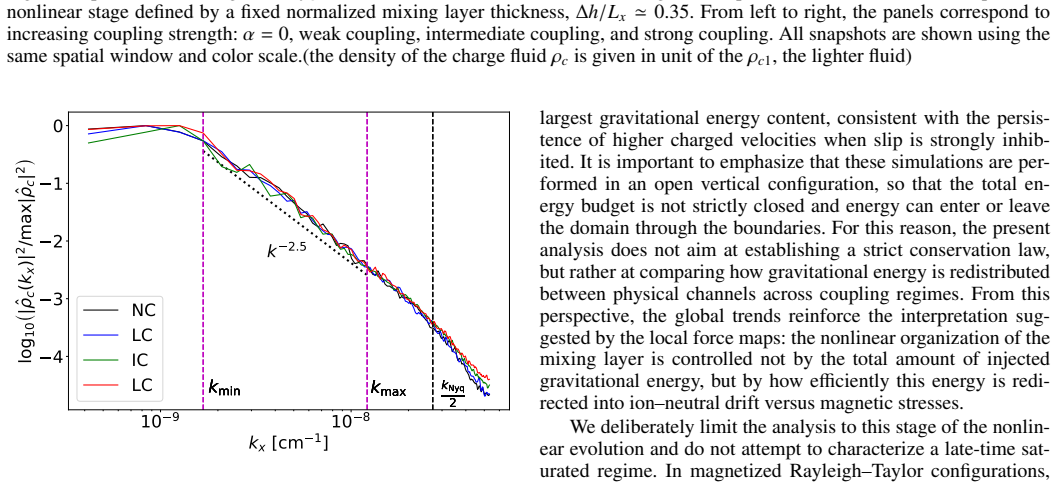
- Sect. 4.3 and Figs. 7–8: the central multi-mode MHD claim is a non-monotonic reorganization with smoothest interfaces at intermediate coupling. The evidence is primarily visual (Fig. 7). The corresponding charge-density spectra (Fig. 8) show essentially no coupling dependence in slope or power distribution at fixed Δh/Lx ≃ 0.35, in contrast to the clear high-kx enhancement at IC in the hydrodynamic suite (Fig. 6). Without a quantitative morphology metric (e.g., interface perimeter/length, curvature statistics, or bubble/finger aspect-ratio distributions) the non-monotonic MHD claim rests on subjective snapshot comparison and is only weakly supported by the spectral diagnostics the paper itself presents. A reproducible morphological diagnostic at the same fixed nonlinear stage would substantially strengthen (or qualify) this result.
- Sect. 4.3 and Fig. 10: the energy-pathway analysis is performed in an open vertical domain whose boundaries act as reservoirs; the authors note that the global energy budget is not closed. The IC maximum of cumulative drag dissipation and minimum of retained gravitational energy are therefore comparative diagnostics, not closed conversion efficiencies. The text sometimes reads as if these establish a robust physical ranking of coupling regimes. The conclusions should state more carefully what is and is not constrained by open-boundary cumulative integrals, and avoid implying a unique energy-partition ranking that would necessarily survive in a closed or control-volume formulation.
minor comments (6)
- Table 3 header and caption say “four” coupling regimes but list five (NC, LC, IC, HC, HC-Lim). Align the count with the table contents.
- Fig. 8 legend appears to label two curves as LC (NC, LC, IC, LC). Correct the HC label if that is intended.
- Conclusions state that the ratio of mixing heights between coupled and uncoupled runs “asymptotically approaches a value significantly below unity, of order ∼0.7.” This quantitative claim is not clearly shown or tabulated in Sect. 4 for the multi-mode runs; either add the supporting figure/measurement or soften the wording.
- Sect. 2.4 and Table 1: absolute values of Lx and gc are rescaled for numerical convenience; a short explicit statement of the dimensionless groups that are held fixed (and which free parameters map to astrophysical CNM conditions) would help readers assess “astrophysically relevant” claims in the abstract.
- Occasional wording issues (e.g., “the non linear phase,” missing hyphens, “thenonlinear” in the abstract) should be cleaned in copy-editing.
- Fig. 1 and coupling labels: define ωth consistently when νnc/ωth is used to name regimes, since ωth itself depends on coupling; a one-sentence clarification would avoid circular reading of Table 3.
Circularity Check
No meaningful circularity: nonlinear morphology and energy claims are measured simulation outputs; Paper I is only upstream linear theory, revised and re-validated here.
specific steps
-
self citation load bearing
[Sect. 2.1; Introduction (Paper I); Appendix A]
"Building on the linear analysis of Paper I, we extend the study beyond the exponential stage... The linear theory developed in Paper I relied on the simplifying assumption that the ion–neutral and neutral–ion collision frequencies were identical on both sides of the density interface... we relax this assumption... The analytical framework of Paper I therefore remains fully applicable, provided that the coupling strength is interpreted in terms of an effective collision frequency."
The linear dispersion framework and the asymmetric gravity setup (g_c only) are imported from the authors' own Paper I. This is sequential self-citation of upstream theory, not a closed loop: Appendix A re-derives matching conditions for ξ=d, and Sect. 3 independently validates growth rates against the simulations. The central nonlinear claims (non-monotonic morphology, IC drag peak) do not reduce to Paper I by construction; they are new measured outputs. Flagged only as minor self-citation, not load-bearing circularity.
full rationale
This is a controlled two-fluid simulation study. Linear growth rates are taken from a prior dispersion analysis (Paper I), revised in Appendix A for density-dependent collision frequencies, and then independently recovered in the simulations (multi-wavelength collapse of h/h0 vs ω_th t in both NC and IC). That is ordinary sequential validation, not a closed loop. Coupling labels (NC/LC/IC/HC) are fixed a priori from α and ν_nc/ω_th (Table 3), not reverse-engineered from the morphology result. The classical quadratic law h≈α A g t² is used only as a reference; the paper then measures departures (curvature, sub-quadratic growth) and interprets them with a minimal local two-fluid model (Eqs. 20–25) whose purpose is explicitly qualitative, not a fitted prediction. Multi-wavelength morphology, Welch spectra, force maps, and cumulative E_g / E_D budgets at fixed Δh/L_x are direct diagnostics of the runs. The asymmetric gravity choice (g_n=0) is a load-bearing modeling assumption for physics fidelity, not a circular derivation step: it is stated as an idealization consistent with Paper I, not derived from the nonlinear conclusions. No uniqueness theorem, no fitted parameter renamed as prediction, and no self-definitional identity between input and claimed result. Score 1 only for the minor, non-load-bearing self-citation of Paper I as the linear starting point.
Axiom & Free-Parameter Ledger
free parameters (6)
- collision coefficient α (coupling regimes NC/LC/IC/HC/HC-Lim)
- plasma beta β
- gravitational acceleration gc
- magnetic inclination θ
- Atwood number A and density ratio nc/nn
- initial perturbation amplitude ε≃1/3 and multi-mode coefficients ci, ϕi
axioms (6)
- domain assumption Two-fluid continuity, momentum, energy, and ideal induction equations with collisional Rn, Mn exchange; ionization/recombination, Ohmic resistivity, Hall effect neglected.
- ad hoc to paper Gravitational acceleration acts only on the charged component (gc=−gẑ, gn=0).
- domain assumption Sharp density interface with hydrostatic charged pressure and uniform neutral pressure; identical Atwood numbers for both fluids.
- domain assumption Incompressible linear dispersion of Paper I (with ξ=d collision-frequency asymmetry) is an adequate reference for ordering growth rates when gL/cs²≪1.
- domain assumption Two-dimensional dynamics suffice to isolate ambipolar effects on growth laws, force balance, and energy redistribution relative to ideal MHD.
- ad hoc to paper Morphology-based comparison at fixed normalized mixing thickness Δh/Lx (or h/λ) equates nonlinear stages across different linear growth rates.
invented entities (1)
-
Named coupling regimes NC/LC/IC/HC/HC-Lim
independent evidence
Cite this review
Pith. "Pith review of The Rayleigh Taylor instability in partially ionized plasmas: ambipolar diffusion effects in the non linear phase." pith.science (2026). https://pith.science/paper/LJUKTKAW
@misc{pith2026260310566,
  author       = {Pith},
  title        = {Pith review of: The Rayleigh Taylor instability in partially ionized plasmas: ambipolar diffusion effects in the non linear phase},
  year         = {2026},
  howpublished = {\url{https://pith.science/paper/LJUKTKAW}},
  note         = {Machine review of arXiv:2603.10566}
}
read the original abstract
Aims. We aim to determine how ion neutral coupling and ambipolar diffusion affect the linear and the nonlinear growth of the RTinstability under astrophysically relevant conditions, and to identify the coupling regimes in which departures from the classical single fluid picture become significant. Methods. We perform high resolution two fluid numerical simulations using the MPI AMRVAC code, spanning a wide range of perturbation wavelengths, coupling strengths, from uncoupled to strongly coupled passing by intermediate or ambipolar diffusion dominated regimes, and magnetic field configurations. The linear theory is revisited using a physically consistent formulation with different ion neutral coupling strengths across the interface and validated against the simulations. We investigate the physics of the instability using morphology based diagnostics of the mixing layer to compare simulations at equivalent nonlinear stages, complemented by spectral, force, and energy budgets analyses. Results. In the linear regime, theoretical growth rates are recovered over a wide range of wavelengths, from the single fluid limit to intermediate bi fluid coupling. In the nonlinear regime, ambipolar diffusion modifies the classical quadratic growth and introduces a coupling dependent evolution. For multi wavelength perturbations, the nonlinear dynamics becomes strongly scale dependent: intermediate coupling enhances fragmentation in hydrodynamic configurations, while magnetised cases exhibit a non monotonic reorganisation of the interface, with the smoothest morphologies occurring at intermediate coupling. Spectral and energetic diagnostics indicate that these behaviours correlate with changes in the relative contributions of ion neutral drift and magnetic stresses during thenonlinear evolution
Figures




Reference graph
Works this paper leans on
-
[1]
& Lea, S
Arons, J. & Lea, S. M. 1976, Astrophysical Journal, 207, 914
1976
-
[2]
M., Ruuth, S
Ascher, U. M., Ruuth, S. J., & Spiteri, R. J. 1997, Applied Numerical Mathemat- ics, 25, 151, special Issue on Time Integration
1997
-
[3]
Braileanu, B. P. & Keppens, R. 2022, A&A, 664, A55
2022
-
[4]
2004, Astronomy and Astrophysics, 423, 253
Bucciantini, N., Amato, E., & Del Zanna, L. 2004, Astronomy and Astrophysics, 423, 253
2004
-
[5]
2025, A&A, 698, A147
Callies, E., Guillet, V ., Marcowith, A., Meliani, Z., & Lesaffre, P. 2025, A&A, 698, A147
2025
-
[6]
& Hillier, A
Carlyle, J. & Hillier, A. 2017, Astronomy and Astrophysics, 605, A21
2017
-
[7]
1961, Hydrodynamic and Hydromagnetic Stability (Oxford University Press)
Chandrasekhar, S. 1961, Hydrodynamic and Hydromagnetic Stability (Oxford University Press)
1961
-
[8]
M., Durrive, J
Changmai, M., Jenkins, J. M., Durrive, J. B., & Keppens, R. 2023, Astronomy and Astrophysics, 672, A152
2023
-
[9]
& Woodward, P
Colella, P. & Woodward, P. R. 1984, Journal of Computational Physics, 54, 174
1984
-
[10]
W., Cabot, W
Cook, A. W., Cabot, W. H., & Miller, P. L. 2004, Journal of Fluid Mechanics, 511, 333 Díaz, A. J., Khomenko, E., & Collados, M. 2014, A&A, 564, A97 Díaz, A. J., Soler, R., & Ballester, J. L. 2012, ApJ, 754, 41
2004
-
[11]
2004, Physics of Fluids, 16, 1668
Dimonte, G., Youngs, D., Dimits, A., et al. 2004, Physics of Fluids, 16, 1668
2004
-
[12]
& von Neumann, J
Fermi, E. & von Neumann, J. 1953, Los Alamos Scientific Laboratory Report
1953
-
[13]
Hester, J. J. et al. 1996, Astrophysical Journal, 456, 225
1996
-
[14]
2016, PhD thesis, University of St Andrews
Hillier, A. 2016, PhD thesis, University of St Andrews
2016
-
[15]
2005, Nature, 434, 478
Isobe, H., Miyagoshi, T., Shibata, K., & Yokoyama, T. 2005, Nature, 434, 478
2005
-
[16]
& Norman, M
Jun, B.-I. & Norman, M. L. 1996, Astrophysical Journal, 465, 800
1996
-
[17]
L., & Stone, J
Jun, B.-I., Norman, M. L., & Stone, J. M. 1995, Astrophysical Journal, 453, 332
1995
-
[18]
Kalluri, M. T. & Hillier, A. 2025, Arxiv 2510.27053
arXiv 2025
-
[19]
2025, A&A, 697, A29
Khomenko, E., Vitas, N., Collados, M., & Modestov, M. 2025, A&A, 697, A29
2025
-
[20]
& Kusano, K
Miyoshi, T. & Kusano, K. 2005, Journal of Computational Physics, 208, 315 Popescu Braileanu, B., Lukin, V . S., & Khomenko, E. 2023, A&A, 670, A31 Popescu Braileanu, B., Lukin, V . S., Khomenko, E., & de Vicente, Á. 2021a, Astronomy and Astrophysics, 646, A93 Popescu Braileanu, B., Lukin, V . S., Khomenko, E., & de Vicente, Á. 2021b, Astronomy and Astroph...
2005
-
[21]
Ristorcelli, J. R. & Clark, T. T. 2004, Journal of Fluid Mechanics, 507, 213
2004
-
[22]
J., Ricker, P
Robinson, K., Dursi, L. J., Ricker, P. M., et al. 2004, Astrophysical Journal, 601, 621
2004
-
[23]
A., Brüggen, M., & Heinz, S
Ruszkowski, M., Enßlin, T. A., Brüggen, M., & Heinz, S. 2007, Monthly Notices of the Royal Astronomical Society, 378, 662
2007
-
[24]
Ruuth, S. J. & Spiteri, R. J. 2002, Journal of Scientific Computing, 17, 211
2002
-
[25]
Sharp, D. H. 1984, Physics Reports, 101, 221
1984
-
[26]
& Ballester, J
Soler, R. & Ballester, J. L. 2022, Frontiers in Astronomy and Space Sciences, 9, 789083
2022
-
[27]
Taylor, G. I. 1950, Proceedings of the Royal Society of London. Series A, 201, 192
1950
-
[28]
2020, A&A, 634, A96
Vickers, E., Ballai, I., & Erdélyi, R. 2020, A&A, 634, A96
2020
-
[29]
2026, JWST imaging of the Pleiades: anisotropy of turbulence in the cold neutral medium
Vigoureux, G., Flagey, N., Boulanger, F., et al. 2026, JWST imaging of the Pleiades: anisotropy of turbulence in the cold neutral medium
2026
-
[30]
& Nepveu, M
Wang, Y .-M. & Nepveu, M. 1983, Astronomy and Astrophysics, 118, 267
1983
-
[31]
i kx tanθ ! − Ω sinθc Acϕc1 # (A.11) m2+ =− i kx tanθ ! + Ω sinθ √ dcAcϕc2 (A.12) α1c ≡k x
Welch, P. 1967, IEEE Transactions on Audio and Electroacoustics, 15, 70 Article number, page 13 of 15 A&A proofs:manuscript no. aa59496-26 Appendix A: Discussion on Paper I In Paper I, the analytical dispersion relation was derived under the simplifying assumption that the ion–neutral and neutral–ion collision frequencies were identical on both sides of t...
1967
discussion (0)
Sign in with ORCID, Apple, or X to comment. Anyone can read and Pith papers without signing in.