Disentangled Latent Dynamics Manifold Fusion for Solving Parameterized PDEs
Pith reviewed 2026-05-21 11:33 UTC · model grok-4.3
The pith
Modeling PDE prediction as latent dynamic evolution separates parameter changes from time progression.
A machine-rendered reading of the paper's core claim, the machinery that carries it, and where it could break.
Core claim
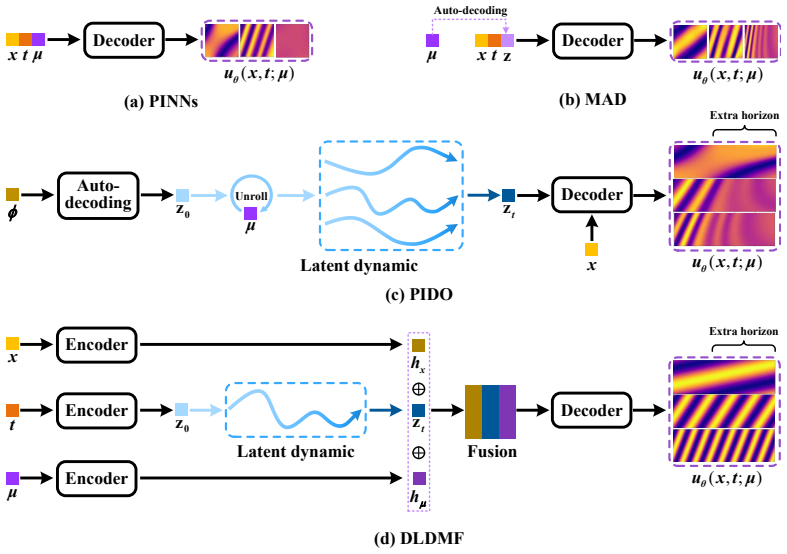
DLDMF explicitly separates space, time, and parameters by mapping PDE parameters directly to a continuous latent embedding through a feed-forward network. This embedding initializes and conditions a parameter-conditioned Neural ODE. A dynamic manifold fusion mechanism uses a shared decoder to combine spatial coordinates, parameter embeddings, and time-evolving latent states to reconstruct the spatiotemporal solution. By modeling prediction as latent dynamic evolution rather than static coordinate fitting, the approach reduces interference between parameter variation and temporal evolution while preserving a smooth and coherent solution manifold.
What carries the argument
The parameter-conditioned Neural ODE initialized by a feed-forward mapped latent embedding, combined with dynamic manifold fusion via a shared decoder.
If this is right
- Performs well on unseen parameter settings without retraining.
- Achieves long-term temporal extrapolation beyond the training time range.
- Outperforms state-of-the-art baselines in accuracy on benchmark problems.
- Maintains a smooth and coherent solution manifold across parameter variations.
- Reduces interference between parameter changes and time evolution in the model.
Where Pith is reading between the lines
- This separation might allow the same latent dynamics to apply to a wider range of physical systems by adjusting only the initial embedding.
- Future work could test if this approach scales to higher-dimensional or nonlinear PDEs with many parameters.
- It suggests that enforcing disentanglement in latent space could improve generalization in other time-dependent modeling tasks like fluid dynamics or climate simulation.
Load-bearing premise
A feed-forward network can map any PDE parameters to a latent embedding that allows a Neural ODE to evolve the solution stably without needing to decode the parameters again during testing or causing jumps in the solution space.
What would settle it
Running the model on a parameter value outside the training range and checking if the predicted solution matches the true PDE solution over an extended time period beyond training data; failure would show the mapping or evolution does not generalize.
Figures


read the original abstract
Generalizing neural surrogate models across different PDE parameters remains difficult because changes in PDE coefficients often make learning harder and optimization less stable. The problem becomes even more severe when the model must also predict beyond the training time range. Existing methods usually cannot handle parameter generalization and temporal extrapolation at the same time. Standard parameterized models treat time as just another input and therefore fail to capture intrinsic dynamics, while recent continuous-time latent methods often rely on expensive test-time auto-decoding for each instance, which is inefficient and can disrupt continuity across the parameterized solution space. To address this, we propose Disentangled Latent Dynamics Manifold Fusion (DLDMF), a physics-informed framework that explicitly separates space, time, and parameters. Instead of unstable auto-decoding, DLDMF maps PDE parameters directly to a continuous latent embedding through a feed-forward network. This embedding initializes and conditions a latent state whose evolution is governed by a parameter-conditioned Neural ODE. We further introduce a dynamic manifold fusion mechanism that uses a shared decoder to combine spatial coordinates, parameter embeddings, and time-evolving latent states to reconstruct the corresponding spatiotemporal solution. By modeling prediction as latent dynamic evolution rather than static coordinate fitting, DLDMF reduces interference between parameter variation and temporal evolution while preserving a smooth and coherent solution manifold. As a result, it performs well on unseen parameter settings and in long-term temporal extrapolation. Experiments on several benchmark problems show that DLDMF consistently outperforms state-of-the-art baselines in accuracy, parameter generalization, and extrapolation robustness.
Editorial analysis
A structured set of objections, weighed in public.
Referee Report
Summary. The paper proposes Disentangled Latent Dynamics Manifold Fusion (DLDMF), a physics-informed neural framework for solving parameterized PDEs. It explicitly disentangles space, time, and parameters by using a feed-forward network to map PDE parameters directly to a continuous latent embedding; this embedding initializes and conditions a parameter-conditioned Neural ODE whose evolution is decoded via a dynamic manifold fusion mechanism with a shared decoder that combines spatial coordinates, parameter embeddings, and time-evolving latent states. The central claim is that modeling prediction as latent dynamic evolution (rather than static fitting) reduces interference between parameter variation and temporal dynamics, preserves a smooth solution manifold, and yields improved accuracy, generalization to unseen parameters, and long-term temporal extrapolation on benchmark problems relative to state-of-the-art baselines.
Significance. If the empirical results and stability assumptions hold, the work could advance neural surrogates for parameterized PDEs by eliminating test-time auto-decoding while jointly addressing parameter generalization and temporal extrapolation. The explicit disentanglement via Neural ODEs and manifold fusion provides a concrete architectural template that may transfer to other scientific machine-learning tasks involving multi-scale physical systems.
major comments (2)
- [Method (parameter-to-latent mapping and Neural ODE conditioning)] The central architectural claim—that a feed-forward network produces a latent embedding that both initializes and stably conditions a parameter-conditioned Neural ODE across the solution manifold—lacks any explicit continuity enforcement (e.g., Lipschitz regularization, manifold penalties, or Jacobian constraints). This assumption is load-bearing for the generalization and long-term extrapolation results; without it, small parameter perturbations can induce divergent latent dynamics under integration.
- [Abstract and Experiments] The abstract asserts that 'experiments on several benchmark problems show that DLDMF consistently outperforms state-of-the-art baselines,' yet the provided text contains no quantitative error metrics, error bars, dataset specifications (number of parameter settings, time horizons, grid resolutions), or ablation studies isolating the dynamic manifold fusion component. These details are required to substantiate the central performance claims.
minor comments (1)
- [Method] The notation for the latent state z(t), parameter embedding e_p, and the fusion decoder could be formalized with explicit equations and a schematic diagram to clarify the information flow between the feed-forward mapper, Neural ODE, and shared decoder.
Simulated Author's Rebuttal
We thank the referee for the constructive and detailed feedback on our manuscript. We address each major comment point by point below, indicating where revisions will be made to strengthen the presentation and claims.
read point-by-point responses
-
Referee: [Method (parameter-to-latent mapping and Neural ODE conditioning)] The central architectural claim—that a feed-forward network produces a latent embedding that both initializes and stably conditions a parameter-conditioned Neural ODE across the solution manifold—lacks any explicit continuity enforcement (e.g., Lipschitz regularization, manifold penalties, or Jacobian constraints). This assumption is load-bearing for the generalization and long-term extrapolation results; without it, small parameter perturbations can induce divergent latent dynamics under integration.
Authors: We appreciate this observation regarding the need for explicit continuity enforcement. The feed-forward network with standard smooth activations (such as tanh) is continuous by construction, and the Neural ODE integration inherently produces continuous trajectories in latent space. However, we acknowledge that the original submission did not include explicit regularization such as Lipschitz constraints or manifold penalties on the parameter-to-latent mapping. To directly address the concern about stability under small parameter perturbations, we will incorporate a Lipschitz regularization term on the parameter embedding network in the revised manuscript. This term will be added to the overall loss function, with corresponding discussion in the method section and updated experimental protocols to verify its effect on generalization and extrapolation. revision: yes
-
Referee: [Abstract and Experiments] The abstract asserts that 'experiments on several benchmark problems show that DLDMF consistently outperforms state-of-the-art baselines,' yet the provided text contains no quantitative error metrics, error bars, dataset specifications (number of parameter settings, time horizons, grid resolutions), or ablation studies isolating the dynamic manifold fusion component. These details are required to substantiate the central performance claims.
Authors: We agree that the abstract would be strengthened by including concise quantitative support for the performance claims. While the full manuscript's Experiments section already reports relative L2 errors with standard deviations across multiple runs, specific dataset details (including the number of parameter settings, time horizons, and grid resolutions), and ablation studies on the dynamic manifold fusion component, these were not summarized in the abstract. We will revise the abstract to incorporate key quantitative metrics, error bar information, and brief references to the dataset specifications and ablations, ensuring the central claims are substantiated at the summary level without exceeding length constraints. revision: yes
Circularity Check
No circularity: DLDMF is an independent architectural proposal with no self-referential reductions
full rationale
The paper introduces DLDMF as a new framework that uses a feed-forward network to map PDE parameters to a latent embedding which initializes a parameter-conditioned Neural ODE, combined with a dynamic manifold fusion decoder. No equations, predictions, or core claims reduce by construction to fitted inputs, self-citations, or renamed known results. The derivation relies on the proposed separation of space/time/parameters and experimental validation on benchmarks rather than tautological definitions or load-bearing self-references. This is self-contained against external benchmarks.
Axiom & Free-Parameter Ledger
free parameters (2)
- latent embedding dimension
- Neural ODE integration tolerances and step size
axioms (1)
- domain assumption PDE solutions lie on a smooth manifold that can be factored into independent spatial, temporal, and parametric components in latent space.
invented entities (1)
-
dynamic manifold fusion mechanism
no independent evidence
Lean theorems connected to this paper
-
IndisputableMonolith/Cost/FunctionalEquation.leanwashburn_uniqueness_aczel unclear?
unclearRelation between the paper passage and the cited Recognition theorem.
DLDMF maps PDE parameters directly to a continuous latent embedding through a feed-forward network. This embedding initializes and conditions a latent state whose evolution is governed by a parameter-conditioned Neural ODE.
-
IndisputableMonolith/Foundation/RealityFromDistinction.leanreality_from_one_distinction unclear?
unclearRelation between the paper passage and the cited Recognition theorem.
dynamic manifold fusion mechanism that uses a shared decoder to combine spatial coordinates, parameter embeddings, and time-evolving latent states
What do these tags mean?
- matches
- The paper's claim is directly supported by a theorem in the formal canon.
- supports
- The theorem supports part of the paper's argument, but the paper may add assumptions or extra steps.
- extends
- The paper goes beyond the formal theorem; the theorem is a base layer rather than the whole result.
- uses
- The paper appears to rely on the theorem as machinery.
- contradicts
- The paper's claim conflicts with a theorem or certificate in the canon.
- unclear
- Pith found a possible connection, but the passage is too broad, indirect, or ambiguous to say the theorem truly supports the claim.
discussion (0)
Sign in with ORCID, Apple, or X to comment. Anyone can read and Pith papers without signing in.