RetimeGS: Continuous-Time Reconstruction of 4D Gaussian Splatting
Pith reviewed 2026-05-15 11:45 UTC · model grok-4.3
The pith
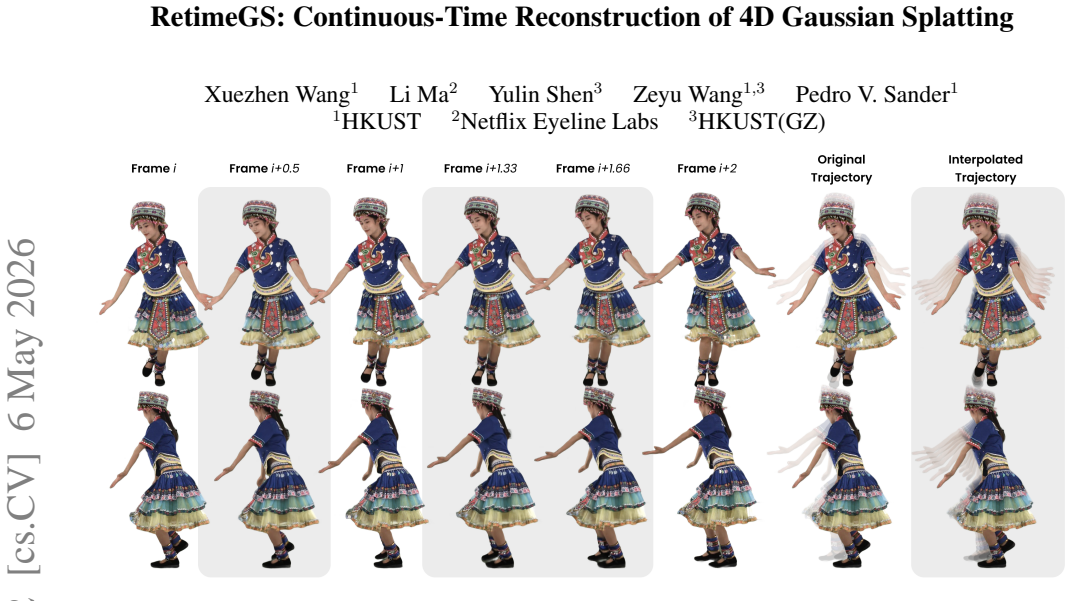
RetimeGS defines explicit temporal behavior for 3D Gaussians to enable continuous-time rendering of dynamic scenes without ghosting.
A machine-rendered reading of the paper's core claim, the machinery that carries it, and where it could break.
Core claim
RetimeGS is a 4D Gaussian Splatting representation that explicitly defines the temporal behavior of the 3D Gaussian and mitigates temporal aliasing. Optical flow-guided initialization and triple-rendering supervision, together with other targeted strategies, enable ghost-free, temporally coherent rendering at arbitrary timestamps even under large motions.
What carries the argument
Explicit temporal definition of each 3D Gaussian, supported by optical flow initialization and triple-rendering supervision, which together prevent discrete-frame overfitting and enforce consistent continuous-time interpolation.
If this is right
- Rendering becomes possible at any continuous timestamp rather than only at discrete captured frames.
- Temporal coherence holds under fast motion, non-rigid deformation, and severe occlusions where prior methods fail.
- Applications such as slow-motion playback and temporal video editing gain direct support.
- Interpolation between frames no longer requires separate post-processing to suppress artifacts.
Where Pith is reading between the lines
- The same explicit-timing idea could be applied to other continuous scene representations beyond Gaussians.
- If training cost remains moderate, the method could support interactive temporal editing in consumer video tools.
- Scenes reconstructed from fewer cameras might benefit if the temporal supervision reduces reliance on dense view coverage.
Load-bearing premise
Temporal aliasing from discrete-frame overfitting is the primary cause of ghosting, and the added optical-flow and supervision strategies will eliminate it reliably across varied scenes without introducing new artifacts.
What would settle it
If rendering RetimeGS at timestamps between training frames on a fast-motion sequence still produces visible ghosting, the claim that the method achieves effective continuous-time reconstruction would be false.
Figures


read the original abstract
Temporal retiming, the ability to reconstruct and render dynamic scenes at arbitrary timestamps, is crucial for applications such as slow-motion playback, temporal editing, and post-production. However, most existing 4D Gaussian Splatting (4DGS) methods overfit at discrete frame indices but struggle to represent continuous-time frames, leading to ghosting artifacts when interpolating between timestamps. We identify this limitation as a form of temporal aliasing and propose RetimeGS, a simple yet effective 4DGS representation that explicitly defines the temporal behavior of the 3D Gaussian and mitigates temporal aliasing. To achieve smooth and consistent interpolation, we incorporate optical flow-guided initialization and supervision, triple-rendering supervision, and other targeted strategies. Together, these components enable ghost-free, temporally coherent rendering even under large motions. Experiments on datasets featuring fast motion, non-rigid deformation, and severe occlusions demonstrate that RetimeGS achieves superior quality and coherence over state-of-the-art methods.
Editorial analysis
A structured set of objections, weighed in public.
Referee Report
Summary. The paper introduces RetimeGS, a 4D Gaussian Splatting method that explicitly defines continuous-time parameters for 3D Gaussians to mitigate temporal aliasing and enable ghost-free rendering at arbitrary timestamps. It augments prior 4DGS with optical flow-guided initialization, triple-rendering supervision, and related strategies, claiming superior quality and temporal coherence over state-of-the-art methods on datasets with fast motion, non-rigid deformation, and severe occlusions.
Significance. If the central claims hold with robust validation, the work would meaningfully advance continuous-time dynamic scene reconstruction, directly benefiting applications such as slow-motion playback and temporal editing. The targeted fixes for aliasing in 4DGS represent a practical incremental contribution, though its significance depends on demonstrating that gains are not artifacts of flow-dependent supervision.
major comments (2)
- [Method and Experiments] The central construction relies on optical-flow-guided initialization and flow-based loss terms to suppress temporal aliasing, yet the manuscript provides no ablation isolating performance under accurate versus noisy or failed flow estimates (known to occur precisely on the fast-motion and occlusion datasets highlighted in the abstract). This leaves open whether reported gains are robust or flow-dependent; a concrete test with synthetic flow degradation or alternative initializers is needed to support the superiority claim.
- [Abstract and §4] No quantitative metrics, error analysis, or ablation tables are referenced in the abstract or early sections to substantiate the 'superior quality and coherence' claim; the soundness assessment requires explicit reporting of PSNR/SSIM/LPIPS deltas versus baselines on the targeted regimes, with statistical significance.
minor comments (2)
- [Method] Notation for continuous-time Gaussian parameters (e.g., time-dependent means and covariances) should be introduced with explicit equations early in the method section to clarify how they differ from discrete-frame 4DGS.
- [Figures] Figure captions for qualitative results should include the specific timestamps used for interpolation and note any failure cases observed.
Simulated Author's Rebuttal
We thank the referee for the constructive feedback. We address the major comments point-by-point below and will incorporate revisions to strengthen the manuscript.
read point-by-point responses
-
Referee: [Method and Experiments] The central construction relies on optical-flow-guided initialization and flow-based loss terms to suppress temporal aliasing, yet the manuscript provides no ablation isolating performance under accurate versus noisy or failed flow estimates (known to occur precisely on the fast-motion and occlusion datasets highlighted in the abstract). This leaves open whether reported gains are robust or flow-dependent; a concrete test with synthetic flow degradation or alternative initializers is needed to support the superiority claim.
Authors: We agree that robustness to flow estimation errors warrants explicit validation. In the revised manuscript we will add a dedicated ablation that synthetically degrades the input optical flow (via additive Gaussian noise and simulated occlusions on fast-motion regions) and reports the resulting changes in PSNR/SSIM/LPIPS. This will isolate the contribution of the explicit continuous-time Gaussian parameterization and triple-rendering supervision, which are intended to provide complementary robustness beyond flow guidance. revision: yes
-
Referee: [Abstract and §4] No quantitative metrics, error analysis, or ablation tables are referenced in the abstract or early sections to substantiate the 'superior quality and coherence' claim; the soundness assessment requires explicit reporting of PSNR/SSIM/LPIPS deltas versus baselines on the targeted regimes, with statistical significance.
Authors: We will revise the abstract and introduction to include the key quantitative deltas (average PSNR, SSIM, and LPIPS improvements versus the strongest baselines on the fast-motion and occlusion subsets). We will also add error analysis with standard deviations computed across scenes and multiple random seeds to support statistical significance. revision: yes
Circularity Check
No significant circularity; derivation builds on prior 4DGS with independent external signals
full rationale
The paper identifies temporal aliasing in existing 4DGS methods as the source of ghosting during interpolation and introduces RetimeGS, which explicitly defines continuous-time behavior for 3D Gaussians. It adds optical flow-guided initialization, triple-rendering supervision, and related strategies. These components rely on external inputs (optical flow estimators) and supervision signals that are not defined in terms of the method's own outputs or predictions. No equations reduce by construction to fitted parameters renamed as predictions, no load-bearing uniqueness theorems are imported via self-citation, and no ansatz is smuggled through prior work by the same authors. The central claims remain independent of the reported results.
Axiom & Free-Parameter Ledger
Reference graph
Works this paper leans on
-
[1]
Per-Gaussian Embedding- Based Deformation for Deformable 3D Gaussian Splatting
Jeongmin Bae, Seoha Kim, Youngsik Yun, Hahyun Lee, Gun Bang, and Youngjung Uh. Per-Gaussian Embedding- Based Deformation for Deformable 3D Gaussian Splatting. InEuropean Conference on Computer Vision, pages 321–
-
[2]
A Class of Local Interpo- lating Splines
Edwin Catmull and Raphael Rom. A Class of Local Interpo- lating Splines. InComputer Aided Geometric Design, pages 317–326. Elsevier, 1974. 2, 4, 5
work page 1974
-
[3]
Yutian Chen, Shi Guo, Tianshuo Yang, Lihe Ding, Xiuyuan Yu, Jinwei Gu, and Tianfan Xue. 4DSloMo: 4D Reconstruc- tion for High Speed Scene with Asynchronous Capture.Pro- ceedings of the SIGGRAPH Asia 2025 Conference Papers, pages 1–11, 2025. 3
work page 2025
-
[4]
DNA-Rendering: A Diverse Neural Actor Repository for High-Fidelity Human-Centric Render- ing
Wei Cheng, Ruixiang Chen, Siming Fan, Wanqi Yin, Keyu Chen, Zhongang Cai, Jingbo Wang, Yang Gao, Zheng- ming Yu, Zhengyu Lin, Daxuan Ren, Lei Yang, Ziwei Liu, Chen Change Loy, Chen Qian, Wayne Wu, Dahua Lin, Bo Dai, and Kwan-Yee Lin. DNA-Rendering: A Diverse Neural Actor Repository for High-Fidelity Human-Centric Render- ing. InProceedings of the IEEE/CVF...
work page 2023
-
[5]
4D-Rotor Gaussian Splat- ting: Towards Efficient Novel View Synthesis for Dynamic Scenes
Yuanxing Duan, Fangyin Wei, Qiyu Dai, Yuhang He, Wen- zheng Chen, and Baoquan Chen. 4D-Rotor Gaussian Splat- ting: Towards Efficient Novel View Synthesis for Dynamic Scenes. InACM SIGGRAPH Conference Papers, pages 1– 11, 2024. 2
work page 2024
-
[6]
Quankai Gao, Qiangeng Xu, Zhe Cao, Ben Mildenhall, Wen- chao Ma, Le Chen, Danhang Tang, and Ulrich Neumann. GaussianFlow: Splatting Gaussian Dynamics for 4D Con- tent Creation.Transactions on Machine Learning Research,
-
[7]
Zhiyang Guo, Wengang Zhou, Li Li, Min Wang, and Houqiang Li. Motion-Aware 3D Gaussian Splatting for Effi- cient Dynamic Scene Reconstruction.IEEE Transactions on Circuits and Systems for Video Technology, 2024. 2
work page 2024
-
[8]
Yingdong Hu, Yisheng He, Jinnan Chen, Weihao Yuan, Ke- jie Qiu, Zehong Lin, Siyu Zhu, Zilong Dong, and Jun Zhang. Forge4D: Feed-Forward 4D Human Reconstruction and In- terpolation from Uncalibrated Sparse-view Videos.arXiv preprint arXiv:2509.24209, 2025. 3
-
[9]
SC-GS: Sparse-Controlled Gaussian Splatting for Editable Dynamic Scenes
Yi-Hua Huang, Yang-Tian Sun, Ziyi Yang, Xiaoyang Lyu, Yan-Pei Cao, and Xiaojuan Qi. SC-GS: Sparse-Controlled Gaussian Splatting for Editable Dynamic Scenes. InPro- ceedings of the IEEE/CVF Conference on Computer Vision and Pattern Recognition, pages 4220–4230, 2024. 2
work page 2024
-
[10]
Co- Tracker: It is Better to Track Together
Nikita Karaev, Ignacio Rocco, Benjamin Graham, Natalia Neverova, Andrea Vedaldi, and Christian Rupprecht. Co- Tracker: It is Better to Track Together. InEuropean Confer- ence on Computer Vision, pages 18–35, 2024. 2
work page 2024
-
[11]
Bernhard Kerbl, Georgios Kopanas, Thomas Leimkuehler, and George Drettakis. 3D Gaussian Splatting for Real-Time Radiance Field Rendering.ACM Transactions on Graphics (TOG), 42(4), 2023. 3
work page 2023
-
[12]
Shakiba Kheradmand, Daniel Rebain, Gopal Sharma, Wei- wei Sun, Yang-Che Tseng, Hossam Isack, Abhishek Kar, Andrea Tagliasacchi, and Kwang Moo Yi. 3D Gaussian Splatting as Markov Chain Monte Carlo.Advances in Neural Information Processing Systems, 2024. 5, 8, 1, 3
work page 2024
-
[13]
Dahyeon Kye, Changhyun Roh, Sukhun Ko, Chanho Eom, and Jihyong Oh. AceVFI: A Comprehensive Survey of Advances in Video Frame Interpolation.arXiv preprint arXiv:2506.01061, 2025. 3
-
[14]
DGD: Dynamic 3D Gaussians Distillation
Isaac Labe, Noam Issachar, Itai Lang, and Sagie Benaim. DGD: Dynamic 3D Gaussians Distillation. InEuropean Conference on Computer Vision, pages 361–378, 2024. 2
work page 2024
-
[15]
Junoh Lee, ChangYeon Won, Hyunjun Jung, Inhwan Bae, and Hae-Gon Jeon. Fully Explicit Dynamic Gaussian Splat- ting.Advances in Neural Information Processing Systems, 37:5384–5409, 2024. 2, 3
work page 2024
-
[16]
Harley, Leonidas Guibas, and Kostas Daniilidis
Jiahui Lei, Yijia Weng, Adam W. Harley, Leonidas Guibas, and Kostas Daniilidis. MoSca: Dynamic Gaussian Fusion from Casual Videos via 4D Motion Scaffolds. InProceed- ings of the IEEE/CVF Conference on Computer Vision and Pattern Recognition (CVPR), pages 6165–6177, 2025. 2
work page 2025
-
[17]
Neural 3D Video Synthesis from Multi-View Video
Tianye Li, Mira Slavcheva, Michael Zollhoefer, Simon Green, Christoph Lassner, Changil Kim, Tanner Schmidt, Steven Lovegrove, Michael Goesele, Richard Newcombe, et al. Neural 3D Video Synthesis from Multi-View Video. InProceedings of the IEEE/CVF Conference on Computer Vision and Pattern Recognition, pages 5521–5531, 2022. 2, 3
work page 2022
-
[18]
Spacetime Gaussian Feature Splatting for Real-Time Dynamic View Synthesis
Zhan Li, Zhang Chen, Zhong Li, and Yi Xu. Spacetime Gaussian Feature Splatting for Real-Time Dynamic View Synthesis. InProceedings of the IEEE/CVF Conference on Computer Vision and Pattern Recognition, pages 8508– 8520, 2024. 2, 3, 6, 1, 4
work page 2024
-
[19]
GauFRe: Gaussian Deformation Fields for Real-time Dy- namic Novel View Synthesis
Yiqing Liang, Numair Khan, Zhengqin Li, Thu Nguyen- Phuoc, Douglas Lanman, James Tompkin, and Lei Xiao. GauFRe: Gaussian Deformation Fields for Real-time Dy- namic Novel View Synthesis. InProc. IEEE/CVF Winter Conference on Applications of Computer Vision, 2025. 2
work page 2025
-
[20]
Chieh Hubert Lin, Zhaoyang Lv, Songyin Wu, Zhen Xu, Thu Nguyen-Phuoc, Hung-Yu Tseng, Julian Straub, Nu- mair Khan, Lei Xiao, Ming-Hsuan Yang, et al. DGS-LRM: Real-Time Deformable 3D Gaussian Reconstruction From Monocular Videos.Advances in Neural Information Pro- cessing Systems, 2025. 3 9
work page 2025
-
[21]
Global Motion Corresponder for 3D Point-Based Scene Interpola- tion under Large Motion
Junru Lin, Chirag Vashist, Mikaela Angelina Uy, Colton Stearns, Xuan Luo, Leonidas Guibas, and Ke Li. Global Motion Corresponder for 3D Point-Based Scene Interpola- tion under Large Motion. InProceedings of the IEEE/CVF International Conference on Computer Vision, pages 7884– 7893, 2025. 3
work page 2025
-
[22]
3D Geometry-Aware Deformable Gaussian Splatting for Dynamic View Synthe- sis
Zhicheng Lu, Xiang Guo, Le Hui, Tianrui Chen, Ming Yang, Xiao Tang, Feng Zhu, and Yuchao Dai. 3D Geometry-Aware Deformable Gaussian Splatting for Dynamic View Synthe- sis. InProceedings of the IEEE/CVF Conference on Com- puter Vision and Pattern Recognition, 2024. 2
work page 2024
-
[23]
Dynamic 3D Gaussians: Tracking by Persis- tent Dynamic View Synthesis
Jonathon Luiten, Georgios Kopanas, Bastian Leibe, and Deva Ramanan. Dynamic 3D Gaussians: Tracking by Persis- tent Dynamic View Synthesis. InInternational Conference on 3D Vision, pages 800–809. IEEE, 2024. 2
work page 2024
-
[24]
Sauradip Nag, Daniel Cohen-Or, Hao Zhang, and Ali Mahdavi-Amiri. In-2-4D: Inbetweening from Two Sin- gle View Images to 4D Generation.arXiv preprint arXiv:2504.08366, 2025. 3
-
[25]
SplineGS: Robust Motion-Adaptive Spline for Real-Time Dynamic 3D Gaussians from Monocular Video
Park, Jongmin and Bui, Minh-Quan Viet and Bello, Juan Luis Gonzalez and Moon, Jaeho and Oh, Jihyong and Kim, Munchurl. SplineGS: Robust Motion-Adaptive Spline for Real-Time Dynamic 3D Gaussians from Monocular Video. InProceedings of the Computer Vision and Pattern Recogni- tion Conference, pages 26866–26875, 2025. 2
work page 2025
-
[26]
Adam Paszke, Sam Gross, Francisco Massa, Adam Lerer, James Bradbury, Gregory Chanan, Trevor Killeen, Zeming Lin, Natalia Gimelshein, Luca Antiga, and Alban Desmai- son. PyTorch: An Imperative Style, High-Performance Deep Learning Library.Advances in Neural Information Process- ing Systems, pages 8026–8037, 2019. 6
work page 2019
-
[27]
PAPR in Motion: Seamless Point-level 3D Scene Interpolation
Shichong Peng, Yanshu Zhang, and Ke Li. PAPR in Motion: Seamless Point-level 3D Scene Interpolation. InProceed- ings of the IEEE/CVF Conference on Computer Vision and Pattern Recognition, pages 21007–21016, 2024. 3
work page 2024
-
[28]
FILM: Frame In- terpolation for Large Motion
Fitsum Reda, Janne Kontkanen, Eric Tabellion, Deqing Sun, Caroline Pantofaru, and Brian Curless. FILM: Frame In- terpolation for Large Motion. InEuropean Conference on Computer Vision, 2022. 6, 1, 2, 3
work page 2022
-
[29]
Jiawei Ren, Cheng Xie, Ashkan Mirzaei, Karsten Kreis, Zi- wei Liu, Antonio Torralba, Sanja Fidler, Seung Wook Kim, Huan Ling, et al. L4GM: Large 4D Gaussian Reconstruction Model.Advances in Neural Information Processing Systems, 37:56828–56858, 2024. 3
work page 2024
-
[30]
SWinGS: Sliding Windows for Dynamic 3D Gaussian Splatting
Richard Shaw, Michal Nazarczuk, Jifei Song, Arthur Moreau, Sibi Catley-Chandar, Helisa Dhamo, and Eduardo P´erez-Pellitero. SWinGS: Sliding Windows for Dynamic 3D Gaussian Splatting. InEuropean Conference on Computer Vision, pages 37–54. Springer, 2024. 2
work page 2024
-
[31]
Wan: Open and Advanced Large-Scale Video Generative Models
Team Wan, Ang Wang, Baole Ai, Bin Wen, Chaojie Mao, Chen-Wei Xie, Di Chen, Feiwu Yu, Haiming Zhao, Jianx- iao Yang, Jianyuan Zeng, Jiayu Wang, Jingfeng Zhang, Jin- gren Zhou, Jinkai Wang, Jixuan Chen, Kai Zhu, Kang Zhao, Keyu Yan, Lianghua Huang, Mengyang Feng, Ningyi Zhang, Pandeng Li, Pingyu Wu, Ruihang Chu, Ruili Feng, Shiwei Zhang, Siyang Sun, Tao Fan...
work page internal anchor Pith review Pith/arXiv arXiv 2025
-
[32]
Jialin Wang, Rongkai Shi, Wenxuan Zheng, Weijie Xie, Do- minic Kao, and Hai-Ning Liang. Effect of Frame Rate on User Experience, Performance, and Simulator Sickness in Virtual Reality.IEEE Transactions on Visualization and Computer Graphics, 29(5):2478–2488, 2023. 1
work page 2023
-
[33]
VGGT: Visual Geometry Grounded Transformer
Jianyuan Wang, Minghao Chen, Nikita Karaev, Andrea Vedaldi, Christian Rupprecht, and David Novotny. VGGT: Visual Geometry Grounded Transformer. InProceedings of the IEEE/CVF Conference on Computer Vision and Pattern Recognition, 2025. 6
work page 2025
-
[34]
Shape of Mo- tion: 4D Reconstruction from a Single Video
Qianqian Wang, Vickie Ye, Hang Gao, Weijia Zeng, Jake Austin, Zhengqi Li, and Angjoo Kanazawa. Shape of Mo- tion: 4D Reconstruction from a Single Video. InInterna- tional Conference on Computer Vision (ICCV), 2025. 2
work page 2025
-
[35]
W AFT: Warping-Alone Field Transforms for Optical Flow.arXiv preprint arXiv:2506.21526, 2025
Yihan Wang and Jia Deng. W AFT: Warping-Alone Field Transforms for Optical Flow.arXiv preprint arXiv:2506.21526, 2025. 3, 4
-
[36]
SEA-RAFT: Simple, Efficient, Accurate RAFT for Optical Flow
Yihan Wang, Lahav Lipson, and Jia Deng. SEA-RAFT: Simple, Efficient, Accurate RAFT for Optical Flow. In European Conference on Computer Vision, pages 36–54. Springer, 2024. 3, 4
work page 2024
-
[37]
FreeTimeGS: Free Gaussian Primitives at Anytime Anywhere for Dynamic Scene Reconstruction
Yifan Wang, Peishan Yang, Zhen Xu, Jiaming Sun, Zhan- hua Zhang, Yong Chen, Hujun Bao, Sida Peng, and Xiaowei Zhou. FreeTimeGS: Free Gaussian Primitives at Anytime Anywhere for Dynamic Scene Reconstruction. InProceed- ings of the IEEE/CVF Conference on Computer Vision and Pattern Recognition, pages 21750–21760, 2025. 2, 5, 8
work page 2025
-
[38]
Zhou Wang, A.C. Bovik, H.R. Sheikh, and E.P. Simoncelli. Image Quality Assessment: From Error Visibility to Struc- tural Similarity.IEEE Transactions on Image Processing, 13 (4):600–612, 2004. 6
work page 2004
-
[39]
4D Gaussian Splatting for Real-Time Dynamic Scene Ren- dering
Guanjun Wu, Taoran Yi, Jiemin Fang, Lingxi Xie, Xiaopeng Zhang, Wei Wei, Wenyu Liu, Qi Tian, and Xinggang Wang. 4D Gaussian Splatting for Real-Time Dynamic Scene Ren- dering. InProceedings of the IEEE/CVF Conference on Computer Vision and Pattern Recognition, pages 20310– 20320, 2024. 2, 6, 3
work page 2024
-
[40]
Zike Wu, Qi Yan, Xuanyu Yi, Lele Wang, and Renjie Liao. StreamSplat: Towards Online Dynamic 3D Recon- struction from Uncalibrated Video Streams.arXiv preprint arXiv:2506.08862, 2025. 3
-
[41]
Zhen Xu, Yinghao Xu, Zhiyuan Yu, Sida Peng, Jiaming Sun, Hujun Bao, and Xiaowei Zhou. Representing Long V olumet- ric Video with Temporal Gaussian Hierarchy.ACM Transac- tions on Graphics (TOG), 43(6):1–18, 2024. 2
work page 2024
-
[42]
Zhen Xu, Zhengqin Li, Zhao Dong, Xiaowei Zhou, Richard Newcombe, and Zhaoyang Lv. 4DGT: Learning a 4D Gaus- sian Transformer Using Real-World Monocular Videos.Ad- vances in Neural Information Processing Systems, 2025. 3 10
work page 2025
-
[43]
Deformable 3D Gaussians for High-Fidelity Monocular Dynamic Scene Reconstruction
Ziyi Yang, Xinyu Gao, Wen Zhou, Shaohui Jiao, Yuqing Zhang, and Xiaogang Jin. Deformable 3D Gaussians for High-Fidelity Monocular Dynamic Scene Reconstruction. In Proceedings of the IEEE/CVF Conference on Computer Vi- sion and Pattern Recognition, pages 20331–20341, 2024. 2
work page 2024
-
[44]
Real- time Photorealistic Dynamic Scene Representation and Ren- dering with 4D Gaussian Splatting
Zeyu Yang, Hongye Yang, Zijie Pan, and Li Zhang. Real- time Photorealistic Dynamic Scene Representation and Ren- dering with 4D Gaussian Splatting. InInternational Confer- ence on Learning Representations, 2024. 2
work page 2024
-
[45]
Vickie Ye, Ruilong Li, Justin Kerr, Matias Turkulainen, Brent Yi, Zhuoyang Pan, Otto Seiskari, Jianbo Ye, Jeffrey Hu, Matthew Tancik, and Angjoo Kanazawa. gsplat: An Open-Source Library for Gaussian Splatting.Journal of Ma- chine Learning Research, 26(34):1–17, 2025. 1
work page 2025
-
[46]
TrackerSplat: Exploiting Point Tracking for Fast and Robust Dynamic 3D Gaussians Reconstruction
Daheng Yin, Isaac Ding, Yili Jin, Jianxin Shi, and Jiangchuan Liu. TrackerSplat: Exploiting Point Tracking for Fast and Robust Dynamic 3D Gaussians Reconstruction. In SIGGRAPH Asia 2025 Conference Papers, 2025. 3
work page 2025
-
[47]
Mip-Splatting: Alias-free 3D Gaussian Splatting
Zehao Yu, Anpei Chen, Binbin Huang, Torsten Sattler, and Andreas Geiger. Mip-Splatting: Alias-free 3D Gaussian Splatting. InProceedings of the IEEE/CVF Conference on Computer Vision and Pattern Recognition, pages 19447– 19456, 2024. 2
work page 2024
-
[48]
The Unreasonable Effectiveness of Deep Features as a Perceptual Metric
Richard Zhang, Phillip Isola, Alexei A Efros, Eli Shecht- man, and Oliver Wang. The Unreasonable Effectiveness of Deep Features as a Perceptual Metric. InProceedings of the IEEE/CVF International Conference on Computer Vision, pages 586–595, 2018. 6
work page 2018
-
[49]
Jiaxuan Zhu and Hao Tang. Dynamic Scene Reconstruc- tion: Recent Advance in Real-time Rendering and Stream- ing.arXiv preprint arXiv:2503.08166, 2025. 2
-
[50]
Ruijie Zhu, Yanzhe Liang, Hanzhi Chang, Jiacheng Deng, Jiahao Lu, Wenfei Yang, Tianzhu Zhang, and Yongdong Zhang. MotionGS: Exploring Explicit Motion Guidance for Deformable 3D Gaussian Splatting.Advances in Neural In- formation Processing Systems, 37:101790–101817, 2024. 2 11 RetimeGS: Continuous-Time Reconstruction of 4D Gaussian Splatting Supplementary...
work page 2024
discussion (0)
Sign in with ORCID, Apple, or X to comment. Anyone can read and Pith papers without signing in.