Practical Limits to Single-Mode Vacuum Squeezing in a SNAIL Parametric Amplifier
Pith reviewed 2026-05-21 10:33 UTC · model grok-4.3
The pith
Vacuum squeezing in SNAIL parametric amplifiers is limited by internal resonator loss and microwave chain insertion loss rather than by Kerr nonlinearity.
A machine-rendered reading of the paper's core claim, the machinery that carries it, and where it could break.
Core claim
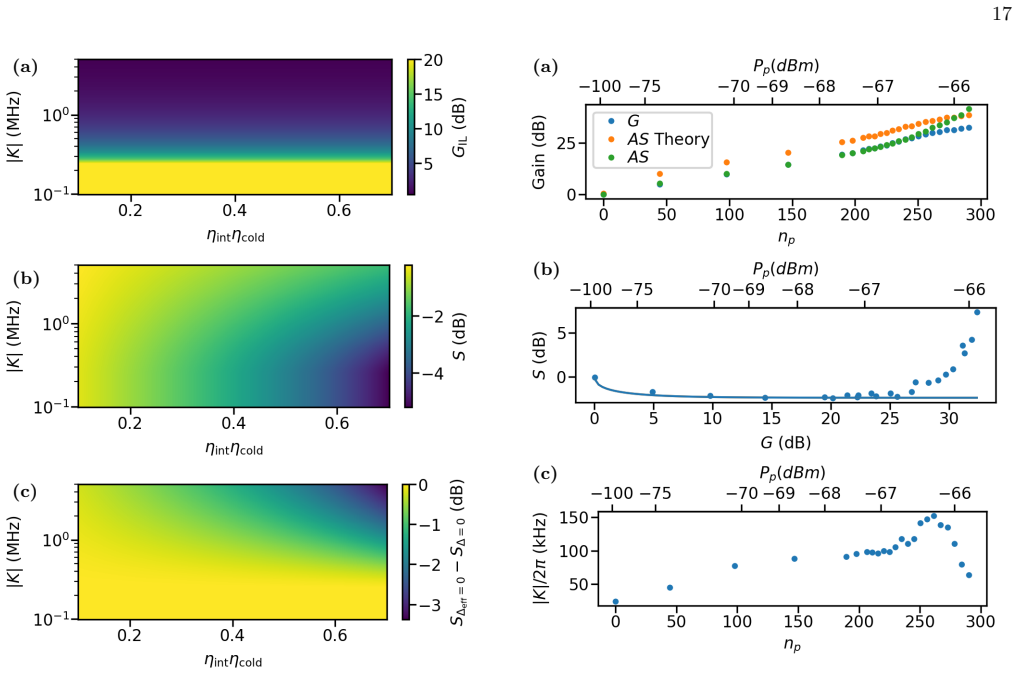
For practical applications with fixed squeezing frequency, varying the Kerr nonlinearity by about a factor of two produces no significant change in the achievable vacuum squeezing. Modeling shows that baseline Kerr in state-of-the-art SPAs is too small to be a limiting factor, with squeezing instead dominated by internal resonator loss and insertion loss in the microwave chain.
What carries the argument
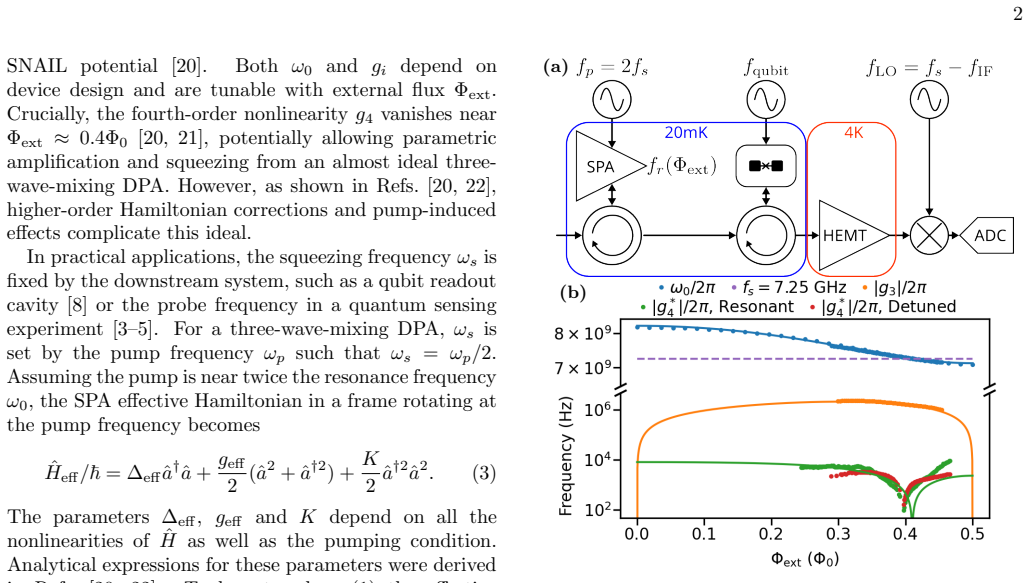
The SNAIL Parametric Amplifier operated at fixed squeezing frequency while varying external flux and pump power to modulate Kerr nonlinearity.
If this is right
- Reducing internal resonator loss and microwave chain insertion loss is the primary path to higher squeezing levels.
- Suppressing Kerr further offers little practical benefit for squeezing performance at fixed frequency.
- State-of-the-art SPAs already operate in a regime where Kerr is not the bottleneck for vacuum squeezing.
- Theoretical models of squeezing must account for loss mechanisms as the dominant constraint.
Where Pith is reading between the lines
- Similar loss-dominated behavior may apply to other parametric amplifiers used in quantum sensing.
- Future device designs could trade off some Kerr for lower loss without hurting squeezing.
- Experiments could test if increasing loss independently reduces squeezing as predicted.
Load-bearing premise
Varying external flux and pump power while holding squeezing frequency fixed isolates the Kerr contribution without introducing other uncontrolled changes in loss, gain, or mode structure.
What would settle it
An experiment that independently varies Kerr at fixed loss and frequency and observes a clear dependence of squeezing on Kerr would contradict the claim.
Figures


read the original abstract
We characterize single-mode vacuum squeezing generated by a SNAIL Parametric Amplifier (SPA) operated under conditions representative of practical sensing and qubit-readout experiments. Motivated by prior expectations that Kerr-induced distortion limits squeezing in degenerate parametric amplifiers, we varied external flux and pump power to explore operating points where Kerr nonlinearity is theoretically minimized. We find that for practical applications where the squeezing frequency is fixed, the Kerr was variable by about a factor of two and the achievable squeezing showed no significant dependence on Kerr. Theoretical modeling supports this observation and indicates that baseline Kerr values in state-of-the-art SPAs are already too small to impose a practical limitation. Instead, squeezing was dominated by internal resonator loss and insertion loss in the microwave chain. These results indicate that, in practical SPAs, reducing loss, rather than suppressing Kerr, is the primary route to improved squeezing performance.
Editorial analysis
A structured set of objections, weighed in public.
Referee Report
Summary. The manuscript characterizes single-mode vacuum squeezing in a SNAIL Parametric Amplifier (SPA) under conditions representative of practical sensing and qubit-readout experiments. By varying external flux and pump power at fixed squeezing frequency, the Kerr nonlinearity is changed by a factor of approximately two; the authors report no significant dependence of achievable squeezing on this Kerr variation. Theoretical modeling with standard circuit parameters indicates that baseline Kerr values in state-of-the-art SPAs are already too small to limit performance, with squeezing instead dominated by internal resonator loss and insertion loss in the microwave chain. The central conclusion is that loss reduction, rather than Kerr suppression, is the primary route to improved squeezing.
Significance. If the result holds, the work has clear practical significance for microwave quantum engineering: it redirects optimization priorities in SPAs toward minimizing internal and insertion losses rather than further Kerr engineering. The parameter-variation experiment combined with modeling supplies a falsifiable, application-oriented assessment that can guide device design for sensing and readout.
major comments (2)
- [Experimental Results] Experimental Results (parameter-variation study): the claim that squeezing shows no significant dependence on Kerr (varied by factor ~2) is load-bearing for the central conclusion, yet the manuscript must demonstrate that internal loss rate κ_int and external coupling κ_ext remain constant or are independently measured across the flux/pump points; otherwise the isolation of the Kerr contribution is incomplete and the lack of dependence could be an artifact of compensating loss changes.
- [Theoretical Modeling] Theoretical Modeling section: the model inputs (loss rates, gain, mode participation) are stated to support negligibility of Kerr, but the manuscript should show these inputs are held fixed or re-measured at each operating point rather than assumed constant; if they are fitted globally, the modeling does not independently confirm that Kerr is sub-dominant.
minor comments (2)
- [Abstract] Abstract: quantitative error bars, statistical significance of 'no significant dependence,' and a brief statement of the model equations or fit quality are absent, making it difficult to assess the strength of the null result.
- Figure captions and data presentation: raw squeezing spectra or full datasets with error bars should be included or made available to allow independent verification of the reported levels and their independence from Kerr.
Simulated Author's Rebuttal
We thank the referee for their thorough review and constructive feedback on our manuscript. We address the major comments point by point below, providing clarifications and indicating where revisions will be made to strengthen the presentation of our results.
read point-by-point responses
-
Referee: Experimental Results (parameter-variation study): the claim that squeezing shows no significant dependence on Kerr (varied by factor ~2) is load-bearing for the central conclusion, yet the manuscript must demonstrate that internal loss rate κ_int and external coupling κ_ext remain constant or are independently measured across the flux/pump points; otherwise the isolation of the Kerr contribution is incomplete and the lack of dependence could be an artifact of compensating loss changes.
Authors: We agree that it is essential to confirm the stability of the loss rates to isolate the effect of Kerr nonlinearity. In our experimental setup, the internal loss rate κ_int was characterized through separate measurements of the resonator decay rate at each external flux bias point without the pump applied. These measurements indicated that κ_int remained constant within 3% across the flux range explored. The external coupling κ_ext is determined by the fixed geometry of the coupling capacitor and does not vary with flux or pump power. To make this explicit, we will include a new panel in Figure 2 or an additional supplementary figure showing the measured κ_int and κ_ext at each operating point in the revised manuscript. revision: yes
-
Referee: Theoretical Modeling section: the model inputs (loss rates, gain, mode participation) are stated to support negligibility of Kerr, but the manuscript should show these inputs are held fixed or re-measured at each operating point rather than assumed constant; if they are fitted globally, the modeling does not independently confirm that Kerr is sub-dominant.
Authors: The loss rates used in the model were extracted from independent resonator characterization measurements performed at each flux point. The gain was measured directly at each operating point, and mode participation ratios were computed from the known circuit parameters and the applied pump amplitude. We did not perform a global fit; rather, the model was evaluated point-by-point using these locally determined inputs. We will revise the Theoretical Modeling section to explicitly describe this procedure and add a table listing the key input parameters for each data point to address this concern. revision: yes
Circularity Check
No significant circularity: central result is direct empirical measurement supported by independent standard modeling
full rationale
The paper's primary claim rests on an experimental scan in which external flux and pump power are varied at fixed squeezing frequency, producing a factor-of-two change in Kerr with no observed change in squeezing level. This is a direct measurement, not a derived prediction. The supporting theoretical modeling invokes standard circuit parameters (loss rates, coupling, etc.) to show that baseline Kerr values are already negligible compared with internal and insertion losses; these parameters are not fitted from the squeezing data itself nor defined in terms of the target observable. No self-definitional loop, fitted-input-as-prediction, or load-bearing self-citation chain appears in the reported derivation. The result is therefore self-contained against external benchmarks and receives a score of 0.
Axiom & Free-Parameter Ledger
free parameters (2)
- internal resonator loss rate
- insertion loss in microwave chain
axioms (1)
- domain assumption Kerr nonlinearity strength can be varied independently by external flux and pump power while holding the squeezing frequency fixed.
Reference graph
Works this paper leans on
-
[1]
(12) Following Ref. [20], the power in an input tone at angular frequency ωβ can be expressed as Pβ,in = ℏω0 κext |Ωβ,in|2 ω0 ωβ 2 ≡ ν2 β ℏω0 κext |Ωβ,in|2, (13) where νβ ≡ ω0/ωβ, Ωβ,in is the complex drive amplitude, and β ∈ { 1, 2, imd} labels the relevant tones proximal to the signal frequency. At this point, it is convenient to connect the input signa...
-
[2]
Inserting χs = −i(√GILeiθg+1)/κext into equation (14), and eliminating |Ωβ,in|2 between Eqs
encodes the phase of the output tone relative to the input, as mentioned in Appendix VIII F. Inserting χs = −i(√GILeiθg+1)/κext into equation (14), and eliminating |Ωβ,in|2 between Eqs. (13) and (14) yields nβ = |√GIL eiθg + 1|2 ν2 β Pβ,in ℏω0 κext (16) = |√GIL eiθg + 1|2 ν2 β GIL Pβ,out ℏω0 κext , (17) where, in the final equality, the linear gain relati...
-
[3]
D. F. Walls and G. J. Milburn, Quantum Optics , Graduate Texts in Physics (Springer Nature Switzerland, Cham, 2025)
work page 2025
-
[4]
The LIGO Scientific Collaboration, A gravitational wave (a) (b) (c) FIG. 12: a. VNA-measured SPA gain and antisqueezing over a finer set of pump powers at Φext = 0.42Φ0. The theoretical antisqueezing, calculated from gain, is also plotted, and is usually higher than AS. b. At the same operating points, squeezing shows saturation by G ≈ 10 dB, followed by ...
work page 2011
-
[5]
A. Bienfait, P. Campagne-Ibarcq, A. Kiilerich, X. Zhou, S. Probst, J. Pla, T. Schenkel, D. Vion, D. Esteve, J. Morton, K. Moelmer, and P. Bertet, Magnetic Resonance with Squeezed Microwaves, Physical Review X 7, 041011 (2017)
work page 2017
- [6]
-
[7]
K. M. Backes, D. A. Palken, S. A. Kenany, B. M. Brubaker, S. B. Cahn, A. Droster, G. C. Hilton, S. Ghosh, H. Jackson, S. K. Lamoreaux, A. F. Leder, K. W. Lehnert, S. M. Lewis, M. Malnou, R. H. Maruyama, N. M. Rapidis, M. Simanovskaia, S. Singh, D. H. Speller, I. Urdinaran, L. R. Vale, E. C. van 18 Assendelft, K. van Bibber, and H. Wang, A quantum enhanced...
work page 2021
-
[8]
S. Barzanjeh, D. P. DiVincenzo, and B. M. Terhal, Dispersive qubit measurement by interferometry with parametric amplifiers, Physical Review B 90, 134515 (2014)
work page 2014
- [9]
- [10]
-
[11]
G. Liu, X. Cao, T.-C. Chien, C. Zhou, P. Lu, and M. Hatridge, Noise Reduction in Qubit Readout with a Two-Mode Squeezed Interferometer, Physical Review Applied 18, 064092 (2022)
work page 2022
-
[12]
R. Movshovich, B. Yurke, P. G. Kaminsky, A. D. Smith, A. H. Silver, R. W. Simon, and M. V. Schneider, Observation of zero-point noise squeezing via a Josephson-parametric amplifier, Physical Review Letters 65, 1419 (1990)
work page 1990
-
[13]
A. I. Lvovsky and M. G. Raymer, Continuous-variable optical quantum-state tomography, Reviews of Modern Physics 81, 299 (2009)
work page 2009
-
[14]
C. Eichler, D. Bozyigit, C. Lang, L. Steffen, J. Fink, and A. Wallraff, Experimental State Tomography of Itinerant Single Microwave Photons, Physical Review Letters106, 220503 (2011)
work page 2011
- [15]
-
[16]
X. Zhou, V. Schmitt, P. Bertet, D. Vion, W. Wustmann, V. Shumeiko, and D. Esteve, High-gain weakly nonlinear flux-modulated Josephson parametric amplifier using a SQUID array, Physical Review B 89, 214517 (2014)
work page 2014
-
[17]
S. Boutin, D. M. Toyli, A. V. Venkatramani, A. W. Eddins, I. Siddiqi, and A. Blais, Effect of higher- order nonlinearities on amplification and squeezing in Josephson parametric amplifiers, Physical Review Applied 8, 054030 (2017), arXiv:1708.00020 [cond-mat, physics:quant-ph]
work page internal anchor Pith review Pith/arXiv arXiv 2017
-
[18]
Optimal operation of a Josephson parametric amplifier for vacuum squeezing
M. Malnou, D. A. Palken, L. R. Vale, G. C. Hilton, and K. W. Lehnert, Optimal operation of a Josephson parametric amplifier for vacuum squeezing, Physical Review Applied 9, 044023 (2018), arXiv:1711.02786 [quant-ph]
work page internal anchor Pith review Pith/arXiv arXiv 2018
-
[19]
M. Perelshtein, K. Petrovnin, V. Vesterinen, S. Hamedani Raja, I. Lilja, M. Will, A. Savin, S. Simbierowicz, R. Jabdaraghi, J. Lehtinen, L. Gr¨ onberg, J. Hassel, M. Prunnila, J. Govenius, G. Paraoanu, and P. Hakonen, Broadband Continuous- Variable Entanglement Generation Using a Kerr-Free Josephson Metamaterial, Physical Review Applied 18, 024063 (2022)
work page 2022
-
[20]
J. Y. Qiu, A. Grimsmo, K. Peng, B. Kannan, B. Lienhard, Y. Sung, P. Krantz, V. Bolkhovsky, G. Calusine, D. Kim, A. Melville, B. M. Niedzielski, J. Yoder, M. E. Schwartz, T. P. Orlando, I. Siddiqi, S. Gustavsson, K. P. O’Brien, and W. D. Oliver, Broadband squeezed microwaves and amplification with a Josephson travelling-wave parametric amplifier, Nature Ph...
work page 2023
-
[21]
A. Vaartjes, A. Kringhøj, W. Vine, T. Day, A. Morello, and J. J. Pla, Strong microwave squeezing above 1 Tesla and 1 Kelvin, Nature Communications 15, 4229 (2024)
work page 2024
-
[22]
N. E. Frattini, V. V. Sivak, A. Lingenfelter, S. Shankar, and M. H. Devoret, Optimizing the Nonlinearity and Dissipation of a SNAIL Parametric Amplifier for Dynamic Range, Physical Review Applied 10, 054020 (2018)
work page 2018
-
[23]
N. E. Frattini, U. Vool, S. Shankar, A. Narla, K. M. Sliwa, and M. H. Devoret, 3-wave mixing Josephson dipole element, Applied Physics Letters 110, 222603 (2017)
work page 2017
-
[24]
V. V. Sivak, N. E. Frattini, V. R. Joshi, A. Lingenfelter, S. Shankar, and M. H. Devoret, Kerr-free three-wave mixing in superconducting quantum circuits, Physical Review Applied 11, 054060 (2019), arXiv:1902.10575 [cond-mat, physics:quant-ph]
work page internal anchor Pith review Pith/arXiv arXiv 2019
- [25]
-
[26]
R. Kaufman, T. White, M. I. Dykman, A. Iorio, G. Sterling, S. Hong, A. Opremcak, A. Bengtsson, L. Faoro, J. C. Bardin, T. Burger, R. Gasca, and O. Naaman, Josephson parametric amplifier with Chebyshev gain profile and high saturation, Physical Review Applied 20, 054058 (2023)
work page 2023
-
[27]
C. C. Gerry and P. Knight, Introductory quantum optics , 3rd ed. (Cambridge Univ. Press, Cambridge, 2008)
work page 2008
-
[28]
Gated conditional displacement readout of superconducting qubits
S. Touzard, A. Kou, N. E. Frattini, V. V. Sivak, S. Puri, A. Grimm, L. Frunzio, S. Shankar, and M. H. Devoret, Gated conditional displacement readout of superconducting qubits, Physical Review Letters 122, 080502 (2019), arXiv:1809.06964 [quant-ph]
work page internal anchor Pith review Pith/arXiv arXiv 2019
-
[29]
J. Bizn´ arov´ a, J. Rivera Hern´ andez, D. Forchheimer, J. Bylander, D. B. Haviland, and G. Andersson, Intermodulation spectroscopy and the nonlinear response of two-level systems in superconducting coplanar- waveguide resonators, Physical Review Applied 22, 014063 (2024)
work page 2024
-
[30]
A. Remm, S. Krinner, N. Lacroix, C. Hellings, F. Swiadek, G. J. Norris, C. Eichler, and A. Wallraff, Intermodulation Distortion in a Josephson Traveling- Wave Parametric Amplifier, Physical Review Applied20, 034027 (2023)
work page 2023
-
[31]
R. Ott, P. Lahl, and R. W¨ ordenweber, Nonlinear microwave properties of ferroelectric thin films, Applied Physics Letters 84, 4147 (2004)
work page 2004
-
[32]
Power-dependent internal loss in Josephson bifurcation amplifiers
M. Watanabe, K. Inomata, T. Yamamoto, and J.- S. Tsai, Power-dependent internal loss in Josephson bifurcation amplifiers, Physical Review B 80, 174502 (2009), arXiv:0911.4221 [cond-mat]
work page internal anchor Pith review Pith/arXiv arXiv 2009
-
[33]
G. J. Dolan, Offset masks for lift-off photoprocessing, Applied Physics Letters 31, 337 (1977)
work page 1977
-
[34]
Y. Shalibo, Y. Rofe, D. Shwa, F. Zeides, M. Neeley, J. M. Martinis, and N. Katz, Lifetime and Coherence of Two- Level Defects in a Josephson Junction, Physical Review Letters 105, 177001 (2010)
work page 2010
-
[35]
I. Garc´ ıa-Mata, R. G. Corti˜ nas, X. Xiao, J. Ch´ avez- Carlos, V. S. Batista, L. F. Santos, and D. A. Wisniacki, 19 Effective versus Floquet theory for the Kerr parametric oscillator, Quantum 8, 1298 (2024), arXiv:2309.12516 [quant-ph]
-
[36]
K. Peng, M. Naghiloo, J. Wang, G. D. Cunningham, Y. Ye, and K. P. O’Brien, Floquet-Mode Traveling-Wave Parametric Amplifiers, PRX Quantum 3, 020306 (2022)
work page 2022
discussion (0)
Sign in with ORCID, Apple, or X to comment. Anyone can read and Pith papers without signing in.