REVIEW 2 major objections 4 minor 135 references
Investigating a strong first-order electroweak phase transition in the RxSM at future linear $e^+e^-$ colliders and LISA
T0 review · 2 major / 4 minor · reviewed 2026-07-13 · grok-4.5
Pith's one-line read Singlet-driven and doublet-driven strong first-order electroweak phase transitions leave opposite experimental footprints: gravitational waves or large Higgs self-coupling deviations.
desk verdict Clean, usable map of two disjoint SFOEWPT regimes in the RxSM, with consistent one-loop trilinear couplings; the LISA/collider split is real but only semi-quantitative because of fixed wall velocity. read the letter →
The pith
A machine-rendered reading of the paper's core claim, the machinery that carries it, and where it could break.
The reading
What carries the argument
Two benchmark planes that isolate the two driving directions of the transition, with all relevant trilinear scalar couplings evaluated at full one-loop order both for the finite-temperature effective potential and for the collider cross sections.
What would settle it
A LISA detection with SNR greater than 10 together with a measured trilinear Higgs coupling still consistent with the Standard Model within a few percent would confirm the singlet-driven class; a measured coupling modifier between 1.35 and 1.7 with no corresponding LISA signal would confirm the doublet-driven class; either opposite combination would falsify the claimed complementarity.
Extended reading notes
Core claim
In the RxSM the parameter regions that realise a strong first-order electroweak phase transition split into two disjoint phenomenological classes: singlet-driven transitions produce LISA signal-to-noise ratios above 10 while the one-loop trilinear Higgs coupling modifier stays within a few percent of unity, whereas doublet-driven transitions force that modifier into the range 1.35–1.7 (and correspondingly large deviations in e+e- di-Higgs rates) while the LISA signal-to-noise ratio stays below 10 for almost the entire plane.
Load-bearing premise
The claimed split between “detectable” and “undetectable” gravitational-wave signals rests on fixing the bubble-wall velocity at the pessimistic value 0.95; a lower velocity would raise the signal-to-noise ratio by a large factor and could erase the dichotomy.
Editorial extensions
If this is right
- A positive LISA signal with SM-like Higgs couplings would select the singlet-driven region of the RxSM and rule out a pure doublet-driven barrier.
- A measured trilinear coupling modifier of order 1.5 at ILC1000, even without a LISA signal, would select the doublet-driven region and indicate that the electroweak barrier itself drove the transition.
- Differential m_hh distributions at a 1 TeV e+e- collider can separately resolve the resonant heavy-Higgs peak and the continuum shift induced by the modified self-coupling, giving two independent handles on the same potential.
- Because the same one-loop couplings enter both the phase-transition calculation and the collider rates, a joint measurement would reconstruct which field direction dominated the early-Universe transition.
Reading between the lines
- If future lattice or real-time simulations fix the bubble-wall velocity well below 0.95, the “GW-only” window of the singlet-driven plane may shrink and the two classes could begin to overlap in SNR space.
- The same complementarity logic should apply to any multi-scalar model in which the barrier can be generated either by a singlet or by the electroweak doublet itself; the RxSM merely supplies the cleanest laboratory.
- A null result at both LISA and ILC1000 would not kill the possibility of a strong first-order transition, but would force it into a narrow intermediate strip where both signals are just below threshold.
Editorial analysis
A structured set of objections, weighed in public.
Referee Report
Summary. The manuscript studies the general real-singlet extension of the SM (RxSM) as a minimal setting that can realise a strong first-order electroweak phase transition (SFOEWPT). Using BSMPT 3.1.1 (with the RxSM newly implemented) the authors map the thermal histories of the scalar potential and identify six distinct patterns, three of which produce SFOEWPTs. Two representative benchmark planes are constructed: BP1 (singlet-driven) and BP2 (doublet-driven). One-loop corrections to the trilinear couplings λ_hhh and λ_hhH are evaluated consistently with anyH3 in a fully on-shell scheme and are fed both into the thermal analysis and into MadGraph predictions for e^{+}e^{-} o Zhh and e^{+}e^{-} o u u hh at ILC1000. The central claim is that the two classes of SFOEWPT yield complementary experimental signatures: BP1 produces LISA SNRs ≳ 10 while κ_λ remains SM-like; BP2 forces 1.35 ≲ κ_λ^{(1)} ≲ 1.7 (and correspondingly large deviations in the di-Higgs rates) while the LISA SNR stays below 10 for almost the entire plane.
Significance. If the reported dichotomy holds, the work supplies a concrete, falsifiable illustration of the complementarity between future e^{+}e^{-} colliders and LISA for reconstructing the shape of the Higgs potential. The consistent inclusion of one-loop trilinear couplings in both the thermal and collider calculations, the public-code implementation of the RxSM in BSMPT, and the explicit differential distributions with experimental cuts and polarisations constitute genuine technical advances over earlier RxSM studies. The two benchmark planes cleanly separate the phenomenological regimes and therefore provide useful targets for both communities.
major comments (2)
- The SNR values that underpin the claimed “detectable vs. undetectable” split between BP1 and BP2 are computed exclusively with the fixed, pessimistic wall velocity v_w = 0.95 (and three years of LISA observation). The text itself notes (around the discussion of Fig. 4 and Fig. 6) that a lower velocity v_w ∼ 0.6 can raise the SNR by a large factor. Because v_w is not derived from the model parameters, the quantitative complementarity is only semi-quantitative; a short sensitivity scan or an explicit statement of the range of v_w over which the dichotomy survives is needed to make the central claim robust.
- The linear relations that define BP1 (Eq. (1)) and BP2 (Eq. (2)) are chosen so as to maximise either the GW signal or the κ_λ deviation. While the choices are transparent, the paper should demonstrate that the qualitative split (SM-like κ_λ + large SNR versus large κ_λ + small SNR) persists for nearby, less optimised slices of parameter space; otherwise the complementarity could be an artefact of the particular hyperplanes selected.
minor comments (4)
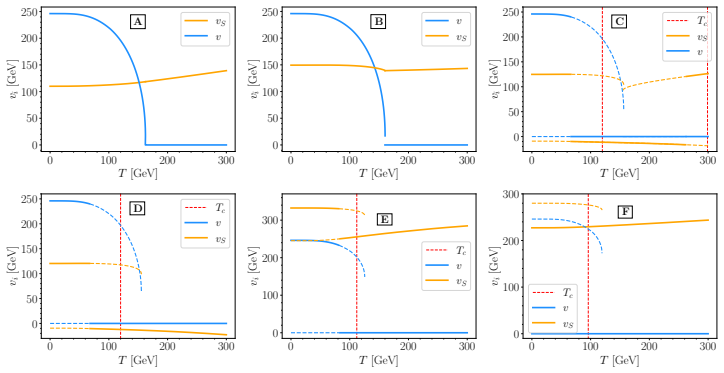
- Fig. 1 captions and the accompanying text use the labels A–F for thermal histories; it would help the reader if the same letters were printed directly on the panels.
- The units of κ_SH in the right-hand panel of Fig. 6 and in the caption of Fig. 7 are occasionally written as “TeV” while the plotted values are in GeV; a uniform convention would avoid confusion.
- A brief remark on the numerical stability of the one-loop effective potential near the vacuum-trapping boundary (region F of BP2) would reassure the reader that the sharp transition from SFOEWPT to trapping is not a lattice artefact of BSMPT.
- The polarisation choice (−80 %, +30 %) and the integrated luminosity 3200 fb^{-1} for ILC1000 are stated only in the caption of Fig. 7; they should also appear in the main text of Sec. 5.
Circularity Check
No load-bearing circularity; only minor explicit parameter tuning of benchmark planes to illustrate high-SNR regions already identified in the scan.
-
fitted input called prediction
[Section 4 (Benchmark plane 1), eq. (1) and surrounding text; also left panel of Fig. 4]
"Here it should be kept in mind that the choice of κ_S H and v_S that defines BP1, see eq. (1) was made to ensure that large parts of this parameter plane exhibit high values of the SNR (the maximal values of the SNR that are reached are however not particularly dependent on this choice)."
The linear relations that fix κ_SH(v_S) in terms of cos α are deliberately chosen so that the subsequent BSMPT evaluation yields SNR ≳ 10 over a sizable fraction of the displayed plane. Reporting “strong GW signals” inside that plane is therefore partly by construction of the slice, even though the existence of high-SNR points was first established in the unrestricted scan of Fig. 2 and the paper notes that peak SNR values are robust. This is a mild, acknowledged selection effect rather than a definitional identity or a data-driven fit renamed as a prediction.
full rationale
The paper's central claims (two disjoint classes of SFOEWPT thermal histories in the RxSM, with complementary GW vs. collider signatures) are obtained by scanning the seven-dimensional parameter space with the public tool BSMPT (for nucleation/percolation temperatures, ξ_n, α, β/H_*, and LISA SNR) and anyH3 (for one-loop on-shell trilinear couplings λ_hhh and λ_hhH), then feeding the latter into MadGraph for e⁺e⁻ di-Higgs rates. These computations are independent of one another and of external data fits. The two benchmark planes are defined after the scan (eqs. (1)–(2)) by fixing linear relations among κ_S, κ_SH, v_S and cos α that populate the high-ξ_n regions already found; the paper itself states that the choice for BP1 “was made to ensure that large parts of this parameter plane exhibit high values of the SNR” while noting that the maximal SNR values “are however not particularly dependent on this choice.” This is ordinary illustrative selection, not a self-definitional or fitted-input “prediction.” Self-citations (to the authors’ prior anyH3/renormalisation papers and to the full arXiv:2510.12569 version of the same work) supply the computational framework but are not load-bearing uniqueness theorems or unverified premises; the thermal histories, κ_λ ranges and SNR maps are new numerical results. The fixed v_w = 0.95 assumption affects quantitative SNR thresholds but is an external dynamical input, not a circular reduction. Hence the derivation chain is self-contained against the paper’s own equations and tools; score remains at the low end of the 0–2 band.
Assumptions & free parameters
free parameters (3)
- bubble wall velocity vw
- κ_S, κ_SH, v_S linear relations that define BP1 and BP2
- seven RxSM input parameters (m_h, m_H, α, v, v_S, κ_S, κ_SH)
assumptions (3)
- domain assumption The one-loop finite-temperature effective potential (with the daisy resummation scheme of BSMPT) correctly captures the nucleation and percolation temperatures of the RxSM.
- domain assumption The fully on-shell renormalisation scheme of Ref. [46] for the trilinear couplings λ_hhh and λ_hhH is the appropriate scheme for both the thermal potential and the collider matrix elements.
- domain assumption Perturbative unitarity, boundedness-from-below and HiggsTools constraints exhaust the relevant theoretical and experimental bounds on the RxSM parameter space.
Cite this review
Pith. "Pith review of Investigating a strong first-order electroweak phase transition in the RxSM at future linear $e^+e^-$ colliders and LISA." pith.science (2026). https://pith.science/paper/72S3RUET
@misc{pith2026260318799,
  author       = {Pith},
  title        = {Pith review of: Investigating a strong first-order electroweak phase transition in the RxSM at future linear $e^+e^-$ colliders and LISA},
  year         = {2026},
  howpublished = {\url{https://pith.science/paper/72S3RUET}},
  note         = {Machine review of arXiv:2603.18799}
}
abstract
The general real singlet extension of the Standard Model (SM), the RxSM, is one of the simplest theories Beyond-the-Standard Model (BSM) that can accommodate a strong first-order electroweak phase transition (SFOEWPT). We investigate the possible thermal histories of the scalar potential in the RxSM, and the regions of the model parameter space in which SFOEWPT can be realised. We then explore complementary avenues to probe such scenarios experimentally: either using searches for a stochastic background of gravitational waves (GWs), or using searches for di-Higgs production processes at future collider experiments, focusing on the case of a high-energy $e^+e^-$ collider. An important aspect of our work is that one-loop corrections to all relevant trilinear scalar couplings are consistently included both in the calculation of dynamics of the electroweak phase transition (EWPT) and in collider processes. We find entirely different phenomenological signatures for different parts of the RxSM parameter space giving rise to SFOEWPTs. On the one hand, if the SFOEWPT is driven by the singlet field, the 125 GeV Higgs boson is very SM-like and signs of BSM physics would be difficult to find at colliders, but strong GW signals could be produced. On the other hand, in scenarios where a SFOEWPT is driven by the doublet field, BSM deviations in properties of the detected Higgs boson, particularly in its trilinear self-coupling, typically lead to observable signals at colliders, while detectable GW signals are much more challenging to achieve. This work highlights the complementarity of collider experiments and cosmological observations to determine the dynamics of the EWPT and reconstruct the shape of the Higgs potential realised in Nature.
Figures


Figures from the paper (4 more)


Reference graph
Works this paper leans on
-
[1]
Astrophys.641(2020) A6 [1807.06209]
Planckcollaboration,Astron. Astrophys.641(2020) A6 [1807.06209]
arXiv 2020
-
[2]
B.D. Fields, K.A. Olive, T.-H. Yeh and C. Young,JCAP03(2020) 010 [1912.01132]
arXiv 2020
-
[3]
Kuzmin, V .A
V .A. Kuzmin, V .A. Rubakov and M.E. Shaposhnikov,Phys. Lett. B155(1985) 36
1985
-
[4]
A.G. Cohen, D.B. Kaplan and A.E. Nelson,Ann. Rev. Nucl. Part. Sci.43(1993) 27 [hep-ph/9302210]
arXiv 1993
-
[5]
Sakharov,Pisma Zh
A.D. Sakharov,Pisma Zh. Eksp. Teor . Fiz.5(1967) 32
1967
-
[6]
T. Barklow, K. Fujii, S. Jung, M.E. Peskin and J. Tian,Phys. Rev. D97(2018) 053004 [1708.09079]
arXiv 2018
-
[7]
LinearColliderVisioncollaboration,2503.19983
-
[8]
Altmann et al.,ECF A Higgs, electroweak, and top Factory Study, vol
J. Altmann et al.,ECF A Higgs, electroweak, and top Factory Study, vol. 5/2025 of CERN Yellow Reports: Monographs(6, 2025), 10.23731/CYRM-2025-005, [2506.15390]
Show all 135 references
-
[9]
Grojean, G
C. Grojean, G. Servant and J.D. Wells,Phys. Rev. D71(2005) 036001 [hep-ph/0407019]. 10
2005 arXiv
-
[10]
Kanemura, Y
S. Kanemura, Y . Okada and E. Senaha,Phys. Lett. B606(2005) 361 [hep-ph/0411354]
2005 arXiv
-
[11]
Kakizaki, S
M. Kakizaki, S. Kanemura and T. Matsui,Phys. Rev. D92(2015) 115007 [1509.08394]
2015 arXiv
-
[12]
Hashino, M
K. Hashino, M. Kakizaki, S. Kanemura and T. Matsui,Phys. Rev. D94(2016) 015005 [1604.02069]
2016 arXiv
-
[13]
Hashino, M
K. Hashino, M. Kakizaki, S. Kanemura, P. Ko and T. Matsui,Phys. Lett. B766 (2017) 49 [1609.00297]
2017 arXiv
- [14]
-
[15]
Biekötter, S
T. Biekötter, S. Heinemeyer, J.M. No, M.O. Olea-Romacho and G. Weiglein,JCAP 03(2023) 031 [2208.14466]
2023 arXiv
-
[16]
Bittar, S
P. Bittar, S. Roy and C.E.M. Wagner,JHEP12(2025) 021 [2504.02024]
2025
-
[17]
Braathen, S
J. Braathen, S. Heinemeyer, C. Pulido Boatella and A. Verduras Schaeidt, 2510.12569
-
[18]
Kanemura, S
S. Kanemura, S. Kiyoura, Y . Okada, E. Senaha and C.P. Yuan,Phys. Lett. B558 (2003) 157 [hep-ph/0211308]
2003 arXiv
-
[19]
Kanemura, Y
S. Kanemura, Y . Okada, E. Senaha and C.P. Yuan,Phys. Rev. D70(2004) 115002 [hep-ph/0408364]
2004 arXiv
-
[20]
M. Aoki, S. Kanemura, M. Kikuchi and K. Yagyu,Phys. Rev. D87(2013) 015012 [1211.6029]
2013 arXiv
- [21]
- [22]
- [23]
-
[24]
Kanemura, M
S. Kanemura, M. Kikuchi and K. Sakurai,Phys. Rev. D94(2016) 115011 [1605.08520]
2016 arXiv
- [25]
- [26]
-
[27]
Kanemura, M
S. Kanemura, M. Kikuchi, K. Sakurai and K. Yagyu,Phys. Rev. D96(2017) 035014 [1705.05399]
2017 arXiv
-
[28]
Kanemura, M
S. Kanemura, M. Kikuchi, K. Sakurai and K. Yagyu,Comput. Phys. Commun.233 (2018) 134 [1710.04603]
2018 arXiv
-
[29]
Chiang, A.-L
C.-W. Chiang, A.-L. Kuo and K. Yagyu,Phys. Rev. D98(2018) 013008 [1804.02633]
2018 arXiv
- [30]
- [31]
- [32]
-
[33]
Kanemura, M
S. Kanemura, M. Kikuchi, K. Mawatari, K. Sakurai and K. Yagyu,Comput. Phys. Commun.257(2020) 107512 [1910.12769]
2020 arXiv
- [34]
- [35]
-
[36]
Basler, M
P. Basler, M. Mühlleitner and J. Müller,Comput. Phys. Commun.269(2021) 108124 [2007.01725]
2021 arXiv
-
[37]
H. Bahl, J. Braathen and G. Weiglein,Phys. Rev. Lett.129(2022) 231802 [2202.03453]. 11
2022 arXiv
-
[38]
Bahl, W.H
H. Bahl, W.H. Chiu, C. Gao, L.-T. Wang and Y .-M. Zhong,Eur . Phys. J. C82(2022) 944 [2207.04059]
2022 arXiv
- [39]
-
[40]
H. Bahl, J. Braathen, M. Gabelmann and G. Weiglein,Eur . Phys. J. C83(2023) 1156 [2305.03015]
2023 arXiv
-
[41]
M. Aiko, J. Braathen and S. Kanemura,Eur . Phys. J. C85(2025) 489 [2307.14976]
2025 arXiv
-
[42]
Cherchiglia and L.J
A. Cherchiglia and L.J. Ferreira Leite,JHEP09(2025) 101 [2411.00094]
2025
-
[43]
Basler, L
P. Basler, L. Biermann, M. Mühlleitner, J. Müller, R. Santos and J. Viana,Comput. Phys. Commun.316(2025) 109766 [2404.19037]
2025 arXiv
-
[44]
H. Bahl, J. Braathen, M. Gabelmann and S. Paßehr,JHEP11(2025) 161 [2503.15645]
2025 arXiv
-
[45]
F. Arco, S. Heinemeyer and M. Mühlleitner,JHEP01(2026) 160 [2505.02947]
2026 arXiv
-
[46]
Braathen, S
J. Braathen, S. Heinemeyer, A. Parra Arnay and A. Verduras Schaeidt,Eur . Phys. J. C85(2025) 1153 [2507.02569]
2025
- [47]
-
[48]
Athron, C
P. Athron, C. Balázs, A. Fowlie, L. Morris and L. Wu,Prog. Part. Nucl. Phys.135 (2024) 104094 [2305.02357]
2024 arXiv
- [49]
- [50]
-
[51]
J.M. No,Phys. Rev. D84(2011) 124025 [1103.2159]
2011 arXiv
- [52]
-
[53]
Dorsch, S.J
G.C. Dorsch, S.J. Huber, T. Konstandin and J.M. No,JCAP05(2017) 052 [1611.05874]
2017 arXiv
-
[54]
Z. Kang, P. Ko and T. Matsui,JHEP02(2018) 115 [1706.09721]
2018 arXiv
-
[55]
Bruggisser, B
S. Bruggisser, B. V on Harling, O. Matsedonskyi and G. Servant,JHEP12(2018) 099 [1804.07314]
2018 arXiv
- [56]
- [57]
-
[58]
Hashino, M
K. Hashino, M. Kakizaki, S. Kanemura, P. Ko and T. Matsui,JHEP06(2018) 088 [1802.02947]
2018 arXiv
-
[59]
Hashino, R
K. Hashino, R. Jinno, M. Kakizaki, S. Kanemura, T. Takahashi and M. Takimoto, Phys. Rev. D99(2019) 075011 [1809.04994]
2019 arXiv
-
[60]
Gonçalves, A
D. Gonçalves, A. Kaladharan and Y . Wu,Phys. Rev. D105(2022) 095041 [2108.05356]
2022 arXiv
-
[61]
Lewicki, P
M. Lewicki, P. Toczek and V . Vaskonen,Phys. Rev. Lett.133(2024) 221003 [2402.04158]
2024 arXiv
-
[62]
Biekötter, A
T. Biekötter, A. Dashko, M. Löschner and G. Weiglein,2511.14831
-
[63]
Kodama, M
H. Kodama, M. Sasaki and K. Sato,Prog. Theor . Phys.68(1982) 1979
1982
-
[64]
J. Liu, L. Bian, R.-G. Cai, Z.-K. Guo and S.-J. Wang,Phys. Rev. D105(2022) L021303 [2106.05637]
2022 arXiv
-
[65]
Hashino, S
K. Hashino, S. Kanemura and T. Takahashi,Phys. Lett. B833(2022) 137261 [2111.13099]
2022 arXiv
- [66]
- [67]
- [68]
-
[69]
Gouttenoire and T
Y . Gouttenoire and T. V olansky,Phys. Rev. D110(2024) 043514 [2305.04942]
2024 arXiv
- [70]
-
[71]
Flores, A
M.M. Flores, A. Kusenko and M. Sasaki,Phys. Rev. D110(2024) 015005 [2402.13341]
2024 arXiv
- [72]
-
[73]
Hashino, S
K. Hashino, S. Kanemura, T. Takahashi, M. Tanaka and C.-M. Yoo,JCAP09(2025) 006 [2501.11040]
2025 arXiv
- [74]
- [75]
-
[76]
Vachaspati,Phys
T. Vachaspati,Phys. Lett. B265(1991) 258
1991
-
[77]
Ellis, M
J. Ellis, M. Fairbairn, M. Lewicki, V . Vaskonen and A. Wickens,JCAP09(2019) 019 [1907.04315]
2019 arXiv
- [78]
-
[79]
Caprini et al.,JCAP03(2020) 024 [1910.13125]
C. Caprini et al.,JCAP03(2020) 024 [1910.13125]
2020 arXiv
-
[80]
Rel.26(2023) 5 [2204.05434]
LISA CosmologyWorkingGroupcollaboration,Living Rev. Rel.26(2023) 5 [2204.05434]
2023 arXiv
- [81]
-
[82]
Profumo, M.J
S. Profumo, M.J. Ramsey-Musolf and G. Shaughnessy,JHEP08(2007) 010 [0705.2425]
2007 arXiv
- [83]
-
[84]
Alves, T
A. Alves, T. Ghosh, H.-K. Guo, K. Sinha and D. Vagie,JHEP04(2019) 052 [1812.09333]
2019 arXiv
- [85]
-
[86]
Ellis, M
J. Ellis, M. Lewicki, M. Merchand, J.M. No and M. Zych,JHEP01(2023) 093 [2210.16305]
2023 arXiv
-
[87]
Blasi, R
S. Blasi, R. Jinno, T. Konstandin, H. Rubira and I. Stomberg,JCAP10(2023) 051 [2302.06952]
2023 arXiv
- [88]
- [89]
- [90]
-
[91]
Niemi, M.J
L. Niemi, M.J. Ramsey-Musolf and G. Xia,Phys. Rev. D110(2024) 115016 [2405.01191]
2024 arXiv
- [92]
- [93]
-
[94]
Gonçalves, A
D. Gonçalves, A. Kaladharan and Y . Wu,Phys. Rev. D111(2025) 035009 [2406.07622]
2025 arXiv
-
[95]
H.-L. Li, M. Ramsey-Musolf and S. Willocq,Phys. Rev. D100(2019) 075035 [1906.05289]
2019 arXiv
-
[96]
Zhang, H.-L
W. Zhang, H.-L. Li, K. Liu, M.J. Ramsey-Musolf, Y . Zeng and S. Arunasalam,JHEP 12(2023) 018 [2303.03612]
2023 arXiv
- [97]
-
[98]
Feuerstake, E
F. Feuerstake, E. Fuchs, T. Robens and D. Winterbottom,JHEP04(2025) 094 [2409.06651]
2025 arXiv
-
[99]
Lewis, J.L
I.M. Lewis, J.L. Scott, M.A.S. Alcaraz and M. Sullivan,Phys. Rev. D112(2025) 095024 [2410.08275]. 13
2025
-
[100]
Aboudonia, C
M. Aboudonia, C. Balazs, A. Papaefstathiou and G. White,JHEP04(2025) 093 [2410.22700]
2025 arXiv
-
[101]
Braathen, M.D
J. Braathen, M.D. Goodsell, M.E. Krauss, T. Opferkuch and F. Staub,Phys. Rev. D 97(2018) 015011 [1711.08460]
2018 arXiv
-
[102]
H. Bahl, T. Biekötter, S. Heinemeyer, C. Li, S. Paasch, G. Weiglein et al.,Comput. Phys. Commun.291(2023) 108803 [2210.09332]
2023 arXiv
-
[103]
Bechtle, O
P. Bechtle, O. Brein, S. Heinemeyer, G. Weiglein and K.E. Williams,Comput. Phys. Commun.181(2010) 138 [0811.4169]
2010 arXiv
-
[104]
Bechtle, O
P. Bechtle, O. Brein, S. Heinemeyer, G. Weiglein and K.E. Williams,Comput. Phys. Commun.182(2011) 2605 [1102.1898]
2011 arXiv
-
[105]
Bechtle, O
P. Bechtle, O. Brein, S. Heinemeyer, O. Stål, T. Stefaniak, G. Weiglein et al.,Eur . Phys. J. C74(2014) 2693 [1311.0055]
2014 arXiv
-
[106]
Bechtle, S
P. Bechtle, S. Heinemeyer, O. Stal, T. Stefaniak and G. Weiglein,Eur . Phys. J. C75 (2015) 421 [1507.06706]
2015 arXiv
-
[107]
Bechtle, D
P. Bechtle, D. Dercks, S. Heinemeyer, T. Klingl, T. Stefaniak, G. Weiglein et al.,Eur . Phys. J. C80(2020) 1211 [2006.06007]
2020 arXiv
-
[108]
Bechtle, S
P. Bechtle, S. Heinemeyer, O. Stål, T. Stefaniak and G. Weiglein,Eur . Phys. J. C74 (2014) 2711 [1305.1933]
2014 arXiv
-
[109]
Bechtle, S
P. Bechtle, S. Heinemeyer, O. Stål, T. Stefaniak and G. Weiglein,JHEP11(2014) 039 [1403.1582]
2014 arXiv
-
[110]
Bechtle, S
P. Bechtle, S. Heinemeyer, T. Klingl, T. Stefaniak, G. Weiglein and J. Wittbrodt,Eur . Phys. J. C81(2021) 145 [2012.09197]
2021 arXiv
-
[111]
H. Bahl, J. Braathen, M. Gabelmann, K. Radchenko and G. Weiglein, DESY-26-010, IFT–UAM/CSIC-26-7
-
[112]
H. Bahl, J. Braathen, M. Gabelmann, K. Radchenko and G. Weiglein, DESY-26-038
-
[113]
Alwall, R
J. Alwall, R. Frederix, S. Frixione, V . Hirschi, F. Maltoni, O. Mattelaer et al.,JHEP 07(2014) 079 [1405.0301]
2014 arXiv
- [114]
- [115]
- [116]
- [117]
- [118]
- [119]
- [120]
- [121]
-
[122]
Cline, G.D
J.M. Cline, G.D. Moore and G. Servant,Phys. Rev. D60(1999) 105035 [hep-ph/9902220]
1999 arXiv
-
[123]
S. Baum, M. Carena, N.R. Shah, C.E.M. Wagner and Y . Wang,JHEP03(2021) 055 [2009.10743]
2021 arXiv
-
[124]
Biekötter, S
T. Biekötter, S. Heinemeyer, J.M. No, M.O. Olea and G. Weiglein,JCAP06(2021) 018 [2103.12707]
2021 arXiv
-
[125]
ATLAS collaboration,Eur . Phys. J. C81(2021) 332 [2009.14791]
2021 arXiv
-
[126]
W.-Y . Ai, B. Laurent and J. van de Vis,JCAP07(2023) 002 [2303.10171]
2023 arXiv
-
[127]
Ekstedt, O
A. Ekstedt, O. Gould, J. Hirvonen, B. Laurent, L. Niemi, P. Schicho et al.,JHEP04 (2025) 101 [2411.04970]. 14
2025 arXiv
-
[128]
Branchina, A
C. Branchina, A. Conaci, S. De Curtis, L. Delle Rose, A. Guiggiani, A. Gil Muyor et al.,EPJ Web Conf.314(2024) 00031 [2410.00766]
2024 arXiv
-
[129]
De Curtis, L
S. De Curtis, L. Delle Rose, A. Guiggiani, Á. Gil Muyor and G. Panico,JHEP05 (2024) 009 [2401.13522]
2024 arXiv
-
[130]
De Curtis, L
S. De Curtis, L. Delle Rose, A. Guiggiani, Á. Gil Muyor and G. Panico,JHEP05 (2023) 194 [2303.05846]
2023 arXiv
-
[131]
De Curtis, L.D
S. De Curtis, L.D. Rose, A. Guiggiani, Á.G. Muyor and G. Panico,JHEP03(2022) 163 [2201.08220]
2022 arXiv
-
[132]
Branchina, A
C. Branchina, A. Conaci, L. Delle Rose and S. De Curtis,Phys. Rev. D113(2026) 035024 [2510.21942]
2026
-
[133]
ATLAS collaboration,Phys. Rev. D98(2018) 052008 [1808.02380]
2018 arXiv
-
[134]
CMS collaboration,JHEP11(2021) 057 [2106.10361]
2021 arXiv
-
[135]
F. Arco, S. Heinemeyer, M. Mühlleitner, A. Parra Arnay, N. Rivero González and A. Verduras Schaeidt,JHEP06(2025) 211 [2502.03878]. 15
2025 arXiv
Reviewed July 13, 2026 · model on record in the stance chip above.
Discussion (0). Sign in to comment.