Regulation of propulsion in assemblies of thermophoretic nanomotors
Pith reviewed 2026-05-15 07:26 UTC · model grok-4.3
The pith
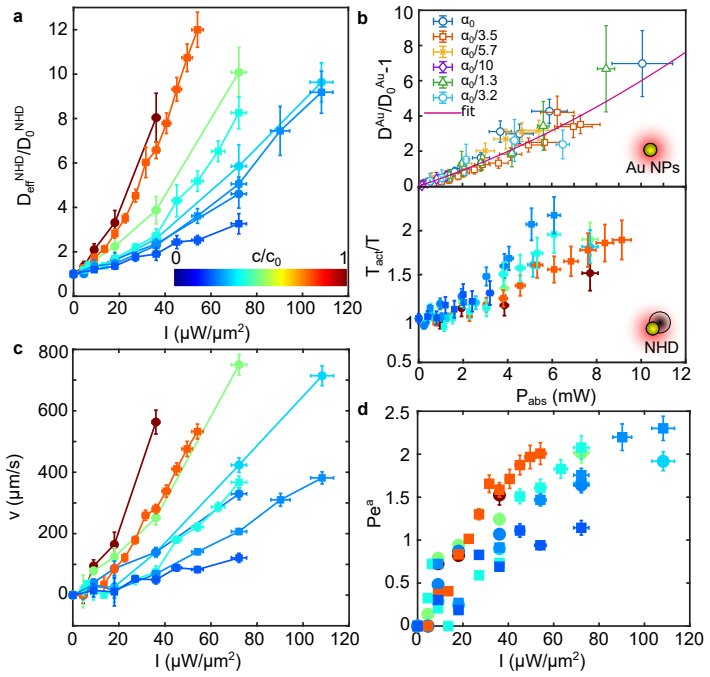
Thermophoretic nanomotors in assemblies reach speeds up to 800 micrometers per second because their own local density alters the temperature field that drives them.
A machine-rendered reading of the paper's core claim, the machinery that carries it, and where it could break.
Core claim
Assemblies of thermophoretic nanomotors display a strong, nonlinear dependence of propulsion speed on local particle concentration, reaching up to 800 μm/s. The origin is a coupling in which the concentration field modifies the temperature distribution, which then feeds back to alter the thermophoretic mobility of the nanoparticles. Modeling that accounts for all thermal nonlinearities reproduces the observed behavior.
What carries the argument
The concentration-temperature feedback loop in which local nanomotor density changes the temperature field and thereby the thermophoretic mobility of each particle.
If this is right
- Active fluids can achieve self-regulated, ultrafast propulsion through thermal coupling alone.
- Concentration acts as an internal control parameter for thermophoretic mobility without external sensing.
- 3D active materials can be designed whose dynamics emerge from heat-particle interactions.
- Nonlinear propulsion becomes dominant once local density exceeds a threshold set by the thermal length scale.
Where Pith is reading between the lines
- The same feedback could stabilize or destabilize collective motion in other photothermal systems if particle heating is strong enough.
- Varying laser intensity or solvent thermal conductivity would provide a direct test of how the speed-concentration curve shifts.
- The mechanism suggests a route to passive swarm behaviors in which density itself modulates activity level.
Load-bearing premise
The assumption that all relevant thermal effects are captured by the independent model and that no significant unmodeled hydrodynamic interactions alter the concentration dependence.
What would settle it
Direct measurement of the local temperature gradient around nanomotor clusters at varying densities to check whether the predicted mobility shift quantitatively matches the measured speed increase.
Figures




read the original abstract
Active particles locally transduce energy into motion, leading to unusual and emergent behaviors. However, current synthetic particles lack sensing and adaptation mechanisms. Here, we demonstrate a novel regulation pathway, through the combined use of thermophoretic propulsion and nanometric building blocks. We build an active fluid composed of artificial nanomotors and study its three-dimensional (3D) dynamics. We use laser-induced photo-thermal effect to actuate nanoparticles, and probe their self-propulsion within assemblies. Despite significant thermal fluctuations at the nanoscale, our results reveal a strong dependence of the thermophoretic propulsion on the concentration of nanomotors, leading to ultrafast velocities of up to ~ 800 um/s. This unique behavior originates from a strong coupling of the local concentration of nanomotors and the temperature field, which feeds back on the thermophoretic mobility of the nanoparticles. We rationalize our results from independent modeling of all thermal effects, accounting for nonlinearities of thermophoretic self-propulsion. Our results open novel routes for the design and self-regulation of 3D active fluids by thermal processes.
Editorial analysis
A structured set of objections, weighed in public.
Referee Report
Summary. The manuscript reports experimental observations of thermophoretic nanomotors in 3D assemblies, claiming a strong nonlinear dependence of propulsion velocity on particle concentration that produces ultrafast speeds up to ~800 μm/s. This is attributed to a self-consistent feedback loop in which local nanomotor density modulates the temperature field, which in turn alters thermophoretic mobility; the effect is said to be fully accounted for by independent modeling of all thermal contributions while incorporating nonlinearities in self-propulsion.
Significance. If the central claim is substantiated with explicit derivations and controls, the work would be significant for active-matter physics: it identifies a thermal-concentration feedback route to self-regulation that is distinct from conventional hydrodynamic or phoretic mechanisms and could enable design of adaptive 3D active fluids. The reported velocities are unusually high for nanoscale thermophoresis, so confirmation would strengthen the case for thermal actuation as a practical control parameter.
major comments (2)
- [Abstract] Abstract and modeling description: the claim that 'independent modeling of all thermal effects' fully rationalizes the nonlinear concentration dependence is load-bearing for the central result, yet no equations, boundary conditions, or fitting protocol are supplied. Without these, it is impossible to verify whether the mobility feedback is derived from first principles or adjusted post hoc to match the observed velocities.
- [Modeling section] The stress-test concern is valid and unresolved: at the densities where the ~800 μm/s velocities appear, temperature-induced flows will generate hydrodynamic interactions (Stokeslet or Faxén corrections) between neighboring particles. The manuscript must demonstrate either that these terms were retained in the model or that they are negligible compared with the thermophoretic mobility feedback; otherwise the extracted coupling may be an effective parameter that absorbs unmodeled hydrodynamics.
minor comments (1)
- [Abstract] The abstract states 'up to ~800 um/s' without error bars, sample size, or velocity distribution; these quantitative details should be supplied in the results section or supplementary material to allow assessment of reproducibility.
Simulated Author's Rebuttal
We thank the referee for the careful reading of our manuscript and for the constructive comments that help clarify the modeling aspects. We appreciate the positive assessment of the work's potential significance for active-matter physics. We address each major comment below and have revised the manuscript to incorporate the requested details.
read point-by-point responses
-
Referee: [Abstract] Abstract and modeling description: the claim that 'independent modeling of all thermal effects' fully rationalizes the nonlinear concentration dependence is load-bearing for the central result, yet no equations, boundary conditions, or fitting protocol are supplied. Without these, it is impossible to verify whether the mobility feedback is derived from first principles or adjusted post hoc to match the observed velocities.
Authors: We agree that explicit modeling details are necessary to substantiate the central claim. In the revised manuscript we have added a dedicated Modeling section that presents the governing equations for the temperature field (steady-state heat equation with distributed sources from laser absorption and particle heating), the concentration-dependent thermophoretic mobility (derived from the Soret coefficient's temperature and density dependence), the boundary conditions appropriate to the 3D assembly geometry, and the numerical protocol used to solve the self-consistent feedback loop and fit the observed velocity-versus-concentration data. All elements follow directly from established thermophoresis and heat-transfer theory; the nonlinearity arises naturally from the coupling without post-hoc parameter tuning. revision: yes
-
Referee: [Modeling section] The stress-test concern is valid and unresolved: at the densities where the ~800 μm/s velocities appear, temperature-induced flows will generate hydrodynamic interactions (Stokeslet or Faxén corrections) between neighboring particles. The manuscript must demonstrate either that these terms were retained in the model or that they are negligible compared with the thermophoretic mobility feedback; otherwise the extracted coupling may be an effective parameter that absorbs unmodeled hydrodynamics.
Authors: We thank the referee for raising this valid concern. In the revised manuscript we now include an explicit scaling analysis demonstrating that hydrodynamic velocities arising from temperature-induced flows remain at least an order of magnitude smaller than the measured thermophoretic speeds across the relevant density range. The estimate uses the Stokeslet strength generated by the local thermal gradients together with Faxén corrections for inter-particle distances set by the experimental concentrations; both contributions fall below 5 % of the observed propulsion. Consequently the thermophoretic mobility feedback remains the dominant mechanism, and the extracted coupling constant is not an effective parameter absorbing unmodeled hydrodynamics. We retain the original model focus while adding this justification. revision: yes
Circularity Check
No significant circularity; modeling presented as independent
full rationale
The abstract states results are rationalized from 'independent modeling of all thermal effects, accounting for nonlinearities of thermophoretic self-propulsion.' No equations, fitting procedures, or self-citations are shown that reduce a claimed prediction to an input by construction. The concentration-temperature feedback is described as emerging from the model rather than being imposed definitionally or via fitted parameters renamed as predictions. No load-bearing self-citation chains or uniqueness theorems appear in the provided text. The derivation chain is therefore self-contained against the stated thermal modeling.
Axiom & Free-Parameter Ledger
Lean theorems connected to this paper
-
IndisputableMonolith/Cost/FunctionalEquation.leanwashburn_uniqueness_aczel unclear?
unclearRelation between the paper passage and the cited Recognition theorem.
This unique behavior originates from a strong coupling of the local concentration of nanomotors and the temperature field, which feeds back on the thermophoretic mobility of the nanoparticles. We rationalize our results from independent modeling of all thermal effects, accounting for nonlinearities of thermophoretic self-propulsion.
-
IndisputableMonolith/Foundation/AlphaCoordinateFixation.leanJ_uniquely_calibrated_via_higher_derivative unclear?
unclearRelation between the paper passage and the cited Recognition theorem.
From Eq.(1), we directly estimate the self-propulsion velocity v... a linear fit to the data gives a typical order of magnitude for µ_NHD ∼1 µm²/s/K
What do these tags mean?
- matches
- The paper's claim is directly supported by a theorem in the formal canon.
- supports
- The theorem supports part of the paper's argument, but the paper may add assumptions or extra steps.
- extends
- The paper goes beyond the formal theorem; the theorem is a base layer rather than the whole result.
- uses
- The paper appears to rely on the theorem as machinery.
- contradicts
- The paper's claim conflicts with a theorem or certificate in the canon.
- unclear
- Pith found a possible connection, but the passage is too broad, indirect, or ambiguous to say the theorem truly supports the claim.
Reference graph
Works this paper leans on
-
[1]
Active particles in complex and crowded environments,
C. Bechinger, R. Di Leonardo, H. L ¨owen, C. Reichhardt, G. V olpe, and G. V olpe, “Active particles in complex and crowded environments,” Rev. Mod. Phys., vol. 88, p. 045006, Nov 2016
work page 2016
-
[2]
Living crystals of light-activated colloidal surfers,
J. Palacci, S. Sacanna, A. P. Steinberg, D. J. Pine, and P. M. Chaikin, “Living crystals of light-activated colloidal surfers,”Science, vol. 339, no. 6122, pp. 936–940, 2013
work page 2013
-
[3]
Dynamic clus- tering in active colloidal suspensions with chemical signaling,
I. Theurkauff, C. Cottin-Bizonne, J. Palacci, C. Ybert, and L. Bocquet, “Dynamic clus- tering in active colloidal suspensions with chemical signaling,”Phys. Rev. Lett., vol. 108, p. 268303, Jun 2012
work page 2012
-
[4]
Imaging the emergence of bacterial turbulence: Phase diagram and transition kinetics,
Y . Peng, Z. Liu, and X. Cheng, “Imaging the emergence of bacterial turbulence: Phase diagram and transition kinetics,”Science Advances, vol. 7, no. 17, p. eabd1240, 2021
work page 2021
-
[5]
Transition from turbulent to coherent flows in confined three-dimensional active fluids,
K.-T. Wu, J. B. Hishamunda, D. T. N. Chen, S. J. DeCamp, Y .-W. Chang, A. Fern´andez- Nieves, S. Fraden, and Z. Dogic, “Transition from turbulent to coherent flows in confined three-dimensional active fluids,”Science, vol. 355, no. 6331, 2017
work page 2017
-
[6]
Topology-driven ordering of flocking matter,
A. Chardac, L. A. Hoffmann, Y . Poupart, L. Giomi, and D. Bartolo, “Topology-driven ordering of flocking matter,”Phys. Rev. X, vol. 11, p. 031069, Sep 2021
work page 2021
-
[7]
Emergence of macroscopic directed motion in populations of motile colloids,
A. Bricard, J.-B. Caussin, N. Desreumaux, O. Dauchot, and D. Bartolo, “Emergence of macroscopic directed motion in populations of motile colloids,” Nature, vol. 503, pp. 95– 98, Nov. 2013
work page 2013
-
[8]
The evolution of social behavior in microorganisms,
B. J. Crespi, “The evolution of social behavior in microorganisms,” Trends in Ecology & Evolution, vol. 16, pp. 178–183, Apr. 2001
work page 2001
-
[9]
Active matter at the interface between materials science and cell biology,
D. Needleman and Z. Dogic, “Active matter at the interface between materials science and cell biology,”Nature Reviews Materials, vol. 2, p. 17048, July 2017
work page 2017
-
[10]
Painting with light- powered bacteria,
J. Arlt, V . A. Martinez, A. Dawson, T. Pilizota, and W. C. K. Poon, “Painting with light- powered bacteria,”Nature Communications, vol. 9, p. 768, Feb. 2018
work page 2018
-
[11]
Dynamic density shaping of pho- tokinetic e. coli,
G. Frangipane, D. Dell’Arciprete, S. Petracchini, C. Maggi, F. Saglimbeni, S. Bianchi, G. Vizsnyiczai, M. L. Bernardini, and R. Di Leonardo, “Dynamic density shaping of pho- tokinetic e. coli,”eLife, vol. 7, p. e36608, Aug. 2018
work page 2018
-
[12]
Metamachines of pluripotent colloids,
A. Aubret, Q. Martinet, and J. Palacci, “Metamachines of pluripotent colloids,” Nature Communications, vol. 12, no. 1, p. 6398, 2021. 28
work page 2021
-
[13]
Emergent dynamics of active elastic microbeams,
Q. Martinet, Y . I. Li, A. Aubret, E. Hannezo, and J. Palacci, “Emergent dynamics of active elastic microbeams,”PRX, vol. 15, p. 041017, Oct. 2025
work page 2025
-
[14]
Synthetic quorum sensing and absorbing phase transitions in colloidal active matter,
T. Lefranc, A. Dinelli, C. Fern ´andez-Rico, R. P. A. Dullens, J. Tailleur, and D. Bartolo, “Synthetic quorum sensing and absorbing phase transitions in colloidal active matter,” PRX, vol. 15, p. 031050, Aug. 2025
work page 2025
-
[15]
Reconfigurable artificial microswimmers with internal feedback,
L. Alvarez, M. A. Fernandez-Rodriguez, A. Alegria, S. Arrese-Igor, K. Zhao, M. Kr ¨oger, and L. Isa, “Reconfigurable artificial microswimmers with internal feedback,” Nature Communications, vol. 12, no. 1, p. 4762, 2021
work page 2021
-
[16]
Reinforcement learning with artificial microswimmers,
S. Mui ˜nos Landin, A. Fischer, V . Holubec, and F. Cichos, “Reinforcement learning with artificial microswimmers,”Science Robotics, vol. 6, p. eabd9285, Mar. 2021
work page 2021
-
[17]
Group formation and cohesion of active particles with visual perception-dependent motility,
F. A. Lavergne, H. Wendehenne, T. B ¨auerle, and C. Bechinger, “Group formation and cohesion of active particles with visual perception-dependent motility,”Science, vol. 364, pp. 70–74, Apr. 2019
work page 2019
-
[18]
Self-organization of active particles by quorum sensing rules,
T. B ¨auerle, A. Fischer, T. Speck, and C. Bechinger, “Self-organization of active particles by quorum sensing rules,”Nature Communications, vol. 9, no. 1, p. 3232, 2018
work page 2018
-
[19]
Feedback-controlled active brownian colloids with space-dependent rotational dynamics,
M. A. Fernandez-Rodriguez, F. Grillo, L. Alvarez, M. Rathlef, I. Buttinoni, G. V olpe, and L. Isa, “Feedback-controlled active brownian colloids with space-dependent rotational dynamics,”Nature Communications, vol. 11, no. 1, p. 4223, 2020
work page 2020
-
[20]
Efficiency of surface-driven motion: Nanoswimmers beat mi- croswimmers,
B. Sabass and U. Seifert, “Efficiency of surface-driven motion: Nanoswimmers beat mi- croswimmers,”PRL, vol. 105, p. 218103, Nov. 2010
work page 2010
-
[21]
Size dependent efficiency of photophoretic swimmers,
A. P. Bregulla and F. Cichos, “Size dependent efficiency of photophoretic swimmers,” Faraday Discuss., vol. 184, no. 0, pp. 381–391, 2015
work page 2015
-
[22]
A practical guide to analyzing and reporting the movement of nanoscale swimmers,
W. Wang and T. E. Mallouk, “A practical guide to analyzing and reporting the movement of nanoscale swimmers,”ACS Nano, vol. 15, pp. 15446–15460, Oct. 2021
work page 2021
-
[23]
Self- propelling nanomotors in the presence of strong brownian forces,
T.-C. Lee, M. Alarcn-Correa, C. Miksch, K. Hahn, J. G. Gibbs, and P. Fischer, “Self- propelling nanomotors in the presence of strong brownian forces,” Nano Lett., vol. 14, pp. 2407–2412, May 2014
work page 2014
-
[24]
Catalysis-driven self-thermophoresis of janus plasmonic nanomotors,
W. Qin, T. Peng, Y . Gao, F. Wang, X. Hu, K. Wang, J. Shi, D. Li, J. Ren, and C. Fan, “Catalysis-driven self-thermophoresis of janus plasmonic nanomotors,” Angew. Chem. Int. Ed., vol. 56, pp. 515–518, Jan. 2017
work page 2017
-
[25]
A. Christoulaki and E. Buhler, “Light-induced directed self-propulsion of active nanosized 29 particles in a three-dimensional brownian environment probed by heterodyne photon cor- relation laser spectroscopy,”PRE, vol. 111, p. 015433, Jan. 2025
work page 2025
-
[26]
Light-activated self- thermophoretic janus nanopropellers,
H. Truong, C. Moretti, L. Buisson, B. Ab ´ecassis, and E. Grelet, “Light-activated self- thermophoretic janus nanopropellers,”Nanoscale, pp. –, 2026
work page 2026
-
[27]
Chemical nanomotors at the gram scale form a dense active optorheological medium,
U. Choudhury, D. P. Singh, T. Qiu, and P. Fischer, “Chemical nanomotors at the gram scale form a dense active optorheological medium,” Advanced Materials, vol. 31, no. 12, p. 1807382, 2019
work page 2019
-
[28]
Collective buoyancy-driven dynamics in swarming enzymatic nanomotors,
S. Chen, X. Peetroons, A. C. Bakenecker, F. Lezcano, I. S. Aranson, and S. S ´anchez, “Collective buoyancy-driven dynamics in swarming enzymatic nanomotors,” Nature Communications, vol. 15, no. 1, p. 9315, 2024
work page 2024
-
[29]
Swarm- ing behavior and in vivo monitoring of enzymatic nanomotors within the bladder,
A. C. Hortelao, C. Sim ´o, M. Guix, S. Guallar-Garrido, E. Juli ´an, D. Vilela, L. Rejc, P. Ramos-Cabrer, U. Coss´ıo, V . G´omez-Vallejo, T. P. no, J. Llop, and S. S´anchez, “Swarm- ing behavior and in vivo monitoring of enzymatic nanomotors within the bladder,”Science Robotics, vol. 6, no. 52, p. eabd2823, 2021
work page 2021
-
[30]
J. H. Park, D. S. Dumani, A. Arsiwala, S. Emelianov, and R. S. Kane, “Tunable aggrega- tion of gold-silica janus nanoparticles to enable contrast-enhanced multiwavelength pho- toacoustic imaging in vivo,”Nanoscale, vol. 10, pp. 15365–15370, 2018
work page 2018
-
[31]
Controlled growth of monodisperse silica spheres in the micron size range,
W. St ¨ober, A. Fink, and E. Bohn, “Controlled growth of monodisperse silica spheres in the micron size range,”Journal of Colloid and Interface Science, vol. 26, no. 1, pp. 62–69, 1968
work page 1968
-
[32]
Active Motion of a Janus Particle by Self- Thermophoresis in a Defocused Laser Beam,
H.-R. Jiang, N. Yoshinaga, and M. Sano, “Active Motion of a Janus Particle by Self- Thermophoresis in a Defocused Laser Beam,” Physical Review Letters, vol. 105, no. 26, p. 268302, 2010
work page 2010
-
[33]
Self-motile colloidal particles: From directed propulsion to random walk,
J. R. Howse, R. A. L. Jones, A. J. Ryan, T. Gough, R. Vafabakhsh, and R. Golestanian, “Self-motile colloidal particles: From directed propulsion to random walk,” Phys. Rev. Lett., vol. 99, p. 048102, Jul 2007
work page 2007
-
[34]
Sedimentation and effective temperature of active colloidal suspensions,
J. Palacci, C. Cottin-Bizonne, C. Ybert, and L. Bocquet, “Sedimentation and effective temperature of active colloidal suspensions,” Phys. Rev. Lett., vol. 105, p. 088304, Aug 2010
work page 2010
-
[35]
H. Liu, C. Dong, and J. Ren, “Tempo-spatially resolved scattering correlation spec- troscopy under dark-field illumination and its application to investigate dynamic behav- iors of gold nanoparticles in live cells,”J. Am. Chem. Soc., vol. 136, pp. 2775–2785, Feb. 2014. 30
work page 2014
-
[36]
D. Rings, R. Schachoff, M. Selmke, F. Cichos, and K. Kroy, “Hot brownian motion,”Phys. Rev. Lett., vol. 105, p. 090604, Aug 2010
work page 2010
-
[37]
Ultrafast light-activated polymeric nanomotors,
J. Wang, H. Wu, X. Zhu, R. Zwolsman, S. R. J. Hofstraat, Y . Li, Y . Luo, R. R. M. Joosten, H. Friedrich, S. Cao, L. K. E. A. Abdelmohsen, J. Shao, and J. C. M. van Hest, “Ultrafast light-activated polymeric nanomotors,” Nature Communications, vol. 15, no. 1, p. 4878, 2024
work page 2024
-
[38]
Thermo-osmotic flow in thin films,
A. P. Bregulla, A. W ¨urger, K. G¨unther, M. Mertig, and F. Cichos, “Thermo-osmotic flow in thin films,”Phys. Rev. Lett., vol. 116, p. 188303, May 2016
work page 2016
-
[39]
Thermophoresis: moving particles with thermal gradients,
R. Piazza, “Thermophoresis: moving particles with thermal gradients,”Soft Matter, vol. 4, no. 9, pp. 1740–1744, 2008
work page 2008
-
[40]
Does Thermophoretic Mobility Depend on Par- ticle Size?,
M. Braibanti, D. Vigolo, and R. Piazza, “Does Thermophoretic Mobility Depend on Par- ticle Size?,”Physical Review Letters, vol. 100, p. 108303, Mar. 2008
work page 2008
-
[41]
Colloid thermophoresis in the dilute electrolyte concentration regime: from theory to experiment,
D. Pu, A. Panahi, G. Natale, and A. M. Benneker, “Colloid thermophoresis in the dilute electrolyte concentration regime: from theory to experiment,”Soft Matter, vol. 19, no. 19, pp. 3464–3474, 2023
work page 2023
-
[42]
D. Pu, A. Panahi, G. Natale, and A. M. Benneker, “Colloid thermophoresis in surfactant solutions: Probing colloid-solvent interactions through microscale experiments,”J. Chem. Phys., vol. 161, p. 104701, Sept. 2024
work page 2024
-
[43]
Photoinduced heating of nanoparticle arrays,
G. Baffou, P. Berto, E. Berm ´udez Ure ˜na, R. Quidant, S. Monneret, J. Polleux, and H. Rigneault, “Photoinduced heating of nanoparticle arrays,”ACS Nano, vol. 7, pp. 6478– 6488, Aug. 2013
work page 2013
-
[44]
Non-equilibrium properties of an active nanoparticle in a harmonic potential,
F. Schmidt, H. ˇS´ıpov´a Jungov ´a, M. K ¨all, A. W ¨urger, and G. V olpe, “Non-equilibrium properties of an active nanoparticle in a harmonic potential,” Nature Communications, vol. 12, no. 1, p. 1902, 2021
work page 1902
-
[45]
L. GRUNBERG and A. NISSAN, “Mixture law for viscosity,”Nature, vol. 164, no. 4175, pp. 799–800, 1949
work page 1949
-
[46]
Thermal non-equilibrium transport in colloids,
A. Wurger, “Thermal non-equilibrium transport in colloids,” Reports on Progress in Physics, vol. 73, no. 12, p. 126601, 2010
work page 2010
-
[47]
C. Carrasco, Q. Martinet, Z. Shen, J. Lintuvuori, J. Palacci, and A. Aubret, “Charac- terization of nonequilibrium interactions of catalytic microswimmers using phoretically responsive nanotracers,”ACS Nano, vol. 19, pp. 11133–11145, Mar. 2025. 31
work page 2025
-
[48]
Flow fields around pinned self-thermophoretic microswim- mers under confinement,
A. P. Bregulla and F. Cichos, “Flow fields around pinned self-thermophoretic microswim- mers under confinement,” The Journal of Chemical Physics, vol. 151, no. 4, p. 044706, 2019
work page 2019
-
[49]
N.-A. Goy, N. Bruni, A. Girot, J.-P. Delville, and U. Delabre, “Thermal marangoni trapping driven by laser absorption in evaporating droplets for particle deposition,” Soft Matter, vol. 18, pp. 7949–7958, 2022
work page 2022
-
[50]
Thermophoresis beyond local thermo- dynamic equilibrium,
D. B. Mayer, T. Franosch, C. Mast, and D. Braun, “Thermophoresis beyond local thermo- dynamic equilibrium,”PRL, vol. 130, p. 168202, Apr. 2023
work page 2023
-
[51]
Collective behavior of thermophoretic dimeric active colloids in three-dimensional bulk,
M. Wagner, S. Roca-Bonet, and M. Ripoll, “Collective behavior of thermophoretic dimeric active colloids in three-dimensional bulk,”The European Physical Journal E, vol. 44, no. 3, p. 43, 2021
work page 2021
-
[52]
Hydrodynamic front-like swarming of phoretically active dimeric colloids,
M. Wagner and M. Ripoll, “Hydrodynamic front-like swarming of phoretically active dimeric colloids,”EPL (Europhysics Letters), vol. 119, p. 66007, sep 2017
work page 2017
-
[53]
Self-phoretic brownian dynamics simulations,
S. Roca-Bonet and M. Ripoll, “Self-phoretic brownian dynamics simulations,” The European Physical Journal E, vol. 45, no. 3, p. 25, 2022
work page 2022
-
[54]
Dynamic light scattering by non-ergodic media,
P. Pusey and W. Van Megen, “Dynamic light scattering by non-ergodic media,” Physica A: Statistical Mechanics and its Applications, vol. 157, no. 2, pp. 705–741, 1989
work page 1989
-
[55]
Dynamic and static light scattering by aqueous polyacrylamide gels,
J. G. H. Joosten, J. L. McCarthy, and P. N. Pusey, “Dynamic and static light scattering by aqueous polyacrylamide gels,”Macromolecules, vol. 24, pp. 6690–6699, Dec. 1991
work page 1991
-
[56]
Intermediate scattering function of an anisotropic active brownian particle,
C. Kurzthaler, S. Leitmann, and T. Franosch, “Intermediate scattering function of an anisotropic active brownian particle,”Scientific Reports, vol. 6, no. 1, p. 36702, 2016
work page 2016
-
[57]
Absolute measurements of the thermal conductivity of mixtures of alcohols with water,
M. J. Assael, E. Charitidou, and W. A. Wakeham, “Absolute measurements of the thermal conductivity of mixtures of alcohols with water,”International Journal of Thermophysics, vol. 10, no. 4, pp. 793–803, 1989
work page 1989
-
[58]
Calorimeter chip calibration for thermal characterization of liquid samples,
E. Iervolino, A. W. van Herwaarden, and P. M. Sarro, “Calorimeter chip calibration for thermal characterization of liquid samples,”Thermochimica Acta, vol. 492, no. 1, pp. 95– 100, 2009. 32 Acknowledgments The authors thank M. Perrin, T. Gu ´erin, and C. Pin for fruitful discussions. We also thank Y . Louyer for lending the PicoHarp, and T . Salez (EMetBr...
work page 2009
discussion (0)
Sign in with ORCID, Apple, or X to comment. Anyone can read and Pith papers without signing in.