End-to-End Optical Propagation Modeling for Water-to-Air Channels under Sea Surface and UAV Effects
Pith reviewed 2026-05-15 00:12 UTC · model grok-4.3
The pith
Monte Carlo ray-tracing shows optical links can carry 1 Mbps from 47 m underwater to a UAV with acceptable error rates.
A machine-rendered reading of the paper's core claim, the machinery that carries it, and where it could break.
Core claim
A Monte Carlo ray-tracing algorithm that traces individual photon paths while incorporating Mie scattering from air bubbles, sea-surface elevations generated from the JONSWAP spectrum, and analytically derived loss from UAV motion under wind produces channel statistics that support practical water-to-air optical communication, specifically a bit-error rate of 10^{-3} at 1 Mbps for a 47 m transmitter depth and wind speeds up to 13 m/s.
What carries the argument
Monte Carlo ray-tracing algorithm that propagates photons through a volume containing Mie-scattering bubbles, a statistically generated JONSWAP sea surface, and time-varying UAV receiver positions derived from wind-induced perturbations.
If this is right
- Underwater sensors can send data to nearby UAVs at 1 Mbps with a bit-error rate of 10^{-3} under the modeled conditions.
- The link remains usable for transmitter depths up to 47 m and wind speeds up to 13 m/s.
- Marine observatories can use optical wireless muling instead of cables or surface relays to reach aerial nodes.
Where Pith is reading between the lines
- Periodic UAV overflights could replace fixed surface buoys for data collection from distributed underwater sensor arrays.
- The same modeling approach could be reused to explore trade-offs when LED power or receiver field-of-view is changed.
- Combining the channel model with UAV trajectory planning might allow coverage of larger ocean areas with fewer flights.
Load-bearing premise
The Monte Carlo ray-tracing simulation captures every important loss and correlation caused by bubbles, waves, and UAV motion without missing significant interactions or extra attenuation mechanisms.
What would settle it
A field measurement of actual bit-error rate using an LED transmitter at 47 m depth, a silicon photo-multiplier receiver on a UAV, and wind speeds near 13 m/s would directly test whether the modeled 10^{-3} error rate at 1 Mbps is observed.
Figures




read the original abstract
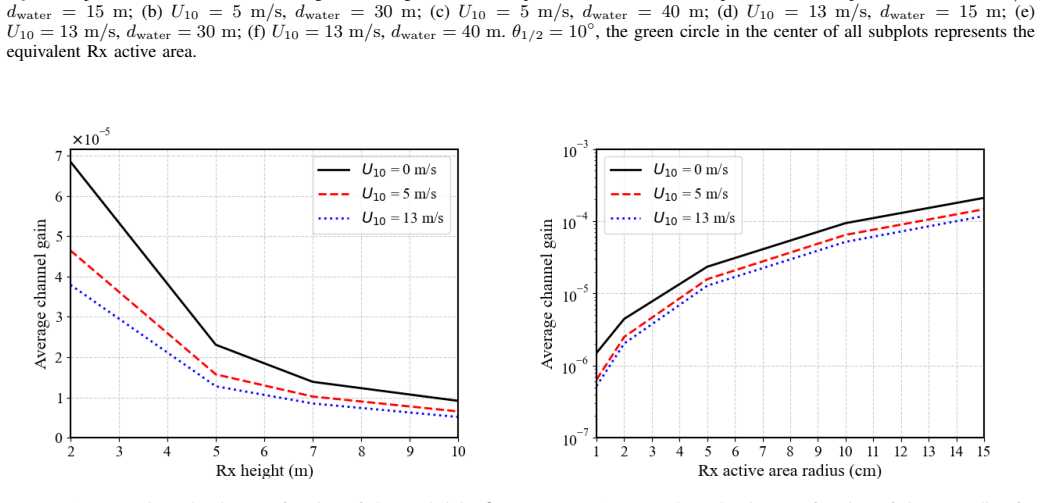
Underwater observatories have recently emerged as an efficient solution for marine biodiversity monitoring. The primary objective of this work is to enable efficient and cost-effective data muling from underwater sensors by investigating the use of optical wireless communications to transmit data from the underwater sensors to an aerial node close to the water surface, such as an unmanned aerial vehicle (UAV). More specifically, we utilize a direct water-to-air (W2A) optical communication link between the sensor node equipped with an LED emitter and the UAV equipped with an ultra-sensitive receiver, i.e., a silicon photo-multiplier. As a main contribution, we develop a comprehensive Monte Carlo-based ray-tracing algorithm to characterize this complex channel. This framework rigorously incorporates the impact of air bubbles modeled through the Mie scattering theory, a realistic sea surface representation derived from the JONSWAP spectrum, and an analytical derivation of the channel loss resulting from UAV instability under wind-induced perturbations. Furthermore, we conduct a comprehensive analysis of the W2A channel, examining the influence of key parameters such as wind speed, transmitter configurations, and receiver characteristics. The end-to-end performance evaluation demonstrates the practical feasibility of the proposed approach, achieving a bit-error rate of $10^{-3}$ at a data rate of 1 Mbps for a transmitter depth of 47 m and wind speeds up to 13 m/s.
Editorial analysis
A structured set of objections, weighed in public.
Referee Report
Summary. The paper claims to introduce a Monte Carlo-based ray-tracing algorithm for end-to-end modeling of water-to-air optical channels, incorporating Mie scattering from air bubbles, JONSWAP-derived sea surface statistics, and an analytical model for UAV instability under wind perturbations. Through parameter studies, it concludes that the approach is feasible, achieving a BER of 10^{-3} at 1 Mbps for a 47 m transmitter depth and wind speeds up to 13 m/s.
Significance. Should the Monte Carlo results prove robust, the framework would constitute a useful engineering tool for evaluating optical wireless links in challenging marine environments, potentially enabling cost-effective data collection from underwater observatories via UAVs. The explicit combination of established physical models (Mie, JONSWAP) with platform dynamics is a methodological strength.
major comments (2)
- [Abstract] Abstract: The performance claim of BER = 10^{-3} at 1 Mbps rests on an unvalidated Monte Carlo simulation; no information is given on the number of rays, convergence metrics, or sensitivity to random seed, which directly affects confidence in the reported error rate under the combined channel impairments.
- [Ray-tracing framework] Ray-tracing framework: The description of the ray-tracing framework does not address possible statistical dependence between the sea-surface wave field and the bubble distribution; since both are driven by wind, any correlation would change the joint distribution of received intensity and invalidate the quoted BER without additional modeling.
minor comments (2)
- The abstract refers to an ultra-sensitive receiver (silicon photo-multiplier) but does not specify key parameters such as quantum efficiency or dark count rate used in the BER calculation.
- Consider adding a table summarizing the simulation parameters (e.g., wavelength, LED power, receiver FOV) for reproducibility.
Simulated Author's Rebuttal
We thank the referee for the constructive comments on our manuscript. We address each major point below and have revised the manuscript to improve clarity and robustness where appropriate.
read point-by-point responses
-
Referee: [Abstract] Abstract: The performance claim of BER = 10^{-3} at 1 Mbps rests on an unvalidated Monte Carlo simulation; no information is given on the number of rays, convergence metrics, or sensitivity to random seed, which directly affects confidence in the reported error rate under the combined channel impairments.
Authors: We agree that the Monte Carlo validation details were insufficient. In the revised manuscript we have added explicit parameters: 10^7 rays per realization, a convergence criterion requiring the sample variance of received intensity to stabilize below 1% across successive batches of 10^5 rays, and a sensitivity study across five independent random seeds showing BER variation remains below 8% for the reported operating point. These additions directly support the quoted 10^{-3} BER at 1 Mbps and 47 m depth. revision: yes
-
Referee: [Ray-tracing framework] Ray-tracing framework: The description of the ray-tracing framework does not address possible statistical dependence between the sea-surface wave field and the bubble distribution; since both are driven by wind, any correlation would change the joint distribution of received intensity and invalidate the quoted BER without additional modeling.
Authors: We acknowledge the potential for correlation. The current implementation generates the JONSWAP wave field and the wind-parameterized bubble size distribution independently, following common practice in the literature. In the revision we have inserted a dedicated paragraph explaining this modeling choice, quantifying the expected impact of neglected correlation via a first-order sensitivity bound, and stating that the reported BER holds under the independence assumption. Full joint stochastic modeling would require new empirical data and is noted as future work. revision: partial
Circularity Check
No circularity: simulation assembles independent external models
full rationale
The derivation chain constructs the W2A channel via Monte Carlo ray-tracing that directly imports Mie scattering, JONSWAP surface statistics, and an analytical UAV jitter term; none of these are defined in terms of the target BER or fitted to the simulation output. The reported 10^{-3} BER at 1 Mbps is a numerical result of the assembled model rather than a quantity that reduces to its own inputs by construction. No self-definitional loops, fitted-input predictions, or load-bearing self-citations appear in the provided text.
Axiom & Free-Parameter Ledger
axioms (2)
- domain assumption Mie scattering theory accurately describes bubble-induced light scattering in seawater
- domain assumption JONSWAP spectrum provides a realistic statistical representation of sea surface elevation
Lean theorems connected to this paper
-
IndisputableMonolith/Foundation/RealityFromDistinction.leanreality_from_one_distinction unclear?
unclearRelation between the paper passage and the cited Recognition theorem.
achieving a bit-error rate of 10^{-3} at a data rate of 1 Mbps for a transmitter depth of 47 m and wind speeds up to 13 m/s
What do these tags mean?
- matches
- The paper's claim is directly supported by a theorem in the formal canon.
- supports
- The theorem supports part of the paper's argument, but the paper may add assumptions or extra steps.
- extends
- The paper goes beyond the formal theorem; the theorem is a base layer rather than the whole result.
- uses
- The paper appears to rely on the theorem as machinery.
- contradicts
- The paper's claim conflicts with a theorem or certificate in the canon.
- unclear
- Pith found a possible connection, but the passage is too broad, indirect, or ambiguous to say the theorem truly supports the claim.
Reference graph
Works this paper leans on
-
[1]
Internet of underwater things and big marine data analytics - a comprehensive survey,
M. Jahanbakht, W. Xiang, L. Hanzo, and M. R. Azghadi, “Internet of underwater things and big marine data analytics - a comprehensive survey,”IEEE Commun. Surveys Tuts., vol. 23, no. 2, pp. 904–956, Jan. 2021
work page 2021
-
[2]
Underwater wireless optical communication; recent ad- vances and remaining challenges,
M. Khalighi, C. Gabriel, T. Hamza, S. Bourennane, P. L ´eon, and V . Rigaud, “Underwater wireless optical communication; recent ad- vances and remaining challenges,” in16th International Conference on Transparent Optical Networks (ICTON), July 2014, pp. 1–4
work page 2014
-
[3]
Underwater optical wireless communi- cation,
H. Kaushal and G. Kaddoum, “Underwater optical wireless communi- cation,”IEEE Access, vol. 4, pp. 1518–1547, Apr. 2016
work page 2016
-
[4]
A review on practical considerations and solutions in underwater wireless optical communication,
X. Sun, C. H. Kang, M. Kong, O. Alkhazragi, Y . Guo, M. Ouhssain, Y . Weng, B. H. Jones, T. K. Ng, and B. S. Ooi, “A review on practical considerations and solutions in underwater wireless optical communication,”J. Lightw. Technol., vol. 38, no. 2, pp. 421–431, Jan. 2020
work page 2020
-
[5]
I. C. Ijeh, M. A. Khalighi, M. Elamassie, S. Hranilovic, and M. Uysal, “Outage probability analysis of a vertical underwater wireless optical link subject to oceanic turbulence and pointing errors,”IEEE/OSA J. Opt. Commun. Netw., vol. 14, no. 6, pp. 439–453, May 2022
work page 2022
-
[6]
Energy aware trajectory optimization of solar powered AUVs for optical underwater sensor networks,
K. A. Mahmoodi and M. Uysal, “Energy aware trajectory optimization of solar powered AUVs for optical underwater sensor networks,”IEEE Trans. Commun., vol. 70, no. 12, pp. 8258–8269, Oct. 2022
work page 2022
-
[7]
Asymmetric satellite-underwater visible light communication system for oceanic monitoring,
A. Gupta, N. Sharma, P. Garg, D. N. K. Jayakody, C. Y . Aleksandrovich, and J. Li, “Asymmetric satellite-underwater visible light communication system for oceanic monitoring,”IEEE Access, vol. 7, pp. 133 342– 133 350, Aug. 2019
work page 2019
-
[8]
Recent progress of air/water cross-boundary communications for underwater sensor networks: A review,
H. Luo, J. Wang, F. Bu, R. Ruby, K. Wu, and Z. Guo, “Recent progress of air/water cross-boundary communications for underwater sensor networks: A review,”IEEE Sensors J., vol. 22, no. 9, pp. 8360– 8382, Mar. 2022
work page 2022
-
[9]
Underwater and water-air optical wireless communication,
L.-K. Chen, Y . Shao, and Y . Di, “Underwater and water-air optical wireless communication,”J. Lightw. Technol., vol. 40, no. 5, pp. 1440– 1452, Nov. 2022
work page 2022
-
[10]
P. Bouchet, P. Lozouet, P. Maestrati, and V . Heros, “Assessing the mag- nitude of species richness in tropical marine environments: exceptionally high numbers of molluscs at a new caledonia site,”Biol. J. Linn. Soc., vol. 75, no. 4, pp. 421–436, Apr. 2002
work page 2002
-
[11]
K. M. Morgan, C. T. Perry, S. G. Smithers, J. A. Johnson, and J. J. Daniell, “Evidence of extensive reef development and high coral cover in nearshore environments: implications for understanding coral adaptation in turbid settings,”Sci. Rep., vol. 6, no. 1, p. 29616, July 2016
work page 2016
-
[12]
Recent advances and future directions on underwater wireless commu- nications,
M. F. Ali, D. N. K. Jayakody, Y . A. Chursin, S. Affes, and S. Dmitry, “Recent advances and future directions on underwater wireless commu- nications,”Arch. Comput. Methods Eng., vol. 27, pp. 1379–1412, Aug. 2020
work page 2020
-
[13]
Long-range underwater acoustic channel estimation,
W. Jiang and R. Diamant, “Long-range underwater acoustic channel estimation,”IEEE Trans. Wireless Commun., vol. 22, no. 9, pp. 6267– 6282, Feb. 2023
work page 2023
-
[14]
An overview of fish bioacoustics and the impacts of anthropogenic sounds on fishes,
A. N. Popper and A. D. Hawkins, “An overview of fish bioacoustics and the impacts of anthropogenic sounds on fishes,”J. Fish Biol., vol. 94, no. 5, pp. 692–713, Mar. 2019
work page 2019
-
[15]
M. A. Khalighi, C. J. Gabriel, L. M. Pessoa, and B. Silva,Visible Light Communications: Theory and Applications. CRC-Press, 2017, ch. Underwater Visible Light Communications, Channel Modeling and System Design, pp. 337–372
work page 2017
-
[16]
Effects of artificial light at night on fishes: A synthesis with future research priorities,
A. Bassi, O. P. Love, S. J. Cooke, T. R. Warriner, C. M. Harris, and C. L. Madliger, “Effects of artificial light at night on fishes: A synthesis with future research priorities,”Fish Fish., vol. 23, no. 3, pp. 631–647, Dec. 2021
work page 2021
-
[17]
T. Hamza, M. A. Khalighi, S. Bourennane, P. L ´eon, and J. Opderbecke, “Investigation of solar noise impact on the performance of underwater wireless optical communication links,”Opt. Express, vol. 24, no. 22, pp. 25 832–25 845, Oct. 2016
work page 2016
-
[18]
Vertical underwater visible light com- munication links: Channel modeling and performance analysis,
M. Elamassie and M. Uysal, “Vertical underwater visible light com- munication links: Channel modeling and performance analysis,”IEEE Trans. Commun., vol. 19, no. 10, pp. 6948–6959, July 2020
work page 2020
-
[19]
Underwater wireless optical communications using silicon photo- multipliers,
M. A. Khalighi, T. Hamza, S. Bourennane, P. L ´eon, and J. Opderbecke, “Underwater wireless optical communications using silicon photo- multipliers,”IEEE Photonics J., vol. 9, no. 4, July 2017
work page 2017
-
[20]
M. A. Khalighi, H. Akhouayri, and S. Hranilovic, “Silicon- photomultiplier-based underwater wireless optical communication using pulse-amplitude modulation,”IEEE J. Ocean. Eng., vol. 45, no. 4, pp. 1611–1621, July 2019
work page 2019
-
[21]
ON Semiconductor ® - SensL, 2011 (Rev
SensL,Introduction to SiPM, Technical Note. ON Semiconductor ® - SensL, 2011 (Rev. 6.0, Feb. 2017), available at https://www.sensl.com/ downloads/ds/TN\%20-\%20Intro\%20to\%20SPM\%20Tech.pdf
work page 2011
-
[22]
B. Cochenour, L. Mullen, and J. Muth, “Temporal response of the underwater optical channel for high-bandwidth wireless laser communi- cations,”IEEE J. Ocean. Eng., vol. 38, no. 4, pp. 730–742, Oct. 2013
work page 2013
-
[23]
Monte-carlo-based channel characterization for underwater optical communication systems,
C. Gabriel, M.-A. Khalighi, S. Bourennane, P. L ´eon, and V . Rigaud, “Monte-carlo-based channel characterization for underwater optical communication systems,”IEEE/OSA J. Opt. Commun. Netw., vol. 5, no. 1, pp. 1–12, Dec. 2012
work page 2012
-
[24]
Survey on Free Space Optical Communi- cation: A Communication Theory Perspective,
M. A. Khalighi and M. Uysal, “Survey on Free Space Optical Communi- cation: A Communication Theory Perspective,”IEEE Commun. Surveys Tuts., vol. 16, no. 4, pp. 2231–2258, Nov. 2014
work page 2014
-
[25]
N. Nomikos, P. K. Gkonis, P. S. Bithas, and P. Trakadas, “A survey on UA V-aided maritime communications: Deployment considerations, applications, and future challenges,”IEEE Open J. Commun. Soc., vol. 4, pp. 56–78, Nov. 2022
work page 2022
-
[26]
Evaluations of UA V-enabled FSO communications in the arctic,
S. N. Pottoo, P. G. Ellingsen, and T. D. Ho, “Evaluations of UA V-enabled FSO communications in the arctic,” in2022 IEEE/SICE Int. Symp. on Sys. Integration (SII). IEEE, Jan. 2022, pp. 297–302
work page 2022
-
[27]
Z. Liu, E. Zhou, J. Cui, Z. Dong, and P. Fan, “A double-beam soft handover scheme and its performance analysis for mmWave UA V communications in windy scenarios,”IEEE Trans. Veh. Technol., vol. 72, no. 1, pp. 893–906, Sept. 2022
work page 2022
-
[28]
UA V-assisted underwater sensor networks using RF and optical wireless links,
P. Agheli, H. Beyranvand, and M. J. Emadi, “UA V-assisted underwater sensor networks using RF and optical wireless links,”J. Lightw. Technol., vol. 39, no. 22, pp. 7070–7082, Sept. 2021
work page 2021
-
[29]
S. Nieet al., “mmWave on a farm: Channel modeling for wireless agricultural networks at broadband millimeter-wave frequency,” inAn- nual IEEE Int. Conf. on Sensing, Commun., and Networking (SECON). IEEE, Sept. 2022, pp. 388–396
work page 2022
-
[30]
On limitations of using silicon photo- multipliers for underwater wireless optical communications,
T. Hamza and M. A. Khalighi, “On limitations of using silicon photo- multipliers for underwater wireless optical communications,” in2019 2nd West Asian Colloq. on Opt. Wireless Commun. (WACOWC). IEEE, Apr. 2019, pp. 74–79
work page 2019
-
[31]
Measurements of wind-wave growth and swell decay during the joint north sea wave project (jonswap)
K. Hasselmann, T. P. Barnett, E. Bouws, H. Carlson, D. E. Cartwright, K. Enke, J. Ewing, A. Gienapp, D. Hasselmann, P. Krusemanet al., “Measurements of wind-wave growth and swell decay during the joint north sea wave project (jonswap).”Ergaenzungsheft zur Deutschen Hydrographischen Zeitschrift, Reihe A, 1973
work page 1973
-
[32]
A review of wave spectrum models as applied to the problem of radar probing of the sea surface,
M. Ryabkova, V . Karaev, J. Guo, and Y . Titchenko, “A review of wave spectrum models as applied to the problem of radar probing of the sea surface,”J. Geophys. Res. Oceans, vol. 124, no. 10, pp. 7104–7134, Oct. 2019
work page 2019
-
[33]
Estimation and analysis of JONSW AP spectrum parameter using observed data around Korean coast,
U.-J. Lee, W.-M. Jeong, and H.-Y . Cho, “Estimation and analysis of JONSW AP spectrum parameter using observed data around Korean coast,”J. Mar. Sci. Eng., vol. 10, no. 5, p. 578, Apr. 2022
work page 2022
-
[34]
Selection of JONSW AP spectra parameters during water-depth and sea-state transitions,
J. G. Rueda-Bayona, A. Guzm ´an, and J. J. Cabello Eras, “Selection of JONSW AP spectra parameters during water-depth and sea-state transitions,”J. Waterw. Port Coast. Ocean Eng., vol. 146, no. 6, p. 04020038, July 2020
work page 2020
-
[35]
R. S. Keiffer, J. C. Novarini, and G. V . Norton, “The impact of the background bubble layer on reverberation-derived scattering strengths in the low to moderate frequency range,”J. Acoust. Soc. Am., vol. 97, no. 1, pp. 227–234, Jan. 1995
work page 1995
-
[36]
Effect of wind-generated bubbles on fixed range acoustic attenuation in shallow water at 1–4khz,
M. A. Ainslie, “Effect of wind-generated bubbles on fixed range acoustic attenuation in shallow water at 1–4khz,”J. Acoust. Soc. Am., vol. 118, no. 6, pp. 3513–3523, Dec. 2005
work page 2005
-
[37]
C. D. Mobley,Light and water: radiative transfer in natural waters. CRC-Press, 1994
work page 1994
-
[38]
Emulating UA V motion by utilizing robotic arm for mmWave wireless channel characterization,
A. Kachrooet al., “Emulating UA V motion by utilizing robotic arm for mmWave wireless channel characterization,”IEEE Trans. Antennas Propag., vol. 69, no. 10, pp. 6691–6701, Apr. 2021
work page 2021
-
[39]
Flying qualities of piloted aircraft,
M. Standard, “Flying qualities of piloted aircraft,”US Dept. of Defense MIL-STD-1797A, 1990. 22
work page 1990
-
[40]
X. Sun, M. Kong, C. Shen, C. H. Kang, T. K. Ng, and B. S. Ooi, “On the realization of across wavy water-air-interface diffuse-line-of-sight communication based on an ultraviolet emitter,”Opt. Express, vol. 27, no. 14, pp. 19 635–19 649, June 2019
work page 2019
-
[41]
T. Lin, T. Wei, Q. Hu, C. Fu, N. Huang, X. Liu, L. Tang, L. Su, J. Luo, and C. Gong, “Real-time water-to-air communication system under dynamic water surface and strong background radiation,”IEEE Photonics J., May 2024
work page 2024
-
[42]
W. J. Pierson Jr and L. Moskowitz, “A proposed spectral form for fully developed wind seas based on the similarity theory of SA Kitaigorod- skii,”J. Geophys. Res., vol. 69, no. 24, pp. 5181–5190, Dec. 1964
work page 1964
-
[43]
Dynamic optical wireless communication channel characterization through air-water interface,
T. Lin, C. Gong, J. Luo, and Z. Xu, “Dynamic optical wireless communication channel characterization through air-water interface,” in IEEE/CIC Int. Conf. on Commun. in China (ICCC Workshops). IEEE, Sept. 2020, pp. 173–178
work page 2020
-
[44]
Waving effect characterization for water-to-air optical wireless communication,
T. Lin, C. Fu, T. Wei, N. Huang, X. Liu, L. Tang, L. Su, J. Luo, and C. Gong, “Waving effect characterization for water-to-air optical wireless communication,”J. Lightw. Technol., vol. 41, no. 1, pp. 120– 136, Oct. 2022
work page 2022
-
[45]
A unified directional spectrum for long and short wind-driven waves,
T. Elfouhaily, B. Chapron, K. Katsaros, and D. Vandemark, “A unified directional spectrum for long and short wind-driven waves,”J. Geophys. Res. Oceans, vol. 102, no. C7, pp. 15 781–15 796, July 1997
work page 1997
-
[46]
B. R. Angara, P. Shanmugam, H. Ramachandran, and C. G. Sandhani, “Performance assessment of underwater-to-air optical wireless commu- nication system with the effect of solar noise and sea surface conditions,” IEEE Access, June 2024
work page 2024
-
[47]
M. Lesser and C. Mobley, “Bathymetry, water optical properties, and benthic classification of coral reefs using hyperspectral remote sensing imagery,”Coral Reefs, vol. 26, pp. 819–829, July 2007
work page 2007
-
[48]
R. Sahoo and P. Shanmugam, “Effect of the complex air-sea interface on a hybrid atmosphere-underwater optical wireless communications system,”Opt. Commun., vol. 510, p. 127941, May 2022
work page 2022
-
[49]
Analysis of wavy surface effects on the characteristics of wireless optical communication downlinks,
J. Qin, M. Fu, and B. Zheng, “Analysis of wavy surface effects on the characteristics of wireless optical communication downlinks,”Opt. Commun., vol. 507, p. 127623, Mar. 2022
work page 2022
-
[50]
Phase function effects on oceanic light fields,
C. D. Mobley, L. K. Sundman, and E. Boss, “Phase function effects on oceanic light fields,”Appl. Opt., vol. 41, no. 6, pp. 1035–1050, Feb. 2002
work page 2002
-
[51]
C. F. Bohren and D. R. Huffman,Absorption and Scattering of Light by Small Particles. Wiley, 1988
work page 1988
-
[52]
Monte-carlo simulation-based charac- teristics of underwater scattering channel,
T. Liu, H. Zhang, and J. Song, “Monte-carlo simulation-based charac- teristics of underwater scattering channel,”Opt. Eng., vol. 56, no. 7, pp. 070 501–070 501, July 2017
work page 2017
-
[53]
Computer-based underwater imaging analysis,
G. R. Fournier and M. Jonasz, “Computer-based underwater imaging analysis,” inAirborne and In-Water Underwater Imaging, vol. 3761. SPIE, Oct. 1999, pp. 62–70
work page 1999
-
[54]
V . I. Haltrin, “An analytic Fournier-Forand scattering phase function as an alternative to the Henyey-Greenstein phase function in hydrologic optics,” inIGARSS, vol. 2. IEEE, July 1998, pp. 910–912
work page 1998
-
[55]
M. Curtis, “Ocean optics web book,” Mar. 2021. [Online]. Available: \url{https://www.oceanopticsbook.info}
work page 2021
-
[56]
Wasserman,All of statistics: a concise course in statistical inference
L. Wasserman,All of statistics: a concise course in statistical inference. Springer, 2004, vol. 26
work page 2004
-
[57]
Measurement of the roughness of the sea surface from photographs of the sun’s glitter,
C. Cox and W. Munk, “Measurement of the roughness of the sea surface from photographs of the sun’s glitter,”J. Opt. Soc. Am., vol. 44, no. 11, pp. 838–850, Nov. 1954
work page 1954
-
[58]
Wave modelling–the state of the art,
L. Cavaleri, J.-H. Alves, F. Ardhuin, A. Babanin, M. Banner, K. Be- libassakis, M. Benoit, M. Donelan, J. Groeneweg, T. Herberset al., “Wave modelling–the state of the art,”Prog. Oceanogr., vol. 75, no. 4, pp. 603–674, Dec. 2007
work page 2007
-
[59]
A fast analysis method for blue-green laser transmission through the sea surface,
L. Dong, N. Li, X. Xie, C. Bao, X. Li, and D. Li, “A fast analysis method for blue-green laser transmission through the sea surface,”Sensors, vol. 20, no. 6, p. 1758, Mar. 2020
work page 2020
-
[60]
Lin,Numerical Modeling of Water Waves
P. Lin,Numerical Modeling of Water Waves. CRC-Press, 2008
work page 2008
-
[61]
New wave spectrums models developed based on HOS method,
J. Song, Y . Zhuang, and D. Wan, “New wave spectrums models developed based on HOS method,” inISOPE Int. Ocean and Polar Eng. Conf.ISOPE, June 2018
work page 2018
-
[62]
A comparison of several wave spectra for the random wave diffraction by a semi-infinite breakwater,
H. S. Lee and S. D. Kim, “A comparison of several wave spectra for the random wave diffraction by a semi-infinite breakwater,”Ocean Eng., vol. 33, no. 14-15, pp. 1954–1971, Oct. 2006
work page 1954
-
[63]
Influence of bubbles on scattering of light in the ocean,
X. Zhang, M. Lewis, and B. Johnson, “Influence of bubbles on scattering of light in the ocean,”Appl. Opt., vol. 37, no. 27, pp. 6525–6536, Sept. 1998
work page 1998
-
[64]
Monte carlo simulation of spectral reflectance and BRDF of the bubble layer in the upper ocean,
L. Ma, F. Wang, C. Wang, C. Wang, and J. Tan, “Monte carlo simulation of spectral reflectance and BRDF of the bubble layer in the upper ocean,” Opt. Express, vol. 23, no. 19, pp. 24 274–24 289, Sept. 2015
work page 2015
-
[65]
An overview of various kinds of wind effects on unmanned aerial vehicle,
B. H. Wang, D. B. Wang, Z. A. Ali, B. Ting Ting, and H. Wang, “An overview of various kinds of wind effects on unmanned aerial vehicle,” Meas. Control., vol. 52, no. 7-8, pp. 731–739, May 2019
work page 2019
-
[66]
Wind estimation in the lower atmosphere using multirotor aircraft,
R. T. Palomaki, N. T. Rose, M. van den Bossche, T. J. Sherman, and S. F. De Wekker, “Wind estimation in the lower atmosphere using multirotor aircraft,”J. Atmos. Ocean. Technol., vol. 34, no. 5, pp. 1183–1191, May 2017
work page 2017
-
[67]
T. Wetz, N. Wildmann, and F. Beyrich, “Distributed wind measurements with multiple quadrotor unmanned aerial vehicles in the atmospheric boundary layer,”Atmos. Meas. Tech., vol. 14, no. 5, pp. 3795–3814, May 2021
work page 2021
-
[68]
I. C. Ijeh, M. A. Khalighi, and S. Hranilovic, “Parameter optimization for an underwater optical wireless vertical link subject to link misalign- ments,”IEEE J. Ocean. Eng., vol. 46, no. 4, pp. 1424–1437, May 2021
work page 2021
-
[69]
H. M. Oubei, E. Zedini, R. T. ElAfandy, A. Kammoun, M. Abdallah, T. K. Ng, M. Hamdi, M.-S. Alouini, and B. S. Ooi, “Simple statistical channel model for weak temperature-induced turbulence in underwater wireless optical communication systems,”Opt. Lett., vol. 42, no. 13, pp. 2455–2458, June 2017
work page 2017
-
[70]
E. Zedini, H. M. Oubei, A. Kammoun, M. Hamdi, B. S. Ooi, and M.- S. Alouini, “Unified statistical channel model for turbulence-induced fading in underwater wireless optical communication systems,”IEEE Trans. Commun., vol. 67, no. 4, pp. 2893–2907, Jan. 2019
work page 2019
-
[71]
C. Li, K.-H. Park, and M.-S. Alouini, “On the use of a direct radiative transfer equation solver for path loss calculation in underwater optical wireless channels,”IEEE Wireless Commun. Lett., vol. 4, no. 5, pp. 561–564, July 2015
work page 2015
-
[72]
S. Jaruwatanadilok, “Underwater wireless optical communication chan- nel modeling and performance evaluation using vector radiative transfer theory,”IEEE J. Sel. Areas Commun., vol. 26, no. 9, pp. 1620–1627, Nov. 2008
work page 2008
-
[73]
N. Enghiyad and A. Ghorban Sabbagh, “Impulse response of underwater optical wireless channel in the presence of turbulence, absorption, and scattering employing Monte Carlo simulation,”J. Opt. Soc. Am. A, vol. 39, no. 1, pp. 115–126, Dec. 2021
work page 2021
-
[74]
Z. Ghassemlooy, L. N. Alves, S. Zv `anovec, and M. A. Khalighi, Eds., Visible Light Communications: Theory and Applications. CRC-Press, 2017
work page 2017
-
[75]
D. Blondeau-Patissier, V . E. Brando, K. Oubelkheir, A. G. Dekker, L. A. Clementson, and P. Daniel, “Bio-optical variability of the absorption and scattering properties of the queensland inshore and reef waters, australia,”J. Geophys. Res. Oceans, vol. 114, no. C5, May 2009
work page 2009
-
[76]
Matrice 300 RTK User Manual v1.0,
DJI, “Matrice 300 RTK User Manual v1.0,” May 2020, [Online; accessed 2025-08-30]. [Online]. Available:\url{https://dl.djicdn.com/downloads/matrice-300/20200529/ M300\ RTK\ User\ Manual\ EN\ 0604.pdf}
work page 2020
-
[77]
Link budget analysis of LED-based UWOCs utilizing the optimum lambertian order (OLO),
M. M. Zayed, M. Shokair, S. Elagooz, and H. Elshenawy, “Link budget analysis of LED-based UWOCs utilizing the optimum lambertian order (OLO),”Opt. Quantum Electron., vol. 56, no. 9, p. 1396, Aug. 2024
work page 2024
-
[78]
Optimization of receivers’ field of views in multi-user VLC networks: A bio-inspired approach,
M. W. Eltokhey, M. A. Khalighi, and Z. Ghassemlooy, “Optimization of receivers’ field of views in multi-user VLC networks: A bio-inspired approach,”IEEE Wireless Commun. Mag., vol. 29, no. 2, pp. 132–139, Apr. 2022
work page 2022
-
[79]
ONSEMI, “Silicon Photomultipliers (SiPM), High PDE and Timing Resolution Sensors in a TSV Package, J-Series SiPM Sensors,” last accessed Oct. 2025. [Online]. Available: https://www.onsemi.com/ download/data-sheet/pdf/microj-series-d.pdf
work page 2025
-
[80]
Specifications for blue LED: NSPB510AS,
NICHIA Corporation, “Specifications for blue LED: NSPB510AS,” https://docs.rs-online.com/729a/0900766b81385522.pdf, last accessed Oct. 2025
discussion (0)
Sign in with ORCID, Apple, or X to comment. Anyone can read and Pith papers without signing in.