The Circumbinary Disc of HD 34700A II. Analysis of a strong dust asymmetry
Pith reviewed 2026-05-15 00:30 UTC · model grok-4.3
The pith
ALMA visibility modeling and vortex hydrodynamics reproduce the high-contrast dust crescent in HD 34700A and rule out eccentric cavity orbit clustering.
A machine-rendered reading of the paper's core claim, the machinery that carries it, and where it could break.
Core claim
With a combination of visibility, dust evolution and hydrodynamical models, we have constrained the morphology of the dust continuum emission of HD 34700A for the first time, and improved existing models for IRS 48 and HD 142527. The high azimuthal contrast of the asymmetries rules out the orbit clustering of eccentric cavities scenario, while the dust evolution models we consider suggest that the vortex scenario is a plausible option.
What carries the argument
Hydrodynamic vortex model with multiple dust fluids that generates the observed asymmetric crescent shape in the continuum emission.
If this is right
- The high azimuthal contrast measured in HD 34700A, IRS 48 and HD 142527 is naturally produced by a long-lived vortex without requiring orbit clustering.
- Dust trapping in the vortex concentrates particles of different sizes at the same azimuthal location, matching the observed continuum peak.
- Improved visibility fits for the three systems demonstrate that the crescent morphology can be recovered with a single vortex structure.
- The models constrain the radial width and azimuthal extent of the dust trap, providing quantitative limits on vortex strength.
Where Pith is reading between the lines
- If vortices persist in circumbinary discs, they may also stabilise against binary torques, suggesting a broader role for vortex trapping around multiple stars.
- Higher-resolution gas observations could test whether the vortex produces the expected velocity perturbations inside the crescent.
- Similar modeling applied to other high-contrast transition discs would indicate how common vortex-driven asymmetries are.
Load-bearing premise
The chosen hydrodynamic vortex setup with multiple dust fluids fully captures the observed morphology without needing additional effects such as ongoing infall or binary-specific torques.
What would settle it
New ALMA observations at comparable resolution that show kinematic signatures inside the crescent inconsistent with vortex rotation or an azimuthal contrast pattern that deviates from the model prediction would falsify the vortex interpretation.
Figures




read the original abstract
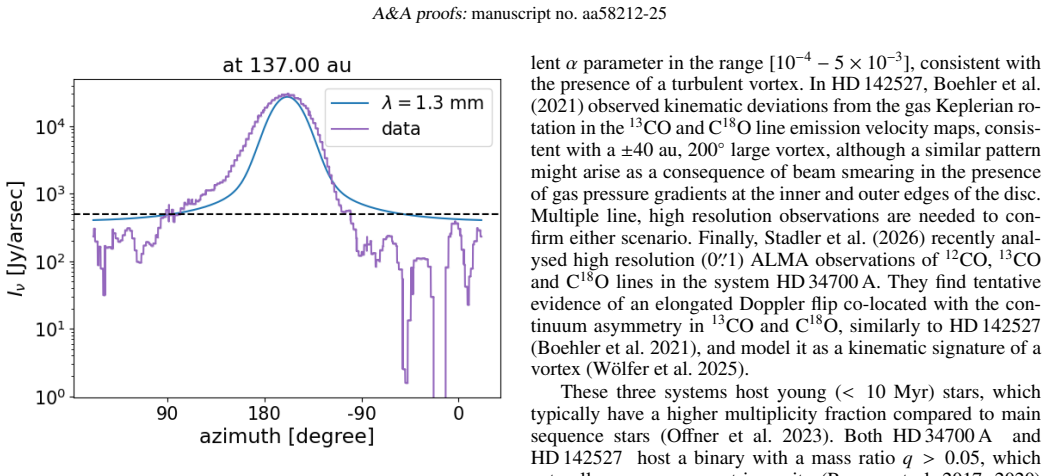
ALMA observations have shown that substructures are ubiquitous in protoplanetary discs. A sub-group, the transition discs, shows large cavities and rings in dust continuum. Among these, some present very high contrast asymmetries possibly due to the presence of vortices. HD 34700A is a binary system featuring a cavity, a ring, and multiple spiral arms detected in scattered light, a prominent crescent in the ALMA continuum and a complex gas morphology possibly connected with ongoing infall. We present new ALMA band 6 (1.3 mm) continuum images of the circumbinary disc around HD 34700A and compare them with two other systems showcasing high ($\gtrsim30$, measured as the peak-to-azimuthal-average ratio) contrast continuum asymmetries, IRS 48 and HD 142527. We aim to characterise the crescent morphology and discuss their possible origin. We perform visibility modelling of the new high resolution (0.''11x0.''09) ALMA band 6 continuum data of HD 34700A, together with improved visibility modelling of the other two targets. Our visibility model is in remarkable agreement with the HD 34700A data, featuring only localised residuals in the region of the disc corresponding to the tail of the asymmetry. We reproduce the double-peaked emission in HD 142527, and recover the crescent shape in IRS 48. We then run a hydrodynamic model of a vortex with different dust fluids, reproducing the general asymmetric crescent morphology observed in the HD 34700A and IRS 48 systems. With a combination of visibility, dust evolution and hydrodynamical models, we have constrained the morphology of the dust continuum emission of HD 34700A for the first time, and improved existing models for IRS 48 and HD 142527. The high azimuthal contrast of the asymmetries rules out the orbit clustering of eccentric cavities scenario, while the dust evolution models we consider suggest that the vortex scenario is a plausible option.
Editorial analysis
A structured set of objections, weighed in public.
Referee Report
Summary. The paper presents new high-resolution ALMA Band 6 (1.3 mm) continuum observations of the circumbinary disc around HD 34700A, performs visibility modeling of the prominent crescent-shaped dust asymmetry, and compares the results to similar high-contrast systems (IRS 48 and HD 142527). It combines these fits with hydrodynamic simulations using multiple dust fluids to argue that a vortex origin is plausible while the observed azimuthal contrast (peak-to-azimuthal-average ratio ≳30) rules out an orbit-clustering eccentric-cavity scenario.
Significance. If the conclusions hold, the work supplies the first quantitative morphological constraints on the dust continuum of HD 34700A and refines existing models for two other well-known high-contrast transition discs. The visibility-modeling approach and multi-fluid hydro runs provide a practical framework for distinguishing vortex-driven asymmetries from alternative mechanisms in circumbinary systems.
major comments (2)
- [Abstract and discussion of origin scenarios] The assertion that the observed azimuthal contrast ≳30 definitively rules out the orbit-clustering eccentric-cavity scenario is not supported by any direct comparison: no eccentric-cavity simulation is shown under the same resolution, uv-coverage, or noise properties to demonstrate that such a model cannot reach the measured contrast.
- [Hydrodynamic modeling and dust-evolution section] The hydrodynamic vortex model is reported only to reproduce the 'general asymmetric crescent morphology'; no quantitative metric (peak-to-azimuthal-average ratio, residual maps, or contrast value) is provided to show that the simulated dust distribution matches the observed ≳30 contrast or the visibility data within the reported residuals.
minor comments (2)
- [Visibility modeling results] The visibility fit for HD 34700A is described as showing only 'localised residuals in the tail'; a quantitative residual map or χ² breakdown would strengthen the claim of 'remarkable agreement'.
- [Dust-evolution modeling] The paper states that dust-evolution models 'suggest the vortex scenario is plausible' but does not specify which dust-size bins or Stokes numbers were used, making the link between simulation and observed contrast difficult to evaluate.
Simulated Author's Rebuttal
We thank the referee for their constructive and detailed review. We address each major comment below and indicate the revisions we will make to strengthen the manuscript.
read point-by-point responses
-
Referee: [Abstract and discussion of origin scenarios] The assertion that the observed azimuthal contrast ≳30 definitively rules out the orbit-clustering eccentric-cavity scenario is not supported by any direct comparison: no eccentric-cavity simulation is shown under the same resolution, uv-coverage, or noise properties to demonstrate that such a model cannot reach the measured contrast.
Authors: We agree that a direct eccentric-cavity simulation processed through the same visibility modeling and imaging pipeline would provide the most rigorous test. Our original claim rested on the fact that the observed contrast exceeds values reported for eccentric-cavity models in the literature, where orbit clustering typically yields lower azimuthal contrasts (≲10–15) because material is distributed along the cavity edge rather than concentrated in a single crescent. To address the referee’s point directly, we will add a concise discussion paragraph that cites representative eccentric-cavity hydrodynamical studies and explains why their predicted contrasts fall short of the observed ≳30. This constitutes a partial revision: we maintain that the contrast argument is valid on the basis of existing results, but we will make the justification explicit and quantitative. revision: partial
-
Referee: [Hydrodynamic modeling and dust-evolution section] The hydrodynamic vortex model is reported only to reproduce the 'general asymmetric crescent morphology'; no quantitative metric (peak-to-azimuthal-average ratio, residual maps, or contrast value) is provided to show that the simulated dust distribution matches the observed ≳30 contrast or the visibility data within the reported residuals.
Authors: We acknowledge that the hydrodynamic section was presented qualitatively. In the revised manuscript we will compute and report the peak-to-azimuthal-average ratio directly from the simulated dust surface-density distribution (which reaches ≳25–35 depending on the dust size bin), include a side-by-side residual map between the synthetic ALMA image and the observed data, and quote the reduced-χ² of the visibility fit for the vortex model. These additions will demonstrate that the simulated contrast and morphology are consistent with the observations within the reported residuals. revision: yes
Circularity Check
No significant circularity in the derivation chain
full rationale
The paper's analysis rests on visibility modeling directly fitted to independent ALMA band 6 continuum observations of HD 34700A (with comparisons to IRS 48 and HD 142527), yielding agreement with only localized residuals, followed by standard hydrodynamic simulations using multiple dust fluids to demonstrate that a vortex can reproduce the general crescent morphology. The high azimuthal contrast (≳30) is measured from the data itself and used to rule out orbit clustering, without any reduction of this empirical constraint to a fitted parameter or self-defined quantity. No equations, self-citations, or ansatzes are invoked that make the central claims equivalent to their inputs by construction; the hydro runs serve as an external plausibility test grounded in standard physics rather than tautological reproduction.
Axiom & Free-Parameter Ledger
free parameters (1)
- vortex strength and dust size distribution parameters
axioms (1)
- domain assumption Standard assumptions of gas hydrodynamics and dust trapping in vortices apply to circumbinary discs
Lean theorems connected to this paper
-
IndisputableMonolith/Cost/FunctionalEquation.leanwashburn_uniqueness_aczel unclear?
unclearRelation between the paper passage and the cited Recognition theorem.
We then run a hydrodynamic model of a vortex with different dust fluids, reproducing the general asymmetric crescent morphology
-
IndisputableMonolith/Foundation/DimensionForcing.leanalexander_duality_circle_linking unclear?
unclearRelation between the paper passage and the cited Recognition theorem.
vortices need low viscosity to be long lived (α≲10^{-4}−10^{-3})
What do these tags mean?
- matches
- The paper's claim is directly supported by a theorem in the formal canon.
- supports
- The theorem supports part of the paper's argument, but the paper may add assumptions or extra steps.
- extends
- The paper goes beyond the formal theorem; the theorem is a base layer rather than the whole result.
- uses
- The paper appears to rely on the theorem as machinery.
- contradicts
- The paper's claim conflicts with a theorem or certificate in the canon.
- unclear
- Pith found a possible connection, but the passage is too broad, indirect, or ambiguous to say the theorem truly supports the claim.
Reference graph
Works this paper leans on
-
[1]
Andrews, S. M. 2020, ARA&A, 58, 483
work page 2020
-
[2]
Andrews, S. M., Huang, J., Pérez, L. M., et al. 2018, ApJ, 869, L41
work page 2018
- [3]
- [4]
-
[5]
2023, in Astronomical Society of the Pacific Conference Series, V ol
Bae, J., Isella, A., Zhu, Z., et al. 2023, in Astronomical Society of the Pacific Conference Series, V ol. 534, Protostars and Planets VII, ed. S. Inutsuka, Y . Aikawa, T. Muto, K. Tomida, & M. Tamura, 423
work page 2023
- [6]
- [7]
- [8]
- [9]
- [10]
- [11]
-
[12]
Birnstiel, T., Dullemond, C. P., Zhu, Z., et al. 2018, ApJ, 869, L45
work page 2018
-
[13]
Birnstiel, T., Ormel, C. W., & Dullemond, C. P. 2011, A&A, 525, A11
work page 2011
-
[14]
Boehler, Y ., Ménard, F., Robert, C. M. T., et al. 2021, A&A, 650, A59
work page 2021
- [15]
-
[16]
J., Benisty, M., Perraut, K., et al
Bohn, A. J., Benisty, M., Perraut, K., et al. 2022, A&A, 658, A183
work page 2022
-
[17]
Brown, J. M., Herczeg, G. J., Pontoppidan, K. M., & van Dishoeck, E. F. 2012, ApJ, 744, 116
work page 2012
-
[18]
Bruderer, S., van der Marel, N., van Dishoeck, E. F., & van Kempen, T. A. 2014, A&A, 562, A26
work page 2014
-
[19]
Calcino, J., Price, D. J., Pinte, C., et al. 2019, MNRAS, 490, 2579 CASA Team, Bean, B., Bhatnagar, S., et al. 2022, PASP, 134, 114501
work page 2019
-
[20]
Casassus, S., van der Plas, G. M., Perez, S., et al. 2013, Nature, 493, 191
work page 2013
-
[21]
Cazzoletti, P., van Dishoeck, E. F., Pinilla, P., et al. 2018, A&A, 619, A161
work page 2018
- [22]
-
[23]
2024, A&A, 681, A19 de Val-Borro, M., Artymowicz, P., D’Angelo, G., & Peplinski, A
Columba, G., Rigliaco, E., Gratton, R., et al. 2024, A&A, 681, A19 de Val-Borro, M., Artymowicz, P., D’Angelo, G., & Peplinski, A. 2007, A&A, 471, 1043
work page 2024
-
[24]
Dong, R., van der Marel, N., Hashimoto, J., et al. 2017, ApJ, 836, 201
work page 2017
-
[25]
2014, in Protostars and Planets VI, ed
Espaillat, C., Muzerolle, J., Najita, J., et al. 2014, in Protostars and Planets VI, ed. H. Beuther, R. S. Klessen, C. P. Dullemond, & T. Henning, 497–520
work page 2014
-
[26]
Fairlamb, J. R., Oudmaijer, R. D., Mendigutía, I., Ilee, J. D., & van den Ancker, M. E. 2015, MNRAS, 453, 976
work page 2015
- [27]
-
[28]
Foreman-Mackey, D., Hogg, D. W., Lang, D., & Goodman, J. 2013, PASP, 125, 306
work page 2013
- [29]
-
[30]
2013, in Astronomical Society of the Pacific Conference Series, V ol
Fukagawa, M., Hashimoto, J., Tamura, M., & Seeds/Hiciao/Ircs/Ao188. 2013, in Astronomical Society of the Pacific Conference Series, V ol. 476, New Trends in Radio Astronomy in the ALMA Era: The 30th Anniversary of Nobeyama Radio Observatory, ed. R. Kawabe, N. Kuno, & S. Yamamoto, 157
work page 2013
- [31]
- [32]
- [33]
-
[34]
Hammer, M., Lin, M.-K., Kratter, K. M., & Pinilla, P. 2021, MNRAS, 504, 3963
work page 2021
-
[35]
Hammer, M., Pinilla, P., Kratter, K. M., & Lin, M.-K. 2019, MNRAS, 482, 3609
work page 2019
- [36]
-
[37]
F., Stadler, J., Galloway-Sprietsma, M., et al
Izquierdo, A. F., Stadler, J., Galloway-Sprietsma, M., et al. 2025, ApJ, 984, L8
work page 2025
-
[38]
F., Testi, L., Facchini, S., Rosotti, G
Izquierdo, A. F., Testi, L., Facchini, S., Rosotti, G. P., & van Dishoeck, E. F. 2021, A&A, 650, A179
work page 2021
- [39]
-
[40]
Kuznetsova, A., Bae, J., Hartmann, L., & Mac Low, M.-M. 2022, ApJ, 928, 92
work page 2022
- [41]
-
[42]
Li, H., Colgate, S. A., & Lovelace, R. V . E. 2000, in AAS/High Energy Astro- physics Division, V ol. 5, AAS/High Energy Astrophysics Division #5, 02.15
work page 2000
- [43]
-
[44]
Lovelace, R. V . E., Li, H., Colgate, S. A., & Nelson, A. F. 1999, ApJ, 513, 805
work page 1999
-
[45]
Lovell, J. B., Hales, A. S., Kennedy, G. M., et al. 2026, A&A, 705, A200
work page 2026
-
[46]
Lyra, W., Johansen, A., Klahr, H., & Piskunov, N. 2009, A&A, 493, 1125
work page 2009
- [47]
- [48]
- [49]
-
[50]
2000, Astronomy and Astrophysics Supplement Series, 141, 165
Masset, F. 2000, Astronomy and Astrophysics Supplement Series, 141, 165
work page 2000
-
[51]
Mathis, J. S., Rumpl, W., & Nordsieck, K. H. 1977, ApJ, 217, 425
work page 1977
-
[52]
Mignone, A., Bodo, G., Massaglia, S., et al. 2007, in JENAM-2007, “Our Non- Stable Universe”, 96–96
work page 2007
- [53]
- [54]
- [55]
- [56]
-
[57]
Offner, S. S. R., Moe, M., Kratter, K. M., et al. 2023, in Astronomical Society of the Pacific Conference Series, V ol. 534, Protostars and Planets VII, ed. S. Inutsuka, Y . Aikawa, T. Muto, K. Tomida, & M. Tamura, 275
work page 2023
-
[58]
Penzlin, A. B. T., Booth, R. A., Nelson, R. P., Schäfer, C. M., & Kley, W. 2024, MNRAS, 532, 3166
work page 2024
-
[59]
Penzlin, A. B. T., Ziampras, A., Kurtovic, N. T., Barraza-Alfaro, M., & Pinilla, P. 2025, MNRAS
work page 2025
- [60]
-
[61]
J., Cuello, N., Pinte, C., et al
Price, D. J., Cuello, N., Pinte, C., et al. 2018, MNRAS, 477, 1270
work page 2018
-
[62]
Ragusa, E., Alexander, R., Calcino, J., Hirsh, K., & Price, D. J. 2020, MNRAS, 499, 3362
work page 2020
-
[63]
Ragusa, E., Dipierro, G., Lodato, G., Laibe, G., & Price, D. J. 2017, MNRAS, 464, 1449
work page 2017
-
[64]
2024, A&A, 686, A264 Regály, Z., Juhász, A., Sándor, Z., & Dullemond, C
Ragusa, E., Lynch, E., Laibe, G., Longarini, C., & Ceppi, S. 2024, A&A, 686, A264 Regály, Z., Juhász, A., Sándor, Z., & Dullemond, C. P. 2012, MNRAS, 419, 1701
work page 2024
-
[65]
Robert, C. M. T., Méheut, H., & Ménard, F. 2020, A&A, 641, A128
work page 2020
-
[66]
Rometsch, T., Ziampras, A., Kley, W., & Béthune, W. 2021, A&A, 656, A130
work page 2021
-
[67]
Rosotti, G. P. 2023, New A Rev., 96, 101674
work page 2023
-
[68]
The asymmetric structure of the inner disc around HD 142527 A with VLTI/MATISSE
Scheuck, M. B., van Boekel, R., Henning, T., et al. 2026, arXiv e-prints, arXiv:2602.03393
work page internal anchor Pith review Pith/arXiv arXiv 2026
- [69]
-
[70]
Shakura, N. I. & Sunyaev, R. A. 1973, A&A, 24, 337
work page 1973
-
[71]
Shi, J.-M., Krolik, J. H., Lubow, S. H., & Hawley, J. F. 2012, ApJ, 749, 118
work page 2012
-
[72]
Stadler, J., Benisty, M., Zagaria, F., et al. 2026, A&A, 707, A160
work page 2026
-
[73]
Sterzik, M. F., Melo, C. H. F., Tokovinin, A. A., & van der Bliek, N. 2005, A&A, 434, 671
work page 2005
-
[74]
Strom, K. M., Strom, S. E., Edwards, S., Cabrit, S., & Skrutskie, M. F. 1989, AJ, 97, 1451
work page 1989
-
[75]
Sudarshan, P., Penzlin, A. B. T., Ziampras, A., Kley, W., & Nelson, R. P. 2022, A&A, 664, A157
work page 2022
- [76]
-
[77]
Surville, C., Mayer, L., & Lin, D. N. C. 2016, ApJ, 831, 82 Article number, page 11 of 14 A&A proofs:manuscript no. aa58212-25
work page 2016
-
[78]
Tanaka, Y . A., Kanagawa, K. D., Tanaka, H., & Tanigawa, T. 2022, ApJ, 925, 95
work page 2022
- [79]
-
[80]
2019, The Journal of Open Source Software, 4, 1632
Teague, R. 2019, The Journal of Open Source Software, 4, 1632
work page 2019
discussion (0)
Sign in with ORCID, Apple, or X to comment. Anyone can read and Pith papers without signing in.