Detecting the Unexpected: AI-Driven Anomaly Detection in Smart Bridge Monitoring
Pith reviewed 2026-05-14 21:21 UTC · model grok-4.3
The pith
A DBSCAN model using real-time bridge sensor data outperforms other machine learning approaches at detecting accidents.
A machine-rendered reading of the paper's core claim, the machinery that carries it, and where it could break.
Core claim
Using real-time sensor data collected by iBridge devices on a Norwegian bridge, the authors build a simple machine learning model for anomaly detection and demonstrate that the DBSCAN-based version outperforms other ML models in accurately identifying anomalous events such as bridge accidents.
What carries the argument
The DBSCAN density-based clustering algorithm applied to real-time sensor data streams to separate normal bridge operation from anomalous events.
If this is right
- Automated detection can flag accidents in real time rather than waiting for scheduled inspections.
- The approach supports continuous monitoring that reduces dependence on human visual checks.
- Timely alerts can enable quicker emergency responses on critical infrastructure.
- The same sensor-based method can be applied to other bridges equipped with similar devices.
Where Pith is reading between the lines
- The method could extend to other infrastructure like tunnels or dams if comparable sensor streams are available.
- Handling rare events like accidents may require techniques for imbalanced data in operational deployments.
- Cross-validation on bridges in different climates or traffic conditions would test how broadly the performance advantage holds.
Load-bearing premise
The collected sensor data contains enough labeled examples of actual bridge accidents for the model to learn reliable distinctions from normal operation.
What would settle it
Test the trained DBSCAN model on a fresh collection of sensor recordings that includes documented bridge accident periods and measure whether it flags those periods with high accuracy and low false alarms.
Figures




read the original abstract
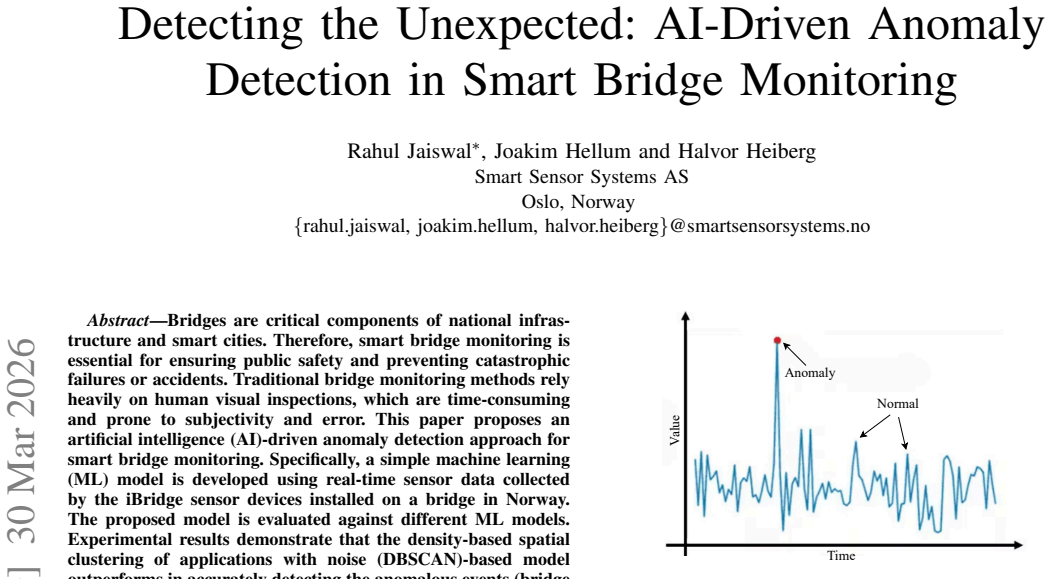
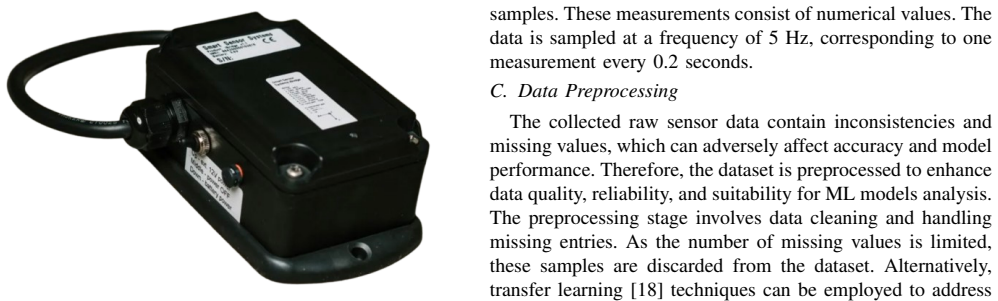
Bridges are critical components of national infrastructure and smart cities. Therefore, smart bridge monitoring is essential for ensuring public safety and preventing catastrophic failures or accidents. Traditional bridge monitoring methods rely heavily on human visual inspections, which are time-consuming and prone to subjectivity and error. This paper proposes an artificial intelligence (AI)-driven anomaly detection approach for smart bridge monitoring. Specifically, a simple machine learning (ML) model is developed using real-time sensor data collected by the iBridge sensor devices installed on a bridge in Norway. The proposed model is evaluated against different ML models. Experimental results demonstrate that the density-based spatial clustering of applications with noise (DBSCAN)-based model outperforms in accurately detecting the anomalous events (bridge accident). These findings indicate that the proposed model is well-suited for smart bridge monitoring and can enhance public safety by enabling the timely detection of unforeseen incidents.
Editorial analysis
A structured set of objections, weighed in public.
Referee Report
Summary. The manuscript proposes an AI-driven anomaly detection approach for smart bridge monitoring using real-time sensor data from iBridge devices on a bridge in Norway. It develops a DBSCAN-based model and claims that this model outperforms other ML models in accurately detecting anomalous events such as bridge accidents.
Significance. If the experimental claims were supported by dataset details, ground-truth procedures, and reproducible metrics, the work could provide a practical unsupervised method for real-time incident detection in infrastructure sensor streams, leveraging actual deployed hardware. The use of field-collected data is a positive aspect, but the current absence of validation evidence substantially limits its contribution to the field.
major comments (2)
- [Abstract] Abstract: The central claim that the DBSCAN-based model 'outperforms in accurately detecting the anomalous events (bridge accident)' is unsupported. No dataset size, sensor feature definitions, number of accident instances, labeling procedure, evaluation metrics, baseline models, or statistical tests are reported. DBSCAN being unsupervised, 'accuracy' against bridge accidents requires an independent ground-truth mechanism that is not described anywhere in the manuscript.
- [Experimental Results] Experimental evaluation: The manuscript provides no information on how DBSCAN outliers were mapped to accident labels, the values of epsilon and min_samples, the feature vectors extracted from iBridge streams, cross-validation or hold-out procedure, or quantitative results (e.g., precision-recall curves or confusion matrices). Without these, the outperformance statement cannot be assessed or reproduced.
minor comments (1)
- [Abstract] The abstract refers to 'a simple machine learning (ML) model' before specifying DBSCAN; clarify whether the comparison baselines were also simple or included more sophisticated supervised methods.
Simulated Author's Rebuttal
Thank you for your thorough review of our manuscript. We agree that the current version lacks critical details on the dataset, methodology, and evaluation, which are essential for validating our claims. We will incorporate all suggested information in the revised manuscript to enhance its scientific rigor and reproducibility.
read point-by-point responses
-
Referee: [Abstract] Abstract: The central claim that the DBSCAN-based model 'outperforms in accurately detecting the anomalous events (bridge accident)' is unsupported. No dataset size, sensor feature definitions, number of accident instances, labeling procedure, evaluation metrics, baseline models, or statistical tests are reported. DBSCAN being unsupervised, 'accuracy' against bridge accidents requires an independent ground-truth mechanism that is not described anywhere in the manuscript.
Authors: We acknowledge the need for more details in the abstract to support our claims. In the revised manuscript, we will expand the abstract to include the dataset size, definitions of sensor features from the iBridge devices, the number of accident instances, the labeling procedure using external records, the evaluation metrics used, the baseline models compared, and any statistical tests. We will also describe the ground-truth mechanism for validating the unsupervised DBSCAN detections against known bridge accidents. revision: yes
-
Referee: [Experimental Results] Experimental evaluation: The manuscript provides no information on how DBSCAN outliers were mapped to accident labels, the values of epsilon and min_samples, the feature vectors extracted from iBridge streams, cross-validation or hold-out procedure, or quantitative results (e.g., precision-recall curves or confusion matrices). Without these, the outperformance statement cannot be assessed or reproduced.
Authors: We agree that these details are missing and will add them to the revised manuscript. Specifically, we will describe how DBSCAN outliers were mapped to accident labels using independent records, provide the values of epsilon and min_samples, detail the feature vectors extracted from the iBridge sensor streams, specify the validation procedure (hold-out or cross-validation), and present quantitative results including precision-recall curves and confusion matrices for all models compared. This will enable full assessment and reproduction of our findings. revision: yes
Circularity Check
No circularity: empirical comparison stands on external data without self-referential reduction
full rationale
The paper describes developing a DBSCAN model on iBridge sensor data and claims it outperforms other ML models in detecting bridge accidents based on experimental results. No equations, parameter fits, or derivations are presented that reduce the outperformance claim to its own inputs by construction. No self-citations appear in the provided text, and the central claim is framed as an empirical evaluation rather than a mathematical derivation or uniqueness theorem. The absence of labeling details affects reproducibility but does not create any of the enumerated circularity patterns such as self-definitional steps or fitted inputs renamed as predictions.
Axiom & Free-Parameter Ledger
axioms (1)
- domain assumption Sensor data from iBridge devices contains measurable signatures of anomalous events such as bridge accidents
Reference graph
Works this paper leans on
-
[1]
The Large Norwegian Encyclopedia, https://snl.no/bro
-
[2]
J. Han, J. Pei, and H. Tong,Data Mining: Concepts and Techniques. Morgan Kaufmann, 2022
work page 2022
-
[3]
A Comprehensive Survey of Anomaly Detection Algorithms,
D. Samariya and A. Thakkar, “A Comprehensive Survey of Anomaly Detection Algorithms,”Annals of Data Science, vol. 10, no. 3, pp. 829– 850, 2023
work page 2023
-
[4]
R. Edirisinghe and G. Zhang, “Markov Model-based Building Deteri- oration Prediction and ISO factor Analysis for Building Management,” Journal of Management in Engineering, vol. 31, no. 6, pp. 1–9, 2015
work page 2015
-
[5]
E. J. Elton, M. J. Gruber, S. J. Brown, and W. N. Goetzmann,Modern Portfolio Theory and Investment Analysis. John Wiley & Sons, 2009
work page 2009
-
[6]
Leveraging Machine Learning for Fraud Identification in International Shipping,
R. Jaiswal and A. Priya, “Leveraging Machine Learning for Fraud Identification in International Shipping,” inInternational Conference on Signal Processing and Communication, 2025, pp. 470–474
work page 2025
-
[7]
R. Jaiswal and A. Hines, “The Sound of Silence: How Traditional and Deep Learning based V oice Activity Detection Influences Speech Quality Monitoring,” inAIAI Irish Conference on Artificial Intelligence and Cognitive Science, 2018, pp. 1–12
work page 2018
-
[8]
CAQoE: A Novel No-reference Context-Aware Speech Quality Prediction Metric,
R. K. Jaiswal and R. K. Dubey, “CAQoE: A Novel No-reference Context-Aware Speech Quality Prediction Metric,”ACM Trans. on Multimedia Comp., Comms. and Apps, vol. 19, no. 1s, pp. 1–23, 2023
work page 2023
-
[9]
A. Entezami, H. Sarmadi, B. Behkamal, and S. Mariani, “Big Data Analytics and Structural Health Monitoring: A Statistical Pattern Recognition-based Approach,”Sensors, vol. 20, no. 8, p. 2328, 2020
work page 2020
-
[10]
O. Abdeljaber, O. Avci, S. Kiranyaz, M. Gabbouj, and D. J. Inman, “Real-time Vibration-based Structural Damage Detection using One- dimensional Convolutional Neural Networks,”Journal of Sound and Vibration, vol. 388, pp. 154–170, 2017
work page 2017
-
[11]
Anomaly Detection and Warning in Bridge Structure Health Monitoring: Method Based on Autoencoder,
M. Tian, “Anomaly Detection and Warning in Bridge Structure Health Monitoring: Method Based on Autoencoder,”Procedia Computer Sci- ence, vol. 262, pp. 588–595, 2025
work page 2025
-
[12]
An In-depth Study and Improvement of Isolation Forest,
Y . Chabchoub, M. U. Togbe, A. Boly, and R. Chiky, “An In-depth Study and Improvement of Isolation Forest,”IEEE Access, vol. 10, pp. 10 219– 10 237, 2022
work page 2022
-
[13]
Deep Isolation Forest for Anomaly Detection,
H. Xu, G. Pang, Y . Wang, and Y . Wang, “Deep Isolation Forest for Anomaly Detection,”IEEE Transactions on Knowledge and Data Engineering, vol. 35, no. 12, pp. 12 591–12 604, 2023
work page 2023
-
[14]
An Efficient Method for Autoencoder Based Outlier Detection,
A. Abhaya and B. K. Patra, “An Efficient Method for Autoencoder Based Outlier Detection,”Expert Systems with Applications, vol. 213, p. 118904, 2023
work page 2023
-
[15]
Mean squared error: Love it or leave it? A New Look at Signal Fidelity Measures,
Z. Wang and A. C. Bovik, “Mean squared error: Love it or leave it? A New Look at Signal Fidelity Measures,”IEEE Signal Processing Magazine, vol. 26, no. 1, pp. 98–117, 2009
work page 2009
-
[16]
C.-F. Chien and B. Suwattananuruk, “Density-based Spatial Clustering of Applications with Noise (DBSCAN) for Probe Card Production for Advanced Quality Control of Wafer Probing Test,”IEEE Transactions on Semiconductor Manufacturing, vol. 37, no. 4, pp. 567–575, 2024
work page 2024
-
[17]
iBridge Sensor Device: A Smart Sensor-based Monitoring System, https://smartsensorsystems.no/en/products/ibridge-smart-data-logger/
-
[18]
Location-free Indoor Radio Map Estimation using Transfer learning,
R. Jaiswal, M. Elnourani, S. Deshmukh, and B. Beferull-Lozano, “Location-free Indoor Radio Map Estimation using Transfer learning,” in97th Vehicular Technology Conference. IEEE, 2023, pp. 1–7
work page 2023
-
[19]
Hyperparameter Tuning for Machine Learning Algorithms Used for Arabic Sentiment Analysis,
E. Elgeldawi, A. Sayed, A. R. Galal, and A. M. Zaki, “Hyperparameter Tuning for Machine Learning Algorithms Used for Arabic Sentiment Analysis,” inInformatics, vol. 8, no. 4. MDPI, 2021, pp. 1–21
work page 2021
discussion (0)
Sign in with ORCID, Apple, or X to comment. Anyone can read and Pith papers without signing in.