Recognition: no theorem link
Global asteroseismology of 19,000 red giants in the TESS Continuous Viewing Zones
Pith reviewed 2026-05-13 22:25 UTC · model grok-4.3
The pith
Asteroseismology of 19,000 TESS red giants delivers mass and radius precisions matching Kepler data
A machine-rendered reading of the paper's core claim, the machinery that carries it, and where it could break.
Core claim
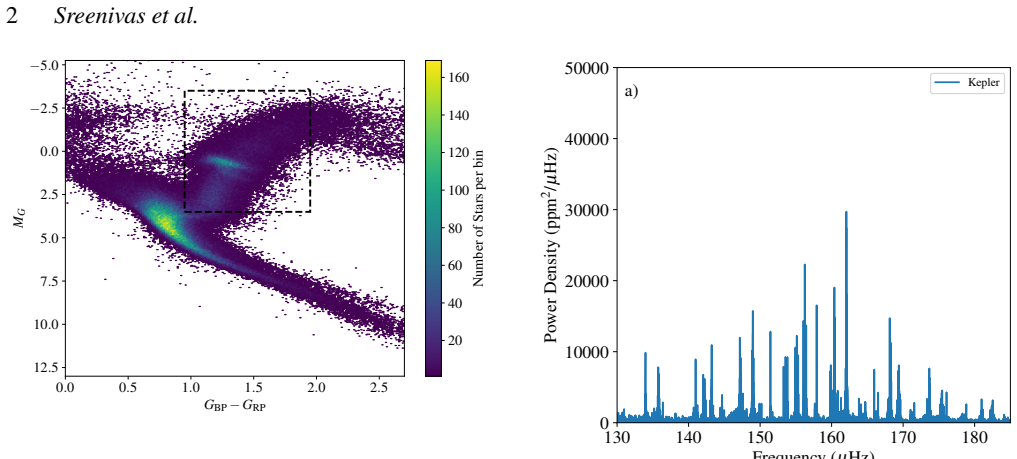
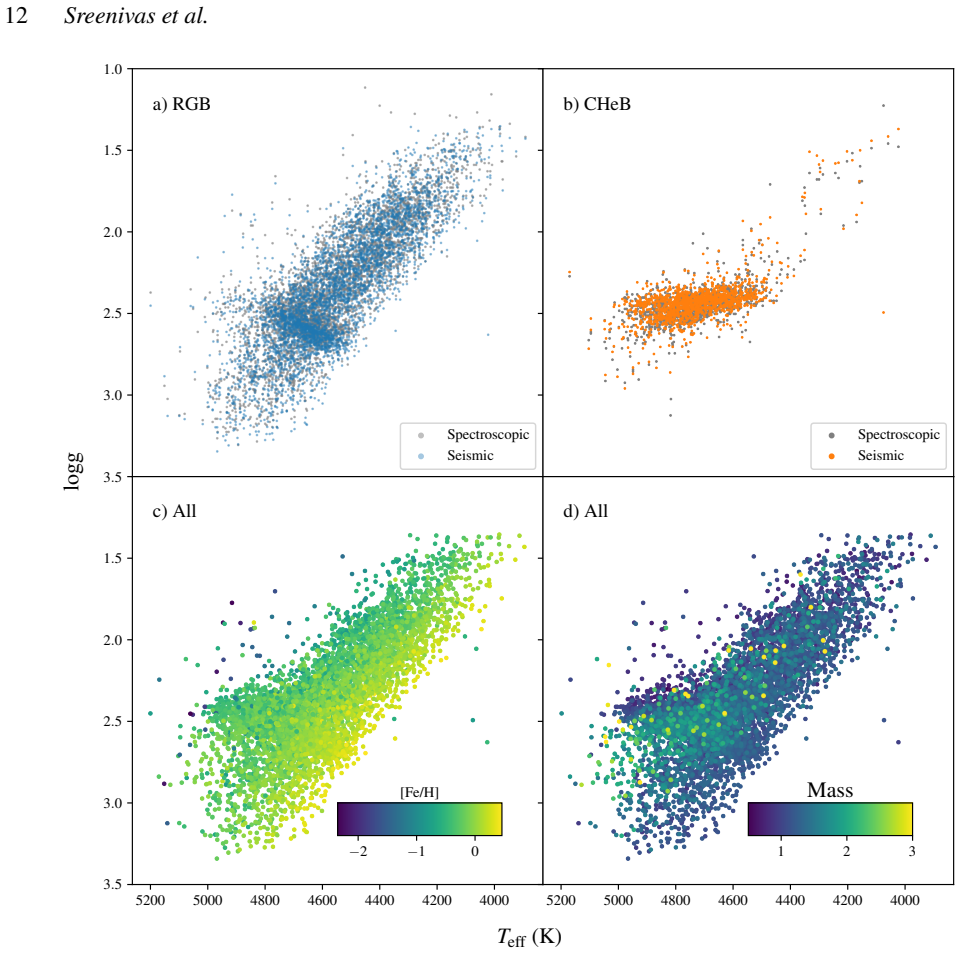
The paper establishes a catalogue of asteroseismic parameters for 19,151 red giants, including the frequency of maximum power and the large frequency separation, derived from TESS photometry. Using a convolutional neural network for evolutionary classification and combining the results with spectroscopic data, it measures stellar masses and radii with 7.5 percent and 2.8 percent precision for 10,298 stars. The measurements match the precision achieved with four-year Kepler data, show excellent agreement with Gaia radii, and enable identification of the RGB bump and zero-age helium-burning edge with only three years of TESS observations.
What carries the argument
The pySYD pipeline that extracts nu_max and Delta nu from the power spectra, after visual assessment and nuSYD confirmation of oscillations
If this is right
- Stellar masses and radii can be determined uniformly for a large galactic sample suitable for archaeology studies.
- Three years of TESS data suffice to identify the red-giant-branch bump and delineate the zero-age helium-burning edge.
- Seismic radii agree with Gaia radii, confirming the reliability of the asteroseismic scale.
- The parameters reveal established trends in stellar properties across the Galactic plane when combined with astrometry.
Where Pith is reading between the lines
- The same extraction methods could be extended to additional TESS sectors to increase the sample size beyond the continuous viewing zones.
- The catalogue supplies a ready test set for calibrating stellar-evolution models that predict the locations of the RGB bump and helium-burning edge.
- When cross-matched with exoplanet-host catalogues, the precise masses and radii could improve constraints on planet occurrence rates around evolved stars.
Load-bearing premise
The assumption that visual assessment combined with nuSYD confirmation and pySYD extraction reliably identifies true oscillations and yields unbiased parameters for TESS data quality and sampling.
What would settle it
A systematic discrepancy larger than the stated uncertainties between the derived seismic radii and independent Gaia radius measurements across the 10,298-star spectroscopic subsample.
Figures




read the original abstract
TESS (Transiting Exoplanet Survey Satellite) has produced long-term photometry for millions of stars across the sky. In this work, we present an asteroseismic catalogue of 19,151 red giants in the TESS Continuous Viewing Zones using sectors 1--87 (Years 1--7). We visually assessed the power spectra for oscillations, and then applied the computationally efficient nuSYD method to confirm reliability. We identified an increase of 80% in the number of previously known oscillating red giants at a TESS magnitude $>$ 8. We determined the frequency of maximum power ($\rm \nu_{max}$) and the large frequency separation ($\rm \Delta \nu$) using the pySYD pipeline, achieving typical precisions of 1.5% and 1%, respectively. We classified the stars into Red Giant Branch (RGB) and Core Helium Burning (CHeB) classes using a Convolutional Neural Network. Using spectroscopic data for 10,298 stars with reliable asteroseismic measurements, we have been able to measure stellar mass and radii with precisions of 7.5% and 2.8%, which is comparable to that from 4-yr $Kepler$ data. A comparison of the seismic radii with Gaia radii shows excellent agreement. With three years of TESS data, the asteroseismic parameters are precise enough to identify the RGB bump and delineate the Zero Age Helium Burning edge. Combined with astrometric data, these parameters reveal established trends across the Galactic plane, providing a valuable set of uniformly determined asteroseismic parameters for Galactic Archaeology.
Editorial analysis
A structured set of objections, weighed in public.
Referee Report
Summary. The paper reports an asteroseismic catalogue of 19,151 red giants in the TESS Continuous Viewing Zones (sectors 1-87), obtained by visual inspection of power spectra followed by confirmation with the nuSYD pipeline and parameter extraction (nu_max and Delta nu) via pySYD. For the subset of 10,298 stars with spectroscopic data, stellar masses and radii are derived with claimed precisions of 7.5% and 2.8% using standard scaling relations; these are stated to be comparable to 4-year Kepler results. The stars are classified into RGB and CHeB evolutionary states with a convolutional neural network. The catalogue shows good agreement between seismic and Gaia radii, recovers known features such as the RGB bump, and is positioned for use in Galactic archaeology.
Significance. If the internal precisions and lack of bias hold, the work delivers a large, uniformly processed sample of asteroseismic parameters for red giants across a wide magnitude range and new sky coverage, substantially expanding the dataset available for Galactic archaeology. The reported ability to detect the RGB bump and ZAHB edge with only three years of TESS data, together with the Gaia radius agreement, indicates practical utility for population studies.
major comments (2)
- [Methods (pySYD application and precision reporting)] Methods (oscillation detection and pySYD extraction): The central precision claims (1.5% on nu_max, 1% on Delta nu, leading to 7.5%/2.8% mass/radius) rest on the assumption that the visual + nuSYD + pySYD chain yields unbiased parameters for TESS sampling, duty cycle, and noise properties. No injection-recovery statistics or cross-pipeline comparisons specific to TESS CVZ light curves are described, so it is unclear whether the formal precisions are realistic rather than optimistic.
- [Results (seismic parameters and Gaia comparison)] Results (mass/radius precision and Gaia comparison): While the Gaia radius agreement provides an external check on radii, it does not validate the mass precision or the full error budget for the 10,298 stars. Additional tests (e.g., consistency with independent mass indicators or period-spacing constraints) would be needed to support the claim that the mass precision is truly comparable to Kepler.
minor comments (2)
- [Abstract] Abstract: the statement of an 80% increase in known oscillating red giants at TESS mag >8 would benefit from stating the absolute previous and new counts for immediate context.
- [Evolutionary classification] The CNN classification section should report the training/validation accuracy and any confusion matrix to allow assessment of RGB/CHeB purity.
Simulated Author's Rebuttal
We thank the referee for their constructive and positive review. The comments highlight important aspects of validation that we address point-by-point below. We believe the suggested clarifications will strengthen the manuscript without altering its core conclusions.
read point-by-point responses
-
Referee: Methods (oscillation detection and pySYD extraction): The central precision claims (1.5% on nu_max, 1% on Delta nu, leading to 7.5%/2.8% mass/radius) rest on the assumption that the visual + nuSYD + pySYD chain yields unbiased parameters for TESS sampling, duty cycle, and noise properties. No injection-recovery statistics or cross-pipeline comparisons specific to TESS CVZ light curves are described, so it is unclear whether the formal precisions are realistic rather than optimistic.
Authors: We appreciate this observation. The quoted precisions are the median formal uncertainties from pySYD fits after visual confirmation with nuSYD. pySYD has been benchmarked on both Kepler and TESS data in its original publications and subsequent works, showing good recovery of input parameters in simulated spectra. Our visual inspection step further filters for reliable detections across the TESS CVZ duty cycle and noise levels. We agree that TESS-specific injection-recovery tests would provide additional reassurance. We will expand the methods section to include a dedicated paragraph on pipeline validation, citing relevant prior tests on TESS light curves, and explicitly note that the reported values are formal uncertainties. This constitutes a partial revision as we cannot add new simulations here but can clarify the existing basis. revision: partial
-
Referee: Results (mass/radius precision and Gaia comparison): While the Gaia radius agreement provides an external check on radii, it does not validate the mass precision or the full error budget for the 10,298 stars. Additional tests (e.g., consistency with independent mass indicators or period-spacing constraints) would be needed to support the claim that the mass precision is truly comparable to Kepler.
Authors: We agree that the Gaia radius comparison primarily validates the radii derived from the scaling relations. Masses depend on the combination of nu_max, Delta nu, and spectroscopic parameters, so the Gaia check does not independently constrain the mass error budget. The statement of comparability to 4-year Kepler results refers to the similar median formal precisions achieved with the same scaling relations in the Kepler literature. To strengthen this, we will revise the relevant results section to (i) explicitly state that mass precisions are formal, (ii) add a brief comparison to APOGEE-derived masses for the overlapping subset where available, and (iii) qualify the Kepler comparison as referring to reported formal uncertainties rather than a full end-to-end validation. This will be incorporated in the revised manuscript. revision: yes
Circularity Check
No significant circularity; derivation relies on external pipelines and standard scaling relations
full rationale
The paper extracts nu_max and Delta nu via the established pySYD pipeline (after visual assessment and nuSYD confirmation) and applies standard asteroseismic scaling relations to spectroscopic data for mass and radius. These steps use independently developed tools and literature scaling relations whose validity is external to the present work; reported precisions follow from formal error propagation rather than any self-referential fit or redefinition. Gaia radius comparisons supply external checks, and no equation or claim reduces by construction to the inputs being reported. The central results are therefore self-contained against external benchmarks.
Axiom & Free-Parameter Ledger
axioms (1)
- domain assumption Asteroseismic scaling relations connect nu_max and Delta nu to stellar mass and radius with known accuracy for red giants
Reference graph
Works this paper leans on
-
[1]
Abdurro’uf et al., 2022, ApJS, 259, 35 Anders F., et al., 2017, A&A, 597, A30 Andrae R., Rix H.-W., Chandra V., 2023, The Astrophysical Journal Supple- ment Series, 267, 8 Arenou F., et al., 2018, A&A, 616, A17 Ash A. L., Pinsonneault M. H., Vrard M., Zinn J. C., 2025, ApJ, 979, 135 Astropy Collaboration 2013, A&A, 558, A33 Astropy Collaboration 2018, AJ,...
discussion (0)
Sign in with ORCID, Apple, or X to comment. Anyone can read and Pith papers without signing in.