A P-Adaptive Hybridizable Discontinuous Galerkin Spectral Element Method for Electrostatic Particle-in-Cell Simulations
Pith reviewed 2026-05-13 22:08 UTC · model grok-4.3
The pith
P-adaptive HDG spectral elements reduce global degrees of freedom for electrostatic Poisson solves in particle-in-cell plasma models.
A machine-rendered reading of the paper's core claim, the machinery that carries it, and where it could break.
Core claim
Element-local p-refinement inside the HDG-SEM discretization of the Poisson equation allows the global number of degrees of freedom to be reduced relative to fixed high-order schemes while solution accuracy on benchmark electrostatic PIC problems is preserved.
What carries the argument
Element-wise p-adaptation driven by local gradient indicators inside the hybridizable discontinuous Galerkin spectral element Poisson solver.
If this is right
- The total number of degrees of freedom drops compared with uniform high-order meshes while accuracy on the dielectric-sphere and one-dimensional sheath benchmarks remains comparable.
- The method can be applied directly to two-dimensional axisymmetric ion-optic geometries inside existing PIC codes.
- Computational savings scale with the fraction of the domain that requires high polynomial order.
- The implementation is already available inside the open-source PICLas framework.
Where Pith is reading between the lines
- The same local adaptation logic could be tested on three-dimensional multi-scale discharges where gradients occupy only a small fraction of the volume.
- Coupling the p-adaptive field solver with dynamic particle weighting or mesh motion might further reduce cost in time-dependent problems.
- Interface flux continuity across polynomial-degree jumps will need explicit verification in regimes with strong particle-induced source terms.
Load-bearing premise
Gradient-based local p-refinement keeps solution error controlled and prevents artifacts at interfaces between elements of different polynomial degree.
What would settle it
A simulation of a plasma sheath or ion optic in which the error or charge conservation error grows measurably at p-refinement interfaces compared with a uniform high-order run would falsify the claim.
Figures
read the original abstract
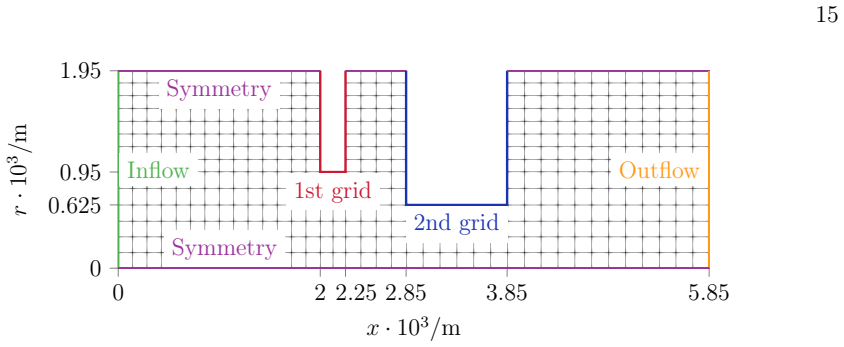
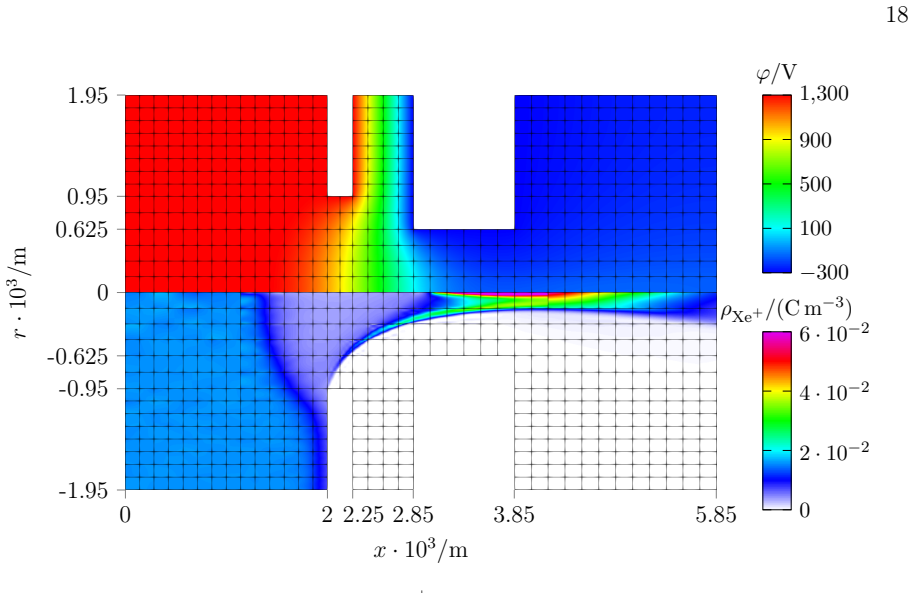
This paper presents a p-adaptive high-order hybridizable discontinuous Galerkin spectral element method (HDG-SEM) for solving the Poisson equation in electrostatic plasma simulations using particle-in-cell (PIC) schemes. This approach enables element-local refinement of the polynomial degree, concentrating computational effort specifically in regions with strong gradients. Thus, the method significantly reduces the global number of degrees of freedom compared to uniform high-order methods. The proposed method is implemented in the open-source framework PICLas and validated through a series of benchmark test cases, including a dielectric sphere and a one-dimensional plasma sheath. Finally, a two-dimensional axisymmetric simulation of an ion optic demonstrates the method's capability to efficiently model complex plasma phenomena but also highlights current limitations.
Editorial analysis
A structured set of objections, weighed in public.
Referee Report
Summary. The paper presents a p-adaptive high-order hybridizable discontinuous Galerkin spectral element method (HDG-SEM) for the Poisson equation in electrostatic PIC simulations. Element-local polynomial-degree refinement is driven by gradient indicators to concentrate degrees of freedom in high-gradient regions, thereby reducing the global DOF count relative to uniform high-order discretizations. The method is implemented in PICLas and validated on a dielectric sphere, a one-dimensional plasma sheath, and a two-dimensional axisymmetric ion-optic problem.
Significance. If the interface consistency of the hybrid variable is rigorously established, the approach would offer a practical route to efficient high-order electrostatic PIC simulations in multi-scale plasma configurations, directly addressing the computational cost of uniform high-order methods while preserving accuracy on standard benchmarks.
major comments (2)
- [§3 and §2.2] §3 (p-adaptation strategy) and §2.2 (HDG formulation): the element-local gradient-based criterion for increasing polynomial degree does not specify how the polynomial space for the hybrid trace variable is chosen on faces shared by elements of differing degree. In HDG the numerical flux couples adjacent elements through this trace; without an explicit rule (minimum-p, maximum-p, or mortar projection) or an a priori error estimate that accounts for the resulting nonconformity, the claim that local adaptation preserves global accuracy without interface artifacts remains unproven.
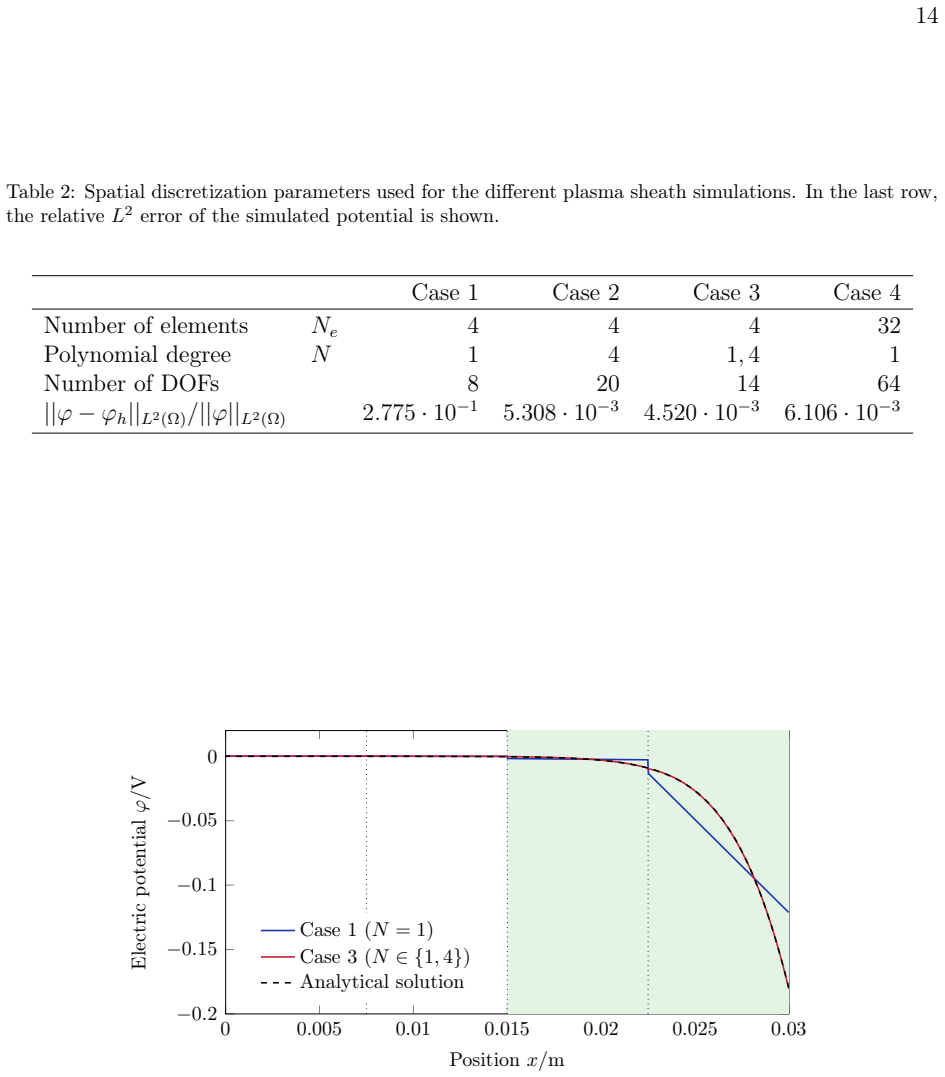
- [Table 2] Table 2 (error tables for dielectric sphere and 1-D sheath): quantitative comparison of total DOFs and L2 errors versus uniform p-refinement is presented, but the tables do not report the number or location of p-jumps at interfaces nor any measure of trace-variable discontinuity; this information is required to assess whether the observed error reduction is achieved without hidden interface penalties.
minor comments (2)
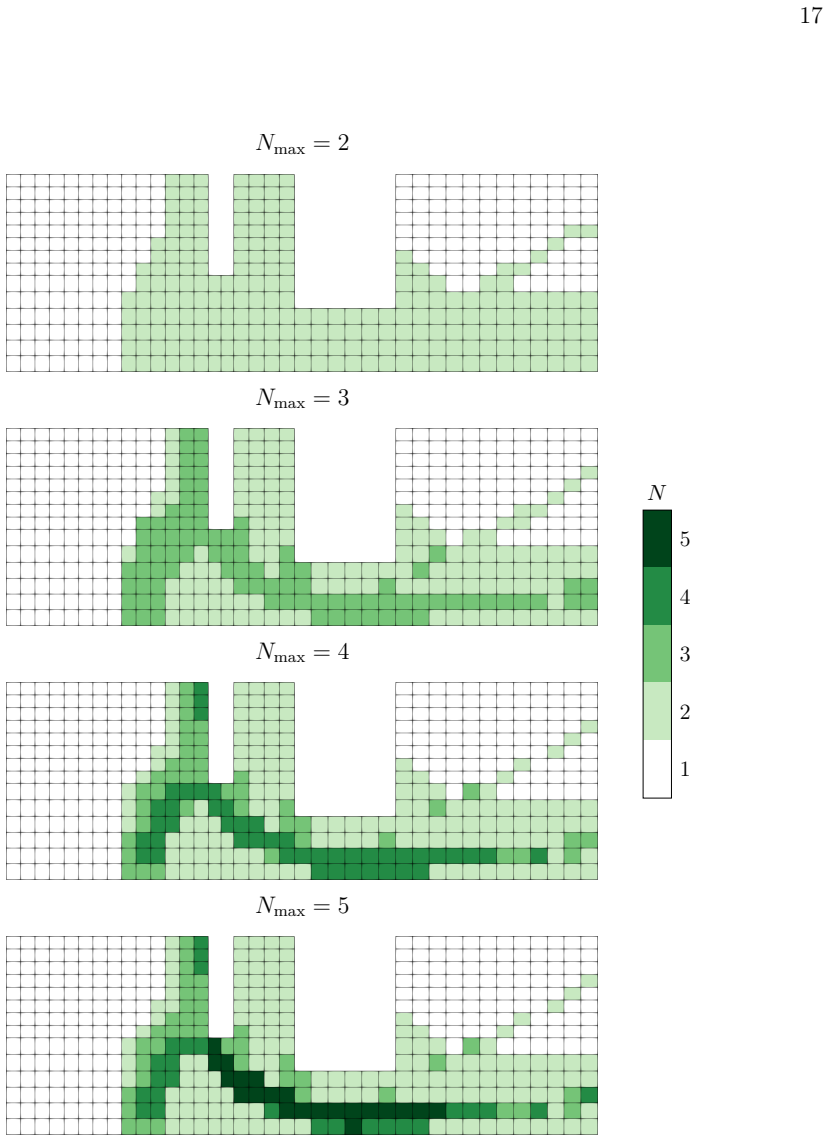
- [Figure 4] Figure 4 (ion-optic mesh): the color scale for local polynomial degree is not labeled with the exact range of p values used; adding this would improve reproducibility.
- [Eq. (12)] Equation (12) (adaptation indicator): the threshold value for gradient-based refinement is introduced without a sensitivity study; a brief remark on its selection would clarify robustness.
Simulated Author's Rebuttal
We thank the referee for the constructive feedback on our manuscript describing the p-adaptive HDG-SEM for electrostatic PIC simulations. We address each major comment below and will revise the manuscript accordingly to improve clarity and completeness.
read point-by-point responses
-
Referee: [§3 and §2.2] §3 (p-adaptation strategy) and §2.2 (HDG formulation): the element-local gradient-based criterion for increasing polynomial degree does not specify how the polynomial space for the hybrid trace variable is chosen on faces shared by elements of differing degree. In HDG the numerical flux couples adjacent elements through this trace; without an explicit rule (minimum-p, maximum-p, or mortar projection) or an a priori error estimate that accounts for the resulting nonconformity, the claim that local adaptation preserves global accuracy without interface artifacts remains unproven.
Authors: We agree that an explicit rule for the hybrid trace variable on p-nonconforming faces is essential. In the implementation, the polynomial degree for the trace variable on each shared face is set to the minimum of the degrees of the two adjacent elements. This choice maintains flux consistency and stability without requiring mortar projections. We will add a precise description of this rule to Section 2.2, together with a short justification referencing existing HDG theory for variable-degree spaces. While a full a priori error estimate for the p-adaptive case lies beyond the scope of the present work, the numerical benchmarks exhibit no visible interface artifacts, and we will expand the discussion in Section 3 to note this empirical evidence and cite supporting literature on nonconforming HDG methods. revision: yes
-
Referee: [Table 2] Table 2 (error tables for dielectric sphere and 1-D sheath): quantitative comparison of total DOFs and L2 errors versus uniform p-refinement is presented, but the tables do not report the number or location of p-jumps at interfaces nor any measure of trace-variable discontinuity; this information is required to assess whether the observed error reduction is achieved without hidden interface penalties.
Authors: We acknowledge that additional quantitative information on p-jumps would allow readers to better evaluate interface effects. In the revised manuscript we will augment Table 2 with the number of p-jumps present in each adapted configuration. We will also add a supplementary note (or short table) reporting the maximum L2 discontinuity of the hybrid trace variable across all interfaces for the p-adaptive runs. These data are directly available from the simulations and will demonstrate that the observed error reductions occur with only small, controlled discontinuities. revision: yes
Circularity Check
P-adaptive HDG-SEM derivation is self-contained; no load-bearing reductions to fitted inputs or self-citations
full rationale
The paper introduces an element-local gradient-based p-adaptation criterion within an HDG-SEM discretization of the Poisson equation for PIC electrostatics. The central claim (reduced global DOFs while preserving accuracy) is demonstrated via direct numerical validation on independent benchmarks (dielectric sphere, 1-D sheath, 2-D ion optic). No equations equate a derived quantity to its own fitting procedure, no uniqueness theorem is imported from prior self-work to force the formulation, and the adaptation rule is presented as a practical heuristic rather than a first-principles derivation that collapses by construction. Interface consistency for the hybrid variable when neighboring elements differ in p is addressed as an implementation detail, not as a tautological assumption. This yields a minor self-citation score only; the method remains externally falsifiable through the reported benchmark comparisons.
Axiom & Free-Parameter Ledger
Lean theorems connected to this paper
-
IndisputableMonolith/Cost/FunctionalEquation.leanwashburn_uniqueness_aczel unclear?
unclearRelation between the paper passage and the cited Recognition theorem.
iterative modal analysis strategy... squared normalized modal contribution falls below a predefined threshold ε... dynamic threshold that accounts for the noise level... ˆρ²_k < εσ²_k
What do these tags mean?
- matches
- The paper's claim is directly supported by a theorem in the formal canon.
- supports
- The theorem supports part of the paper's argument, but the paper may add assumptions or extra steps.
- extends
- The paper goes beyond the formal theorem; the theorem is a base layer rather than the whole result.
- uses
- The paper appears to rely on the theorem as machinery.
- contradicts
- The paper's claim conflicts with a theorem or certificate in the canon.
- unclear
- Pith found a possible connection, but the passage is too broad, indirect, or ambiguous to say the theorem truly supports the claim.
Reference graph
Works this paper leans on
-
[1]
Adams, Steven Benson, Jed Brown, Peter Brune, Kris Buschelman, Emil M
Satish Balay, Shrirang Abhyankar, Mark F. Adams, Steven Benson, Jed Brown, Peter Brune, Kris Buschelman, Emil M. Constantinescu, Lisandro Dalcin, Alp Dener, Victor 21 Eijkhout, Jacob Faibussowitsch, William D. Gropp, Václav Hapla, Tobin Isaac, Pierre Jolivet, Dmitry Karpeev, Dinesh Kaushik, Matthew G. Knepley, Fande Kong, Scott Kruger, Dave A. May, Lois C...
work page 2025
- [2]
-
[3]
Charles K. Birdsall and A. Bruce Langdon.Plasma Physics via Computer Simulation. McGraw-Hill, New York, 1985
work page 1985
-
[4]
John P Boyd.Chebyshev and Fourier spectral methods. Courier Corporation, 2001
work page 2001
-
[5]
Bernardo Cockburn, Bo Dong, and Johnny Guzmán. A superconvergent LDG- hybridizable Galerkin method for second-order elliptic problems.Mathematics of Com- putation, 77(264):1887–1916, May 2008
work page 1916
-
[6]
Bernardo Cockburn, Bo Dong, Johnny Guzmán, Marco Restelli, and Riccardo Sacco. A Hybridizable Discontinuous Galerkin Method for Steady-State Convection-Diffusion- Reaction Problems.SIAM Journal on Scientific Computing, 31(5):3827–3846, January 2009
work page 2009
-
[7]
Bernardo Cockburn and Jayadeep Gopalakrishnan. The Derivation of Hybridizable Dis- continuous Galerkin Methods for Stokes Flow.SIAM Journal on Numerical Analysis, 47(2):1092–1125, January 2009
work page 2009
-
[8]
Bernardo Cockburn, Jayadeep Gopalakrishnan, and Raytcho Lazarov. Unified Hy- bridization of Discontinuous Galerkin, Mixed, and Continuous Galerkin Methods for Second Order Elliptic Problems.SIAM Journal on Numerical Analysis, 47(2):1319– 1365, January 2009
work page 2009
-
[9]
S. Fasoulas, C.-D. Munz, M. Pfeiffer, J. Beyer, T. Binder, S. Copplestone, A. Mirza, P. Nizenkov, P. Ortwein, and W. Reschke. Combining particle-in-cell and direct sim- ulation Monte Carlo for the simulation of reactive plasma flows.Physics of Fluids, 31(7):072006, July 2019
work page 2019
-
[10]
E. Hairer, Christian Lubich, and Gerhard Wanner.Geometric Numerical Integration: Structure-Preserving Algorithms for Ordinary Differential Equations. Number 31 in Springer Series in Computational Mathematics. Springer, Berlin ; New York, 2nd ed. edition, 2006
work page 2006
-
[11]
R.W Hockney and J.W Eastwood.Computer Simulation Using Particles. CRC Press, 1st ed. edition, 1988. 22
work page 1988
-
[12]
HYPRE: High performance preconditioners.https://llnl.gov/casc/hypre,https: //github.com/hypre-space/hypre
-
[13]
John David Jackson.Classical electrodynamics. Wiley, New York, NY, 3rd ed. edition, 1999
work page 1999
-
[14]
G.B. Jacobs and J.S. Hesthaven. High-order nodal discontinuous Galerkin particle-in- cell method on unstructured grids.Journal of Computational Physics, 214(1):96–121, May 2006
work page 2006
-
[15]
K -U Riemann. The Bohm criterion and sheath formation.Journal of Physics D: Applied Physics, 24(4):493–518, April 1991
work page 1991
-
[16]
Blind, Anna Schwarz, Marius Kurz, Felix Rodach, Stephen M
Patrick Kopper, Marcel P. Blind, Anna Schwarz, Marius Kurz, Felix Rodach, Stephen M. Copplestone, and Andrea D. Beck. Pyhope: A python toolkit for three-dimensional unstructured high-order meshes.Journal of Open Source Software, 10(115):8769, 2025
work page 2025
-
[17]
Catherine Mavriplis. Adaptive mesh strategies for the spectral element method.Com- puter Methods in Applied Mechanics and Engineering, 116(1-4):77–86, January 1994
work page 1994
-
[18]
Claus-Dieter Munz, Monika Auweter-Kurtz, Stefanos Fasoulas, Asim Mirza, Philip Or- twein, Marcel Pfeiffer, and Torsten Stindl. Coupled Particle-In-Cell and Direct Sim- ulation Monte Carlo method for simulating reactive plasma flows.Comptes Rendus. Mécanique, 342(10-11):662–670, August 2014
work page 2014
-
[19]
M. Pfeiffer, F. Hindenlang, T. Binder, S.M. Copplestone, C.-D. Munz, and S. Fasoulas. A Particle-in-Cell solver based on a high-order hybridizable discontinuous Galerkin spectral element method on unstructured curved meshes.Computer Methods in Applied Mechanics and Engineering, 349:149–166, June 2019
work page 2019
discussion (0)
Sign in with ORCID, Apple, or X to comment. Anyone can read and Pith papers without signing in.