Convolutional Surrogate for 3D Discrete Fracture-Matrix Tensor Upscaling
Pith reviewed 2026-05-16 12:42 UTC · model grok-4.3
The pith
A 3D convolutional neural network surrogate predicts equivalent hydraulic conductivity tensors for fractured rock domains with normalized errors below 0.22 and over 100x speedup on GPU.
A machine-rendered reading of the paper's core claim, the machinery that carries it, and where it could break.
Core claim
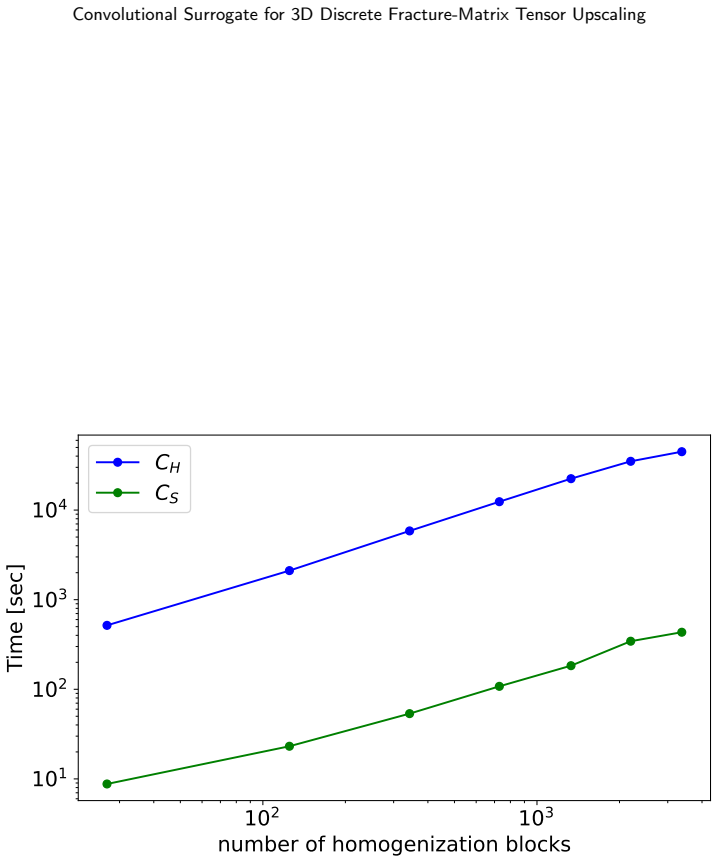
The central claim is that a 3D convolutional surrogate trained on discrete fracture-matrix simulation data can predict the equivalent conductivity tensor Keq from voxelized inputs with normalized root-mean-square errors below 0.22 in most cases, while delivering speedups exceeding 100x during GPU inference in two macro-scale demonstration problems that compare surrogate outputs against direct numerical homogenization.
What carries the argument
A 3D convolutional neural network followed by feed-forward layers that ingests voxelized random fields of matrix and fracture conductivities and outputs the six independent components of the equivalent conductivity tensor.
If this is right
- Surrogate predictions can substitute for numerical homogenization inside multilevel Monte Carlo frameworks without substantial accuracy loss.
- In macro-scale problems the surrogate reproduces both equivalent conductivity tensors and domain outflow values at far lower cost than direct simulation.
- GPU-based inference reduces the wall-clock time of repeated upscaling operations by more than two orders of magnitude.
- Separate models trained for each conductivity contrast allow the method to handle different geological regimes.
Where Pith is reading between the lines
- The same voxel-to-tensor mapping could be retrained for other heterogeneous media such as porous rocks with inclusions or layered sediments.
- If the statistical fracture distributions match field data only loosely, the surrogate error may rise sharply and require online fine-tuning or ensemble correction.
- Embedding the surrogate inside an adaptive mesh-refinement loop might allow on-the-fly upscaling at every coarse-scale time step.
Load-bearing premise
Fracture networks generated from the chosen statistical distributions adequately represent real geological sites and the trained surrogate generalizes to fracture configurations and conductivity contrasts outside the three training regimes.
What would settle it
Apply the surrogate to a fracture network whose size, orientation, aperture, or conductivity contrast lies outside the training distributions and measure whether the normalized root-mean-square error on the predicted tensor exceeds 0.22.
Figures


read the original abstract
Modeling groundwater flow in three-dimensional fractured crystalline media requires accounting for strong spatial heterogeneity induced by fractures. Fine-scale discrete fracture-matrix (DFM) simulations can capture this complexity but are computationally expensive, especially when repeated evaluations are needed. To address this, we aim to employ a multilevel Monte Carlo (MLMC) framework in which numerical homogenization is used to upscale sub-resolution fracture effects when transitioning between accuracy levels. To reduce the cost of conventional 3D numerical homogenization, we develop a surrogate model that predicts the equivalent hydraulic conductivity tensor Keq from a voxelized 3D domain representing tensor-valued random fields of matrix and fracture conductivities. Fracture size, orientation, and aperture are sampled from distributions informed by natural observations. The surrogate architecture combines a 3D convolutional neural network with feed-forward layers, enabling it to capture both local spatial features and global interactions. Three surrogates are trained on data generated by DFM simulations, each corresponding to a different fracture-to-matrix conductivity contrast. Performance is evaluated across a wide range of fracture network parameters and matrix-field correlation lengths. The trained models achieve high accuracy, with normalized root-mean-square errors below 0.22 across most test cases. Practical applicability is demonstrated by comparing numerically homogenized conductivities with surrogate predictions in two macro-scale problems: computing equivalent conductivity tensors and predicting outflow from a constrained 3D domain. In both cases, surrogate-based upscaling preserves accuracy while substantially reducing computational cost, achieving speedups exceeding 100x when inference is performed on a GPU.
Editorial analysis
A structured set of objections, weighed in public.
Referee Report
Summary. The manuscript develops a 3D CNN surrogate that predicts the six independent components of the equivalent hydraulic conductivity tensor Keq from voxelized 3D fracture-matrix conductivity fields. Three separate models are trained on DFM simulation data for distinct fracture-to-matrix conductivity contrasts; performance is reported via NRMSE on held-out test sets spanning fracture statistics and matrix correlation lengths. The surrogate is then substituted into two macro-scale test problems (tensor homogenization and outflow prediction) to demonstrate accuracy preservation and >100x GPU speedup relative to direct numerical homogenization.
Significance. If the tensors remain physically valid, the work supplies a practical route to cheap sub-grid upscaling inside MLMC hierarchies for 3D fractured-media flow. The reported NRMSE values below 0.22 on wide test ranges and the end-to-end preservation of macro-scale quantities constitute concrete evidence of utility; the GPU inference speedup is a clear practical gain for repeated evaluations.
major comments (1)
- [§3] §3 (Surrogate Architecture): the network directly regresses the six independent entries of Keq with no Cholesky factorization, eigenvalue projection, or other post-processing to enforce symmetry and positive-definiteness. Because the Darcy problem requires a symmetric positive-definite tensor, any negative eigenvalue produced by the surrogate would render the macro-scale demonstrations in §5 ill-posed and would invalidate both the accuracy-preservation claim and the reported speedups.
minor comments (2)
- [Figure 4] Figure 4 and Table 2: the NRMSE values are given without accompanying standard deviations across the multiple random seeds or network initializations; adding these would strengthen the reproducibility statement.
- [§2.2] §2.2: the precise voxel resolution and padding strategy used to embed the fracture networks into the 3D grid should be stated explicitly so that readers can reproduce the input representation.
Simulated Author's Rebuttal
We thank the referee for the careful review and for raising this important point about physical constraints on the predicted tensors. We address the comment directly below.
read point-by-point responses
-
Referee: [§3] §3 (Surrogate Architecture): the network directly regresses the six independent entries of Keq with no Cholesky factorization, eigenvalue projection, or other post-processing to enforce symmetry and positive-definiteness. Because the Darcy problem requires a symmetric positive-definite tensor, any negative eigenvalue produced by the surrogate would render the macro-scale demonstrations in §5 ill-posed and would invalidate both the accuracy-preservation claim and the reported speedups.
Authors: We agree that the conductivity tensor must remain symmetric and positive definite for the Darcy problem to be well-posed. Symmetry is already enforced by construction, as the network regresses only the six independent components. However, the original manuscript does not include any explicit mechanism (such as Cholesky factorization or eigenvalue projection) to guarantee positive-definiteness, nor does it report verification that all predicted tensors satisfy this property. We will therefore revise §3 to add a post-processing projection step that enforces positive-definiteness while preserving the six-component output format. In the revised version we will also quantify the frequency and magnitude of any adjustments required and confirm that the macro-scale results in §5 remain unchanged after projection. This addition directly addresses the concern and strengthens the applicability claims. revision: yes
Circularity Check
No circularity: standard supervised surrogate trained on independent DFM data
full rationale
The paper generates training data from separate DFM simulations, trains a 3D-CNN + feed-forward surrogate to regress the six Keq components, and reports NRMSE on held-out test cases drawn from the same distributions. Performance metrics are direct comparisons to simulation outputs rather than quantities recomputed from fitted parameters inside the model. No derivation step reduces by construction to its inputs, no load-bearing self-citations appear, and the central claims rest on empirical validation against external simulations. This is a conventional ML surrogate workflow with no self-definitional or fitted-input-called-prediction patterns.
Axiom & Free-Parameter Ledger
free parameters (1)
- CNN architecture hyperparameters
axioms (1)
- domain assumption Voxelized 3D grids of matrix and fracture conductivities contain all information needed for accurate tensor upscaling.
Lean theorems connected to this paper
-
IndisputableMonolith/Cost/FunctionalEquation.leanwashburn_uniqueness_aczel unclear?
unclearRelation between the paper passage and the cited Recognition theorem.
The surrogate architecture combines a 3D convolutional neural network with feed-forward layers... four Conv3D layers... final output layer has 6 neurons
-
IndisputableMonolith/Foundation/AlexanderDuality.leanalexander_duality_circle_linking unclear?
unclearRelation between the paper passage and the cited Recognition theorem.
NRMSE<0.22 across most test cases... speedups exceeding 100x
What do these tags mean?
- matches
- The paper's claim is directly supported by a theorem in the formal canon.
- supports
- The theorem supports part of the paper's argument, but the paper may add assumptions or extra steps.
- extends
- The paper goes beyond the formal theorem; the theorem is a base layer rather than the whole result.
- uses
- The paper appears to rely on the theorem as machinery.
- contradicts
- The paper's claim conflicts with a theorem or certificate in the canon.
- unclear
- Pith found a possible connection, but the passage is too broad, indirect, or ambiguous to say the theorem truly supports the claim.
Reference graph
Works this paper leans on
-
[1]
Springer Netherlands, Dordrecht
Fractures and Fracture Networks. Springer Netherlands, Dordrecht. doi:10.1007/978-94-017-1599-7. Andrianov, N.,
-
[2]
Homogenization of Coupled Phenomena in Heterogenous Media. ISTE, London, UK. doi:10.1002/9780470612033. Azizmohammadi, S., Matthäi, S.K.,
-
[3]
URL:http://doi.wiley.com/10.1002/2016WR019764, doi:10.1002/2016WR019764. Banks, D., Robins, N.,
-
[4]
Transport in Porous Media 130, 215–236
Flow in fractured porous media. Transport in Porous Media 130, 215–236. URL:http://link. springer.com/10.1007/s11242-018-1171-6, doi:10.1007/s11242-018-1171-6. Berrone, S., Pieraccini, S., Scialò, S.,
-
[5]
SIAM Journal on Scientific Computing 35, A908–A935
On Simulations of Discrete Fracture Network Flows with an Optimization-Based Extended Finite Element Method. SIAM Journal on Scientific Computing 35, A908–A935. doi:10.1137/120882883. Bogdanov, I.I., Mourzenko, V.V., Thovert, J.F., Adler, P.M.,
-
[6]
Bogdanov, I.I., Mourzenko, V.V., Thovert, J.F., Adler, P.M.,
URL:https://agupubs.onlinelibrary.wiley.com/doi/abs/10.1029/2001WR000756, doi:https: //doi.org/10.1029/2001WR000756. Bogdanov, I.I., Mourzenko, V.V., Thovert, J.F., Adler, P.M.,
-
[7]
Effective permeability of fractured porous media with power-law distribution of fracture sizes. Phys. Rev. E 76, 036309. URL:https://link.aps.org/doi/10.1103/PhysRevE.76.036309, doi:10.1103/PhysRevE. 76.036309. Bonnet, E., Bour, O., Odling, N.E., Davy, P., Main, I., Cowie, P., Berkowitz, B.,
-
[8]
Reviews of Geophysics 39, 347–383
Scaling of fracture systems in geological media. Reviews of Geophysics 39, 347–383. doi:https://doi.org/10.1029/1999RG000074. Březina, J., Stebel, J.,
-
[9]
Analysis of model error for a continuum-fracture model of porous media flow, in: Kozubek, T., Blaheta, R., Šístek, J., Rozložník, M., Čermák, M. (Eds.), High Performance Computing in Science and Engineering, Springer International Publishing, Cham. pp. 152–160. doi:10.1007/978-3-319-40361-8_11. Březina,J.,Stebel,J.,Exner,P.,Hybš,J.,2011–2025.Flow123d.http...
-
[10]
Journal of Biomedical Informatics 137, 104264 (2023) https://doi.org/10.1016/j.jbi.2022.104264
A framework for upscaling and modelling fluid flow for discrete fractures using conditional generative adversarial networks. Advances in Water Resources 166, 104264. URL:https://www.sciencedirect.com/ science/article/pii/S0309170822001336, doi:https://doi.org/10.1016/j.advwatres.2022.104264. M. Špetlík, J. Březina:Preprint submitted to ElsevierPage 28 of ...
-
[11]
Multilevel Monte Carlo methods. Acta Numerica 24, 259–328. doi:10.1017/S096249291500001X. Goodfellow, I., Bengio, Y., Courville, A.,
-
[12]
Journal of Hydrology 553, 59–70
A comparative study of discrete fracturenetworkandequivalentcontinuummodelsforsimulatingflowandtransportinthefarfieldofahypotheticalnuclearwasterepositoryin crystalline host rock. Journal of Hydrology 553, 59–70. doi:10.1016/j.jhydrol.2017.07.046. He, X., Santoso, R., Alsinan, M., Kwak, H., Hoteit, H.,
-
[13]
Constructing Dual-Porosity Models from High-Resolution Discrete-Fracture Models Using Deep Neural Networks, in: Proceedings of the SPE Reservoir Simulation Conference, p. D011S014R012. doi:10.2118/203901-MS. Hong, J., Liu, J.,
-
[14]
Computational Geosciences 24, 1523–1539
Rapid estimation of permeability from digital rock using 3d convolutional neural network. Computational Geosciences 24, 1523–1539. URL:https://link.springer.com/10.1007/s10596-020-09941-w, doi:10.1007/s10596-020-09941-w. IAEA (Ed.),
-
[15]
Investigating the effects of intersection flow localization in equivalent-continuum-based upscaling of flow in discrete fracture networks. Solid Earth 12, 2235–2254. doi:10.5194/se-12-2235-2021. Lang, P.S., Paluszny, A., Zimmerman, R.W.,
-
[16]
Journal of Geophysical Research: Solid Earth 119, 6288–6307
Permeability tensor of three-dimensional fractured porous rock and a comparison to trace map predictions. Journal of Geophysical Research: Solid Earth 119, 6288–6307. URL:https://onlinelibrary.wiley.com/doi/abs/10. 1002/2014JB011027, doi:10.1002/2014JB011027. Meng, Y., Jiang, J., Wu, J., Wang, D.,
-
[17]
Advances in Water Resources 179, 104520
Transformer-based deep learning models for predicting permeability of porous media. Advances in Water Resources 179, 104520. URL:https://www.sciencedirect.com/science/article/pii/S0309170823001549, doi:https: //doi.org/10.1016/j.advwatres.2023.104520. Müller, S., Schüler, L.,
-
[18]
Pal,M.,Makauskas,P.,Malik,S.,2023
GSTools.https://github.com/GeoStat-Framework/GSTools. Pal,M.,Makauskas,P.,Malik,S.,2023. Upscalingporousmediausingneuralnetworks:Adeeplearningapproachtohomogenizationandaveraging. Processes
work page 2023
-
[19]
URL:https://www.mdpi.com/2227-9717/11/2/601, doi:10.3390/pr11020601. Rao, C., Liu, Y.,
-
[20]
Computational Materials Science 184, 109850
Three-dimensional convolutional neural network (3d-cnn) for heterogeneous material homogenization. Computational Materials Science 184, 109850. URL:https://www.sciencedirect.com/science/article/pii/S0927025620303414, doi:https: //doi.org/10.1016/j.commatsci.2020.109850. Rhén,I.,Forsmark,T.,Hartley,L.,Jackson,P.,Roberts,D.,Swan,D.,Gylling,B.,2008. Hydrogeo...
-
[21]
ed., Wiley. doi:10.1002/9783527636693. Sandve, T.H., Berre, I., Nordbotten, J.M.,
-
[22]
Journal of Computational Physics 231, 3784–3800
An efficient multi-point flux approximation method for Discrete Fracture–Matrix simulations. Journal of Computational Physics 231, 3784–3800. doi:10.1016/j.jcp.2012.01.023. Špetlík, M., Březina, J., Laloy, E.,
-
[23]
Deep learning surrogate for predicting hydraulic conductivity tensors from stochastic discrete fracture- matrixmodels. ComputationalGeosciencesURL:https://link.springer.com/article/10.1007/s10596-024-10324-8,doi:https: //doi.org/10.1007/s10596-024-10324-8. Stepanov,S.,Spiridonov,D.,Mai,T.,2023.Predictionofnumericalhomogenizationusingdeeplearningfortherich...
-
[24]
Computers & Mathematics with Applications 84, 185–202
Machine learning for accelerating macroscopic parameters prediction for poroelasticity problem in stochastic media. Computers & Mathematics with Applications 84, 185–202. URL:https://www.sciencedirect.com/science/article/pii/ S0898122121000067, doi:https://doi.org/10.1016/j.camwa.2020.09.024. Wang,N.,Liao,Q.,Chang,H.,Zhang,D.,2023. Deep-learning-basedupsc...
discussion (0)
Sign in with ORCID, Apple, or X to comment. Anyone can read and Pith papers without signing in.