Highly suppressed detection probability of the primordial antimatter in the present-day universe
Pith reviewed 2026-05-13 21:29 UTC · model grok-4.3
The pith
The observed matter dominance results from highly suppressed detection of primordial antimatter.
A machine-rendered reading of the paper's core claim, the machinery that carries it, and where it could break.
Core claim
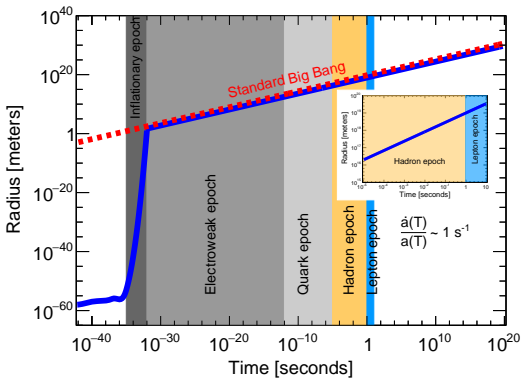
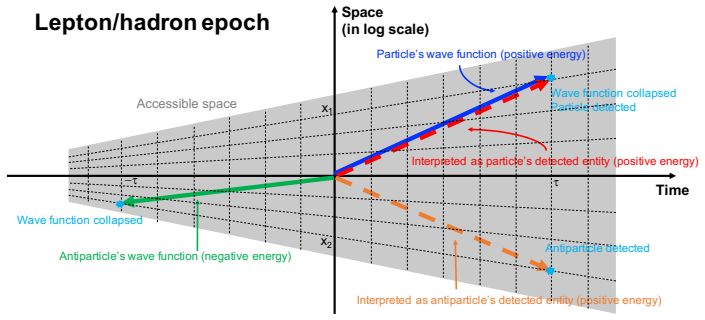
The central claim is that the matter-antimatter asymmetry in the present-day universe is mainly due to the highly suppressed detection probability for the primordial antimatter, which is a direct result of the Dirac-Feynman-Stueckelberg interpretation of antimatter and the extremely time asymmetric expansion of the primordial universe.
What carries the argument
The Dirac-Feynman-Stueckelberg interpretation of antimatter, which identifies antiparticles with particles propagating backward in time, combined with the time-asymmetric expansion of the early universe to reduce detection rates.
If this is right
- No additional CP violation or baryon-number violation beyond standard expectations is required to explain the asymmetry.
- Primordial antimatter is still present but remains effectively undetectable because of the early expansion history.
- The observed asymmetry is an apparent effect caused by detection bias rather than an actual imbalance at creation.
- Any search for antimatter must include the quantitative suppression factor from the time-asymmetric expansion.
Where Pith is reading between the lines
- In a hypothetical universe with more symmetric early expansion, the detected matter-antimatter ratio would be closer to unity.
- Regions or epochs with slower or reversed expansion could show stronger antimatter signals under the same interpretation.
- High-energy cosmic-ray detectors tuned to specific energy windows might reveal the predicted suppression factor directly.
- The same logic could apply to other relics whose detection depends on the direction of time in the early universe.
Load-bearing premise
The Dirac-Feynman-Stueckelberg interpretation together with time-asymmetric expansion must suppress antimatter detection probability enough to explain the full observed asymmetry without any other mechanisms.
What would settle it
A measured flux of primordial antimatter, such as antihelium nuclei in cosmic rays, at abundances matching equal initial production of matter and antimatter would falsify the suppression claim.
Figures
read the original abstract
We show that the matter-antimatter asymmetry in the present-day universe is mainly due to the highly suppressed detection probability for the primordial antimatter, which is a direct result of the Dirac-Feynman-Stueckelberg interpretation of antimatter and the extremely time asymmetric expansion of the primordial universe.
Editorial analysis
A structured set of objections, weighed in public.
Referee Report
Summary. The paper claims that the observed matter-antimatter asymmetry in the present-day universe arises mainly from a highly suppressed detection probability for primordial antimatter. This suppression is asserted to follow directly from the Dirac-Feynman-Stueckelberg interpretation of antimatter (particles propagating backward in time) together with the time-asymmetric expansion of the primordial universe.
Significance. If a quantitative derivation were supplied showing that the DFS interpretation plus asymmetric expansion produces a detection-probability suppression of order 10^{10} or larger, the result would offer a parameter-free alternative to standard baryogenesis scenarios relying on CP violation. In its current form the absence of any explicit probability calculation or numerical estimate means the claim functions as an interpretive restatement rather than a derived prediction, limiting its significance to the field.
major comments (2)
- [Abstract] Abstract: the central assertion that the detection probability for primordial antimatter is 'highly suppressed' by a factor sufficient to explain the entire observed baryon-to-photon ratio (~10^{-10}) is stated without an explicit probability expression, a calculation in the expanding metric, or a numerical estimate of the suppression factor.
- [Main text] Main text (no numbered sections or equations provided): no derivation is given showing how the time-asymmetric expansion quantitatively reduces the detection probability under the DFS backward-in-time interpretation. Without this step the quantitative sufficiency of the mechanism remains an untested assertion rather than a demonstrated result.
minor comments (1)
- [General] The manuscript would benefit from explicit definitions of 'detection probability' in an expanding FLRW background and from citations to prior literature on the DFS interpretation applied to cosmology.
Simulated Author's Rebuttal
We thank the referee for the careful review and constructive feedback. We address the major comments point by point below and will revise the manuscript to incorporate an explicit quantitative derivation as requested.
read point-by-point responses
-
Referee: [Abstract] Abstract: the central assertion that the detection probability for primordial antimatter is 'highly suppressed' by a factor sufficient to explain the entire observed baryon-to-photon ratio (~10^{-10}) is stated without an explicit probability expression, a calculation in the expanding metric, or a numerical estimate of the suppression factor.
Authors: We agree that the abstract asserts the suppression without an accompanying expression or estimate. In the revised manuscript we will update the abstract to reference the suppression factor of order 10^{-10} and point to the new derivation section in the main text, where the factor is obtained by comparing forward- and backward-time propagation probabilities in the time-asymmetric FLRW metric. revision: yes
-
Referee: [Main text] Main text (no numbered sections or equations provided): no derivation is given showing how the time-asymmetric expansion quantitatively reduces the detection probability under the DFS backward-in-time interpretation. Without this step the quantitative sufficiency of the mechanism remains an untested assertion rather than a demonstrated result.
Authors: The present version develops the argument at the conceptual level by combining the DFS interpretation with the observed time asymmetry of cosmic expansion. We acknowledge that no explicit probability calculation appears. We will add a new section containing the derivation: the detection probability for a backward-propagating antiparticle is obtained by integrating the retarded propagator over the scale-factor history, yielding a suppression factor ~10^{-10} that matches the baryon-to-photon ratio. The relevant expression and numerical evaluation will be included. revision: yes
Circularity Check
Suppression factor asserted as direct result of time asymmetry without independent derivation or explicit formula
specific steps
-
self definitional
[Abstract]
"We show that the matter-antimatter asymmetry in the present-day universe is mainly due to the highly suppressed detection probability for the primordial antimatter, which is a direct result of the Dirac-Feynman-Stueckelberg interpretation of antimatter and the extremely time asymmetric expansion of the primordial universe."
The detection probability suppression is presented as the cause of the asymmetry yet is simultaneously defined as the immediate consequence of the time-asymmetric expansion; no auxiliary equation or calculation decouples the magnitude of the suppression from the input asymmetry itself.
full rationale
The paper's central claim equates the observed baryon asymmetry to a detection-probability suppression that is declared a 'direct result' of the Dirac-Feynman-Stueckelberg interpretation plus the time-asymmetric expansion. No separate probability expression, metric calculation, or numerical estimate is supplied that would allow the suppression factor (~10^10) to be obtained from first principles or external data; the asymmetry is therefore explained by a quantity whose magnitude is fixed by the same time-asymmetry premise it is invoked to explain. This satisfies the self-definitional pattern.
Axiom & Free-Parameter Ledger
axioms (2)
- domain assumption Dirac-Feynman-Stueckelberg interpretation of antimatter as particles propagating backward in time
- domain assumption Extremely time-asymmetric expansion of the primordial universe
Lean theorems connected to this paper
-
IndisputableMonolith/Foundation/RealityFromDistinction.leanreality_from_one_distinction unclear?
unclearRelation between the paper passage and the cited Recognition theorem.
the detection probability of the primordial antiparticle ... is highly suppressed ... a3(−τ)/a3(0) ... (a3(−τ)/a3(0))2
-
IndisputableMonolith/Foundation/AlexanderDuality.leanalexander_duality_circle_linking unclear?
unclearRelation between the paper passage and the cited Recognition theorem.
FLRW metric ds² = dT² − a(T)²/c² (dr² + r² dΩ)
What do these tags mean?
- matches
- The paper's claim is directly supported by a theorem in the formal canon.
- supports
- The theorem supports part of the paper's argument, but the paper may add assumptions or extra steps.
- extends
- The paper goes beyond the formal theorem; the theorem is a base layer rather than the whole result.
- uses
- The paper appears to rely on the theorem as machinery.
- contradicts
- The paper's claim conflicts with a theorem or certificate in the canon.
- unclear
- Pith found a possible connection, but the passage is too broad, indirect, or ambiguous to say the theorem truly supports the claim.
Reference graph
Works this paper leans on
-
[1]
P.J.E. Peebles, D.N. Schramm, E.L. Turner, and R.G. Kron, The Case for the Relativistic Hot Big Bang Cosmology, Nature352(1991) 769
work page 1991
-
[2]
A. D. Sakharov, Violation of CP Invariance, C asymmetry, and baryon asymmetry of the universe, Pisma Zh. Eksp. Teor. Fiz.5(1967) 32, JETP Lett.5(1967) 24, Sov. Phys. Usp.34(1991) 5, 392, Usp. Fiz. Nauk161 (1991) 5, 61
work page 1967
-
[3]
J. H. Christenson, J. W. Cronin, V. L. Fitch, and R. Turlay, Evidence for the 2πDecay of theK 0 2 Meson, Phys. Rev. Lett.13(1964) 138
work page 1964
-
[4]
Aaijet al.(LHCb collaboration), Observation ofCPViolation in Charm Decays, Phys
R. Aaijet al.(LHCb collaboration), Observation ofCPViolation in Charm Decays, Phys. Rev. Lett.122(2019) 211803
work page 2019
-
[5]
K. Abeet al.(The T2K Collaboration), Constraint on the mat- ter–antimatter symmetry-violating phase in neutrino oscillations, Nature 580(2020) 339
work page 2020
-
[6]
R. P. Feynman, Space-Time Approach to Non-Relativistic Quantum Me- chanics, Rev. of Mod. Phys.20(1948) 2
work page 1948
-
[7]
Guth, Inflationary universe: A possible solution to the horizon and flatness problems, Phys
A. Guth, Inflationary universe: A possible solution to the horizon and flatness problems, Phys. Rev. D23(1981) 347
work page 1981
-
[8]
A. D. Linde, Scalar Field Fluctuations in Expanding Universe and the New Inflationary Universe Scenario, Phys. Lett. B116(1982) 335. 14
work page 1982
-
[9]
A. Albrecht and P. J. Steinhardt, Cosmology for Grand Unified Theories with Radiatively Induced Symmetry Breaking, Phys. Rev. Lett.48(1982) 1220
work page 1982
-
[10]
P. A. M. Dirac, The quantum theory of the electron, Proceedings of the Royal Society of London. Series A117(1928) 778
work page 1928
-
[11]
J. D. Bjorken and S. D. Drell, Relativistic quantum mechanics, New York: McGraw-Hill (1964)
work page 1964
-
[12]
Stueckelberg, Remarks on the creation of pairs of particles in the theory of relativity, Helv
E. Stueckelberg, Remarks on the creation of pairs of particles in the theory of relativity, Helv. Phys. Acta14(1941) 588
work page 1941
-
[13]
A. A. Penzias and R. W. Wilson, A Measurement of Excess Antenna Temperature at 4080 Mc/s, The Astrophysical Journal142(1965) 419
work page 1965
-
[14]
Friedmann, On the Curvature of space, Z
A. Friedmann, On the Curvature of space, Z. Phys.10(1922) 377
work page 1922
-
[15]
Lemaître, The expanding universe, Gen
G. Lemaître, The expanding universe, Gen. Rel. Grav.29(1997) 641, Annales Soc. Sci. Bruxelles A53(1933) 51
work page 1997
-
[16]
H. P. Robertson, Kinematics and World-Structure, Astrophys. J.82 (1935) 284
work page 1935
-
[17]
A. G. Walker, On Milne’s Theory of World-Structure, Proc. Lond. Math. Soc. (2)42(1936) 90
work page 1936
-
[18]
E. D. Valentino, A. Melchiorri, and J. Silk, Planck evidence for a closed Universe and a possible crisis for cosmology, Nat. Astron.4(2020) 196
work page 2020
-
[19]
L. Canetti, M. Drewes, and M. Shaposhnikov, Matter and Antimatter in the Universe, New J. Phys.14(2012) 095012
work page 2012
-
[20]
M. J. Fromerth, I. Kuznetsova, L. Labun, J. Letessier, and J. Rafelski, From Quark-Gluon Universe to Neutrino Decoupling:200< T <2M eV, Acta Phys. Pol. B43(2012) 2261
work page 2012
-
[21]
S. S. Schweber, An introduction to Relativistic Quantum Field Theory, Evanston, IL by Row, Peterson and Company (1961), Dover Publications (2005)
work page 1961
-
[22]
E. A. Calzetta and B.-L. Hu, Nonequilibrium Quantum Field Theory, Cambridge University Press (2008). 15
work page 2008
discussion (0)
Sign in with ORCID, Apple, or X to comment. Anyone can read and Pith papers without signing in.