Hamiltonian flocks: Time-Reversal Symmetry and its consequences
Pith reviewed 2026-05-13 18:20 UTC · model grok-4.3
The pith
Hamiltonian flocks obey a generalized time-reversal symmetry that produces a mixed fluctuation-dissipation theorem.
A machine-rendered reading of the paper's core claim, the machinery that carries it, and where it could break.
Core claim
Hamiltonian flocks are invariant under a generalized time-reversal symmetry that treats polarity as odd. This invariance produces a fluctuation-dissipation theorem relating position fluctuations to polarity dissipation and vice versa. Because polarity changes sign under the operation, the linear-response relations satisfy Onsager-Casimir rather than standard Onsager reciprocity. The symmetry also governs spin-orientation dynamics, including a non-constant diffusion coefficient at long times. Applying the naive time-reversal operation instead yields a non-zero entropy-production rate that does not reflect any genuine departure from equilibrium.
What carries the argument
The generalized time-reversal symmetry that reverses time, flips velocities, and sends polarity to its negative while leaving the Hamiltonian invariant.
If this is right
- Position and polarity fluctuations are linked by a single fluctuation-dissipation relation.
- Linear response obeys Onsager-Casimir reciprocity rather than ordinary Onsager relations.
- Spin orientations exhibit a non-trivial long-time diffusion constant fixed by the symmetry.
- Naive application of ordinary time reversal produces a spurious positive entropy-production rate.
Where Pith is reading between the lines
- Similar generalized time-reversal symmetries may exist in other conservative active-looking models and could be used to derive new fluctuation-dissipation relations.
- The exact equilibrium distribution implied by the symmetry may allow closed-form calculations of collective observables without simulation.
- The non-trivial spin diffusion could be tested in microfluidic realizations of polar rods or in colloidal flocks with conservative interactions.
Load-bearing premise
The specific Hamiltonian for the flocks is unchanged when polarity is reversed together with the standard time-reversal operation on positions and velocities.
What would settle it
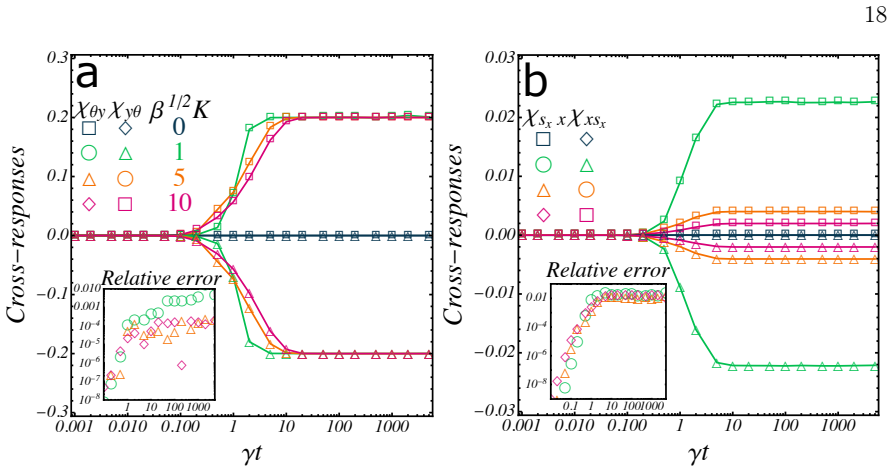
A direct numerical check that the predicted cross-correlations between position fluctuations and polarity dissipation exactly satisfy the mixed fluctuation-dissipation relation derived from the generalized symmetry.
Figures


read the original abstract
The fluctuation-dissipation theorem is a hallmark of equilibrium system that stem from their time-reversal symmetry. In many non-equilibrium systems, in particular active ones, extensions and explicit violations of this theorem are used to assess their ''distance'' to equilibrium. In Hamiltonian flocks, conservative yet non-Galilean models of polar liquids, previous work reported collective motion without the activity that usually underlies it. In this paper, we show that this model obeys a generalized time-reversal symmetry that yields a fluctuation-dissipation theorem that mixes position and polarity degrees of freedom. Due to the oddness of spin under time reversal, the system also obeys Onsager-Casimir reciprocity rather than standard Onsager relations. The coupling also induces rich spin orientation dynamics, including a non-trivial diffusion constant at long times. Finally, we show that considering the na\"ive time-reversal operation rather than the generalized one that leaves the system invariant leads to a spurious entropy production rate, that could be wrongly interpreted as a distance to equilibrium. Our findings suggest looking for possible extensions of time-reversal symmetry in active-looking systems, which may lead to yet unknown generalizations of the fluctuation-dissipation theorem.
Editorial analysis
A structured set of objections, weighed in public.
Referee Report
Summary. The paper claims that Hamiltonian flocks—conservative, non-Galilean models of polar liquids—obey a generalized time-reversal symmetry (flipping polarity while preserving the Hamiltonian structure). This symmetry produces a mixed fluctuation-dissipation theorem coupling position and polarity degrees of freedom. Because polarity (spin) is odd under the operation, the system obeys Onsager-Casimir reciprocity rather than standard Onsager relations. The work further derives non-trivial long-time spin diffusion and shows that the naive time-reversal operation yields a spurious entropy-production rate that could be misinterpreted as a distance from equilibrium.
Significance. If the derivation holds, the result supplies a concrete example of how a hidden generalized time-reversal symmetry can restore equilibrium-like relations in an apparently active system. The mixed FDT and Onsager-Casimir relations constitute a falsifiable prediction that could be tested in simulations or experiments on polar liquids. The caution against naive time reversal is a useful methodological point for the broader active-matter community.
major comments (2)
- [§3] §3 (definition of generalized TR): the claim that the operation leaves the Hamiltonian invariant is load-bearing for the entire FDT derivation; the explicit transformation of the interaction terms and the non-Galilean kinetic term must be written out to confirm that no additional assumptions are required.
- [§4] §4, Eq. (mixed FDT): the relation between the position-polarity cross-correlation and the corresponding response function is stated but the prefactors arising from the odd parity of spin are not derived explicitly; a short calculation showing how the sign flip enters the response function is needed to make the result quantitative.
minor comments (3)
- [Abstract] Abstract: 'stem from their time-reversal symmetry' should read 'stems from its time-reversal symmetry' for subject-verb agreement.
- [§2] Notation: the symbol for the generalized time-reversal operator is introduced late; defining it once in §2 and using it consistently thereafter would improve readability.
- [Figure 2] Figure 2 caption: the long-time diffusion constant is plotted but the fitting procedure (linear regression window) is not stated; adding this detail would allow readers to reproduce the reported value.
Simulated Author's Rebuttal
We thank the referee for their positive assessment and constructive suggestions. We address each major comment below and will revise the manuscript accordingly to improve clarity and rigor.
read point-by-point responses
-
Referee: [§3] §3 (definition of generalized TR): the claim that the operation leaves the Hamiltonian invariant is load-bearing for the entire FDT derivation; the explicit transformation of the interaction terms and the non-Galilean kinetic term must be written out to confirm that no additional assumptions are required.
Authors: We agree that an explicit verification strengthens the presentation. In the revised manuscript we will expand §3 with a step-by-step calculation showing how the pairwise interaction terms and the non-Galilean kinetic term transform under the generalized time-reversal operation (polarity reversal with position and momentum unchanged). This will confirm invariance of the full Hamiltonian without extra assumptions. revision: yes
-
Referee: [§4] §4, Eq. (mixed FDT): the relation between the position-polarity cross-correlation and the corresponding response function is stated but the prefactors arising from the odd parity of spin are not derived explicitly; a short calculation showing how the sign flip enters the response function is needed to make the result quantitative.
Authors: We thank the referee for this observation. In the revised §4 we will insert a short explicit derivation that starts from the definition of the response function, incorporates the odd parity of the polarity variable under the generalized time reversal, and shows how the resulting minus sign appears in the prefactor relating the position-polarity cross-correlation to the response. This will make the mixed FDT fully quantitative. revision: yes
Circularity Check
No significant circularity; derivation follows from Hamiltonian symmetry
full rationale
The paper's central results on generalized time-reversal symmetry, the mixed position-polarity fluctuation-dissipation theorem, and Onsager-Casimir reciprocity are derived directly from the invariance properties of the stated Hamiltonian under the authors' defined operation (flipping polarity while preserving the conservative non-Galilean structure). No step reduces by construction to a fitted parameter, self-definition, or load-bearing self-citation chain; the odd parity of spin is an input property of the model, and the consequences follow logically without renaming known results or smuggling ansatze. The derivation is self-contained against the model's equations.
Axiom & Free-Parameter Ledger
axioms (1)
- domain assumption The Hamiltonian flocks model is conservative and invariant under the generalized time-reversal operation that mixes position and polarity while reversing spin oddly.
Lean theorems connected to this paper
-
IndisputableMonolith/Foundation/AlexanderDuality.leanalexander_duality_circle_linking (D=3 forcing) contradicts?
contradictsCONTRADICTS: the theorem conflicts with this paper passage, or marks a claim that would need revision before publication.
Hamiltonian (1) with K spin-velocity coupling breaking Galilean invariance; generalized TRS (16) flipping θ by π and mixing response fields; FDT cross-relations obey Onsager-Casimir (24) rather than Onsager.
What do these tags mean?
- matches
- The paper's claim is directly supported by a theorem in the formal canon.
- supports
- The theorem supports part of the paper's argument, but the paper may add assumptions or extra steps.
- extends
- The paper goes beyond the formal theorem; the theorem is a base layer rather than the whole result.
- uses
- The paper appears to rely on the theorem as machinery.
- contradicts
- The paper's claim conflicts with a theorem or certificate in the canon.
- unclear
- Pith found a possible connection, but the passage is too broad, indirect, or ambiguous to say the theorem truly supports the claim.
Reference graph
Works this paper leans on
-
[1]
Kubo R 1966Reports on Progress in Physics29255
-
[2]
Marconi U M B, Puglisi A, Rondoni L and Vulpiani A 2008Physics Reports461 111
-
[3]
Cugliandolo L F 2011Journal of Physics A: Mathematical and Theoretical44 483001–41
-
[4]
Evans D J, Cohen E G and Morriss G P 1993Physical Review Letters712401
-
[5]
Gallavotti G and Cohen E G 1995Physical Review Letters742694
-
[6]
Jarzynski C 1997Physical Review Letters782690
-
[7]
Kurchan J 1998Journal of Physics A: Mathematical and General313719
-
[8]
Lebowitz J L and Spohn H 1999Journal of Statistical Physics95333
-
[9]
Crooks G E 1999Physical Review E602721
-
[10]
Harada T and Sasa S I 2005Physical Review Letters95130602
-
[11]
Sevick E M, Prabhakar R, Williams S R and Searles D J 2008Annual Review of Physical Chemistry59603
-
[12]
Seifert U 2012Reports on Progress in Physics75126001
-
[13]
thesis The University of Tokyo
Murashita Y 2021Fluctuation Theorems under Divergent Entropy Production and their Applications for Fundamental Problems in Statistical PhysicsPh.D. thesis The University of Tokyo
-
[14]
Fodor É, Nardini C, Cates M E, Tailleur J, Visco P and Van Wijland F 2016 Physical Review Letters117038103
work page 2016
-
[15]
Pigolotti S, Neri I, Roldán É and Jülicher F 2017Physical Review Letters119 140604
-
[16]
Mandal D, Klymko K and DeWeese M R 2017Physical Review Letters119258001
-
[17]
Nardini C, Fodor E, Tjhung E, van Wijland F, Tailleur J and Cates M E 2017 Physical Review X7021007
work page 2017
-
[18]
Shankar S and Marchetti C M 2018Physical Review E98020604(R)
-
[19]
Caprini L, Marconi U M B, Puglisi A and Vulpiani A 2019Journal of Statistical Mechanics: Theory and Experiment2019053203
-
[20]
Dabelow L, Bo S and Eichhorn R 2019Physical Review X921009
-
[21]
Borthne Ø L, Fodor É and Cates M E 2020New Journal of Physics22123012
-
[22]
Chiarantoni P, Cagnetta F, Corberi F, Gonnella G and Suma A 2020Journal of Physics A: Mathematical and Theoretical5336LT02
-
[23]
Caprini L 2021Journal of Statistical Mechanics: Theory and Experiment2021 063202
-
[24]
Caprini L, Puglisi A and Sarracino A 2021Symmetry1381 REFERENCES60
-
[25]
Cengio S D, Levis D and Pagonabarraga I 2021Journal of Statistical Mechanics: Theory and Experiment2021043201
-
[26]
Markovich T, Fodor É, Tjhung E and Cates M E 2021Physical Review X11021057
-
[27]
Skinner D J and Dunkel J 2021Physical Review Letters127198101
-
[28]
RoS,GuoB,ShihA,PhanTV,AustinRH,LevineD,ChaikinPMandMartiniani S 2022Physical Review Letters129220601
-
[29]
Caprini L, Marconi U M B, Puglisi A and Löwen H 2023Journal of Chemical Physics159041102
-
[30]
Semeraro M, Gonnella G, Suma A and Zamparo M 2023Physical Review Letters 131158302
-
[31]
Boffi N M and Vanden-Eijnden E 2024Proceedings of the National Academy of Sciences of the United States of America121e2318106121
-
[32]
Agranov T, Jack R L, Cates M E and Fodor É 2025New Journal of Physics27 104602
-
[33]
Ferretti F, Giardina I, Grigera T, Pisegna G and Veca M 2025Physical Review Research7L032006
-
[34]
Johnsrud M K and Golestanian R 2025Physical Review Research7L032053
-
[35]
Anand S, Ma X, Guo S, Martiniani S and Cheng X 2024Proceedings of the National Academy of Sciences121e2411608121
- [36]
- [37]
-
[38]
Bore S L, Schindler M, Lam K D N T, Bertin É and Dauchot O 2016Journal of Statistical Mechanics: Theory and Experiment2016033305
-
[39]
Casiulis M, Tarzia M, Cugliandolo L F and Dauchot O 2020Journal of Statistical Mechanics: Theory and Experiment2020013209
-
[40]
Casiulis M, Tarzia M, Cugliandolo L F and Dauchot O 2020Physical Review Letters 124198001
-
[41]
Casiulis M 2019Study of a non-Galilean Hamiltonian liquid: collective motion without activityPhd thesis Sorbonne Université
-
[42]
Tasaki H 2020Physical Review Letters125220601
-
[43]
Bhattacharya A, Horbach J and Karmakar S 2025Physical Review E111015429
- [44]
-
[45]
Takatori S C, Yan W and Brady J F 2014Physical Review Letters113028103
-
[46]
Bissinger T and Fuchs M 2023Journal of Chemical Physics158044902
-
[47]
Diu B, Guthmann C, Lederer D and Roulet B 1996Physique Statistique(Hermann)
-
[48]
Zwanzig R W 1961 Statistical Mechanics of IrreversibilityLectures in Theoretical Physics, Volume IIIed Brittin W E, Downs B W, Downs J and Boulder Summer institute for theoretical Physics (New York; London: Interscience Publishers) pp 106–141 REFERENCES61
work page 1961
-
[49]
Mori H 1965Progress of Theoretical Physics33423
-
[50]
Martin P C, Siggia E D and Rose H A 1973Physical Review A8423
-
[51]
Janssen H K 1976Zeitschrift for Physik B23377
-
[52]
De Dominicis C 1976Le Journal de Physique Colloques37C1–247
-
[53]
De Dominicis C and Peliti L 1978Physical Review B18353
-
[54]
Arnoulx de Pirey T, Cugliandolo L F, Lecomte V and van Wijland F 2022Advances in Physics711
-
[55]
Aron C, Biroli G and Cugliandolo L F 2010Journal of Statistical Mechanics: Theory and Experiment2010P11018
-
[56]
Aron C, Barci D G, Cugliandolo L F, Arenas Z G and Lozano G S 2016Journal of Statistical Mechanics: Theory and Experiment2016053207
-
[57]
Gomez-Solano J R, Petrosyan A, Ciliberto S, Chetrite R and Gawedzki K 2009 Physical Review Letters103040601
work page 2009
-
[58]
Crisanti A, Puglisi A and Villamaina D 2012Physical Review E85061127
-
[59]
Onsager L 1931Physical Review37405
-
[60]
Onsager L 1931Physical Review382266
-
[61]
Casimir H B 1945Reviews of Modern Physics17343
-
[62]
Cugliandolo L, Kurchan J and Parisi G 1994Journal de Physique I41641
-
[63]
Pottier N 2003Physica A: Statistical Mechanics and its Applications317371
-
[64]
Fily Y and Marchetti M C 2012Physical Review Letters108235702
-
[65]
Festa R and D’Agliano E G 1978Physica A90A229
-
[66]
Risken H 1989The Fokker-Planck Equation(Berlin Heidelberg: Springer-Verlag)
-
[67]
Benenti G, Casati G, Saito K and Whitney R S 2017Physics Reports6941–124
-
[68]
Onsager L and Machlup S 1953Physical Review911505
-
[69]
Seifert U 2005Physical Review Letters95040602
-
[70]
5: Statistical Physics, Part I3rd ed (Pergamon Press)
Landau L D and Lifshitz E M 1980Course of Theoretical Physics Vol. 5: Statistical Physics, Part I3rd ed (Pergamon Press)
-
[71]
Dieball C and Godec A 2025Journal of Chemical Physics162090901
-
[72]
Ford G W, Kac M and Mazur P 1965Journal of Mathematical Physics6504
-
[73]
Bertotti G, Mayergoyz I D and Serpico C 2009Nonlinear Magnetization Dynamics in Nanosystems(Elsevier Science)
-
[74]
Cugliandolo L F, Déjardin P M M, Lozano G S and Van Wijland F 2015Physical Review E - Statistical, Nonlinear, and Soft Matter Physics91032139
-
[75]
Brown W F J 1963Physical Review51677
-
[76]
Aron C, Barci D G, Cugliandolo L F, Arenas Z G and Lozano G S 2014Journal of Statistical Mechanics: Theory and Experiment2014P09008 REFERENCES62
-
[77]
dos Santos G, Romá F, Tranchida J, Castedo S, Cugliandolo L F and Bringa E M 2023Physical Review B108134417
-
[78]
Gardiner C 1983Handbook of Stochastic Methods(Berlin: Springer)
-
[79]
Sylvester J 1883The London, Edinburgh, and Dublin Philosophical Magazine and Journal of Science16267
-
[80]
Liverpool T B and Marchetti M C 2003Physical Review Letters90138102
discussion (0)
Sign in with ORCID, Apple, or X to comment. Anyone can read and Pith papers without signing in.