The Quadratic Bin Packing Problem: Exact Formulations and Algorithm
Pith reviewed 2026-05-13 18:37 UTC · model grok-4.3
The pith
The Quadratic Bin Packing Problem admits exact solutions via compact MILP formulations for small cases and a superior Branch-and-Price algorithm for larger instances.
A machine-rendered reading of the paper's core claim, the machinery that carries it, and where it could break.
Core claim
The central claim is that the QBPP can be solved to optimality using the proposed formulations, with the Branch-and-Price algorithm on the set-partitioning formulation providing the best computational performance on larger benchmark instances compared to solving enhanced compact MILP models with a standard solver.
What carries the argument
A set-partitioning formulation solved by Branch-and-Price, where columns represent feasible assignments of items to bins and the pricing subproblem accounts for the quadratic interaction costs.
Load-bearing premise
The benchmark instances used accurately represent the structure and computational difficulty of real-world QBPP applications.
What would settle it
A direct comparison of solution times and optimality gaps on a collection of new QBPP instances larger than those in the benchmarks would falsify the superiority claim if the compact formulations perform better or equally.
Figures

read the original abstract
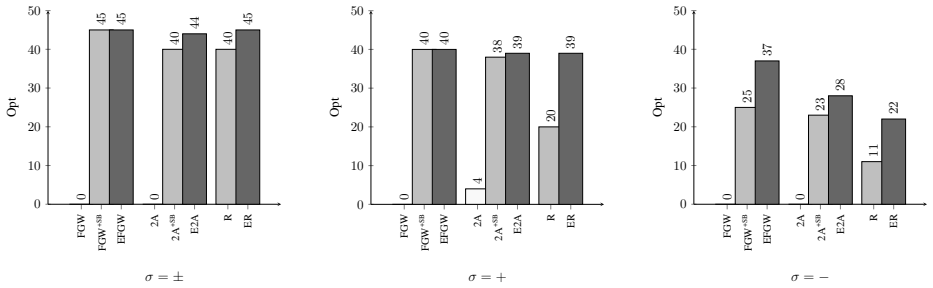
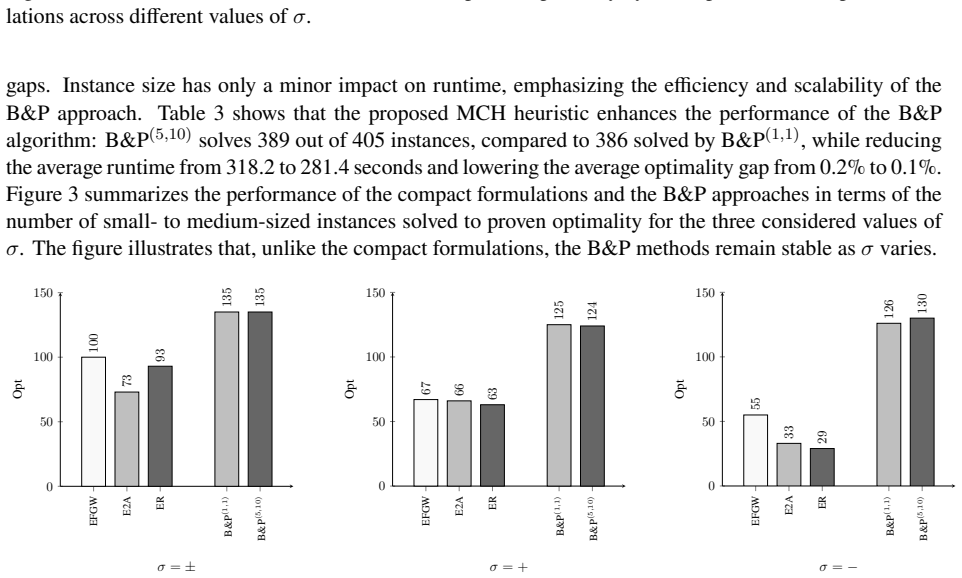
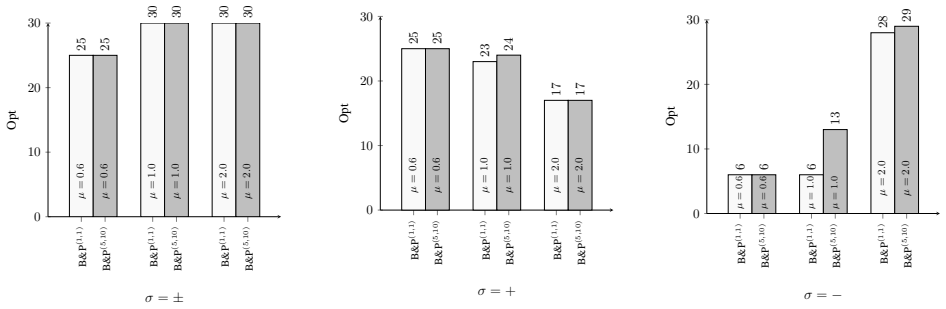
In this article, we introduce and study the Quadratic Bin Packing Problem (QBPP), which generalizes the classical bin packing problem by introducing a fixed cost for each used bin and a pairwise cost (or profit) incurred whenever two items are packed together. Beyond its theoretical relevance, the QBPP is of practical interest due to its numerous real-world applications, mainly related to cluster analysis. To address the QBPP, we propose three compact mixed-integer linear programming (MILP) formulations, along with a set-partitioning formulation. For each compact model, we present an enhanced version with a strengthened continuous relaxation, while, for the set-partitioning formulation, we develop a tailored Branch-and-Price algorithm. Computational experiments on benchmark instances demonstrated that, while the enhanced compact formulations can be effectively solved by a standard MILP solver for small-sized instances, the Branch-and-Price approach delivered superior performance overall, especially on larger and more challenging instances.
Editorial analysis
A structured set of objections, weighed in public.
Referee Report
Summary. The paper introduces the Quadratic Bin Packing Problem (QBPP) as a generalization of the classical bin packing problem incorporating fixed bin costs and pairwise costs or profits for co-packed items. It develops three compact mixed-integer linear programming formulations, along with strengthened versions featuring improved continuous relaxations, a set-partitioning formulation, and a Branch-and-Price algorithm. Computational experiments on benchmark instances indicate that the enhanced compact formulations are suitable for small instances via standard MILP solvers, while the Branch-and-Price method exhibits superior performance on larger and more difficult instances.
Significance. If the reported computational results are confirmed, the paper provides a solid foundation for solving the QBPP exactly, with potential impact on applications in cluster analysis and related fields. The explicit formulations and the tailored algorithm represent a contribution to the literature on quadratic extensions of packing problems. The use of standard techniques like linearization and column generation is appropriate, and the comparison of methods is a strength.
minor comments (2)
- [Abstract] The abstract could more precisely state the number of compact formulations proposed and the specific enhancements made to their relaxations.
- [Computational Experiments] It would be helpful to include details on the hardware used, solver settings, and time limits to allow for better reproducibility of the results.
Simulated Author's Rebuttal
We thank the referee for the constructive and positive review, which recognizes the contributions of our work on the Quadratic Bin Packing Problem. The recommendation for minor revision is appreciated. No specific major comments were provided in the report, so we have no individual points to address point-by-point. We will incorporate any minor editorial or presentational improvements suggested during the revision process.
Circularity Check
No significant circularity detected in derivation chain
full rationale
The paper defines the QBPP directly from the classical bin packing problem by adding fixed bin costs and pairwise interaction terms. It then constructs three compact MILP formulations via standard linearization of the quadratic objective (explicitly stated as replacing pairwise products with auxiliary variables and big-M constraints). The set-partitioning formulation follows immediately from enumerating feasible item subsets, and the Branch-and-Price algorithm is obtained by applying column generation to that formulation with a standard pricing subproblem. No parameter is fitted to data and then re-used as a 'prediction'; no uniqueness theorem or ansatz is imported via self-citation; and the reported computational ordering is an empirical comparison on external benchmark instances rather than a self-referential claim. The entire modeling and algorithmic chain is therefore self-contained against the problem definition and standard OR techniques.
Axiom & Free-Parameter Ledger
axioms (1)
- standard math Standard assumptions and linearization techniques of mixed-integer linear programming suffice to model quadratic pairwise costs exactly.
Lean theorems connected to this paper
-
IndisputableMonolith/Cost/FunctionalEquation.leanwashburn_uniqueness_aczel unclear?
unclearRelation between the paper passage and the cited Recognition theorem.
We propose three compact MILP formulations... enhanced version with a strengthened continuous relaxation... set-partitioning formulation... tailored Branch-and-Price algorithm... pricing problem... Generalized Quadratic Knapsack Problem (GQKP)
-
IndisputableMonolith/Foundation/RealityFromDistinction.leanreality_from_one_distinction unclear?
unclearRelation between the paper passage and the cited Recognition theorem.
The objective function (1) minimizes the overall cost... quadratic term x^k_i x^k_j
What do these tags mean?
- matches
- The paper's claim is directly supported by a theorem in the formal canon.
- supports
- The theorem supports part of the paper's argument, but the paper may add assumptions or extra steps.
- extends
- The paper goes beyond the formal theorem; the theorem is a base layer rather than the whole result.
- uses
- The paper appears to rely on the theorem as machinery.
- contradicts
- The paper's claim conflicts with a theorem or certificate in the canon.
- unclear
- Pith found a possible connection, but the passage is too broad, indirect, or ambiguous to say the theorem truly supports the claim.
Reference graph
Works this paper leans on
-
[1]
W. P. Adams and H. D. Sherali. A tight linearization and an algorithm for zero-one quadratic programming problems. Management Science, 32: 0 1274--1290, 1986
work page 1986
-
[2]
R. Baldacci, S. Coniglio, J.-F. Cordeau, and F. Furini. A numerically exact algorithm for the bin-packing problem. INFORMS Journal on Computing, 36: 0 141 – 162, 2024
work page 2024
-
[3]
D. Bergman. An exact algorithm for the quadratic multiknapsack problem with an application to event seating . INFORMS Journal on Computing, 31: 0 477 – 492, 2019
work page 2019
-
[4]
V. Cacchiani, M. Iori, A. Locatelli, and S. Martello. Knapsack problems — an overview of recent advances. Part II: Multiple , multidimensional, and quadratic knapsack problems. Computers and Operations Research, 143: 0 105693, 2022
work page 2022
-
[5]
M. Campêlo, V. A. Campos, and R. C. Corrêa. On the asymmetric representatives formulation for the vertex coloring problem. Discrete Applied Mathematics, 156: 0 1097--1111, 2008
work page 2008
-
[6]
A. Caprara, D. Pisinger, and P. Toth. Exact solution of the quadratic knapsack problem. INFORMS Journal on Computing, 11: 0 125--137, 1999
work page 1999
- [7]
-
[8]
A. Ceselli and G. Righini. An optimization algorithm for the ordered open-end bin-packing problem. Operations Research, 56: 0 425--436, 2008
work page 2008
-
[9]
Y. Chen and J.-K. Hao. Iterated responsive threshold search for the quadratic multiple knapsack problem. Annals of Operations Research, 226: 0 101 – 131, 2015
work page 2015
-
[10]
F. Clautiaux and I. Ljubić. Last fifty years of integer linear programming: A focus on recent practical advances. European Journal of Operational Research, 324: 0 707--731, 2025
work page 2025
-
[11]
F. Clautiaux, M. Dell’Amico, M. Iori, and A. Khanafer. Lower and upper bounds for the bin packing problem with fragile objects. Discrete Applied Mathematics, 163: 0 73--86, 2014. Matheuristics 2010
work page 2014
-
[12]
E. G. J. Coffman, M. R. Garey, and D. S. Johnson. Approximation algorithms for bin packing: A survey. In Approximation Algorithms for NP-hard Problems, pages 46--93. PWS Publishing Co., Boston, MA, USA, 1996
work page 1996
-
[13]
H. V. da Silva, A. Locatelli, S. A. de Araujo, and M. Iori. Mathematical formulations for the robust bin packing problem with fragile objects. Optimization Letters, (forthcoming), 2025
work page 2025
-
[14]
R. F. da Silva and R. C. Schouery. Solving cutting stock problems via an extended ryan-foster branching scheme and fast column generation. INFORMS Journal on Computing, (forthcoming), 2025
work page 2025
-
[15]
V. L. de Lima, M. Iori, and F. K. Miyazawa. Exact solution of network flow models with strong relaxations. Mathematical Programming, 197 0 (2): 0 813 – 846, 2023
work page 2023
-
[16]
M. Delorme and M. Iori. Enhanced pseudo-polynomial formulations for bin packing and cutting stock problems. INFORMS Journal on Computing, 32: 0 101--119, 2020
work page 2020
-
[17]
M. Delorme, M. Iori, and S. Martello. Bin packing and cutting stock problems: Mathematical models and exact algorithms. European Journal of Operational Research, 255: 0 1--20, 2016
work page 2016
- [18]
-
[19]
S. Elhedhli, L. Li, M. Gzara, and J. Naoum-Sawaya. A branch-and-price algorithm for the bin packing problem with conflicts. INFORMS Journal on Computing, 23: 0 404--415, 2011
work page 2011
- [20]
-
[21]
C. Ferreira, A. Martin, C. De Souza, R. Weismantel, and L. Wolsey. Formulations and valid inequalities for the node capacitated graph partitioning problem. Mathematical Programming, Series B, 74: 0 247 – 266, 1996
work page 1996
-
[22]
K. Fleszar. A branch-and-bound algorithm for the quadratic multiple knapsack problem. European Journal of Operational Research, 298: 0 89 – 98, 2022
work page 2022
-
[23]
F. D. Fomeni and A. N. Letchford. A dynamic programming heuristic for the quadratic knapsack problem. INFORMS Journal on Computing, 26: 0 173--182, 2014
work page 2014
-
[24]
R. Fortet. L’algebre de boole et ses applications en recherche op \'e rationnelle. Trabajos de Estadistica, 11: 0 111--118, 1960
work page 1960
- [25]
- [26]
-
[27]
M. Gendreau, G. Laporte, and F. Semet. Heuristics and lower bounds for the bin packing problem with conflicts. Computers and Operations Research, 31: 0 347 – 358, 2004
work page 2004
-
[28]
F. Glover and E. Woolsey. Converting the 0-1 polynomial programming problem to a 0-1 linear program. Operations Research, 22: 0 180--182, 1974
work page 1974
-
[29]
P. Hansen and B. Jaumard. Cluster analysis and mathematical programming. Mathematical Programming, Series B, 79 0 (1-3): 0 191 – 215, 1997
work page 1997
-
[30]
A. Hiley and B. A. Julstrom. The quadratic multiple knapsack problem and three heuristic approaches to it. volume 1, page 547 – 552, 2006
work page 2006
-
[31]
A. Jain, M. Murty, and P. Flynn. Data clustering: A review. ACM Computing Surveys, 31: 0 264 – 323, 1999
work page 1999
-
[32]
K. Jansen and S. Öhring. Approximation algorithms for time constrained scheduling. Information and Computation, 132: 0 85 -- 108, 1997
work page 1997
-
[33]
L. V. Kantorovich. Mathematical methods of organizing and planning production. Management science, 6: 0 366--422, 1960
work page 1960
-
[34]
A. Khanafer, F. Clautiaux, and E.-G. Talbi. New lower bounds for bin packing problems with conflicts. European Journal of Operational Research, 206: 0 281 – 288, 2010
work page 2010
-
[35]
J. M. Mulvey and M. P. Beck. Solving capacitated clustering problems. European Journal of Operational Research, 18: 0 339 – 348, 1984
work page 1984
-
[36]
A. E. F. Muritiba, M. Iori, E. Malaguti, and P. Toth. Algorithms for the bin packing problem with conflicts. INFORMS J. on Computing, 22: 0 401--415, July 2010
work page 2010
-
[37]
J. Qin, X. Xu, Q. Wu, and T. Cheng. Hybridization of tabu search with feasible and infeasible local searches for the quadratic multiple knapsack problem. Computers and Operations Research, 66: 0 199 – 214, 2016
work page 2016
-
[38]
D. M. Ryan and B. A. Foster. An integer programming approach to scheduling. Computer Scheduling of Public Transport: Urban Passenger Vehicle and Crew Scheduling, 1: 0 269--280, 1981
work page 1981
-
[39]
R. Sadykov and F. Vanderbeck. Bin packing with conflicts: A generic branch-and-price algorithm. INFORMS Journal on Computing, 25: 0 244--255, 2013
work page 2013
-
[40]
H. D. Sherali and W. P. Adams. A hierarchy of relaxations between the continuous and convex hull representations for zero-one programming problems. SIAM Journal on Discrete Mathematics, 3: 0 411--430, 1990
work page 1990
-
[41]
P. Soares and M. Campêlo. t-linearization for the maximum diversity problem. Optimization Letters, 15: 0 2879 – 2895, 2021
work page 2021
-
[42]
S. Theodoridis and K. Koutroumbas. Pattern Recognition. Elsevier Academic Press, Burlington, MA, USA, 4th edition, 2006
work page 2006
discussion (0)
Sign in with ORCID, Apple, or X to comment. Anyone can read and Pith papers without signing in.