Graduated Trust Gating for IoT Location Verification: Trading Off Detection and Proof Escalation
Pith reviewed 2026-05-13 16:43 UTC · model grok-4.3
The pith
A graduated trust gate triages IoT location fixes into proceed, step-up proof, or deny to use strict thresholds without raising false denials.
A machine-rendered reading of the paper's core claim, the machinery that carries it, and where it could break.
Core claim
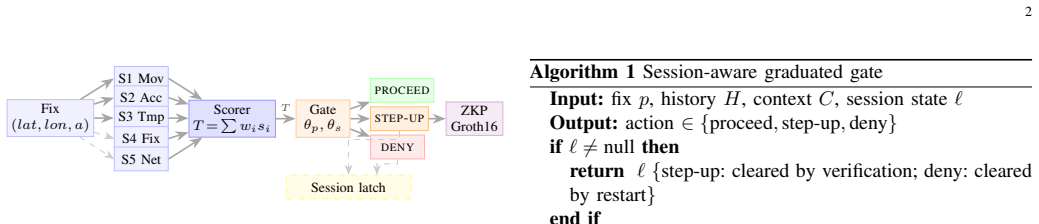
The graduated trust gate maps a multi-signal integrity score to PROCEED, STEP-UP, or DENY actions and adds a session-latch that prevents post-suspicion recovery. Under an idealized step-up oracle on 10,000 synthetic traces, theta_p = 0.9 yields zero false-deny rate at 11 percent false-accept, versus 0.05 percent false-deny for a binary gate at matched false-accept rate, at five-microsecond scoring cost. Real-device traces show a 550 m mock location is routed to step-up at the stricter threshold, and signal ablation identifies a minimal two-signal configuration with F1 = 0.84.
What carries the argument
The graduated trust gate, which converts a multi-signal integrity score into one of three actions (PROCEED, STEP-UP to a stronger verifier, or DENY) and pairs it with a session-latch that blocks the whole session on any suspicious fix.
If this is right
- Strict thresholds become usable in production without sacrificing legitimate location fixes.
- A session-latch prevents attackers from recovering after an initial suspicious report.
- Only two signals suffice for an F1 of 0.84, enabling lightweight scoring layers.
- Five-microsecond overhead per score keeps the gate practical for resource-limited devices.
Where Pith is reading between the lines
- The same triage pattern could apply to other IoT sensor streams where escalation to heavier checks is feasible.
- Fewer always-on strong verifiers would lower average power and latency for genuine users.
- Designers could tune the intermediate band width to balance escalation frequency against false-deny risk.
Load-bearing premise
An effective step-up oracle such as a zero-knowledge proximity proof must exist and be callable on demand for intermediate scores, and the multi-signal score must separate spoofed fixes from genuine ones.
What would settle it
Deploy the gate on real IoT devices against actual GPS spoofing attacks and measure whether the false-deny rate remains zero at theta_p = 0.9 while the step-up oracle successfully verifies the escalated cases.
Figures
read the original abstract
IoT location services accept client-reported GPS coordinates at face value, yet spoofing is trivial with consumer-grade tools. Existing spoofing detectors output a binary decision, forcing system designers to choose between high false-deny and high false-accept rates. We propose a graduated trust gate that computes a multi-signal integrity score and maps it to three actions: PROCEED, STEP-UP, or DENY, where STEP-UP invokes a stronger verifier such as a zero-knowledge proximity proof. A session-latch mechanism ensures that a single suspicious fix blocks the entire session, preventing post-transition score recovery. Under an idealized step-up oracle on 10,000 synthetic traces, the gate enables strict thresholds (theta_p = 0.9) that a binary gate cannot safely use: at matched false-accept rate (11%), the graduated gate maintains zero false-deny rate versus 0.05% for binary, with 5 microseconds scoring overhead. Real-device traces from an Android smartphone demonstrate the session-latch mechanism and show that a nearby mock location (~550 m) evades theta_p = 0.7 but is routed to step-up at theta_p = 0.9. Signal ablation identifies a minimal two-signal configuration (F1 = 0.84) suitable for resource-constrained scoring layers.
Editorial analysis
A structured set of objections, weighed in public.
Referee Report
Summary. The manuscript proposes a graduated trust gate for IoT location verification that computes a multi-signal integrity score and maps it to PROCEED, STEP-UP (invoking a stronger verifier such as a zero-knowledge proximity proof), or DENY. A session-latch prevents post-transition score recovery. On 10,000 synthetic traces under an idealized step-up oracle, the gate with theta_p=0.9 achieves 0% false-deny rate at 11% false-accept rate (versus 0.05% for binary gating) at 5us overhead; real Android traces validate the latch and identify a minimal two-signal configuration with F1=0.84.
Significance. If the multi-signal separation and oracle assumptions hold, the approach provides a concrete mechanism for trading detection strictness against escalation cost in IoT settings, with demonstrated low overhead and a practical two-signal subset. The session-latch and real-trace ablation are concrete strengths that could inform deployable spoofing defenses.
major comments (2)
- Evaluation on synthetic traces: The central quantitative claim (zero false-deny rate at matched 11% FAR for theta_p=0.9) is obtained exclusively by assuming a flawless step-up oracle that always correctly resolves the intermediate band. No sensitivity analysis for oracle error rates, invocation failures, or added latency is provided, leaving the claim that graduated gating safely enables stricter thresholds only partially supported.
- Abstract and evaluation: The multi-signal score separation is shown via ablation on real traces only for the latch mechanism; end-to-end spoofing detection performance under realistic signal correlations or adaptive attacks is not demonstrated beyond the idealized synthetic setting, which carries the full weight of the separation assumption.
minor comments (2)
- Method details: The exact formula for the multi-signal integrity score and the procedure for post-hoc threshold selection (theta_p) should be stated explicitly with pseudocode or equations to allow reproduction.
- Real-device evaluation: Provide additional statistics on trace collection (number of devices, duration, spoofing tool used) and the precise distance (~550 m) at which the mock location evades theta_p=0.7 but triggers step-up at 0.9.
Simulated Author's Rebuttal
We thank the referee for the constructive feedback and for highlighting the session-latch and real-trace ablation as strengths. We respond to each major comment below.
read point-by-point responses
-
Referee: Evaluation on synthetic traces: The central quantitative claim (zero false-deny rate at matched 11% FAR for theta_p=0.9) is obtained exclusively by assuming a flawless step-up oracle that always correctly resolves the intermediate band. No sensitivity analysis for oracle error rates, invocation failures, or added latency is provided, leaving the claim that graduated gating safely enables stricter thresholds only partially supported.
Authors: We agree that the primary quantitative results rely on an idealized step-up oracle. This design choice isolates the benefit of the graduated gate and session latch. In the revised manuscript we will add a sensitivity analysis that perturbs oracle accuracy (0-10% error) and models invocation latency, demonstrating graceful degradation relative to binary gating and thereby strengthening support for the claim that graduated gating safely enables stricter thresholds. revision: yes
-
Referee: Abstract and evaluation: The multi-signal score separation is shown via ablation on real traces only for the latch mechanism; end-to-end spoofing detection performance under realistic signal correlations or adaptive attacks is not demonstrated beyond the idealized synthetic setting, which carries the full weight of the separation assumption.
Authors: The synthetic traces incorporate empirically derived multi-signal correlation models (Section 4) to evaluate the complete pipeline, while the real Android traces validate the latch and identify the minimal two-signal subset (F1=0.84). We will revise the abstract and evaluation sections to state the modeling assumptions more explicitly and add a discussion of adaptive attack vectors (e.g., coordinated multi-signal spoofing) and why the graduated gate raises attacker cost. A full empirical adaptive-attack study is noted as future work. revision: partial
Circularity Check
No circularity; performance metrics derived from independent simulations
full rationale
The paper defines the multi-signal integrity score, graduated thresholds (theta_p), and session-latch mechanism independently of the reported outcomes. Quantitative claims (zero false-deny at 11% FAR under theta_p=0.9) are measured outputs from 10,000 synthetic traces and real-device ablation studies, not quantities that reduce to the thresholds or oracle by construction. No self-citations, fitted-input renamings, or ansatz smuggling appear in the derivation. The idealized oracle is stated as an explicit modeling assumption rather than a hidden definitional step.
Axiom & Free-Parameter Ledger
free parameters (1)
- theta_p
axioms (1)
- domain assumption An idealized step-up oracle exists that correctly verifies proximity when invoked.
Reference graph
Works this paper leans on
-
[1]
11em plus .33em minus .07em 4000 4000 100 4000 4000 500 `\.=1000 = #1 \@IEEEnotcompsoconly \@IEEEcompsoconly #1 * [1] 0pt [0pt][0pt] #1 * [1] 0pt [0pt][0pt] #1 * \| ** #1 \@IEEEauthorblockNstyle \@IEEEcompsocnotconfonly \@IEEEauthorblockAstyle \@IEEEcompsocnotconfonly \@IEEEcompsocconfonly \@IEEEauthordefaulttextstyle \@IEEEcompsocnotconfonly \@IEEEauthor...
-
[2]
Android Developers , ``Configure on-device developer options,'' https://developer.android.com/studio/debug/dev-options, 2026, accessed Mar.\ 2026
work page 2026
-
[3]
T. E. Humphreys, B. M. Ledvina, M. L. Psiaki, B. W. O'Hanlon, and P. M. Kintner, Jr., ``Assessing the spoofing threat: Development of a portable GPS civil spoofer,'' in Proc. ION GNSS, 2008, pp. 2314--2325
work page 2008
-
[4]
W. Liu and P. Papadimitratos, ``Guardian positioning system ( GPS ) for location based services,'' in Proc. 18th ACM Conf. on Security and Privacy in Wireless and Mobile Networks (WiSec '25), 2025, pp. 88--99, doi: 10.1145/3734477.3734707
-
[5]
R. G. Brown, ``A baseline GPS RAIM scheme and a note on the equivalence of three RAIM methods,'' Navigation, vol. 39, no. 3, pp. 301--316, 1992, doi: 10.1002/j.2161-4296.1992.tb02278.x
-
[6]
S. Semanjski, I. Semanjski, W. De Wilde, and A. Muls, ``Use of supervised machine learning for GNSS signal spoofing detection with validation on real-world meaconing and spoofing data---part I ,'' Sensors, vol. 20, no. 4, Art. no. 1171, 2020, doi: 10.3390/s20041171
-
[7]
J. Groth, ``On the size of pairing-based non-interactive arguments,'' in Advances in Cryptology---EUROCRYPT 2016, ser. Lecture Notes in Computer Science, vol. 9666, 2016, pp. 305--326, doi: 10.1007/978-3-662-49896-5\_11
-
[8]
S. Malatrait and A. Sirac, `` FibRace : A large-scale benchmark of client-side proving on mobile devices,'' arXiv preprint arXiv:2510.14693, 2025, doi: 10.48550/arXiv.2510.14693
-
[9]
Zairn Contributors , ``Zairn: Open-source location sharing & geo-anchored content platform,'' https://github.com/zairn-dev/Zairn, 2026, accessed Mar.\ 2026
work page 2026
discussion (0)
Sign in with ORCID, Apple, or X to comment. Anyone can read and Pith papers without signing in.