Polynomial iteration complexity of a path-following smoothing Newton method for symmetric cone programming
Pith reviewed 2026-05-10 20:16 UTC · model grok-4.3
The pith
A path-following smoothing Newton method achieves polynomial iteration complexity O(sqrt(ν) ln(1/ε)) for symmetric cone programming.
A machine-rendered reading of the paper's core claim, the machinery that carries it, and where it could break.
Core claim
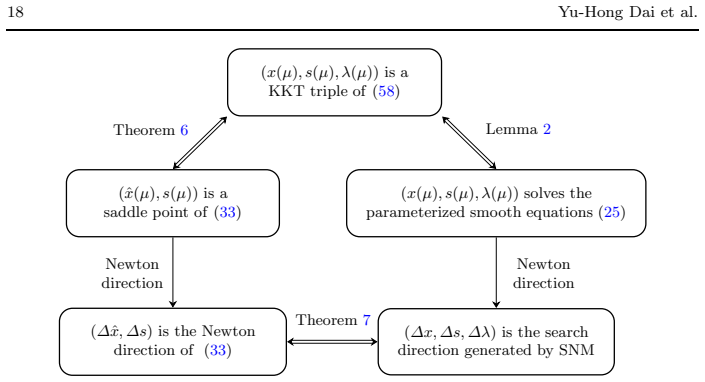
The paper proves that the reduced SBAL function is self-concordant convex-concave, shows that the parameterized smooth equations of the smoothing Newton method are equivalent to the first-order optimality conditions of a minimax problem whose objective is this function, and uses the induced central path together with its neighborhood to control the Newton decrement, establishing an iteration complexity of O(sqrt(ν) ln(1/ε)) for the resulting path-following smoothing Newton method.
What carries the argument
The reduced smoothing barrier augmented Lagrangian (SBAL) function, proven self-concordant convex-concave, which induces the central path and supplies neighborhood estimates for the path-following analysis.
Load-bearing premise
The reduced SBAL function is self-concordant convex-concave.
What would settle it
A symmetric cone problem on which the path-following smoothing Newton method requires more than O(sqrt(ν) ln(1/ε)) iterations to reach accuracy ε would falsify the complexity claim.
Figures


read the original abstract
Whether polynomial iteration complexity can be established for smoothing Newton methods (SNMs) in symmetric cone programming (SCP) remains a long-standing open problem. A key difficulty lies in the lack of an analogue of the self-concordant convex framework in interior-point methods (IPMs). In this paper, we answer this question affirmatively. We introduce a reduced smoothing barrier augmented Lagrangian (SBAL) function and prove that it is self-concordant convex-concave, which extends the classical self-concordant theory beyond the convex setting. Furthermore, we show that the parameterized smooth equations associated with SNMs are equivalent to the first-order optimality conditions of a minimax problem whose objective is the reduced SBAL function. Motivated by this equivalence, we propose a path-following smoothing Newton method (PFSNM). The reduced SBAL function induces a central path and an associated neighborhood, which provide estimates of the Newton decrement needed for the path-following analysis. As a result, the method is proven to achieve an iteration complexity of $\mathcal{O}( \sqrt{\nu} \ln(1/\varepsilon) )$, matching the best-known short-step bound for IPMs. Numerical results on standard benchmarks show that PFSNM is competitive with several well-known interior-point solvers, providing computational support for the polynomial iteration complexity.
Editorial analysis
A structured set of objections, weighed in public.
Referee Report
Summary. The paper introduces a reduced smoothing barrier augmented Lagrangian (SBAL) function for symmetric cone programming (SCP), proves that it is self-concordant convex-concave (extending classical self-concordance beyond convex functions), establishes equivalence between the parameterized smooth equations of smoothing Newton methods and the first-order optimality conditions of the associated minimax problem, proposes a path-following smoothing Newton method (PFSNM) that follows the induced central path and neighborhood, and proves an iteration complexity of O(√ν ln(1/ε)). Numerical experiments on standard benchmarks are included to demonstrate competitiveness with existing interior-point solvers.
Significance. If the self-concordance proof for the reduced SBAL function holds, the work resolves a long-standing open question on polynomial iteration complexity for smoothing Newton methods in SCP. It matches the best-known short-step bound for interior-point methods while providing a new minimax-based analysis framework. The numerical results offer practical support, though they lack detailed statistical validation.
major comments (2)
- [Section proving self-concordance of reduced SBAL (likely §3–4)] The proof that the reduced SBAL function is self-concordant convex-concave (the central technical step enabling the O(√ν ln(1/ε)) bound via Newton decrement estimates and neighborhood invariance) must be checked for uniformity with respect to the smoothing parameter and for all symmetric cones, including non-self-dual cases. If the third-order tensor bounds on the convex and concave blocks depend on the smoothing parameter or fail to preserve barrier properties under reduction, the path-following analysis does not go through.
- [Numerical experiments section] Table of numerical results: no error bars, standard deviations, or baseline comparisons (e.g., against standard IPM solvers with identical tolerances) are reported, which weakens the claim of competitiveness and does not provide statistical support for the polynomial complexity in practice.
minor comments (2)
- [Definition of reduced SBAL] Clarify the precise definition of the reduction step from the original SCP to the reduced SBAL function, including how the smoothing parameter enters the barrier terms.
- [Self-concordance theorem statement] Add a short discussion of how the convex-concave self-concordance parameter relates to the standard self-concordance parameter ν of the underlying symmetric cone.
Simulated Author's Rebuttal
We thank the referee for the thorough review and insightful comments, which help clarify key aspects of our work. We address each major comment below and outline the revisions we will make to strengthen the manuscript.
read point-by-point responses
-
Referee: [Section proving self-concordance of reduced SBAL (likely §3–4)] The proof that the reduced SBAL function is self-concordant convex-concave (the central technical step enabling the O(√ν ln(1/ε)) bound via Newton decrement estimates and neighborhood invariance) must be checked for uniformity with respect to the smoothing parameter and for all symmetric cones, including non-self-dual cases. If the third-order tensor bounds on the convex and concave blocks depend on the smoothing parameter or fail to preserve barrier properties under reduction, the path-following analysis does not go through.
Authors: We appreciate the referee's emphasis on this foundational element. The proof of self-concordance for the reduced SBAL function (detailed in Theorem 3.2 and the supporting lemmas in Sections 3 and 4) establishes that the third-order tensor bounds on both the convex and concave blocks are independent of the smoothing parameter μ. This uniformity follows directly from the reduction procedure, which cancels μ-dependent terms via the specific algebraic structure of the Jordan algebra and the augmented Lagrangian. The analysis applies to all symmetric cones, including non-self-dual cases, because it relies only on the common properties of symmetric cones (such as the spectral decomposition and the barrier function's self-concordance in the classical sense). Barrier properties are preserved under reduction, as shown by the explicit verification that the reduced function retains the required convexity-concavity and the central path remains well-defined. To address the concern explicitly, we will insert a dedicated remark after Theorem 3.2 clarifying the μ-independence and the generality across symmetric cones. revision: partial
-
Referee: [Numerical experiments section] Table of numerical results: no error bars, standard deviations, or baseline comparisons (e.g., against standard IPM solvers with identical tolerances) are reported, which weakens the claim of competitiveness and does not provide statistical support for the polynomial complexity in practice.
Authors: We agree that the numerical results section would benefit from additional statistical rigor and direct comparisons. In the revised manuscript, we will augment the tables with error bars and standard deviations computed over 10 independent runs (varying initial points within the feasible region). We will also include side-by-side comparisons against standard IPM solvers (SDPT3 and MOSEK) using identical termination tolerances (e.g., 10^{-8} on the duality gap and feasibility residuals) and report the same performance metrics (iterations and CPU time). These additions will provide clearer evidence of competitiveness while supporting the practical relevance of the O(√ν ln(1/ε)) bound. revision: yes
Circularity Check
No significant circularity in the derivation chain
full rationale
The paper introduces the reduced SBAL function as a new construction and proves its self-concordant convex-concave property as an independent mathematical result that extends classical self-concordance to the minimax setting. This property is then used to establish equivalence between the parameterized smooth equations and the first-order conditions of the associated minimax problem, which in turn induces the central path and neighborhood for the path-following analysis. The O(sqrt(nu) ln(1/eps)) bound follows from standard Newton-decrement estimates and neighborhood invariance arguments applied to this path. No step reduces by construction to a fitted parameter, self-definition, or load-bearing self-citation; the key extension is proven directly rather than assumed or renamed from prior inputs.
Axiom & Free-Parameter Ledger
axioms (1)
- ad hoc to paper The reduced SBAL function is self-concordant convex-concave
invented entities (1)
-
reduced smoothing barrier augmented Lagrangian (SBAL) function
no independent evidence
Lean theorems connected to this paper
-
IndisputableMonolith/Cost/FunctionalEquation.leanwashburn_uniqueness_aczel unclear?
unclearRelation between the paper passage and the cited Recognition theorem.
We introduce a reduced smoothing barrier augmented Lagrangian (SBAL) function and prove that it is self-concordant convex-concave... iteration complexity of O(√ν ln(1/ε))
-
IndisputableMonolith/Foundation/AlexanderDuality.leanalexander_duality_circle_linking unclear?
unclearRelation between the paper passage and the cited Recognition theorem.
φ(x) := −ln(det(x)) ... 1-self-concordant convex function on int(K)
What do these tags mean?
- matches
- The paper's claim is directly supported by a theorem in the formal canon.
- supports
- The theorem supports part of the paper's argument, but the paper may add assumptions or extra steps.
- extends
- The paper goes beyond the formal theorem; the theorem is a base layer rather than the whole result.
- uses
- The paper appears to rely on the theorem as machinery.
- contradicts
- The paper's claim conflicts with a theorem or certificate in the canon.
- unclear
- Pith found a possible connection, but the passage is too broad, indirect, or ambiguous to say the theorem truly supports the claim.
Reference graph
Works this paper leans on
-
[1]
Alizadeh, F., Goldfarb, D.: Second-order cone programmi ng. Math. Program. 95(1), 3–51 (2003)
work page 2003
-
[2]
Beck, A.: First-order methods in optimization. SIAM, Phi ladelphia (2017)
work page 2017
-
[3]
Biometrika 98(4), 791–806 (2011)
Belloni, A., Chernozhukov, V., W ang, L.: Square-root las so: pivotal recovery of sparse signals via conic programming. Biometrika 98(4), 791–806 (2011)
work page 2011
-
[4]
Burke, J., Xu, S.: A non–interior predictor–corrector pa th following algorithm for the monotone linear complementarity problem. Math. Program. 87(1), 113–130 (2000)
work page 2000
-
[5]
Burke, J.V., Xu, S.: The global linear convergence of a non interior path-following algorithm for linear complementarity problems. Math. Oper. Res. 23(3), 719–734 (1998)
work page 1998
-
[6]
Chan, Z.X., Sun, D.: Constraint nondegeneracy, strong re gularity, and nonsingularity in semidefinite programming. SIAM J. Optim. 19(1), 370–396 (2008)
work page 2008
-
[7]
Chen, B., Harker, P.T.: A non-interior-point continuati on method for linear complemen- tarity problems. SIAM J. Matrix Anal. Appl. 14(4), 1168–1190 (1993)
work page 1993
-
[8]
Chen, X., Tseng, P.: Non-interior continuation methods f or solving semidefinite comple- mentarity problems. Math. Program. 95(3), 431–474 (2003)
work page 2003
-
[9]
Dolan, E.D., Mor´ e, J.J.: Benchmarking optimization sof tware with performance profiles. Math. Program. 91, 201–213 (2002)
work page 2002
-
[10]
In: 2013 European Control Conference (ECC), pp
Domahidi, A., Chu, E., Boyd, S.: ECOS: An SOCP solver for e mbedded systems. In: 2013 European Control Conference (ECC), pp. 3071–3076. IEEE (20 13)
work page 2013
-
[11]
Engelke, S., Kanzow, C.: Predictor-corrector smoothin g methods for linear programs with a more flexible update of the smoothing parameter. Comput. Op tim. Appl. 23(3), 299–320 (2002)
work page 2002
-
[12]
Fukushima, M., Luo, Z.Q., Tseng, P.: Smoothing function s for second-order-cone comple- mentarity problems. SIAM J. Optim. 12(2), 436–460 (2002)
work page 2002
-
[13]
Goulart, P.J., Chen, Y.: Clarabel: An interior-point so lver for conic programs with quadratic objectives. arXiv preprint arXiv:2405.12762 (2 024)
-
[14]
Hauser, R.A., G¨ uler, O.: Self-scaled barrier function s on symmetric cones and their clas- sification. Found. Comput. Math. 2(2), 121–143 (2002)
work page 2002
-
[15]
Hotta, K., Inaba, M., Yoshise, A.: A complexity analysis of a smoothing method using CHKS-functions for monotone linear complementarity probl ems. Comput. Optim. Appl. 17(2), 183–201 (2000)
work page 2000
-
[16]
Huang, Z.H., Qi, L.Q., Sun, D.F.: Sub-quadratic converg ence of a smoothing Newton algorithm for the P 0–and monotone LCP. Math. Program. 99(3), 423–441 (2004)
work page 2004
-
[17]
Kanzow, C.: Some non-interior continuation methods for linear complementarity problems. SIAM J. Matrix Anal. Appl. 17(4), 851–868 (1996)
work page 1996
-
[18]
Kanzow, C., Nagel, C.: Semidefinite programs: new search directions, smoothing-type methods, and numerical results. SIAM J. Optim. 13(1), 1–23 (2002)
work page 2002
-
[19]
Kanzow, C., Pieper, H.: Jacobian smoothing methods for n onlinear complementarity prob- lems. SIAM J. Optim. 9(2), 342–373 (1999)
work page 1999
-
[20]
Kluwer Academic Publishers, Dordrecht (200 2)
de Klerk, E.: Aspects of semidefinite programming: inter ior point algorithms and selected applications. Kluwer Academic Publishers, Dordrecht (200 2)
-
[21]
de Klerk, E., Vallentin, F.: On the Turing model complexi ty of interior point methods for semidefinite programming. SIAM J. Optim. 26(3), 1944–1961 (2016)
work page 1944
-
[22]
Kong, L.C., Sun, J., Xiu, N.H.: A regularized smoothing N ewton method for symmetric cone complementarity problems. SIAM J. Optim. 19(3), 1028–1047 (2008)
work page 2008
-
[23]
Liang, L., Sun, D., Toh, K.C.: An inexact augmented Lagra ngian method for second-order cone programming with applications. SIAM J. Optim. 31(3), 1748–1773 (2021)
work page 2021
-
[24]
Liang, L., Sun, D.F., Toh, K.C.: A squared smoothing Newt on method for semidefinite programming. Math. Oper. Res. 50(4), 2873–2908 (2024)
work page 2024
-
[25]
Liu, Y.J., Zhang, L.W., W ang, Y.H.: Analysis of a smoothi ng method for symmetric conic linear programming. J. Appl. Math. Comput. 22(1), 133–148 (2006)
work page 2006
-
[26]
Monteiro, R.D., Zhang, Y.: A unified analysis for a class o f long-step primal-dual path- following interior-point algorithms for semidefinite prog ramming. Math. Program. 81(3), 281–299 (1998)
work page 1998
-
[27]
Nemirovski, A.: On self-concordant convex–concave fun ctions. Optim. Methods Softw. 11(1–4), 303–384 (1999)
work page 1999
-
[28]
Nesterov, Y.: Long-step strategies in interior-point p rimal-dual methods. Math. Program. 76(1), 47–94 (1997) 40 Yu-Hong Dai et al
work page 1997
-
[29]
Nesterov, Y., Nemirovskii, A.: Interior-point polynom ial algorithms in convex program- ming. SIAM, Philadelphia (1994)
work page 1994
-
[30]
Nesterov, Y.E., Todd, M.J.: Primal-dual interior-poin t methods for self-scaled cones. SIAM J. Optim. 8(2), 324–364 (1998)
work page 1998
-
[31]
Nocedal, J., W right, S.J.: Numerical optimization. Spr inger, New York (2006)
work page 2006
-
[32]
Peng, J.M., Lin, Z.H.: A non-interior continuation meth od for generalized linear comple- mentarity problems. Math. Program. 86(3), 533–563 (1999)
work page 1999
-
[33]
Qi, L.Q., Sun, D.F., Zhou, G.L.: A new look at smoothing Ne wton methods for nonlinear complementarity problems and box constrained variational inequalities. Math. Program. 87(1), 1–35 (2000)
work page 2000
-
[34]
Schmieta, S.H., Alizadeh, F.: Extension of primal-dual interior point algorithms to sym- metric cones. Math. Program. 96(3), 409–438 (2003)
work page 2003
-
[35]
Smale, S.: Algorithms for solving equations. In: F. Cuck er, R.S.C. W ong (eds.) The Col- lected Papers of Stephen Smale, vol. 3, pp. 1263–1286. W orld Scientific, Singapore (2000)
work page 2000
-
[36]
Sturm, J.F.: Using SeDuMi 1.02, a MATLAB toolbox for opti mization over symmetric cones. Optim. Methods Softw. 11(1–4), 625–653 (1999)
work page 1999
-
[37]
Sun, J., Sun, D.F., Qi, L.Q.: A squared smoothing Newton m ethod for nonsmooth matrix equations and its applications in semidefinite optimizatio n problems. SIAM J. Optim. 14(3), 783–806 (2004)
work page 2004
-
[38]
T¨ ut¨ unc¨ u, R.H., Toh, K.C., Todd, M.J.: Solving semide finite-quadratic-linear programs using SDPT3. Math. Program. 95(2), 189–217 (2003)
work page 2003
-
[39]
Vavasis, S.A., Ye, Y.Y.: A primal-dual interior point me thod whose running time depends only on the constraint matrix. Math. Program. 74(1), 79–120 (1996)
work page 1996
-
[40]
Vieira, M.V.C.: Jordan algebraic approach to symmetric optimization. Ph.D. thesis, Delft University of Technology, Delft, The Netherlands (2007)
work page 2007
-
[41]
W right, S.J.: Primal-dual interior-point methods. SIA M, Philadelphia (1997)
work page 1997
-
[42]
Xu, S., Burke, J.V.: A polynomial time interior-point pa th-following algorithm for LCP based on Chen-Harker-Kanzow smoothing techniques. Math. P rogram. 86, 91–103 (1999)
work page 1999
-
[43]
Zhang, R.J., Liu, X.W., Dai, Y.H.: IPRSDP: a primal-dual interior-point relaxation algo- rithm for semidefinite programming. Comput. Optim. Appl. 88(1), 1–36 (2024)
work page 2024
-
[44]
Zhang, R.J., W ang, Z.W., Liu, X.W., Dai, Y.H.: IPRSOCP: a primal-dual interior-point relaxation algorithm for second-order cone programming. J . Oper. Res. Soc. China 14, 1–31 (2026)
work page 2026
-
[45]
Zhao, Y.B., Li, D.: A globally and locally superlinearly convergent non–interior-point algorithm for P 0 LCPs. SIAM J. Optim. 13(4), 1195–1221 (2003)
work page 2003
discussion (0)
Sign in with ORCID, Apple, or X to comment. Anyone can read and Pith papers without signing in.