Characterization of GS20 and CLYC Detectors for Neutron Resonance Transmission Analysis in High Radiation Environments
Pith reviewed 2026-05-10 19:57 UTC · model grok-4.3
The pith
CLYC detectors deliver more precise NRTA measurements than GS20 in intense gamma backgrounds for thorium safeguards.
A machine-rendered reading of the paper's core claim, the machinery that carries it, and where it could break.
Core claim
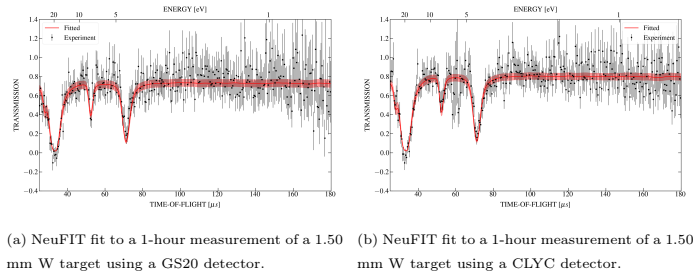
Using a DT neutron source and 2 m flight path, the authors recorded transmission spectra through a 1.50 mm tungsten sample. In the high-gamma setup designed to emulate radioactive 233U, CLYC produced transmission data with significantly smaller uncertainties than GS20. The difference arises because CLYC's strong pulse-shape discrimination rejects gamma events that would otherwise distort neutron timing and amplitude, outweighing the drawbacks of its slower scintillation decay and partial resonance overlap from 133Cs.
What carries the argument
Pulse-shape discrimination in the CLYC scintillator, which tags neutron versus gamma interactions event-by-event to preserve clean epithermal timing spectra during NRTA.
If this is right
- CLYC enables reliable identification and quantification of 233U in thorium-based spent fuel via NRTA despite intense gamma backgrounds.
- Portable NRTA systems for international safeguards can operate effectively in thorium fuel cycle facilities by adopting detectors with strong pulse-shape discrimination.
- The partial overlap of 133Cs resonances with actinide lines can be managed through analysis without destroying the utility of CLYC for epithermal NRTA.
- GS20 remains suitable only for low-gamma environments, limiting its use in thorium safeguards applications.
Where Pith is reading between the lines
- Real spent thorium fuel tests would be the next step to confirm whether the auxiliary-source emulation captures all relevant background effects.
- Pairing CLYC with faster readout electronics could further reduce any residual timing limitations from its decay constant.
- The same detector trade-off may apply to other neutron resonance techniques or to verification of additional actinides in mixed-fuel scenarios.
- Detector selection criteria for future NDA instruments should weight pulse-shape discrimination capability more heavily than raw speed when gamma backgrounds dominate.
Load-bearing premise
The auxiliary gamma source creates a radiation field whose effects on detector timing, discrimination, and spectral response match those of an actual highly radioactive 233U target.
What would settle it
Direct NRTA measurements on a real 233U-bearing thorium sample that show CLYC losing precision relative to GS20 due to decay-time pileup or cesium resonance interference would falsify the preference for CLYC.
Figures



read the original abstract
Advanced reactor concepts based on the thorium fuel cycle offer several advantages over conventional uranium-fueled systems, but they also stress-test the existing NDA toolbox for international safeguards. In particular, the presence of 232U and its ~MeV gamma-emitting daughters in thorium-based spent fuel creates a harsh radiological environment that complicates gamma-based active interrogation safeguard techniques. NRTA has emerged as a promising safeguards technique due to its isotopic specificity in the epithermal range and its robustness against non-resonant shielding. However, deploying NRTA in thorium safeguards requires neutron detectors that maintain timing performance and quantitative accuracy in intense gamma fields. This paper reports a comparative characterization of two candidate detectors for portable NRTA: GS20 and CLYC. GS20 has already been demonstrated as an effective epithermal detector in portable NRTA systems but offers limited neutron--gamma discrimination. CLYC, by contrast, provides strong pulse-shape discrimination (PSD) but has a much longer scintillation decay time and includes 133Cs, whose resonances partially overlap with key actinide resonances in the epithermal region. Using a DT-driven NRTA setup with a 2 m flight path, we compare GS20 and CLYC in measurements of a 1.50 mm tungsten target under both ``clean'' conditions and in an artificially constructed high gamma-radiation environment produced by an auxiliary source as a way of emulating a highly radioactive 233U target. The results indicate that CLYC, despite its long decay time, provides significantly more precise NRTA measurements in high radiation environments than GS20. For thorium-based safeguards scenarios where 233U must be identified and quantified in the presence of intense gamma backgrounds, CLYC-like detectors with strong PSD appear to be the more reliable choice.
Editorial analysis
A structured set of objections, weighed in public.
Referee Report
Summary. The manuscript reports a comparative experimental characterization of GS20 and CLYC scintillation detectors for Neutron Resonance Transmission Analysis (NRTA) in high-radiation environments, motivated by thorium fuel-cycle safeguards challenges from 232U gamma backgrounds. Using a DT neutron source with a 2 m flight path, the authors perform transmission measurements on a 1.50 mm tungsten target under clean conditions and with an auxiliary gamma source constructed to emulate intense gamma fields from a highly radioactive 233U target. They conclude that CLYC, despite its longer decay time, yields significantly more precise NRTA data in high-gamma conditions due to its pulse-shape discrimination capability, recommending CLYC-like detectors for such applications.
Significance. If the gamma-emulation fidelity holds, the work provides timely, practical guidance for detector selection in portable NRTA systems for thorium-based safeguards, where gamma backgrounds hinder isotopic identification of 233U. The direct experimental comparison is a strength, with no circular derivations or fitted parameters, and the focus on a real safeguards gap (epithermal NRTA robustness) adds value. Reproducible setup details and emphasis on PSD performance are positive, but the absence of quantitative validation metrics limits immediate impact on the field.
major comments (3)
- [Abstract/Methods] Abstract and Methods: The high-gamma environment is described as 'artificially constructed... as a way of emulating a highly radioactive 233U target' but provides no quantitative validation (e.g., measured vs. expected gamma spectrum, rate scaling, pile-up statistics, or Monte Carlo modeling of differential effects on timing/PSD). This is load-bearing for the central claim, as CLYC's long decay time and 133Cs resonances make its performance sensitive to exact spectral and intensity mismatches that may not replicate real 233U daughter emissions.
- [Results] Results: The claim that CLYC 'provides significantly more precise NRTA measurements' is stated without accompanying quantitative metrics, error bars, statistical details, data exclusion criteria, or precision values (e.g., transmission uncertainty or resonance parameter errors) for clean vs. high-gamma conditions. This limits verification of the improvement magnitude and undermines assessment of the result's robustness.
- [Introduction/Results] Introduction/Results: The partial overlap of 133Cs resonances in CLYC with key actinide resonances is noted but not quantified for its impact on NRTA accuracy in thorium/233U scenarios; this could offset the reported PSD advantage and requires explicit evaluation to support the recommendation.
minor comments (3)
- [Abstract] Abstract: Include at least one key quantitative result (e.g., factor of precision improvement or specific transmission uncertainty values) to strengthen the summary of findings.
- Figures: Ensure all plots of transmission data include error bars, clear labeling of clean vs. high-gamma conditions, and legends distinguishing GS20 from CLYC datasets.
- References: Verify inclusion of prior NRTA detector characterization studies and thorium safeguards literature to contextualize the comparison.
Simulated Author's Rebuttal
We thank the referee for their insightful comments and the recommendation for major revision. We believe the work provides valuable experimental comparison for detector selection in NRTA applications. Below, we address each major comment in detail, indicating where revisions will be made to the manuscript.
read point-by-point responses
-
Referee: [Abstract/Methods] Abstract and Methods: The high-gamma environment is described as 'artificially constructed... as a way of emulating a highly radioactive 233U target' but provides no quantitative validation (e.g., measured vs. expected gamma spectrum, rate scaling, pile-up statistics, or Monte Carlo modeling of differential effects on timing/PSD). This is load-bearing for the central claim, as CLYC's long decay time and 133Cs resonances make its performance sensitive to exact spectral and intensity mismatches that may not replicate real 233U daughter emissions.
Authors: We agree that the gamma emulation requires more detailed characterization to fully support the claims. In the revised manuscript, we will expand the Methods section to include quantitative information on the auxiliary gamma source, such as measured dose rates, estimated gamma flux at the detector, and how these compare to expected levels from a 233U target. We will also discuss pile-up considerations and clarify that while comprehensive Monte Carlo simulations of all differential effects were not performed, the emulation was designed to match key intensity and energy aspects relevant to PSD performance. This will better substantiate the central claim. revision: yes
-
Referee: [Results] Results: The claim that CLYC 'provides significantly more precise NRTA measurements' is stated without accompanying quantitative metrics, error bars, statistical details, data exclusion criteria, or precision values (e.g., transmission uncertainty or resonance parameter errors) for clean vs. high-gamma conditions. This limits verification of the improvement magnitude and undermines assessment of the result's robustness.
Authors: We appreciate this observation and will revise the Results section to include quantitative metrics. Specifically, we will add error bars to the transmission spectra, provide statistical details on the number of counts and uncertainties, specify data exclusion criteria (e.g., for pile-up events), and report numerical values for the precision, such as the standard deviation of transmission in resonance regions under both conditions. This will allow readers to assess the magnitude of the improvement in CLYC performance. revision: yes
-
Referee: [Introduction/Results] Introduction/Results: The partial overlap of 133Cs resonances in CLYC with key actinide resonances is noted but not quantified for its impact on NRTA accuracy in thorium/233U scenarios; this could offset the reported PSD advantage and requires explicit evaluation to support the recommendation.
Authors: We recognize the importance of quantifying this potential interference. In the revised Introduction and Results, we will provide an explicit evaluation by referencing the relevant resonance parameters for 133Cs and comparing them to those of 233U and other actinides in the epithermal range. We will estimate the potential impact on transmission measurements and discuss why the PSD capability still provides a net advantage in high-gamma environments based on our data. This will strengthen the recommendation for CLYC-like detectors. revision: yes
Circularity Check
No circularity: direct experimental comparison with no derivations or fitted predictions
full rationale
The paper is a purely experimental characterization study. It describes a DT-driven NRTA setup, measures transmission through a tungsten target with GS20 and CLYC detectors under clean and artificially gamma-irradiated conditions, and reports comparative precision from the measured data. No models, equations, first-principles derivations, or parameter fits are presented whose outputs could reduce to their inputs by construction. Conclusions rest on direct comparison of observed count rates, timing, and PSD performance; the work is therefore self-contained against external benchmarks and carries no circularity.
Axiom & Free-Parameter Ledger
axioms (2)
- domain assumption Pulse shape discrimination reliably separates neutron and gamma signals in CLYC scintillators under the tested conditions.
- standard math Epithermal neutron resonances remain distinguishable in transmission measurements despite detector response differences.
Lean theorems connected to this paper
-
IndisputableMonolith/Foundation/RealityFromDistinction.leanreality_from_one_distinction unclear?
unclearRelation between the paper passage and the cited Recognition theorem.
Using a D–T–driven NRTA setup with a 2 m flight path, we compare GS20 and CLYC in measurements of a 1.50 mm tungsten target under both “clean” conditions and in an artificially constructed high gamma-radiation environment produced by an auxiliary source
-
IndisputableMonolith/Cost/FunctionalEquation.leanwashburn_uniqueness_aczel unclear?
unclearRelation between the paper passage and the cited Recognition theorem.
CLYC, despite its long decay time, provides significantly more precise NRTA measurements in high radiation environments than GS20
What do these tags mean?
- matches
- The paper's claim is directly supported by a theorem in the formal canon.
- supports
- The theorem supports part of the paper's argument, but the paper may add assumptions or extra steps.
- extends
- The paper goes beyond the formal theorem; the theorem is a base layer rather than the whole result.
- uses
- The paper appears to rely on the theorem as machinery.
- contradicts
- The paper's claim conflicts with a theorem or certificate in the canon.
- unclear
- Pith found a possible connection, but the passage is too broad, indirect, or ambiguous to say the theorem truly supports the claim.
Reference graph
Works this paper leans on
-
[1]
S. Subzwari, Neutron resonance transmission analysis of nuclear material for reactor safeguards applications, Master’s thesis, Massachusetts Institute of Technology, Cambridge, MA (2025)
work page 2025
-
[2]
W. H. Geist, P. A. Santi, M. T. Swinhoe, et al., Nondestructive assay of nuclear materials for safeguards and security, Springer, 2024
work page 2024
-
[3]
M. Zendel, D. L. Donohue, E. Kuhn, S. Deron, T. Bíró, Nuclear Safeguards Verification Measurement Techniques, Springer US, Boston, MA, 2011, pp. 2893–3015. URLhttps://doi.org/10.1007/978-1-4419-0720-2_63
-
[4]
L. G. Worrall, V. Henzl, A. Swift, et al., Safeguards Technology for Tho- rium Fuel Cycles: Research and Development Needs Assessment and Rec- ommendations (May 2021). URLhttps://info.ornl.gov/sites/publications/Files/Pub150423. pdf
work page 2021
-
[5]
E. A. Klein, Neutron resonance transmission analysis of nuclear material using a portable d-t neutron generator (2023). URLhttps://hdl.handle.net/1721.1/152884 16
work page 2023
-
[6]
E. A. Klein, F. Naqvi, J. E. Bickus, H. Y. Lee, A. Danagoulian, R. J. Gold- ston, Neutron-resonance transmission analysis with a compact deuterium- tritium neutron generator, Physical Review Applied 15 (2021). URL10.1103/PhysRevApplied.15.054026
work page 2021
-
[7]
B. McDonald, A. Danagoulian, J. Kulisek, et al., New NDA methods for thorium fuel cycle safeguards: Mid-project report, Pacific Northwest Na- tional Laboratory (2022). URLhttps://doi.org/10.2172/2571094
-
[8]
B. S. McDonald, A. Danagoulian, A. J. Gilbert, E. A. Klein, J. A. Kulisek, M. E. Moore, J. M. Rahon, M. A. Zalavadia, Neutron resonance transmis- sion analysis prototype system for thorium fuel cycle safeguards, Nuclear Instruments and Methods in Physics Research Section A: Accelerators, Spectrometers, Detectors and Associated Equipment 1062 (2024) 169148...
-
[9]
M. Azzoune, L. Mathieu, N. D. Trinh, M. Aïche, L. Villatte, F. Piquemal, L. Tondut, S. Pelletier, Conceptual study on the implementation of NRTA for industrial applications, Instruments 9 (4) (2025) 30. URLhttps://doi.org/10.3390/instruments9040030
-
[10]
E. M. Engel, A. Danagoulian, A physically cryptographic warhead verifi- cation system using neutron induced nuclear resonances, Nature Commu- nications 10 (1) (2019) 4433. URLhttps://doi.org/10.1038/s41467-019-12386-0
- [11]
-
[12]
F. Ferrulli, M. Labalme, M. Silari, Investigation of CLYC-6 for thermal neutron detection and CLYC-7 for fast neutron spectrometry, Nuclear In- struments and Methods in Physics Research Section A: Accelerators, Spec- 17 trometers, Detectors and Associated Equipment 1029 (Apr. 2022). URLhttps://doi.org/10.1016/j.nima.2022.166460
- [13]
discussion (0)
Sign in with ORCID, Apple, or X to comment. Anyone can read and Pith papers without signing in.