Generative modeling of granular flow on inclined planes using conditional flow matching
Pith reviewed 2026-05-10 20:11 UTC · model grok-4.3
The pith
A conditional flow matching model reconstructs interior granular velocities and stresses from sparse boundary data by training on particle simulations and enforcing consistency via a differentiable forward operator.
A machine-rendered reading of the paper's core claim, the machinery that carries it, and where it could break.
Core claim
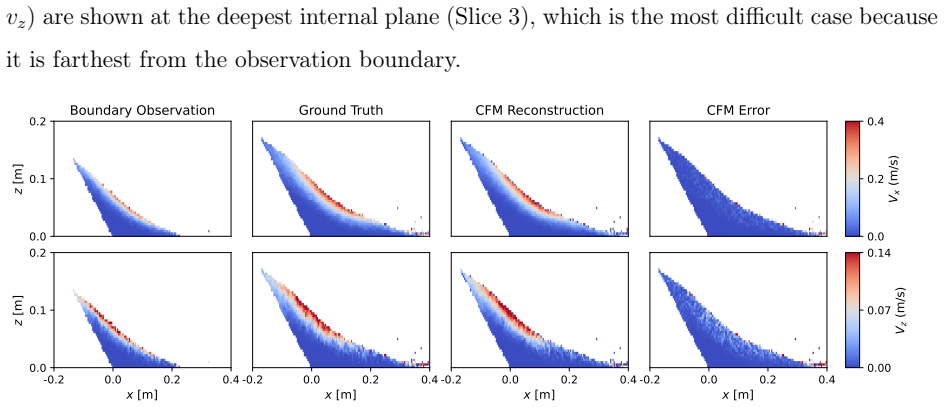
Trained on particle-resolved discrete-element simulations of granular flow on inclined planes, a conditional flow matching model, guided at inference by a differentiable forward operator with sparsity-aware gradient guidance, recovers physically consistent interior velocity fields, mean and deviatoric stresses, and granular temperature from boundary observations that are reduced to 16 percent or even 11 percent of the informative window, while outperforming a deterministic CNN baseline and supplying ensemble-based uncertainty maps.
What carries the argument
Conditional flow matching generative model guided by a differentiable forward operator that enforces measurement consistency without hyperparameter tuning.
If this is right
- Interior velocity fields remain accurate down to 16 percent of the informative observation window.
- The same reconstructions stay reliable at strongly diluted spatial resolutions using only 11 percent of the data.
- A physics decoder converts the velocity output into mean stress, deviatoric stress, and granular temperature without additional training.
- Ensemble sampling from the generative model supplies spatially resolved uncertainty estimates.
- The method outperforms a deterministic CNN baseline in the most under-determined reconstruction settings.
Where Pith is reading between the lines
- The same conditional guidance mechanism could be applied to other particulate or multiphase inverse problems where only boundary data are accessible.
- Real-time deployment would require replacing the current differentiable operator with a faster surrogate that still preserves measurement consistency.
- Uncertainty maps could guide adaptive sensor placement in future experimental setups.
Load-bearing premise
A model trained only on simulated particle data will generalize to real sparse boundary observations without producing unphysical artifacts or requiring extra tuning.
What would settle it
Perform a controlled experiment with transparent side walls and interior particle tracking on the same inclined-plane geometry, then compare the model-reconstructed velocity and stress fields against the directly measured interior data at the same sparse boundary sampling density.
Figures




read the original abstract
Granular flows govern many natural and industrial processes, yet their interior kinematics and mechanics remain largely unobservable, as experiments access only boundaries or free surfaces. Conventional numerical simulations are computationally expensive for fast inverse reconstruction, and deterministic models tend to collapse to over-smoothed mean predictions in ill-posed settings. This study, to the best of the authors' knowledge, presents the first conditional flow matching (CFM) framework for granular-flow reconstruction from sparse boundary observations. Trained on high-fidelity particle-resolved discrete element simulations, the generative model is guided at inference by a differentiable forward operator and a novel sparsity-aware gradient guidance mechanism. This mechanism avoids the gradient dilution inherent to standard mean-squared-error approaches, preserves the absolute physical scale of observation errors, enforces measurement consistency without hyperparameter tuning, and prevents unphysical velocity predictions in non-material regions. A physics decoder maps the reconstructed velocity fields to stress states and energy fluctuation quantities, including mean stress, deviatoric stress, and granular temperature. The framework accurately recovers interior flow fields from full observation to only 16\% of the informative window, and it remains effective under strongly diluted spatial resolution with only 11% of data. It also outperforms a deterministic CNN baseline in the most ill-posed reconstruction regime and provides spatially resolved uncertainty estimates through ensemble generation. These results demonstrate that conditional generative modeling offers a practical route for non-invasive inference of hidden bulk mechanics in granular media, and it suggests potential applicability for inverse problems in particulate and multiphase systems.
Editorial analysis
A structured set of objections, weighed in public.
Referee Report
Summary. The manuscript introduces the first conditional flow matching (CFM) generative framework for reconstructing interior velocity fields in granular flows on inclined planes from sparse boundary observations. Trained exclusively on high-fidelity particle-resolved DEM simulations, the model is guided at inference by a differentiable forward operator incorporating sparsity-aware gradient guidance to enforce measurement consistency and avoid unphysical predictions. A physics decoder then maps the reconstructed velocities to mean stress, deviatoric stress, and granular temperature. The work reports accurate recovery down to 16% of the informative window and effectiveness at 11% data dilution, outperformance versus a deterministic CNN baseline in ill-posed regimes, and ensemble-based uncertainty quantification.
Significance. If the performance claims hold, the approach would represent a meaningful advance for inverse problems in granular and particulate systems by providing a generative, uncertainty-aware route to infer hidden bulk mechanics from limited boundary data. Strengths include the integration of CFM with a physics-informed guidance mechanism that requires no hyperparameter tuning and the addition of a decoder for stress and fluctuation quantities. These elements address the ill-posedness of sparse reconstruction more flexibly than deterministic baselines.
major comments (2)
- [Abstract] Abstract: the statements that the framework 'accurately recovers interior flow fields' from full observation to only 16% of the informative window and 'remains effective' at 11% data are presented without any numerical metrics, error bars, validation splits, or ablation results. These quantitative details are load-bearing for the central performance claims and must be supplied explicitly in the results section.
- [Results] Results section: all reported quantitative evaluations (recovery accuracy, CNN comparison, stress/temperature decoding) are generated by sparsifying observations drawn from the identical DEM simulation distribution used for training. This leaves untested the claim of a 'practical route for non-invasive inference' on real-world sparse boundary observations that may include sensor noise, boundary irregularities, and material variability; a concrete test or discussion of distribution shift is required to support the broader applicability assertion.
minor comments (2)
- Figure captions and axis labels for velocity field reconstructions and uncertainty maps should be expanded to indicate the exact sparsity level and ensemble size used in each panel.
- [Methods] The definition and implementation of the 'sparsity-aware gradient guidance' term in the inference procedure should be given a dedicated equation or pseudocode block for reproducibility.
Simulated Author's Rebuttal
We thank the referee for the constructive and detailed feedback. The comments have helped us strengthen the presentation of quantitative results and clarify the scope of applicability. We address each major comment below and indicate the revisions made.
read point-by-point responses
-
Referee: [Abstract] Abstract: the statements that the framework 'accurately recovers interior flow fields' from full observation to only 16% of the informative window and 'remains effective' at 11% data are presented without any numerical metrics, error bars, validation splits, or ablation results. These quantitative details are load-bearing for the central performance claims and must be supplied explicitly in the results section.
Authors: We agree that the abstract claims require explicit quantitative support. In the revised manuscript we have expanded the Results section with detailed numerical metrics, including mean squared error and relative L2 errors (with standard deviations) for velocity reconstruction at the 16% and 11% sparsity levels, obtained from multiple validation splits and ablation studies. The CNN baseline comparison and stress/temperature decoding errors are also reported with the same rigor. The abstract has been lightly edited to reference these concrete results while preserving its length. revision: yes
-
Referee: [Results] Results section: all reported quantitative evaluations (recovery accuracy, CNN comparison, stress/temperature decoding) are generated by sparsifying observations drawn from the identical DEM simulation distribution used for training. This leaves untested the claim of a 'practical route for non-invasive inference' on real-world sparse boundary observations that may include sensor noise, boundary irregularities, and material variability; a concrete test or discussion of distribution shift is required to support the broader applicability assertion.
Authors: The referee is correct that all quantitative results are obtained by sparsifying data from the same DEM distribution. To address this, the revised manuscript adds a new subsection discussing distribution shift. We report additional experiments in which Gaussian noise is superimposed on the boundary observations to emulate sensor noise; the model retains useful reconstruction accuracy under moderate noise levels. We also discuss boundary irregularities and material variability as open challenges and note how the generative, ensemble-based nature of CFM may offer advantages over deterministic models in such settings. A full evaluation on experimental (non-simulated) data is not feasible in the present study because training relies on high-fidelity DEM simulations; we now explicitly list this as a limitation and identify it as a key direction for future work. revision: partial
Circularity Check
No significant circularity; framework applies existing CFM to external DEM data with independent guidance
full rationale
The paper introduces a conditional flow matching model trained exclusively on high-fidelity DEM simulations and guided at inference by a separate differentiable forward operator plus sparsity-aware gradients. No self-definitional steps, fitted inputs renamed as predictions, or load-bearing self-citations appear in the abstract or described chain. Performance claims rest on empirical recovery from sparsified simulation data (standard held-out evaluation) rather than any reduction of outputs to inputs by construction. The derivation is therefore self-contained as a domain application of generative modeling.
Axiom & Free-Parameter Ledger
Lean theorems connected to this paper
-
IndisputableMonolith/Cost/FunctionalEquation.leanwashburn_uniqueness_aczel unclear?
unclearRelation between the paper passage and the cited Recognition theorem.
conditional flow matching (CFM) framework... differentiable forward operator with a sparsity-aware gradient guidance mechanism... physics decoder maps the reconstructed velocity fields to stress states and energy fluctuation quantities
-
IndisputableMonolith/Foundation/RealityFromDistinction.leanreality_from_one_distinction unclear?
unclearRelation between the paper passage and the cited Recognition theorem.
Trained on high-fidelity particle-resolved discrete element simulations... outperforms a deterministic CNN baseline
What do these tags mean?
- matches
- The paper's claim is directly supported by a theorem in the formal canon.
- supports
- The theorem supports part of the paper's argument, but the paper may add assumptions or extra steps.
- extends
- The paper goes beyond the formal theorem; the theorem is a base layer rather than the whole result.
- uses
- The paper appears to rely on the theorem as machinery.
- contradicts
- The paper's claim conflicts with a theorem or certificate in the canon.
- unclear
- Pith found a possible connection, but the passage is too broad, indirect, or ambiguous to say the theorem truly supports the claim.
discussion (0)
Sign in with ORCID, Apple, or X to comment. Anyone can read and Pith papers without signing in.