Demonstrating SIMA-Play: A Serious Game for Forest Management Decision-Making through Board Game and Digital Simulation
Pith reviewed 2026-05-10 19:56 UTC · model grok-4.3
The pith
SIMA-Play uses forest growth simulations and visualizations to help players understand trade-offs in forest management decisions.
A machine-rendered reading of the paper's core claim, the machinery that carries it, and where it could break.
Core claim
SIMA-Play enables players to simulate forest growth over time and compare performance across economic and sustainability outcomes through gameplay and information visualization, thereby supporting systems thinking and making the trade-offs in forestry practices easier to understand and discuss.
What carries the argument
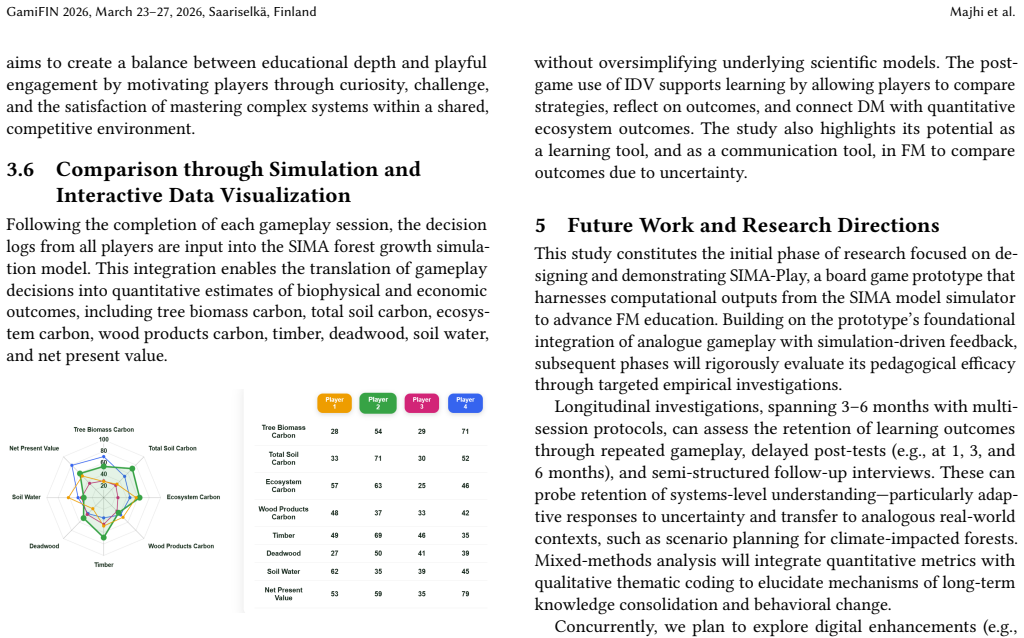
The SIMA-Play serious game, which integrates forest growth simulation data into board-game and digital formats to provide visual feedback on player decisions at the end of play.
If this is right
- Players can more readily compare and discuss alternative forest management strategies once outcomes are visualized.
- Digital versions of the game could support larger or remote groups for wider educational reach.
- Longitudinal studies could test whether repeated play leads to sustained improvements in real-world decision quality.
- Future experiments can directly compare learning gains from SIMA-Play against traditional lectures or case studies.
Where Pith is reading between the lines
- The same visualization-of-trade-offs approach could be adapted to other long-horizon resource problems such as fisheries or water allocation.
- Adding live data feeds from actual forest inventories might increase transfer from game to field decisions.
- Direct comparison of board-game versus fully digital versions could clarify which format better supports collaborative discussion.
- Multiplayer extensions could surface negotiation dynamics that single-player versions leave implicit.
Load-bearing premise
The assumption that the chosen gameplay mechanics and visualizations will actually produce measurable gains in systems thinking or decision-making skill.
What would settle it
A controlled experiment that finds no measurable difference in systems-thinking or decision-quality scores between participants who play SIMA-Play and a matched control group given conventional forest-management instruction.
Figures
read the original abstract
Board games have shown promise as educational tools, but their use in engaging learners with the complex, long-term trade-offs of forest management remains strikingly underdeveloped. Addressing this gap, we investigate how forest growth simulation data can inform decision-making through information visualization and gameplay mechanics. We designed a serious game, SIMA-Play, that enables players to make informed forest management decisions under dynamic environmental and market conditions, simulating forest growth over time and comparing player performance across economic and sustainability outcomes. By using visualization to give players feedback on their choices, at the end of the game, it supports systems thinking and makes the trade-offs in forestry practices easier to understand and discuss. The study concludes with a research roadmap that outlines future experiments, longitudinal studies, and digital versions of SIMA-Play to assess its long-term effects on learning and engagement.
Editorial analysis
A structured set of objections, weighed in public.
Referee Report
Summary. The manuscript presents the design of SIMA-Play, a serious game that integrates board-game mechanics with digital forest-growth simulations to let players make management decisions under varying environmental and market conditions. It describes gameplay elements, the use of visualizations to provide feedback on economic versus sustainability trade-offs, and concludes with a roadmap for future longitudinal studies and digital versions to assess effects on learning and engagement.
Significance. If subsequent user studies confirm that the visualization feedback and mechanics improve systems thinking and decision quality as hypothesized, the work would provide a useful concrete example of embedding long-term simulation data into interactive gameplay for sustainability education, potentially informing similar tools in other complex-systems domains.
major comments (1)
- [Abstract] Abstract: the statement that visualization feedback 'supports systems thinking and makes the trade-offs in forestry practices easier to understand and discuss' is presented as an achieved result. The manuscript supplies only a design description and a future-research roadmap; it contains no user-study data, pre/post measures of systems thinking, decision-quality metrics, or comparative performance results. This claim should be rephrased as a hypothesis to be tested.
Simulated Author's Rebuttal
We thank the referee for the constructive feedback on our design paper. We agree that the abstract overstates the current contributions and will revise it to accurately reflect the work as a description of the game design with a roadmap for future evaluation.
read point-by-point responses
-
Referee: [Abstract] Abstract: the statement that visualization feedback 'supports systems thinking and makes the trade-offs in forestry practices easier to understand and discuss' is presented as an achieved result. The manuscript supplies only a design description and a future-research roadmap; it contains no user-study data, pre/post measures of systems thinking, decision-quality metrics, or comparative performance results. This claim should be rephrased as a hypothesis to be tested.
Authors: We fully agree with this assessment. The manuscript presents the design of SIMA-Play and outlines planned longitudinal studies and digital versions to assess learning effects; it does not include any empirical data. We will revise the abstract to rephrase the relevant sentence as a design goal and hypothesis (e.g., 'The game is designed to support systems thinking through visualization feedback, with the aim of making trade-offs easier to understand and discuss, which we plan to evaluate in future user studies'). This change will be made in the next version of the manuscript. revision: yes
Circularity Check
No circularity: descriptive game-design paper with no derivation chain or fitted predictions
full rationale
The manuscript is a design description of SIMA-Play, outlining board-game mechanics, visualization feedback, and a future research roadmap. It states educational outcomes (support for systems thinking via visualization) as design goals and hypotheses for later longitudinal testing, not as results derived from equations, parameter fits, or self-citation chains. No load-bearing steps reduce to inputs by construction; the paper contains no mathematical derivations, uniqueness theorems, or renamed empirical patterns. The central claim is therefore an untested design assumption rather than a circular derivation.
Axiom & Free-Parameter Ledger
Lean theorems connected to this paper
-
IndisputableMonolith/Foundation/RealityFromDistinction.leanreality_from_one_distinction unclear?
unclearRelation between the paper passage and the cited Recognition theorem.
By using visualization to give players feedback on their choices, at the end of the game, it supports systems thinking and makes the trade-offs in forestry practices easier to understand and discuss.
-
IndisputableMonolith/Cost/FunctionalEquation.leanwashburn_uniqueness_aczel unclear?
unclearRelation between the paper passage and the cited Recognition theorem.
SIMA-Play is a Eurogame-style, turn-based experiential learning tool... post-game use of IDV supports learning by allowing players to compare strategies
What do these tags mean?
- matches
- The paper's claim is directly supported by a theorem in the formal canon.
- supports
- The theorem supports part of the paper's argument, but the paper may add assumptions or extra steps.
- extends
- The paper goes beyond the formal theorem; the theorem is a base layer rather than the whole result.
- uses
- The paper appears to rely on the theorem as machinery.
- contradicts
- The paper's claim conflicts with a theorem or certificate in the canon.
- unclear
- Pith found a possible connection, but the passage is too broad, indirect, or ambiguous to say the theorem truly supports the claim.
Reference graph
Works this paper leans on
-
[1]
Tarlan Ahmadov, Ayaz Karimov, Susanne Durst, Mirka Saarela, Wolfgang Gerstl- berger, Mike Franz Wahl, and Tommi Karkkainen. 2025. A two-phase systematic literature review on the use of serious games for sustainable environmental education. doi:10.1080/10494820.2024.2414429 Demonstrating SIMA-Play: Forest Management Decision-Making through Board Game and D...
-
[2]
Uwe Arnold, Heinrich Söbke, and Maria Reichelt. 2019. Simcity in infras- tructure management education.Education Sciences9, 3 (2019). doi:10.3390/ educsci9030209
work page 2019
-
[3]
Carolin Becklas and Sabine Baumann. 2023. Game Over for Climate Change? Communicating and Visualising Global Warming in Digital Games.English Literature10 (2023). doi:10.30687/EL/2420-823X/2023/10/003
-
[4]
Paolo Buono and Angela Locoro. 2020. Modelling Data Visualization Interac- tions: From Semiotics to Pragmatics and Back to Humans. InACM International Conference Proceeding Series. doi:10.1145/3399715.3399903
-
[5]
Susan Charnley and Melissa R. Poe. 2007. Community forestry in theory and practice: Where are we now? doi:10.1146/annurev.anthro.35.081705.123143
-
[6]
2020.Global Forest Resources Assessment 2020
FAO. 2020.Global Forest Resources Assessment 2020. FAO. doi:10.4060/ca8753en
-
[7]
James Gee. 2007.Good Video Games and Good Learning: Collected Essays on Video Games, Learning and Literacy (New Literacies and Digital Epistemologies). Vol. 30
work page 2007
-
[8]
Carolin Helbig, Anna Maria Becker, Torsten Masson, Abdelrhman Mohamdeen, Özgür Ozan Sen, and Uwe Schlink. 2022. A game engine based application for visualising and analysing environmental spatiotemporal mobile sensor data in an urban context.Frontiers in Environmental Science10 (2022). doi:10.3389/fenvs. 2022.952725
-
[9]
J. Hullman and N. Diakopoulos. 2011. Visualization Rhetoric: Framing Effects in Narrative Visualization.IEEE Transactions on Visualization and Computer Graphics17, 12 (12 2011), 2231–2240. doi:10.1109/TVCG.2011.255
-
[10]
2015.Decision Support for Forest Management
Annika Kangas, Mikko Kurttila, Teppo Hujala, Kyle Eyvindson, and Jyrki Kangas. 2015.Decision Support for Forest Management. Vol. 30. Springer International Publishing, Cham. doi:10.1007/978-3-319-23522-6
-
[11]
Seppo Kellomäki, Heli Peltola, Tuula Nuutinen, Kari T. Korhonen, and Harri Strandman. 2008. Sensitivity of managed boreal forests in Finland to climate change, with implications for adaptive management.Philosophical Transactions of the Royal Society B: Biological Sciences363, 1501 (2008). doi:10.1098/rstb.2007.2204
-
[12]
2015.Across the spectrum: Resources for environmental education(2 ed.)
Marianne Krasny and Martha Monroe. 2015.Across the spectrum: Resources for environmental education(2 ed.). http://eeingeorgia.org/Files/eewi/2016/ acrossthespectrum_su15_final_spreads.pdf
work page 2015
-
[13]
Ana Lavalle, Alejandro Maté, Juan Trujillo, and Stefano Rizzi. 2019. Visualiza- tion requirements for business intelligence analytics: A goal-based, iterative framework. InProceedings of the IEEE International Conference on Requirements Engineering, Vol. 2019-September. doi:10.1109/RE.2019.00022
-
[14]
Martin Valdemar Anker Lindrup, Arjun Rajendran Menon, and Aksel Biørn- Hansen. 2023. Carbon Scales: Collective Sense-making of Carbon Emissions from Food Production through Physical Data Representation. doi:10.1145/3563657. 3596043
-
[15]
2005.Serious Games: Games That Educate, Train, and Inform
David R Michael and Sandra L Chen. 2005.Serious Games: Games That Educate, Train, and Inform. Muska & Lipman/Premier-Trade
work page 2005
-
[16]
H. Peltola, V. P. Ikonen, H. Gregow, H. Strandman, A. Kilpeläinen, A. Venäläinen, and S. Kellomäki. 2010. Impacts of climate change on timber production and regional risks of wind-induced damage to forests in Finland.Forest Ecology and Management260, 5 (2010). doi:10.1016/j.foreco.2010.06.001
-
[17]
A Samuel Pottinger, Nivedita Biyani, Roland Geyer, Douglas J McCauley, Magali de Bruyn, Molly R Morse, Neil Nathan, Kevin Koy, and Ciera Martinez. 2023. Combining Game Design and Data Visualization to Inform Plastics Policy: Foster- ing Collaboration between Science, Decision-Makers, and Artificial Intelligence. (12 2023). http://arxiv.org/abs/2312.11359
-
[18]
Powley, Craig Anslow, Mairéad De Róiste, and Stuart Marshall
Benjamin T. Powley, Craig Anslow, Mairéad De Róiste, and Stuart Marshall. 2023. Immersive visualization for ecosystem services analysis. InProceedings of the ACM Symposium on Virtual Reality Software and Technology, VRST. doi:10.1145/ 3611659.3617197
-
[19]
Klaus J. Puettmann, K. David Coates, and Christian Messier. 2009. A Critique of Silviculture. Managing for Complexity.Environmental Conservation36, 2 (6 2009), 173–173. doi:10.1017/s0376892909990129
-
[20]
Martin Riopel, Lucian Nenciovici, Patrice Potvin, Pierre Chastenay, Patrick Char- land, Jérémie Blanchette Sarrasin, and Steve Masson. 2019. Impact of serious games on science learning achievement compared with more conventional in- struction: an overview and a meta-analysis.Studies in Science Education55, 2 (2019). doi:10.1080/03057267.2019.1722420
-
[21]
Thomas Rist and Masood Masoodian. 2022. Interactive Map Visualizations for Supporting Environmental Sustainable Development Goals. InLecture Notes in Computer Science (including subseries Lecture Notes in Artificial Intelligence and Lecture Notes in Bioinformatics), Vol. 13198 LNCS. doi:10.1007/978-3-030-98388- 8_4
-
[22]
Edward Segel and Jeffrey Heer. 2010. Narrative visualization: Telling stories with data.IEEE Transactions on Visualization and Computer Graphics16, 6 (2010). doi:10.1109/TVCG.2010.179
-
[23]
Babooshka Shavazipour, Dmitry Podkopaev, and Kaisa Miettinen. 2022. Inter- active decision support and trade-off analysis for sustainable forest landscape planning under deep uncertainty.Canadian Journal of Forest Research52, 11 (2022). doi:10.1139/cjfr-2022-0084
-
[24]
2012.Eurogames : The Design, Culture and Play of Modern European Board Games
Stewart Woods. 2012.Eurogames : The Design, Culture and Play of Modern European Board Games. Number 3
work page 2012
-
[25]
Simon Su, Edward Zhang, Paul Denny, and Nasser Giacaman. 2021. A Game-Based Approach for Teaching Algorithms and Data Structures using Visualizations. In SIGCSE 2021 - Proceedings of the 52nd ACM Technical Symposium on Computer Science Education. doi:10.1145/3408877.3432520
-
[26]
M. Vergarechea, R. Astrup, C. Fischer, K. Øistad, C. Blattert, M. Hartikainen, K. Eyvindson, F. Di Fulvio, N. Forsell, D. Burgas, A. Toraño-Caicoya, M. Mönkkönen, and C. Antón-Fernández. 2023. Future wood demands and ecosystem services trade-offs: A policy analysis in Norway.Forest Policy and Economics147 (2023). doi:10.1016/j.forpol.2022.102899
-
[27]
Daniel Diaz Vidal. 2020. The new era of teaching: Using video games to teach macroeconomics.Journal of Higher Education Theory and Practice20, 13 (2020). doi:10.33423/jhetp.v20i13.3843
-
[28]
Waeber, Mariana Melnykovych, Emilio Riegel, Leonel V
Patrick O. Waeber, Mariana Melnykovych, Emilio Riegel, Leonel V. Chongong, Regie Lloren, Johannes Raher, Tom Reibert, Muhammad Zaheen, Oleksandr Soshenskyi, and Claude A. Garcia. 2023. Fostering Innovation, Transition, and the Reconstruction of Forestry: Critical Thinking and Transdisciplinarity in Forest Education with Strategy Games.Forests14, 8 (2023)....
discussion (0)
Sign in with ORCID, Apple, or X to comment. Anyone can read and Pith papers without signing in.