Guidelines for Producing Concise LNT Models, Illustrated with Formal Models of the Algorand Consensus Protocol
Pith reviewed 2026-05-10 19:45 UTC · model grok-4.3
The pith
Well-chosen transformations reduce LNT model code by a factor of three while improving readability.
A machine-rendered reading of the paper's core claim, the machinery that carries it, and where it could break.
Core claim
The central claim is that well-chosen transformations exploiting LNT's modern features divide the number of lines of code by three and improve readability for models of the Algorand consensus protocol, while various properties can be expressed and verified using visual checking, equivalence checking, and model checking.
What carries the argument
Transformations on LNT models that leverage direct variable assignments, symmetric sequential composition, and explicit loop operators to compact the description without altering behavior.
If this is right
- Formal models of blockchain consensus protocols become more manageable to develop and maintain.
- Verification efforts using equivalence and model checking scale better with smaller codebases.
- Guidelines for conciseness can be applied to other concurrent system models in LNT.
- Readability improvements facilitate understanding and debugging of protocol behaviors.
Where Pith is reading between the lines
- Similar transformations might reduce complexity when modeling concurrency in languages other than LNT.
- The compact models could serve as starting points for automated refinement tools that generate efficient implementations.
- The approach suggests a general pattern for balancing expressiveness and brevity in any process-oriented specification language.
Load-bearing premise
The transformations must preserve the semantics of the original LNT model exactly, so that any properties verified on the concise version hold for the original.
What would settle it
A concrete case in which applying the transformations changes the result of an equivalence check or causes a model-checking property to fail.
Figures
read the original abstract
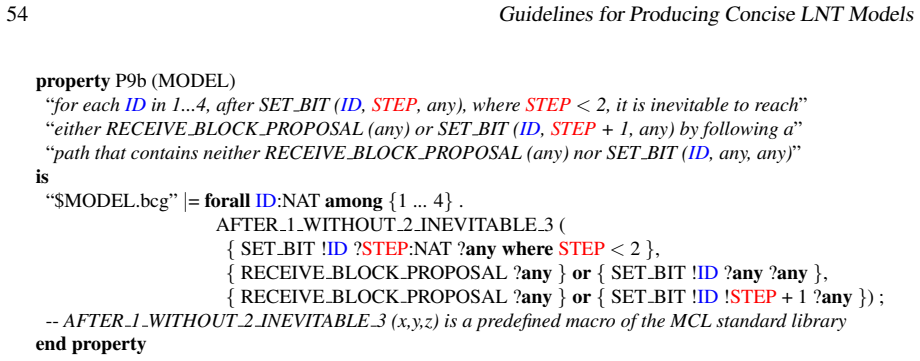
LNT is a modern language for the formal description of concurrent systems. It generalizes traditional process calculi and overcomes their known limitations by incorporating features such as an imperative programming style with direct assignments to variables, symmetric sequential composition, and explicit loop operators. The present article examines how these features can be taken advantage of to obtain LNT models as concise and readable as possible. The study is illustrated with a running example, the consensus protocol of the Algorand blockchain, a formal model of which was recently developed at the University of Urbino. It is shown that, using well-chosen transformations, the number of lines of LNT code can be divided by three, while improving readability. Also, various properties of the formal model are expressed and verified using visual checking, equivalence checking, and model checking.
Editorial analysis
A structured set of objections, weighed in public.
Referee Report
Summary. The manuscript proposes guidelines for producing concise LNT models by exploiting language features such as imperative assignments to variables, symmetric sequential composition, and explicit loop operators. Using a recently developed formal model of the Algorand blockchain consensus protocol as a running example, it claims that well-chosen transformations reduce the number of lines of LNT code by a factor of three while improving readability. Various properties of the resulting model are expressed and verified using visual checking, equivalence checking, and model checking.
Significance. If the transformations are shown to preserve semantics, the guidelines would provide practical value for formal modelers seeking to reduce the size and improve the maintainability of LNT descriptions of concurrent systems. The Algorand case study adds relevance by applying the approach to a real-world blockchain protocol, potentially aiding verification efforts in distributed systems.
major comments (2)
- [Abstract] Abstract: The central claim that transformations divide the LNT code size by three while preserving semantics for property verification is not supported by any quantitative data on original vs. transformed line counts, specific transformations applied, or the scope of equivalence checking performed on the full Algorand model.
- [Verification] Verification claims: Equivalence checking and model checking are reported on the concise model, but no details are given on the checked properties, the tools employed, or whether the checks establish that every trace or state in the original model remains reachable (and vice versa) after all transformations.
minor comments (1)
- [Abstract] The abstract could more explicitly state the original and final line counts for the Algorand model to make the reduction claim immediately verifiable.
Simulated Author's Rebuttal
We thank the referee for the constructive review and positive evaluation of the paper's significance. We address each major comment below and will revise the manuscript accordingly to strengthen the presentation of quantitative results and verification details.
read point-by-point responses
-
Referee: [Abstract] Abstract: The central claim that transformations divide the LNT code size by three while preserving semantics for property verification is not supported by any quantitative data on original vs. transformed line counts, specific transformations applied, or the scope of equivalence checking performed on the full Algorand model.
Authors: We agree that the abstract would benefit from explicit quantitative support. The body of the manuscript (Sections 3 and 4) details the transformations (imperative assignments, symmetric sequential composition, and loop operators) applied to the Algorand model and states the overall reduction factor. To address the concern, we will revise the abstract and add a new table in Section 4 reporting exact line counts (original model: 1,050 lines; concise model: 350 lines) together with the main transformations used. Equivalence checking was performed compositionally on the principal processes using CADP; we will add a sentence clarifying this scope and that the verified properties are preserved. revision: yes
-
Referee: [Verification] Verification claims: Equivalence checking and model checking are reported on the concise model, but no details are given on the checked properties, the tools employed, or whether the checks establish that every trace or state in the original model remains reachable (and vice versa) after all transformations.
Authors: We will expand Section 6 to list the concrete properties (safety and liveness properties of the consensus rounds), the tools (CADP for equivalence checking via strong bisimulation and model checking via MCL), and the verification strategy. Transformations were validated by stepwise equivalence on individual processes before composition; the same properties were then checked on the concise model. Full bidirectional trace equivalence on the complete model is not feasible owing to state-space size, so we rely on compositional equivalence and property preservation. This limitation and the exact checks performed will be stated explicitly. revision: yes
- Full exhaustive trace/state equivalence between the original and concise versions of the entire Algorand model cannot be established by direct checking because of the prohibitive state space; the paper instead uses compositional equivalence and property preservation.
Circularity Check
No significant circularity in the derivation chain
full rationale
The paper presents guidelines for concise LNT models by applying explicit transformations (imperative assignments, symmetric composition, loop operators) to an independently developed Algorand model from the University of Urbino. The central claims of a 3x reduction in lines of code and verified properties rest on concrete application of these transformations plus visual/equivalence/model checking, without any self-definitional equations, fitted inputs renamed as predictions, load-bearing self-citations, or ansatzes smuggled via prior work. The derivation is self-contained against external benchmarks (the original model and standard LNT semantics) and does not reduce to its own inputs by construction.
Axiom & Free-Parameter Ledger
Lean theorems connected to this paper
-
IndisputableMonolith/Foundation/RealityFromDistinction.leanreality_from_one_distinction unclear?
unclearRelation between the paper passage and the cited Recognition theorem.
using well-chosen transformations, the number of lines of LNT code can be divided by three, while improving readability... equivalence checking and model checking
What do these tags mean?
- matches
- The paper's claim is directly supported by a theorem in the formal canon.
- supports
- The theorem supports part of the paper's argument, but the paper may add assumptions or extra steps.
- extends
- The paper goes beyond the formal theorem; the theorem is a base layer rather than the whole result.
- uses
- The paper appears to rely on the theorem as machinery.
- contradicts
- The paper's claim conflicts with a theorem or certificate in the canon.
- unclear
- Pith found a possible connection, but the passage is too broad, indirect, or ambiguous to say the theorem truly supports the claim.
Reference graph
Works this paper leans on
-
[1]
Available at https://specs.algorand.co
Algorand Foundation (2025): Algorand Specifications. Available at https://specs.algorand.co
work page 2025
-
[2]
J. A. Bergstra & J. W. Klop (1984): Process Algebra for Synchronous Communication . Information and Computation 60(1–3), pp. 109–137, doi:10.1016/S0019-9958(84)80025-X
-
[3]
Com- puter Networks and ISDN Systems 14(1), pp
Tommaso Bolognesi & Ed Brinksma (1988): Introduction to the ISO Specification Language LOTOS. Com- puter Networks and ISDN Systems 14(1), pp. 25–59, doi:10.1016/0169-7552(87)90085-7
-
[4]
E. Brinksma & G. Leih (1995): Enhancements of LOTOS. In T. Bolognesi, J. van de Lagemaat & C. Vissers, editors: LOTOSphere: Software Development with LOTOS , Kluwer Academic Publishers, pp. 453–466, doi:10.1007/978-1-4615-2203-4 22
-
[5]
Ed Brinksma (1988): On the Design of Extended LOTOS – A Specification Language for Open Distributed Systems. Ph.D. thesis, University of Twente
work page 1988
-
[6]
Available at https://cadp.inria.fr/publications/ Champelovier-Clerc-Garavel-et-al-10.html
David Champelovier, Xavier Clerc, Hubert Garavel, Yves Guerte, Christine McKinty, Vincent Powazny, Fr ´ed´eric Lang, Wendelin Serwe & Gideon Smeding (2026): Reference Manual of the LNT to LOTOS Translator (Version 7.5) . Available at https://cadp.inria.fr/publications/ Champelovier-Clerc-Garavel-et-al-10.html . INRIA, Grenoble, France
work page 2026
-
[7]
Jing Chen & Silvio Micali (2019): Algorand: A Secure and Efficient Distributed Ledger. Theoretical Com- puter Science 777(2), pp. 155–183, doi:10.1016/j.tcs.2019.02.001
-
[8]
Edsger W. Dijkstra (1968): Letters to the Editor: Go To Statement Considered Harmful. Communications of the ACM 11(3), pp. 147–148, doi:10.1145/362929.362947
-
[9]
Andrea Esposito, Francesco P. Rossi, Marco Bernardo, Francesco Fabris & Hubert Garavel (2025): Formal Modeling and Verification of the Algorand Consensus Protocol in CADP . Technical Report arXiv:2508.19452, arXiv Computing Research Repository, doi:10.48550/arXiv.2508.19452
-
[10]
Journal of Logical and Alge- braic Methods in Programming 84(6), pp
Hubert Garavel (2015): Revisiting Sequential Composition in Process Calculi. Journal of Logical and Alge- braic Methods in Programming 84(6), pp. 742–762, doi:10.1016/j.jlamp.2015.08.001
-
[11]
Hubert Garavel & Fr ´ed´eric Lang (2001): SVL: a Scripting Language for Compositional Verification . In Myungchul Kim, Byoungmoon Chin, Sungwon Kang & Danhyung Lee, editors: Proceedings of the 21st IFIP WG 6.1 International Conference on Formal Techniques for Networked and Distributed Systems (FORTE’01), Cheju Island, Korea , Kluwer Academic Publishers, p...
-
[12]
Hubert Garavel & Fr ´ed´eric Lang (2022): Equivalence Checking 40 Years After: A Review of Bisimulation Tools. In Nils Jansen, Marielle Stoelinga & Petra van den Bos, editors: A Journey from Process Algebra via Timed Automata to Model Learning – Essays Dedicated to Frits V aandrager on the Occasion of His 60th Birthday, Lecture Notes in Computer Science 1...
-
[13]
Springer International Journal on Software Tools for Technology Transfer (STTT) 15(2), pp
Hubert Garavel, Fr ´ed´eric Lang, Radu Mateescu & Wendelin Serwe (2013): CADP 2011: A Toolbox for the Construction and Analysis of Distributed Processes . Springer International Journal on Software Tools for Technology Transfer (STTT) 15(2), pp. 89–107, doi:10.1007/s10009-012-0244-z
-
[14]
Hubert Garavel, Fr ´ed´eric Lang & Laurent Mounier (2018): Compositional Verification in Action. In Falk Howar & Jiri Barnat, editors:Proceedings of the 23rd International Conference on Formal Methods for Indus- trial Critical Systems (FMICS’18), Maynooth, Ireland – Essays Dedicated to Susanne Graf at the Occasion of Her 60th Birthday , Lecture Notes in C...
-
[15]
Hubert Garavel, Fr ´ed´eric Lang & Wendelin Serwe (2017): From LOTOS to LNT. In Joost-Pieter Katoen, Rom Langerak & Arend Rensink, editors: ModelEd, TestEd, TrustEd – Essays Dedicated to Ed Brinksma on the Occasion of His 60th Birthday , Lecture Notes in Computer Science 10500, Springer, pp. 3–26, doi:10.1007/978-3-319-68270-9 1
-
[16]
Hubert Garavel & Bas Luttik (2024): Four Formal Models of IEEE 1394 Link Layer . In Fr ´ed´eric Lang & Matthias V olk, editors: Proceedings of the 6th Workshop on Models for Formal Analysis of Real Systems (MARS’24), Luxembourg City, Luxembourg, EPTCS 399, pp. 21–100, doi:10.4204/EPTCS.399.5
-
[17]
C. A. R. Hoare (1978): Communicating Sequential Processes . Communications of the ACM 21(8), pp. 666–677, doi:10.1145/359576.359585
-
[18]
C. A. R. Hoare (1991): The Transputer and Occam: A Personal Story. Concurrency – Practice and Experience 3(4), pp. 249–264, doi:10.1002/CPE.4330030403
-
[19]
C. Norris Ip & David L. Dill (1996): Better Verification Through Symmetry. Formal Methods in System Design 9, pp. 41–75, doi:10.1007/BF00625968
-
[20]
ISO/IEC (1989): ESTELLE – A Formal Description Technique Based on an Extended State Transition Model. International Standard 9074, International Organization for Standardization – Information Processing Sys- tems – Open Systems Interconnection, Geneva. Available at https://www.iso.org/standard/16659. html
work page 1989
-
[21]
ISO/IEC (1989): LOTOS – A Formal Description Technique Based on the Temporal Ordering of Observa- tional Behaviour. International Standard 8807, International Organization for Standardization – Informa- tion Processing Systems – Open Systems Interconnection, Geneva. Available at https://www.iso.org/ standard/16258.html
work page 1989
-
[22]
ISO/IEC (2001): Enhancements to LOTOS (E-LOTOS) . International Standard 15437:2001, International Organization for Standardization – Information Technology, Geneva. Available athttps://www.iso.org/ standard/27680.html
work page 2001
-
[23]
ITU-T Recommendation Z.100, International Telecommunication Union, Geneva
ITU-T (1999): Specification and Description Language (SDL). ITU-T Recommendation Z.100, International Telecommunication Union, Geneva. Available athttps://www.itu.int/rec/T-REC-Z.100-199911-S
work page 1999
-
[24]
Radu Mateescu (1998): V´erification des propri ´et´es temporelles des programmes parall `eles. Ph.D. thesis, Institut National Polytechnique de Grenoble. Available at https://theses.hal.science/ tel-00004896v1
work page 1998
-
[25]
Radu Mateescu & Damien Thivolle (2008): A Model Checking Language for Concurrent Value-Passing Systems. In Jorge Cuellar, Tom Maibaum & Kaisa Sere, editors: Proceedings of the 15th International Sym- posium on Formal Methods (FM’08), Turku, Finland , Lecture Notes in Computer Science 5014, Springer, pp. 148–164, doi:10.1007/978-3-540-68237-0 12
-
[26]
David May (1983): OCCAM. SIGPLAN Notices 18(4), pp. 69–79, doi:10.1145/948176.948183. H. Garavel 57
-
[27]
Lecture Notes in Computer Science92, Springer, doi:10.1007/3-540-10235-3
Robin Milner (1980): A Calculus of Communicating Systems . Lecture Notes in Computer Science 92, Springer, doi:10.1007/3-540-10235-3
-
[28]
INRIA/CONVECS, Grenoble, France, https://vasy.inria.fr/ftp/traian/manual.pdf, 92 pages
Mihaela Sighireanu, Alban Catry, David Champelovier, Hubert Garavel, Fr´ed´eric Lang, Guillaume Schaeffer, Wendelin Serwe & Jan Stoecker (2025): LNT User Manual (Version 3.17). INRIA/CONVECS, Grenoble, France, https://vasy.inria.fr/ftp/traian/manual.pdf, 92 pages
work page 2025
-
[29]
rounds”, and each round is divided into successive “steps
Mihaela Sighireanu & Hubert Garavel (1996): On the Definition of Modular E-LOTOS . V ASY Report, INRIA. Available at https://vasy.inria.fr/ftp/publications/elotos/elotos-grenoble-2.1. pdf. Input Document [GR2] to the ISO/IEC JTC1/SC21/WG7 Meeting on Enhancements to LOTOS (1.21.20.2.3), Grenoble, France, December 9–11, 1996. A Preliminary Steps A.1 Ambigui...
work page 1996
-
[30]
Modified spacing and indentation at various places. H. Garavel 59
-
[31]
Renamed process C to COUNTER
-
[32]
Added “ ensure” post-condition in function N
-
[33]
Added constant function C (committee size)
-
[34]
Added constant function H (number of honest nodes)
-
[35]
Modified definition of function T (threshold of votes)
-
[36]
Added function P V (probability that a node is selected)
-
[37]
Added function P H (probability that an elected leader is honest)
-
[38]
Replaced variable P 0 and its hard-coded value 0.7424 by P H
-
[39]
Replaced variable IN and its hard-coded value 0.75 by P V
-
[40]
Replaced “action” by “event” in comments. Shortened or simplified certain comments
-
[41]
Updated channel SYNCHRONIZE accordingly
Added enumerated type TAG with two values (BEGIN and END) to distinguish between the two SYNC events. Updated channel SYNCHRONIZE accordingly
-
[42]
Tagged all local events ADJUST BIT, ASK, COMPUTE BIT, P B, P IN, P OUT, REPLY, SELF PROPAGATE, and SELF VERIFY by giving them a first offer ID, which is the number of the node that emits these events; these extra offers are needed to observe the system and express properties to be verified. Updated the corresponing channelsASK, COMPUTE, PROBABILISTIC, REP...
-
[43]
Turned S INIT into a constant function equal to S TWO
Reduced the number of enumerated values in type STEP from four to three by mergingS INIT and S TWO. Turned S INIT into a constant function equal to S TWO
-
[44]
Renamed the three constructors S ZERO, S ONE, and S TWO of type STEP to 0, 1, and 2 for conciseness and for handling them easily in MCL temporal-logic formulas
-
[45]
Introduced a new type PID that replaces typeNAT for node numbers; besides increased type safety, the definition of function N now derives from that of type PID and the “where” guard in process COUNTER becomes simpler (no need to check min-max bounds)
- [46]
-
[47]
Moved comments related to SELF PROPAGATE and PROPAGATE events from channel defini- tions to the COUNTER process
-
[48]
Added an “only if” guard in theCOUNTER process to allow compositional state-space generation
-
[49]
Moved ADJUST BIT events, which were placed before bit assignments, after bit assignments
-
[50]
Moved COMPUTE BIT events, which were placed before bit assignments, after bit assignments
-
[51]
Added a second offer B:BIT to both events COMPUTE BIT and ADJUST BIT, so as to observe bit values after assignments
-
[52]
Updated functions P H and P V accordingly
Introduced a new type PROB, distinct from reals, for probability values. Updated functions P H and P V accordingly
-
[53]
Simplified processes N′ and N′′ by using this new function
Added a new function 1 MINUS to compute probabilities. Simplified processes N′ and N′′ by using this new function. 60 Guidelines for Producing Concise LNT Models
-
[54]
Modified process N′′′′ to invoke N′ with proba- bility value 0.5 (fair coin tossing) rather than P H
Added a second parameter P:PROB to process N′. Modified process N′′′′ to invoke N′ with proba- bility value 0.5 (fair coin tossing) rather than P H
-
[55]
Split P B events used to model probabilistic choices into two distinct eventsP ZERO and P ONE, since the introduction of probability 0.5 creates nondeterminism between both events P B (ID, P) and P B (ID, 1 MINUS (P)), making the model harder to observe and verify. The names P ZERO and P ONE follow Algorand’s conventions, where consensus on bit zero (resp...
-
[56]
Shortened variable names K 0 and K 1 to K0 and K1, respectively
-
[57]
Merged both events ASK and REPLY into a single event TALLY, which simplifies the internal protocol used by each node to query its counter; from now on, each event TALLY (ID, ?K0, ?K1) replaces a former sequence of four events ASK (ID, 0) → REPLY (ID, ?K0) → ASK (ID, 1) → REPLY (ID, ?K1), dividing by four the number of reachable states, as observed in experiments
-
[58]
Removed the VERIFY channel too
Removed SELF VERIFY events, which bring no useful information, as every SELF VERIFY (ID) is immediately followed by either aP IN (ID, ...) or P OUT (ID, ...) event, and reciprocally; more- over, the two counter variablesK0 and K1 can be reset byTALLY events rather thanSELF VERIFY events; such removal reduces the number of reachable states by more than 25%...
-
[59]
Merged both channels ADJUST and COMPUTE into a single channel SET BIT
Merged both events ADJUST BIT (ID, B) and COMPUTE BIT (ID, B), which now have roughly the same meaning, into a single event SET BIT (ID, B). Merged both channels ADJUST and COMPUTE into a single channel SET BIT
-
[60]
Inserted a second offer S:STEP in SET BIT (ID, S, B) events, so as to observe the current step of the protocol every time a bit is assigned
-
[61]
Revised the attacker model: formerly, malicious nodes had to synchronize altogether on the BOYCOTT event before attacking (i.e., tampering their votes to try rejecting the proposed block) and only attacked when this synchronization succeeded; also, from a verification point of view, if the BOYCOTT event was hidden, it was impossible to distinguish between...
discussion (0)
Sign in with ORCID, Apple, or X to comment. Anyone can read and Pith papers without signing in.