Stress network dynamics influence on large particle segregation
Pith reviewed 2026-05-10 19:03 UTC · model grok-4.3
The pith
Squeeze expulsion of large particles depends on stress transmission through lengthening force chains in sheared granular media.
A machine-rendered reading of the paper's core claim, the machinery that carries it, and where it could break.
Core claim
By visualizing stress chains with birefringent disks and applying G-square analysis to quantify active grains and gap factors, the work establishes that squeeze expulsion depends strongly on stress transmission. Larger size ratios produce longer force chains and greater particle participation in the stress network, while stress fluctuations form anisotropic structures that predominantly drive or restrain intruder motion.
What carries the argument
Force-chain length and structure around the intruder, quantified by the gap factor from photoelastic images and G-square analysis of particle participation.
If this is right
- Larger size ratios produce longer force chains and increase the number of particles participating in the global stress network.
- Stress fluctuations predominate over average forces in driving or restraining the large intruder's motion through anisotropic chain formation.
- Squeeze expulsion cannot be fully explained by geometry or kinetics alone and requires accounting for dynamic stress transmission.
- The observed dependence on size ratio suggests segregation efficiency increases with greater mismatch between intruder and surrounding particles.
Where Pith is reading between the lines
- Segregation models in granular flows should incorporate explicit evolution of force networks rather than treating expulsion as a purely local geometric event.
- The same stress-network mechanism may explain size-based separation in three-dimensional industrial or geological shear flows.
- Disrupting chain connectivity experimentally could isolate whether stress transmission is necessary for observed segregation rates at fixed size ratios.
Load-bearing premise
The photoelastic images and G-square analysis capture the causal stress transmissions that produce squeeze expulsion rather than merely correlating with particle motion.
What would settle it
An experiment that suppresses force-chain formation, for instance by reducing interparticle friction, while keeping size ratio fixed and measuring whether segregation rates remain unchanged.
Figures




read the original abstract
A plethora of natural and industrial shear-driven granular flows exhibit particle-size segregation. Its occurrence is commonly attributed to two primary mechanisms: kinetic sieving and squeeze expulsion. While kinetic sieving is relatively well understood, squeeze expulsion lacks a clear mechanical explanation and direct experimental evidence due to difficulties in measuring stresses in granular media. Here, we investigate force networks around a large intruder in a bidimensional granular shear cell. We use transparent, birefringent disks to visualize stress chains via photoelasticity. Experiments were conducted with two different granular media to study force chains over size ratios between the intruder and surrounding particles of 1.25 to 4.0. Particle Tracking Velocimetry and G-square analysis are used to quantify particle trajectories and identify active grains. These methods enable us to measure force-chain lengths and structures around the intruder through the gap factor. Our results confirm that squeeze-expulsion strongly depends on stress transmission. Larger size ratios lead to longer force chains and greater particle participation in the global stress network. In parallel, stress fluctuations predominate in driving or restraining intruder motion by forming anisotropic force chains. These findings advance the understanding of granular segregation by clarifying the link between force-network dynamics and segregation mechanics.
Editorial analysis
A structured set of objections, weighed in public.
Referee Report
Summary. The manuscript reports 2D photoelastic experiments in a shear cell with a large intruder, varying the intruder-to-particle size ratio from 1.25 to 4.0 across two granular media. Using particle tracking velocimetry and G-square analysis, the authors measure force-chain lengths (via gap factor), particle participation in the stress network, and anisotropic fluctuations. They conclude that squeeze expulsion depends on stress transmission, with larger ratios producing longer chains, greater participation, and fluctuations that drive or restrain intruder motion via anisotropic chains.
Significance. If the causal interpretation holds, the work supplies direct experimental visualization linking force-network statistics to the squeeze-expulsion mechanism, which has lacked clear mechanical evidence compared with kinetic sieving. The approach could inform continuum models of segregation in industrial and geophysical granular flows.
major comments (3)
- [Abstract] Abstract: The central claim that 'squeeze-expulsion strongly depends on stress transmission' and that 'stress fluctuations predominate in driving or restraining intruder motion' rests on correlations obtained by varying only the size ratio. No orthogonal control (e.g., friction coefficient, particle stiffness, or external forcing) is applied at fixed size ratio to isolate network connectivity or fluctuation statistics from geometric packing changes, leaving open the possibility that observed chain lengths and anisotropies are epiphenomena rather than mechanistic drivers.
- [Abstract] Abstract and implied Results: The reported trends are described qualitatively without quantitative metrics such as error bars on gap-factor or G-square values, correlation coefficients between network metrics and intruder velocity, or statistical tests. This absence prevents evaluation of the robustness of the 'strong dependence' and 'predominate' assertions.
- [Methods] Methods (implied): The precise definition of the gap factor from photoelastic images and the criteria used in G-square analysis to identify 'active grains' in the global stress network are not specified in sufficient detail to assess whether these quantities faithfully capture causal stress transmission or merely correlate with intruder size.
minor comments (2)
- [Abstract] The abstract uses the vague phrase 'a plethora of natural and industrial shear-driven granular flows'; replacing it with two or three concrete examples would improve precision.
- All figures should include scale bars, color bars for photoelastic intensity, and error bars or shaded regions on any plotted quantitative quantities.
Simulated Author's Rebuttal
We thank the referee for their thoughtful and constructive review. We address each major comment below, providing clarifications and indicating revisions to the manuscript where appropriate. Our responses focus on strengthening the presentation of our experimental findings on force-network dynamics and squeeze expulsion.
read point-by-point responses
-
Referee: [Abstract] Abstract: The central claim that 'squeeze-expulsion strongly depends on stress transmission' and that 'stress fluctuations predominate in driving or restraining intruder motion' rests on correlations obtained by varying only the size ratio. No orthogonal control (e.g., friction coefficient, particle stiffness, or external forcing) is applied at fixed size ratio to isolate network connectivity or fluctuation statistics from geometric packing changes, leaving open the possibility that observed chain lengths and anisotropies are epiphenomena rather than mechanistic drivers.
Authors: We acknowledge that varying the intruder-to-particle size ratio inherently couples geometric packing effects with changes in stress network structure, and our study does not include orthogonal variations such as friction coefficient or stiffness at fixed size ratio. However, the use of two distinct granular media provides some independent variation in particle properties, and the consistent trends in force-chain length, participation, and anisotropy across both media support a mechanistic link to segregation rather than purely geometric epiphenomena. We have revised the abstract and added a dedicated paragraph in the Discussion section to explicitly note this limitation of the experimental design and to clarify why size ratio was chosen as the primary control parameter, as it directly modulates intruder interaction with the surrounding network. revision: partial
-
Referee: [Abstract] Abstract and implied Results: The reported trends are described qualitatively without quantitative metrics such as error bars on gap-factor or G-square values, correlation coefficients between network metrics and intruder velocity, or statistical tests. This absence prevents evaluation of the robustness of the 'strong dependence' and 'predominate' assertions.
Authors: We agree that quantitative support is necessary to substantiate claims of strong dependence and predominance. The full manuscript contains data with variability, but the abstract and key result summaries were presented qualitatively. In the revised version, we have added error bars to all reported gap-factor and G-square values, included Pearson correlation coefficients between network metrics and intruder velocity, and performed statistical significance tests (e.g., t-tests on trends across size ratios). These quantitative elements have been incorporated into the abstract, Results, and figure captions to allow direct assessment of robustness. revision: yes
-
Referee: [Methods] Methods (implied): The precise definition of the gap factor from photoelastic images and the criteria used in G-square analysis to identify 'active grains' in the global stress network are not specified in sufficient detail to assess whether these quantities faithfully capture causal stress transmission or merely correlate with intruder size.
Authors: We appreciate this request for greater methodological transparency. The original Methods section defines the gap factor as the normalized average separation between contacting particles along force chains identified from photoelastic fringes, and G-square analysis thresholds active grains based on local stress intensity exceeding a calibrated background level. To address the concern, we have expanded the Methods with explicit formulas, image-processing steps for gap-factor computation, and precise criteria (including intensity thresholds and connectivity requirements) for classifying active grains. These revisions ensure the metrics can be evaluated for their relation to stress transmission independent of intruder size. revision: yes
Circularity Check
Experimental observations of force chains and segregation show no circular derivations or self-referential predictions.
full rationale
The paper is an experimental study using photoelastic visualization, particle tracking velocimetry, and G-square analysis in a 2D shear cell to measure force-chain lengths, particle participation, and intruder motion across size ratios. Claims that squeeze expulsion depends on stress transmission are presented as direct confirmations from observed correlations with size ratio, not as outputs of any equations, fitted parameters, or derivations that reduce to the inputs by construction. No self-citations, uniqueness theorems, ansatzes, or renamings of known results are invoked as load-bearing steps in the provided text. The work reports measurements rather than deriving predictions from prior results by the same authors, making the central findings self-contained against external benchmarks.
Axiom & Free-Parameter Ledger
axioms (1)
- domain assumption Photoelasticity in birefringent disks accurately visualizes the internal stress chains without significant optical artifacts.
Lean theorems connected to this paper
-
IndisputableMonolith/Cost/FunctionalEquation.leanwashburn_uniqueness_aczel unclear?
unclearRelation between the paper passage and the cited Recognition theorem.
We use transparent, birefringent disks to visualize stress chains via photoelasticity... gap factor g_c = 1 - r_c s_c / S_max... mean network order L = N_p / N_c... Gaussian copula... ζ_c
-
IndisputableMonolith/Foundation/AlexanderDuality.leanalexander_duality_circle_linking unclear?
unclearRelation between the paper passage and the cited Recognition theorem.
Larger size ratios lead to longer force chains and greater particle participation in the global stress network... stress fluctuations predominate... anisotropic force chains
What do these tags mean?
- matches
- The paper's claim is directly supported by a theorem in the formal canon.
- supports
- The theorem supports part of the paper's argument, but the paper may add assumptions or extra steps.
- extends
- The paper goes beyond the formal theorem; the theorem is a base layer rather than the whole result.
- uses
- The paper appears to rely on the theorem as machinery.
- contradicts
- The paper's claim conflicts with a theorem or certificate in the canon.
- unclear
- Pith found a possible connection, but the passage is too broad, indirect, or ambiguous to say the theorem truly supports the claim.
Reference graph
Works this paper leans on
-
[1]
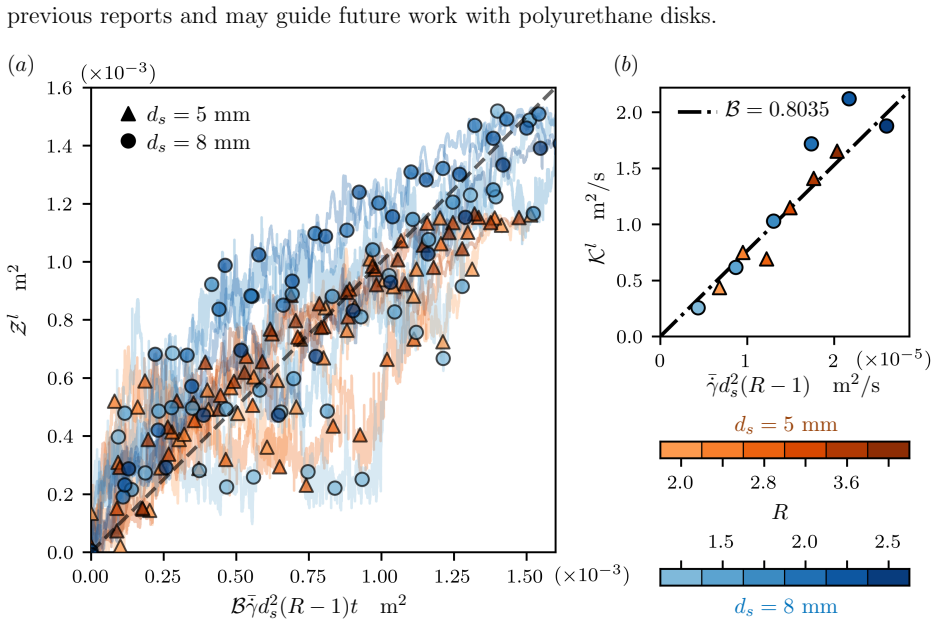
+ Φ 2 (h−z l 0)2 −(h−z l)2 =Z l(zl),(2) HereK l =B ¯˙γd2 s(R−1) is the integration constant. The constantC= 0.271 is a fitted value for the experimental scaling law and is very similar to values previously reported [11, 24]. 9 Theodeintegration requires the initial position att= 0,z l 0, which is taken from the intruder’s initial position in each experime...
-
[2]
+ Φ2(h−z l 0)2 −2ΦK lt .(3) The obtained solutions are shown with our experimental trajectories in figure 2(a,c). Our results confirm earlier findings: intruder segregation accelerates as the size ratioRincreases, with no plateau or maximum, consistent with prior work [11, 24] and distinct from other conditions [e.g. 37, 38]. The theoretical trajectories ...
-
[3]
J. M. N. T. Gray, Particle segregation in dense granular flows, Annu. Rev. Fluid Mech.50, 407 (2018)
work page 2018
-
[4]
P. B. Umbanhowar, R. M. Lueptow, and J. M. Ottino, Modeling segregation in granular flows, Annu. Rev. Chem. Biomol. Eng.10, 129 (2019)
work page 2019
-
[5]
A. R. Thornton, K. Hill, L. Jing, B. Marks, and D. R. Tunuguntla, Modeling granular segre- gation: Insights from four decades of research, Annu. Rev. Cond. Matter Phys.17(2026)
work page 2026
-
[6]
G. V. Middleton, Experimental studies related to problems of flysch sedimentation, Flysch sedimentology in North America. , 253 (1970)
work page 1970
-
[7]
S. Savage and C. Lun, Particle size segregation in inclined chute flow of dry cohesionless granular solids, J. Fluid Mech.189, 311 (1988)
work page 1988
-
[8]
Thomas, Reverse and intermediate segregation of large beads in dry granular media, Phys
N. Thomas, Reverse and intermediate segregation of large beads in dry granular media, Phys. Rev. E62, 961 (2000). 18
work page 2000
-
[9]
L. Jing, C. Kwok, and Y. F. Leung, Micromechanical origin of particle size segregation, Phys. Rev. Lett.118, 118001 (2017)
work page 2017
-
[10]
K. van der Vaart, M. P. van Schrojenstein Lantman, T. Weinhart, S. Luding, C. Ancey, and A. R. Thornton, Segregation of large particles in dense granular flows suggests a granular saffman effect, Phys. Rev. Fluids3, 074303 (2018)
work page 2018
-
[11]
Staron, Rising dynamics and lift effect in dense segregating granular flows, Phys
L. Staron, Rising dynamics and lift effect in dense segregating granular flows, Phys. Fluids30 (2018)
work page 2018
-
[12]
M. Kiani Oshtorjani, L. Meng, and C. R. M¨ uller, Accurate buoyancy and drag force models to predict particle segregation in vibrofluidized beds, Phys. Rev. E103, 062903 (2021)
work page 2021
-
[13]
T. Trewhela, J. M. N. T. Gray, and C. Ancey, Large particle segregation in two-dimensional sheared granular flows, Phys. Rev Fluids6, 054302 (2021)
work page 2021
-
[14]
M. P. van Schrojenstein, K. van der Vaart, S. Luding, and A. R. Thornton, Granular buoyancy in the context of segregation of single large grains in dense granular shear flows, Phys. Rev. Fluids6, 064307 (2021)
work page 2021
-
[15]
S. C. Williams, The mixing of dry powders, Powder Technol.2, 13 (1968)
work page 1968
- [16]
-
[17]
J. M. Ottino and D. V. Khakhar, Mixing and segregation of granular materials, Annu. Rev. Fluid Mech.32, 55 (2000)
work page 2000
-
[18]
F. Guillard, Y. Forterre, and O. Pouliquen, Scaling laws for segregation forces in dense sheared granular flows, J. Fluid Mech.807, R1 (2016)
work page 2016
-
[19]
A. Tripathi, A. Kumar, M. Nema, and D. V. Khakhar, Theory for size segregation in flowing granular mixtures based on computation of forces on a single large particle, Phys. Rev. E103, L031301 (2021)
work page 2021
-
[20]
F. Guillard, Y. Forterre, and O. Pouliquen, Lift forces in granular media, Phys. Fluids26 (2014)
work page 2014
-
[21]
L. Jing, J. M. Ottino, R. M. Lueptow, and P. B. Umbanhowar, Rising and sinking intruders in dense granular flows, Phys. Rev. Res.2, 022069 (2020)
work page 2020
-
[22]
A. Drescher and G. D. J. De Jong, Photoelastic verification of a mechanical model for the flow of a granular material, J. Mech. Phys. Solids20, 337 (1972)
work page 1972
- [23]
-
[24]
K. E. Daniels, J. E. Kollmer, and J. G. Puckett, Photoelastic force measurements in granular materials, Rev. Sci. Instrum.88(2017)
work page 2017
-
[25]
B. McMillan, S. B. Dalziel, and N. M. Vriend, Validation and correction of photoelastic tech- niques for frictional granular systems, Meas. Sci. Technol.36, 055212 (2025)
work page 2025
-
[26]
T. Trewhela, C. Ancey, and J. M. N. T. Gray, An experimental scaling law for particle-size segregation in dense granular flows, J. Fluid Mech.916, A55 (2021)
work page 2021
-
[27]
K. van der Vaart, P. Gajjar, G. Epely-Chauvin, N. Andreini, J. M. N. T. Gray, and C. Ancey, Underlying asymmetry within particle size segregation, Phys. Rev. Lett.114, 238001 (2015)
work page 2015
-
[28]
Janssen, Versuche uber getreidedruck in silozellen, Z
H. Janssen, Versuche uber getreidedruck in silozellen, Z. Ver. Dtsch. Ing.39, 1045 (1895)
-
[29]
A. Abed-Zadeh, J. Bares, T. A. Brzinski, K. E. Daniels, J. Dijksman, N. Docquier, H. O. Everitt, J. E. Kollmer, O. Lantsoght, D. Wang,et al., Enlightening force chains: a review of photoelasticimetry in granular matter, Granul. Matter21, 1 (2019)
work page 2019
-
[30]
K. Ramesh and S. Sasikumar, Digital photoelasticity: Recent developments and diverse ap- plications, Opt. Lasers Eng.135, 106186 (2020)
work page 2020
-
[31]
PhotoElasticity.net, Molding samples with urethane (2024), accessed: 2025-12-02
work page 2024
-
[32]
J. Illingworth and J. Kittler, A survey of the hough transform, Comput. Gr. Image Process. 44, 87 (1988)
work page 1988
-
[33]
H. W. Kuhn, The hungarian method for the assignment problem, Nav. Res. Logist. Q.2, 83 (1955)
work page 1955
-
[34]
J. C. Crocker and D. G. Grier, Methods of digital video microscopy for colloidal studies, J. Colloid Interface Sci.179, 298 (1996)
work page 1996
- [35]
-
[36]
D. S. Bassett, E. T. Owens, M. A. Porter, M. L. Manning, and K. E. Daniels, Extraction of force-chain network architecture in granular materials using community detection, Soft Matter 11, 2731 (2015)
work page 2015
-
[37]
S. Kumawat, V. K. Sahu, and A. Tripathi, Transient segregation of bidisperse granular mix- tures in a periodic chute flow, Phys. Rev. Fluids10, L122301 (2025)
work page 2025
-
[38]
T. Zhao, D. Noto, X. Li, T. Trewhela, and H. N. Ulloa, Scaling particle-size segregation in 20 wide-ranging sheared granular flows, Phys. Fluids37(2025)
work page 2025
-
[39]
N. Thomas and U. D’Ortona, Evidence of reverse and intermediate size segregation in dry granular flows down a rough incline, Phys. Rev. E97, 022903 (2018)
work page 2018
-
[40]
A. Thornton, T. Weinhart, S. Luding, and O. Bokhove, Modeling of particle size segregation: calibration using the discrete particle method, Int. J. Mod. Phys. C23, 1240014 (2012)
work page 2012
-
[41]
C. Genest and A.-C. Favre, Everything you always wanted to know about copula modeling but were afraid to ask, J. Hydrol. Eng.12, 347 (2007)
work page 2007
-
[42]
Y. Fang, L. Guo, and M. Hou, Arching effect analysis of granular media based on force chain visualization, Powder Technol.363, 621 (2020). 21
work page 2020
discussion (0)
Sign in with ORCID, Apple, or X to comment. Anyone can read and Pith papers without signing in.