Probing Gluon TMD Models with Drell--Yan Structure Functions
Pith reviewed 2026-05-10 18:54 UTC · model grok-4.3
The pith
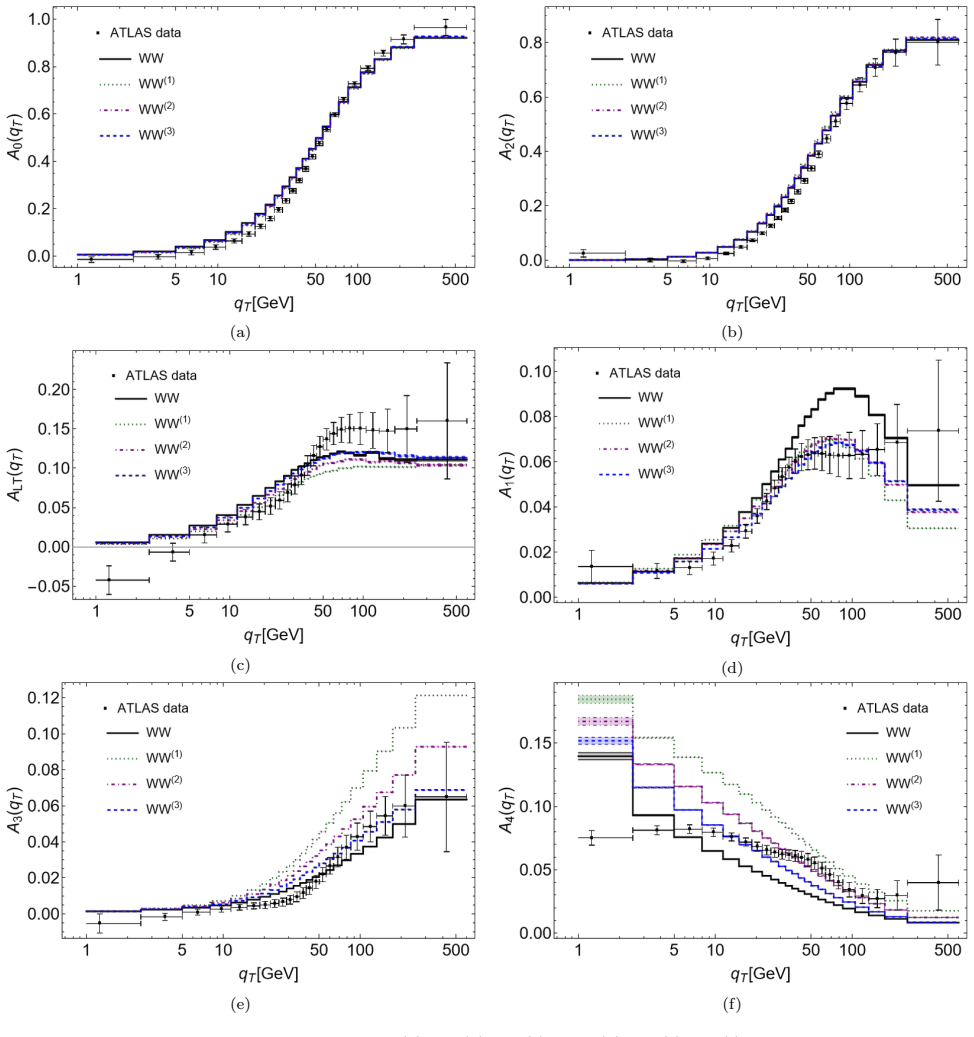
A modified Weizsäcker-Williams gluon TMD model provides the closest match to ATLAS Drell-Yan structure functions at 8 TeV.
A machine-rendered reading of the paper's core claim, the machinery that carries it, and where it could break.
Core claim
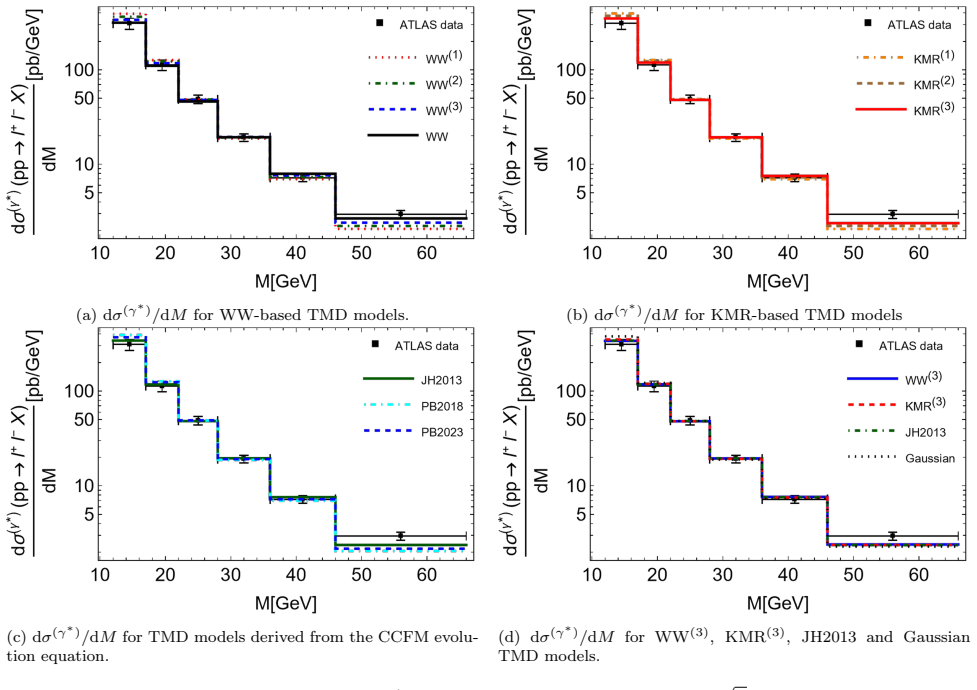
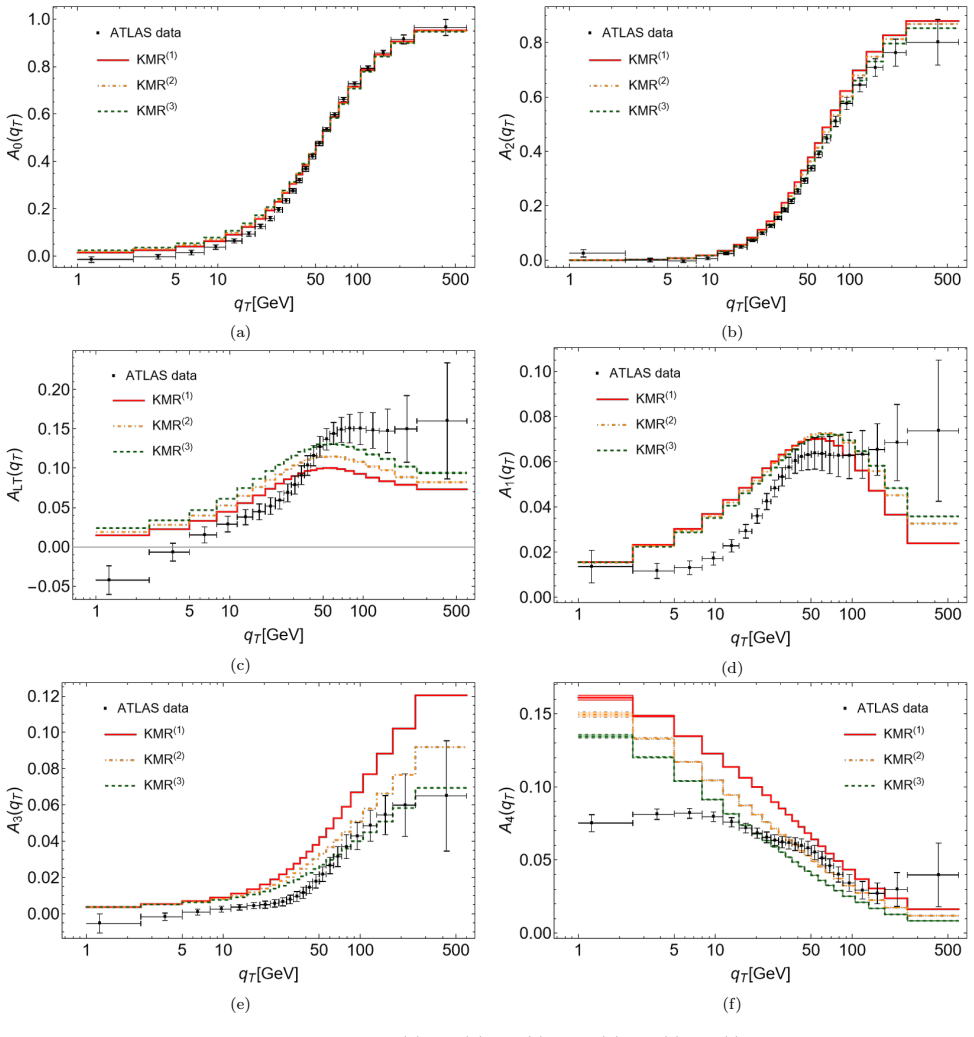
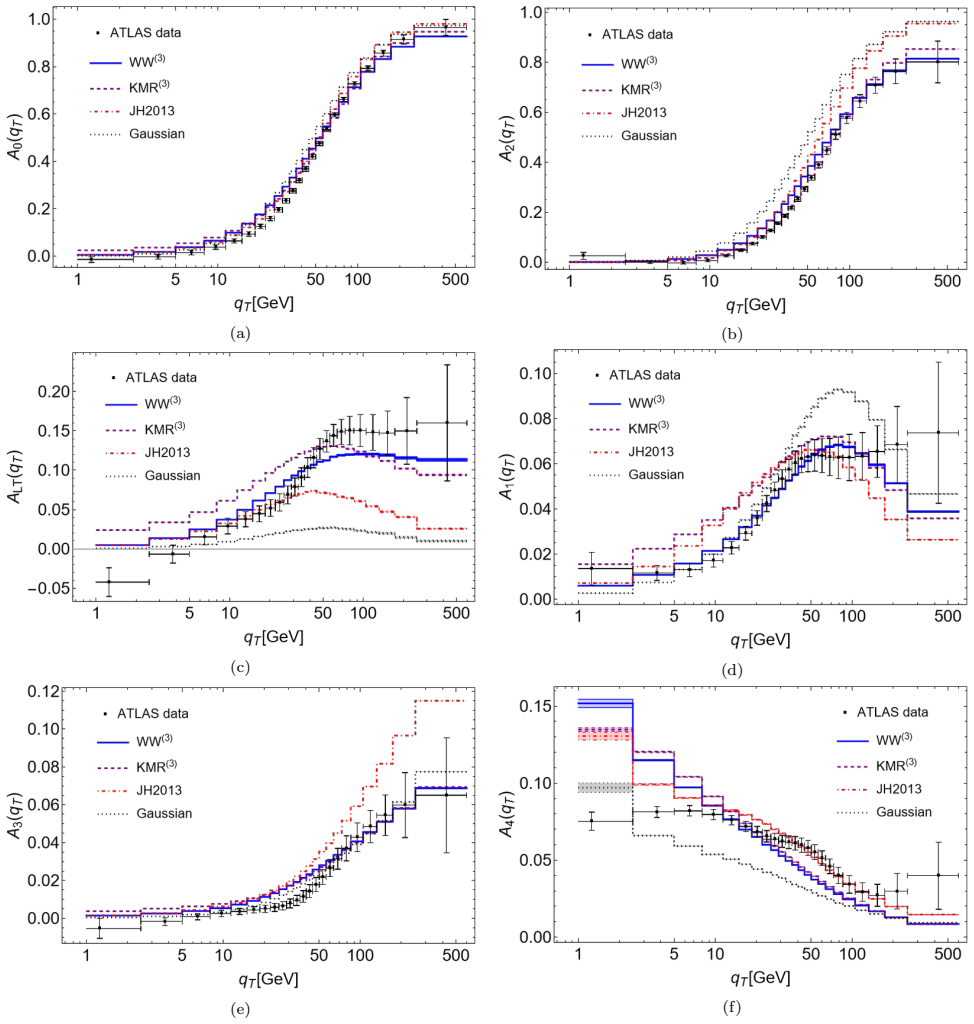
Tree-level high-energy factorization applied to the channels q_val g* to q V* and g* g* to q qbar V* yields structure functions whose agreement with ATLAS data at sqrt(S) = 8 TeV is best for a phenomenologically modified Weizsäcker-Williams gluon TMD model, as measured by chi-squared per degree of freedom, while the unadjusted versions of Gaussian, KMR, and JH models perform noticeably worse.
What carries the argument
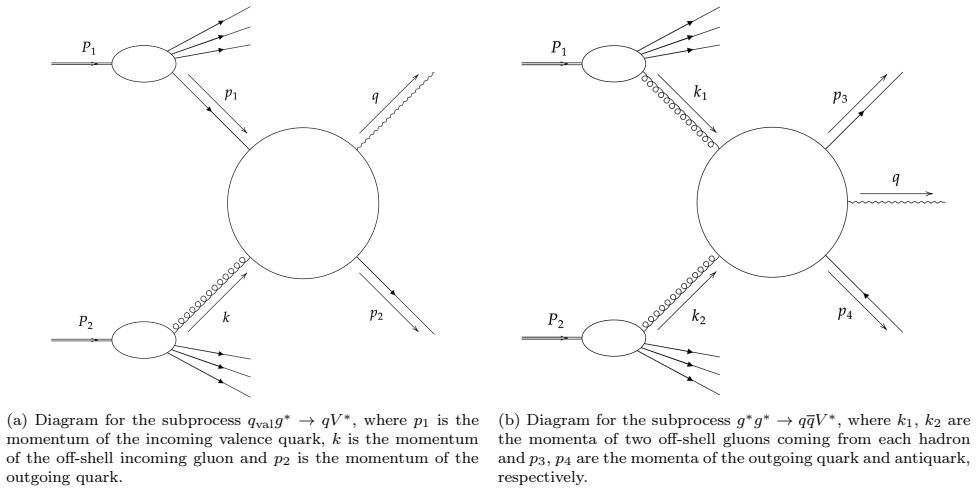
High-energy factorization formalism that convolves tree-level hard-scattering matrix elements with different gluon TMD distributions to generate Drell-Yan structure functions for comparison with data.
Load-bearing premise
The high-energy factorization formula with only tree-level matrix elements for the two specified channels reproduces the Drell-Yan process at 8 TeV without higher-order corrections or other contributions.
What would settle it
A next-to-leading-order calculation of the same structure functions that reverses the ranking of the TMD models or produces a substantially lower chi-squared for a different model would undermine the preference for the modified Weizsäcker-Williams form.
Figures
read the original abstract
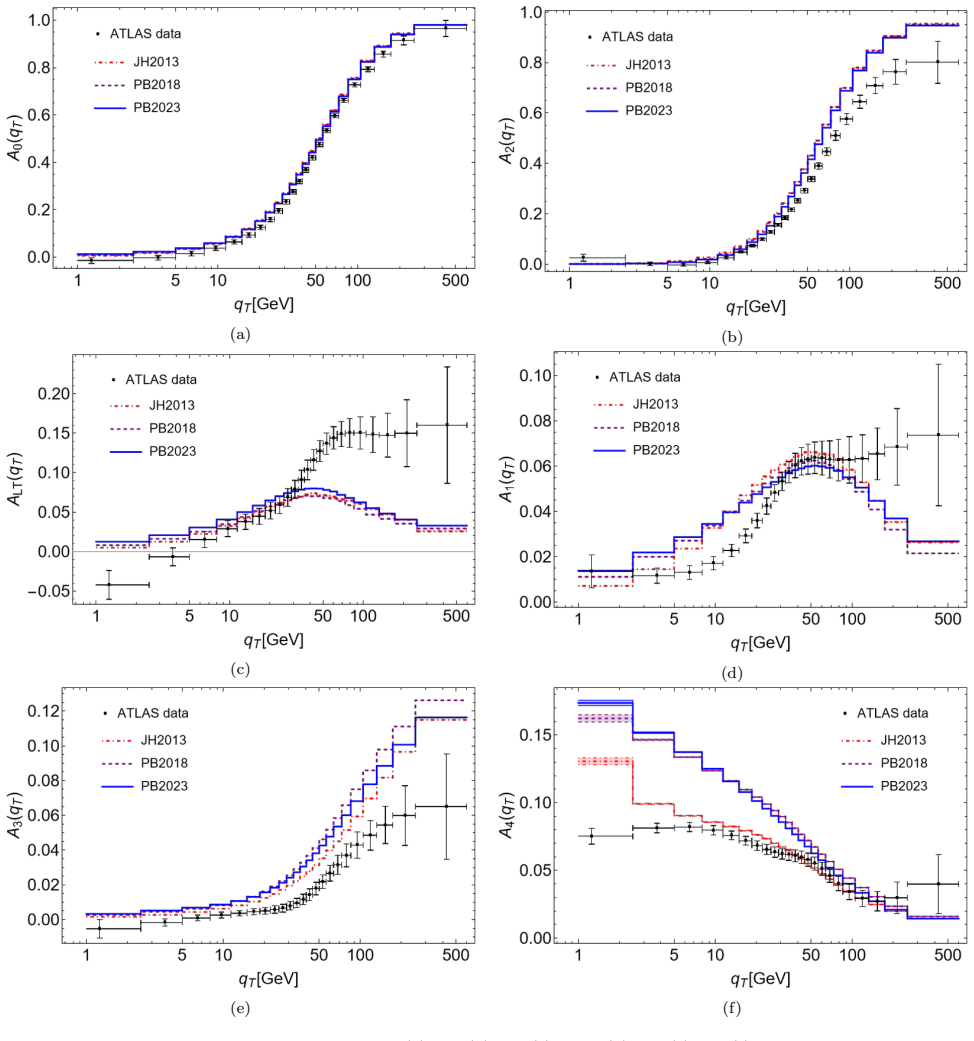
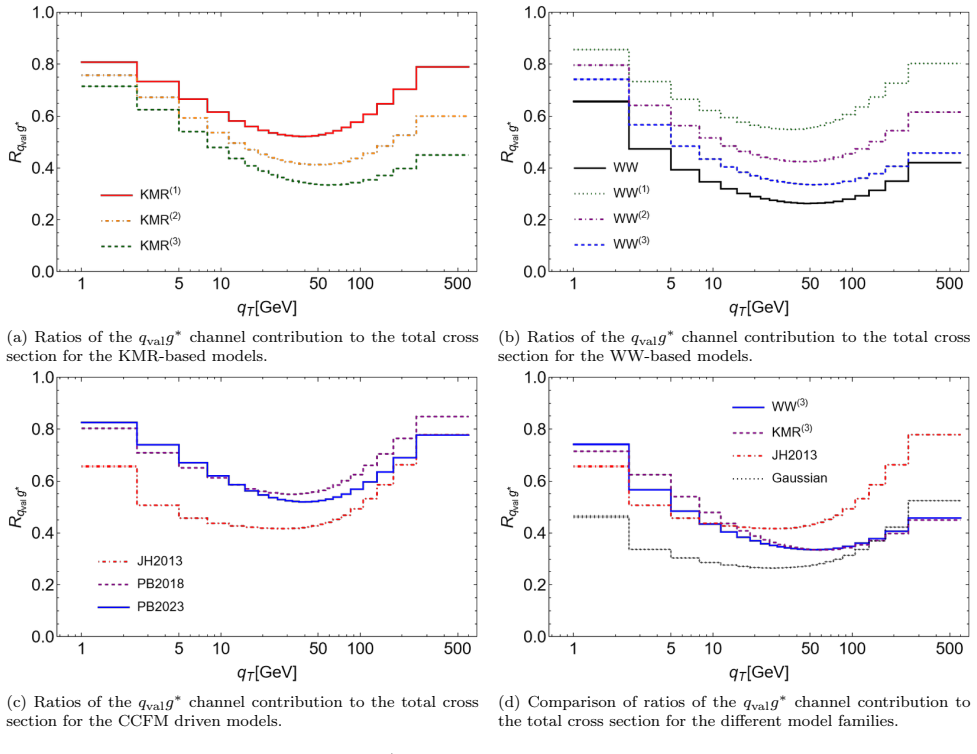
We compute structure functions for the Drell--Yan process in proton-proton collisions at the center of mass energy $\sqrt{S} = 8 \mathrm{TeV}$ both parity conserving and parity breaking. For this calculation, we use the high-energy factorization formalism. The hard scattering matrix elements used in our derivation consist of two channels -- $q_\mathrm{val} g^* \to q V^*$ and $g^* g^* \to q \overline{q} V^*$, both at the tree level. We consider four types of gluon TMD models: Gaussian, Weizs\"{a}cker--Williams (WW), Kimber--Martin--Ryskin (KMR), and Jung--Hautmann (JH). We also consider the models with phenomenological adjustments to improve the data description. We derive and compare the structure functions calculated for different gluon TMD models with the ATLAS 2016 data. Based on this comparison, we calculate $\chi^2$ per number of degrees of freedom for each of the predictions. This assessment shows clear differences between the predictions obtained with different TMD models, both in the description of the full data set and in the case of individual structure functions. The best description of the structure functions data is obtained with one of the modified WW models. Our analysis can serve to identify the features of the TMD model that should be considered in future gluon TMD fits.
Editorial analysis
A structured set of objections, weighed in public.
Referee Report
Summary. The paper computes parity-conserving and parity-violating Drell-Yan structure functions in pp collisions at √S=8 TeV within high-energy factorization, employing tree-level matrix elements for the channels q_val g* → q V* and g* g* → q qbar V*. Predictions from Gaussian, WW, KMR, and JH gluon TMD models (plus phenomenological modifications) are compared to ATLAS 2016 data via χ² per degree of freedom, with the conclusion that a modified WW model yields the best overall description and that the exercise identifies useful features for future TMD fits.
Significance. If the tree-level HEF approximation is reliable, the quantitative χ² ranking of TMD models against existing data provides a practical diagnostic for model features (e.g., the form of the WW modification) that should be retained in global fits. The explicit comparison of multiple models on the same dataset and the separation into individual structure functions are strengths that go beyond qualitative statements.
major comments (3)
- [§2] §2 (High-energy factorization formalism): The central claim that differences in χ² reflect genuine TMD-model features rests on the assumption that the tree-level matrix elements for only two channels accurately capture the process at √S=8 TeV. No estimate is given for the size of omitted NLO hard corrections, additional partonic channels, or matching to collinear factorization; any of these can shift the predicted structure functions in a model-dependent manner and thereby alter the χ² ranking.
- [§3.2 and §4.3] §3.2 (Phenomenological adjustments to TMD models) and §4.3 (χ² results): The modified WW model is reported to give the lowest χ², but the adjustments appear to be introduced to improve data description. Without an a-priori justification or a demonstration that the same modification improves other observables, the superiority may be post-hoc rather than an independent test of the underlying TMD ansatz.
- [Table 1] Table 1 (or equivalent χ² table): The reported χ²/dof values for the full dataset and for individual structure functions show clear numerical differences, yet no uncertainty is attached to these values arising from the neglected higher-order terms. This makes it impossible to judge whether the preference for the modified WW model is statistically robust.
minor comments (3)
- [Introduction] The definition of the structure functions (F1, F2, etc.) and their relation to the TMDs should be stated explicitly in the introduction or §2 rather than assumed from prior literature.
- [Figure captions] Figure captions should specify the exact kinematic cuts and binning used for the ATLAS data comparison to allow direct reproduction.
- [§4] A reference to the original ATLAS 2016 Drell-Yan measurement paper is missing in the data-comparison section.
Simulated Author's Rebuttal
We thank the referee for the careful reading of our manuscript and the constructive comments, which help clarify the scope and limitations of our analysis. We address each major comment below and indicate the corresponding revisions.
read point-by-point responses
-
Referee: [§2] §2 (High-energy factorization formalism): The central claim that differences in χ² reflect genuine TMD-model features rests on the assumption that the tree-level matrix elements for only two channels accurately capture the process at √S=8 TeV. No estimate is given for the size of omitted NLO hard corrections, additional partonic channels, or matching to collinear factorization; any of these can shift the predicted structure functions in a model-dependent manner and thereby alter the χ² ranking.
Authors: We agree that the tree-level HEF approximation with the two specified channels has inherent limitations at √S=8 TeV, and that NLO corrections or additional channels could in principle introduce model-dependent shifts. However, because the same hard-scattering matrix elements are used for every TMD model, the relative differences in predicted structure functions—and thus in χ²—arise primarily from the TMD parametrizations themselves. The exercise therefore remains a useful diagnostic for identifying which TMD features best describe the data within this consistent framework. We will revise §2 to include an explicit discussion of these limitations, citing relevant literature on the expected size of higher-order effects in high-energy factorization for Drell-Yan processes, and to state that while absolute χ² values may change, the comparative ranking provides guidance for future TMD model development. revision: partial
-
Referee: [§3.2 and §4.3] §3.2 (Phenomenological adjustments to TMD models) and §4.3 (χ² results): The modified WW model is reported to give the lowest χ², but the adjustments appear to be introduced to improve data description. Without an a-priori justification or a demonstration that the same modification improves other observables, the superiority may be post-hoc rather than an independent test of the underlying TMD ansatz.
Authors: The modifications applied to the WW model follow forms previously employed in the TMD literature to incorporate small-x saturation and non-perturbative effects. We will strengthen §3.2 by adding explicit references to these earlier works and by articulating the physical motivation for each adjustment prior to the numerical comparison. While the present study does not test the same modifications on independent observables, its purpose—as stated in the abstract—is to isolate promising TMD features that can be retained or refined in future global fits. This comparative approach therefore serves as an independent diagnostic rather than a purely post-hoc optimization. revision: partial
-
Referee: [Table 1] Table 1 (or equivalent χ² table): The reported χ²/dof values for the full dataset and for individual structure functions show clear numerical differences, yet no uncertainty is attached to these values arising from the neglected higher-order terms. This makes it impossible to judge whether the preference for the modified WW model is statistically robust.
Authors: We acknowledge that quantitative uncertainties on the χ²/dof values arising from omitted higher-order contributions are not provided. Because a complete NLO calculation lies outside the scope of this work, we cannot attach numerical error estimates. We will add a clarifying paragraph adjacent to the χ² table (and in §4.3) that states this limitation explicitly and offers a qualitative assessment of how such corrections might affect the observed differences, noting that the modified WW model yields the lowest χ² consistently across both the full dataset and the individual structure functions. revision: partial
- A quantitative estimate of the size of NLO hard corrections, additional partonic channels, and their potential model-dependent impact on the χ² ranking, which would require a separate, more extensive calculation beyond the present tree-level analysis.
Circularity Check
Phenomenological adjustments tuned to data then used to declare 'best' model via chi2
specific steps
-
fitted input called prediction
[Abstract]
"We also consider the models with phenomenological adjustments to improve the data description. ... The best description of the structure functions data is obtained with one of the modified WW models."
Adjustments are explicitly introduced to fit the ATLAS data better; the subsequent chi2 ranking that crowns the modified WW model as superior is then a direct consequence of that fitting step rather than a prediction tested against held-out or independent observables.
full rationale
The paper computes Drell-Yan structure functions in tree-level high-energy factorization for several gluon TMD models and their variants. The central result—that a modified WW model gives the best description—rests on first introducing 'phenomenological adjustments to improve the data description' and then ranking the models by chi2 to the identical ATLAS dataset. This selection step is forced by the tuning procedure itself rather than constituting an independent test of TMD features. No self-citation chains, definitional loops, or renamed known results appear in the derivation; the circularity is localized to the model-adjustment and ranking step.
Axiom & Free-Parameter Ledger
free parameters (1)
- TMD model parameters (e.g., Gaussian width, WW scale, KMR/JH parameters)
axioms (1)
- domain assumption High-energy factorization applies to Drell-Yan structure functions at sqrt(S)=8 TeV with the specified tree-level channels
Lean theorems connected to this paper
-
IndisputableMonolith/Cost/FunctionalEquation.lean (washburn_uniqueness_aczel)J-uniqueness via Aczél unclear?
unclearRelation between the paper passage and the cited Recognition theorem.
We consider four types of gluon TMD models: Gaussian, Weizsäcker–Williams (WW), Kimber–Martin–Ryskin (KMR), and Jung–Hautmann (JH). We also consider the models with phenomenological adjustments... The best description... is obtained with one of the modified WW models.
-
IndisputableMonolith/Foundation/RealityFromDistinction.leanreality_from_one_distinction unclear?
unclearRelation between the paper passage and the cited Recognition theorem.
high-energy factorization formalism... tree-level matrix elements for the channels q_val g* → q V* and g* g* → q qbar V*
What do these tags mean?
- matches
- The paper's claim is directly supported by a theorem in the formal canon.
- supports
- The theorem supports part of the paper's argument, but the paper may add assumptions or extra steps.
- extends
- The paper goes beyond the formal theorem; the theorem is a base layer rather than the whole result.
- uses
- The paper appears to rely on the theorem as machinery.
- contradicts
- The paper's claim conflicts with a theorem or certificate in the canon.
- unclear
- Pith found a possible connection, but the passage is too broad, indirect, or ambiguous to say the theorem truly supports the claim.
Reference graph
Works this paper leans on
-
[1]
S. D. Drell and Tung-Mow Yan. Massive Lepton Pair Production in Hadron-Hadron Collisions at High-Energies.Phys. Rev. Lett., 25:316–320, 1970. [Erratum: Phys.Rev.Lett. 25, 902 (1970)]
work page 1970
-
[2]
John C. Collins and Davison E. Soper. Angular Distribution of Dileptons in High-Energy Hadron Collisions.Phys. Rev. D, 16:2219, 1977
work page 1977
-
[3]
K. Kajantie, J. Lindfors, and Risto Raitio. QCD Angular Correlations for Muon Pair Production.Phys. Lett. B, 74:384–388, 1978
work page 1978
-
[4]
J. Cleymans and M. Kuroda. Angular Distribution of Dileptons in Hadronic Collisions.Nucl. Phys. B, 155:480, 1979. [Erratum: Nucl.Phys.B 160, 510 (1979)]
work page 1979
-
[5]
J. Cleymans and M. Kuroda. Angular Distribution of Lepton Pairs and QCD.Phys. Lett. B, 80:385,
-
[6]
[Erratum: Phys.Lett.B 86, 426 (1979)]
work page 1979
-
[7]
C. S. Lam and Wu-Ki Tung. A Systematic Approach to Inclusive Lepton Pair Production in Hadronic Collisions.Phys. Rev. D, 18:2447, 1978
work page 1978
-
[8]
C. S. Lam and Wu-Ki Tung. Structure Function Relations at Large Transverse Momenta in Lepton Pair Production Processes.Phys. Lett. B, 80:228–231, 1979
work page 1979
-
[9]
C. S. Lam and Wu-Ki Tung. A Parton Model Relation Sans QCD Modifications in Lepton Pair Pro- ductions.Phys. Rev. D, 21:2712, 1980
work page 1980
-
[10]
Georges Aad et al. Measurement of the low-mass Drell-Yan differential cross section at√s= 7 TeV using the ATLAS detector.JHEP, 06:112, 2014
work page 2014
-
[11]
Georges Aad et al. Measurement of the angular coefficients inZ-boson events using electron and muon pairs from data taken at√s= 8TeV with the ATLAS detector.JHEP, 08:159, 2016
work page 2016
-
[12]
Pietro Faccioli, Carlos Lourenco, Joao Seixas, and Hermine K. Wohri. Model-independent constraints on the shape parameters of dilepton angular distributions.Phys. Rev. D, 83:056008, 2011
work page 2011
-
[13]
Interpretation of Angular Distributions ofZ-boson Production at Colliders.Phys
Jen-Chieh Peng, Wen-Chen Chang, Randall Evan McClellan, and Oleg Teryaev. Interpretation of Angular Distributions ofZ-boson Production at Colliders.Phys. Lett. B, 758:384–388, 2016
work page 2016
-
[14]
John C. Collins, Davison E. Soper, and George F. Sterman. Does the Drell-Yan Cross-section Factorize? Phys. Lett. B, 109:388–392, 1982
work page 1982
-
[15]
John C. Collins, Davison E. Soper, and George F. Sterman. All Order Factorization for Drell-Yan Cross-sections.Phys. Lett. B, 134:263, 1984
work page 1984
-
[16]
John C. Collins, Davison E. Soper, and George F. Sterman. Factorization for Short Distance Hadron - Hadron Scattering.Nucl. Phys. B, 261:104–142, 1985
work page 1985
-
[17]
John C. Collins, Davison E. Soper, and George F. Sterman. Soft Gluons and Factorization.Nucl. Phys. B, 308:833–856, 1988
work page 1988
-
[18]
M. Chaichian, M. Hayashi, and K. Yamagishi. Angular Distributions of High Mass Dileptons With Finite Transverse Momentum in High-energy Hadronic Collisions.Phys. Rev. D, 25:130, 1982. [Erratum: Phys.Rev.D 26, 2534 (1982)]
work page 1982
-
[19]
E. Mirkes. Angular decay distribution of leptons from W bosons at NLO in hadronic collisions.Nucl. Phys. B, 387:3–85, 1992. 21
work page 1992
-
[20]
E. Mirkes and J. Ohnemus. Angular distributions of Drell-Yan lepton pairs at the Tevatron: Orderα2 s corrections and Monte Carlo studies.Phys. Rev. D, 51:4891–4904, 1995
work page 1995
-
[21]
E. Mirkes and J. Ohnemus.WandZpolarization effects in hadronic collisions.Phys. Rev. D, 50:5692– 5703, 1994
work page 1994
- [22]
-
[23]
Rikkert Frederix and Timea Vitos. Electroweak corrections to the angular coefficients in finite-pTZ- boson production and dilepton decay.Eur. Phys. J. C, 80(10):939, 2020
work page 2020
-
[24]
Angular coefficients in W+j production at the LHC with high precision.Eur
Mathieu Pellen, Rene Poncelet, Andrei Popescu, and Timea Vitos. Angular coefficients in W+j production at the LHC with high precision.Eur. Phys. J. C, 82(8):693, 2022
work page 2022
-
[25]
NLO vector-boson production matched with shower in POWHEG.JHEP, 07:060, 2008
Simone Alioli, Paolo Nason, Carlo Oleari, and Emanuele Re. NLO vector-boson production matched with shower in POWHEG.JHEP, 07:060, 2008
work page 2008
-
[26]
Drell-Yan lepton angular distribution at small transverse momen- tum.Phys
Daniel Boer and Werner Vogelsang. Drell-Yan lepton angular distribution at small transverse momen- tum.Phys. Rev. D, 74:014004, 2006
work page 2006
- [27]
- [28]
-
[29]
S. J. Brodsky, Arthur Hebecker, and E. Quack. The Drell-Yan process and factorization in impact parameter space.Phys. Rev. D, 55:2584–2590, 1997
work page 1997
-
[30]
B. Z. Kopeliovich, J. Raufeisen, and A. V. Tarasov. The Color dipole picture of the Drell-Yan process. Phys. Lett. B, 503:91–98, 2001
work page 2001
-
[31]
Dilepton production from the color glass condensate.Phys
Francois Gelis and Jamal Jalilian-Marian. Dilepton production from the color glass condensate.Phys. Rev. D, 66:094014, 2002
work page 2002
-
[32]
Drell-Yan production and Lam-Tung relation in the color glass condensate formalism.Phys
Francois Gelis and Jamal Jalilian-Marian. Drell-Yan production and Lam-Tung relation in the color glass condensate formalism.Phys. Rev. D, 76:074015, 2007
work page 2007
-
[33]
Wolfgang Schäfer and Antoni Szczurek. Low mass Drell-Yan production of lepton pairs at forward directions at the LHC: a hybrid approach.Phys. Rev. D, 93(7):074014, 2016
work page 2016
-
[34]
Forward production of a Drell-Yan pair and a jet at small x at next-to-leading order
Pieter Taels. Forward production of a Drell-Yan pair and a jet at small x at next-to-leading order. JHEP, 01:005, 2024
work page 2024
-
[35]
Lam-Tung relation breaking inZ0 hadropro- duction as a probe of parton transverse momentum.Phys
Leszek Motyka, Mariusz Sadzikowski, and Tomasz Stebel. Lam-Tung relation breaking inZ0 hadropro- duction as a probe of parton transverse momentum.Phys. Rev. D, 95(11):114025, 2017
work page 2017
-
[36]
M. A. Nefedov, N. N. Nikolaev, and V. A. Saleev. Drell-Yan lepton pair production at high energies in the Parton Reggeization Approach.Phys. Rev. D, 87(1):014022, 2013
work page 2013
-
[37]
Maxim A. Nefedov and Vladimir A. Saleev. High-Energy Factorization for Drell-Yan process inppand p¯pcollisions with new Unintegrated PDFs.Phys. Rev. D, 102:114018, 2020
work page 2020
-
[38]
S. S. Omelyanchuk, V. A. Saleev, and A. V. Shipilova. Spectra ofZBosons and Lepton Angular Coefficients in the Leading Approximation of the Parton Reggeization Approach with Allowance for the Next-to-Leading-Order Corrections.Phys. Atom. Nucl., 87(3):237–243, 2024
work page 2024
-
[39]
V. A. Saleev and S. S. Omelyanchuk. Lepton Angular Coefficients in the Z-Boson Production in the High-Energy Factorization Approach.Phys. Part. Nucl., 56(2):423–428, 2025
work page 2025
-
[40]
Yan B. Bandeira, Victor P. Goncalves, and Wolfgang Schäfer. Dilepton angular distributions in the color-dipole S-matrix framework.JHEP, 10:010, 2025
work page 2025
-
[41]
Twist expansion of Drell-Yan structure functions in color dipole approach.JHEP, 05:087, 2015
Leszek Motyka, Mariusz Sadzikowski, and Tomasz Stebel. Twist expansion of Drell-Yan structure functions in color dipole approach.JHEP, 05:087, 2015
work page 2015
-
[42]
Dawid Brzeminski, Leszek Motyka, Mariusz Sadzikowski, and Tomasz Stebel. Twist decomposition of Drell-Yan structure functions: phenomenological implications.JHEP, 01:005, 2017
work page 2017
-
[43]
John C. Collins, Davison E. Soper, and George F. Sterman. Transverse Momentum Distribution in Drell-Yan Pair and W and Z Boson Production.Nucl. Phys. B, 250:199–224, 1985
work page 1985
-
[44]
Angular distributions of Drell-Yan leptons in the TMD factor- ization approach.JHEP, 12:059, 2024
Sara Piloneta and Alexey Vladimirov. Angular distributions of Drell-Yan leptons in the TMD factor- ization approach.JHEP, 12:059, 2024
work page 2024
-
[45]
Angular structure of Drell-Yan reaction in the TMD factorization approach
Alexey Vladimirov. Angular structure of Drell-Yan reaction in the TMD factorization approach. In 59th Rencontres de Moriond on QCD and High Energy Interactions: Moriond QCD 2025, 5 2025
work page 2025
- [46]
-
[47]
E. A. Kuraev, L. N. Lipatov, and Victor S. Fadin. Multiregge processes in the Yang-Mills theory.Sov. Phys. JETP, 44(3):443–451, 1976
work page 1976
-
[48]
E. A. Kuraev, L. N. Lipatov, and Victor S. Fadin. The Pomeranchuk Singularity in Nonabelian Gauge Theories.Sov. Phys. JETP, 45:199–204, 1977
work page 1977
-
[49]
I. I. Balitsky and L. N. Lipatov. The Pomeranchuk Singularity in Quantum Chromodynamics.Sov. J. Nucl. Phys., 28:822–829, 1978
work page 1978
-
[50]
Coherence Effects in Initial Jets at Small q**2 / s.Nucl
Marcello Ciafaloni. Coherence Effects in Initial Jets at Small q**2 / s.Nucl. Phys. B, 296:49–74, 1988
work page 1988
- [51]
- [52]
-
[53]
QCD coherence in the structure function and associated distributions at small x.Nucl
Giuseppe Marchesini. QCD coherence in the structure function and associated distributions at small x.Nucl. Phys. B, 445:49–80, 1995
work page 1995
- [54]
- [55]
-
[56]
The Wilson renormaliza- tion group for low x physics: Towards the high density regime.Phys
Jamal Jalilian-Marian, Alex Kovner, Andrei Leonidov, and Heribert Weigert. The Wilson renormaliza- tion group for low x physics: Towards the high density regime.Phys. Rev. D, 59:014014, 1998
work page 1998
-
[57]
The BFKL equation from the Wilson renormalization group.Nucl
Jamal Jalilian-Marian, Alex Kovner, Andrei Leonidov, and Heribert Weigert. The BFKL equation from the Wilson renormalization group.Nucl. Phys. B, 504:415–431, 1997
work page 1997
-
[58]
Unitarity at small Bjorken x.Nucl
Heribert Weigert. Unitarity at small Bjorken x.Nucl. Phys. A, 703:823–860, 2002
work page 2002
- [59]
- [60]
-
[61]
Krzysztof J. Golec-Biernat and M. Wusthoff. Saturation effects in deep inelastic scattering at low Q**2 and its implications on diffraction.Phys. Rev. D, 59:014017, 1998
work page 1998
-
[62]
M. A. Kimber, Alan D. Martin, and M. G. Ryskin. Unintegrated parton distributions and prompt photon hadroproduction.Eur. Phys. J. C, 12:655–661, 2000
work page 2000
-
[63]
M. A. Kimber, Alan D. Martin, and M. G. Ryskin. Unintegrated parton distributions.Phys. Rev. D, 63:114027, 2001
work page 2001
-
[64]
Alan D. Martin and M. G. Ryskin. Unintegrated generalized parton distributions.Phys. Rev. D, 64:094017, 2001
work page 2001
-
[65]
V. N. Gribov and L. N. Lipatov. e+ e- pair annihilation and deep inelastic e p scattering in perturbation theory.Sov. J. Nucl. Phys., 15:675–684, 1972
work page 1972
-
[66]
L. N. Lipatov. The parton model and perturbation theory.Yad. Fiz., 20:181–198, 1974
work page 1974
-
[67]
Guido Altarelli and G. Parisi. Asymptotic Freedom in Parton Language.Nucl. Phys. B, 126:298–318, 1977
work page 1977
-
[68]
Yuri L. Dokshitzer. Calculation of the Structure Functions for Deep Inelastic Scattering and e+ e- Annihilation by Perturbation Theory in Quantum Chromodynamics.Sov. Phys. JETP, 46:641–653, 1977
work page 1977
-
[69]
Universality of Unintegrated Gluon Distributions at small x.Phys
Fabio Dominguez, Cyrille Marquet, Bo-Wen Xiao, and Feng Yuan. Universality of Unintegrated Gluon Distributions at small x.Phys. Rev. D, 83:105005, 2011
work page 2011
-
[70]
John C. Collins and R. Keith Ellis. Heavy quark production in very high-energy hadron collisions.Nucl. Phys. B, 360:3–30, 1991
work page 1991
-
[71]
Michal Deak and Florian Schwennsen.ZandW ± production associated with quark-antiquark pair in kT-factorization at the LHC.JHEP, 09:035, 2008
work page 2008
-
[72]
F. Hautmann and H. Jung. Transverse momentum dependent gluon density from DIS precision data. Nucl. Phys. B, 883:1–19, 2014
work page 2014
-
[73]
Krzysztof J. Golec-Biernat and M. Wusthoff. Saturation in diffractive deep inelastic scattering.Phys. Rev. D, 60:114023, 1999
work page 1999
-
[74]
F. Hautmann, H. Jung, M. Krämer, P. J. Mulders, E. R. Nocera, T. C. Rogers, and A. Signori. TMDlib and TMDplotter: library and plotting tools for transverse-momentum-dependent parton distributions. Eur. Phys. J. C, 74:3220, 2014. 23
work page 2014
-
[75]
A. Bermudez Martinez, P. Connor, H. Jung, A. Lelek, R. Žlebčík, F. Hautmann, and V. Radescu. Collinear and TMD parton densities from fits to precision DIS measurements in the parton branching method.Phys. Rev. D, 99(7):074008, 2019
work page 2019
-
[76]
I. Bubanja et al. The smallkTregion in Drell–Yan production at next-to-leading order with the parton branching method.Eur. Phys. J. C, 84(2):154, 2024
work page 2024
-
[77]
F. Hautmann, H. Jung, A. Lelek, V. Radescu, and R. Zlebcik. Soft-gluon resolution scale in QCD evolution equations.Phys. Lett. B, 772:446–451, 2017
work page 2017
-
[78]
Krzysztof Golec-Biernat and Anna M. Stasto. On the use of the KMR unintegrated parton distribution functions.Phys. Lett. B, 781:633–638, 2018
work page 2018
-
[79]
Hung-Liang Lai, Marco Guzzi, Joey Huston, Zhao Li, Pavel M. Nadolsky, Jon Pumplin, and C. P. Yuan. New parton distributions for collider physics.Phys. Rev. D, 82:074024, 2010
work page 2010
-
[80]
G. Peter Lepage. Adaptive multidimensional integration: VEGAS enhanced.J. Comput. Phys., 439:110386, 2021
work page 2021
discussion (0)
Sign in with ORCID, Apple, or X to comment. Anyone can read and Pith papers without signing in.