Symetra: Visual Analytics for the Parameter Tuning Process of Symbolic Execution Engines
Pith reviewed 2026-05-10 20:09 UTC · model grok-4.3
The pith
Symetra visual analytics lets experts tune symbolic execution parameters to outperform automated methods in branch coverage.
A machine-rendered reading of the paper's core claim, the machinery that carries it, and where it could break.
Core claim
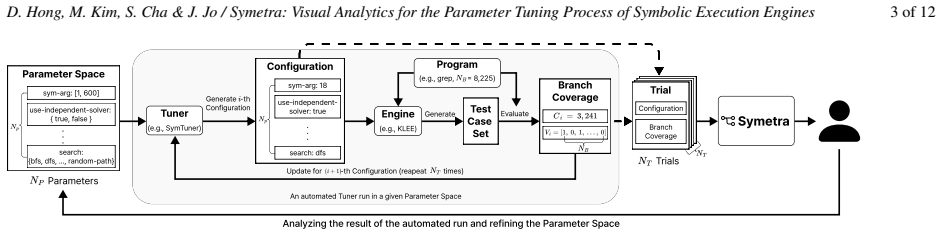
Symetra supports Human-in-the-Loop parameter tuning by offering two complementary overviews of parameter impacts on branch coverage and patterns, along with collective analysis to contrast groups of configurations, leading experts to identify better configurations than fully automated approaches in terms of branch coverage and tuning efficiency.
What carries the argument
Two complementary overviews of parameter impacts on branch coverage values and patterns, combined with collective analysis for contrasting groups of configurations.
Load-bearing premise
The visual analytics features and collective analysis will reliably let users discover better configurations than automated tuners.
What would settle it
A controlled study in which experts using Symetra achieve no statistically higher branch coverage or fewer tuning iterations than an automated tuner on the same set of programs.
Figures


read the original abstract
Symbolic execution engines such as KLEE automatically generate test cases to maximize branch coverage, but their numerous parameters make it difficult to understand the parameters' impact, leading the user to rely on suboptimal default configurations. While automated tuners have shown promising results, they provide limited insights into why certain configurations work well, motivating the need for Human-in-the-Loop approaches. In this work, we present a visual analytics system, Symetra, designed to support Human-in-the-Loop parameter tuning of symbolic execution engines. To handle a large number of parameters and their configurations, we provide two complementary overviews of their impact on branch coverage values and patterns. Building on these overviews, our system enables collective analysis, allowing the user to contrast groups of configurations and identify differences that may affect branch coverage. We also report on case studies and a Human-in-the-Loop tuning process, demonstrating that experts not only interpreted parameter impacts and identified complementary configurations, but also improved upon fully automated approaches in both branch coverage and tuning efficiency.
Editorial analysis
A structured set of objections, weighed in public.
Referee Report
Summary. The paper presents Symetra, a visual analytics system for human-in-the-loop parameter tuning of symbolic execution engines such as KLEE. It provides two complementary overviews of parameter impacts on branch coverage values and patterns, plus collective analysis features to contrast groups of configurations. Case studies are reported in which experts interpret parameter effects, identify complementary configurations, and achieve improvements over fully automated tuning in both branch coverage and tuning efficiency.
Significance. If the claimed improvements can be attributed to the visual analytics and collective analysis features rather than expert knowledge or uncontrolled factors, the work would advance human-computer interaction approaches to software testing by making parameter tuning more interpretable and effective than black-box automated methods alone.
major comments (1)
- [Case studies] Case studies section: the central claim that experts 'improved upon fully automated approaches in both branch coverage and tuning efficiency' using Symetra is not supported by a controlled comparison. No quantitative baseline is provided for the automated tuner (specific algorithm, search budget, or number of independent runs), no participant count or expertise details are given, and there is no condition isolating Symetra's overviews and collective-analysis features (e.g., experts given only automated outputs versus the full interface). This prevents crediting the observed gains specifically to the proposed Human-in-the-Loop mechanisms.
minor comments (1)
- [Abstract and System Overview] The abstract and system description would benefit from explicit statements of the number of parameters handled, the exact visual encodings used in the two overviews, and any quantitative metrics collected during the case studies.
Simulated Author's Rebuttal
We thank the referee for the constructive feedback and the opportunity to address the concerns about the evaluation in our case studies. We provide point-by-point responses below and indicate where revisions will be made to strengthen the manuscript.
read point-by-point responses
-
Referee: Case studies section: the central claim that experts 'improved upon fully automated approaches in both branch coverage and tuning efficiency' using Symetra is not supported by a controlled comparison. No quantitative baseline is provided for the automated tuner (specific algorithm, search budget, or number of independent runs), no participant count or expertise details are given, and there is no condition isolating Symetra's overviews and collective-analysis features (e.g., experts given only automated outputs versus the full interface). This prevents crediting the observed gains specifically to the proposed Human-in-the-Loop mechanisms.
Authors: We agree that the case studies do not include a controlled experimental design that isolates the effects of Symetra's visual overviews and collective analysis features from expert knowledge or other factors. The studies were designed as qualitative demonstrations of the human-in-the-loop tuning process in practice, showing how experts interpreted parameter impacts and identified complementary configurations to improve upon an automated baseline. We will revise the manuscript to add the missing details on the automated tuner (specific algorithm, search budget, and number of independent runs) and on the participants (count and expertise). We will also tone down the central claim to state that improvements were observed during expert use of the full Symetra system rather than attributing them solely to the visual analytics components. A full controlled user study with isolated conditions remains outside the scope of the current work and is noted as future research. revision: partial
- The absence of a controlled comparison condition that isolates Symetra's interface features from expert knowledge alone, as this would require new experimental data not collected in the reported case studies.
Circularity Check
No circularity: system description and case studies contain no derivations, equations, or fitted predictions that reduce to inputs by construction.
full rationale
The paper presents a visual analytics tool (Symetra) for exploring parameter impacts on symbolic execution engines, supported by overviews, collective analysis features, and case-study outcomes. No mathematical derivation chain, parameter fitting, or predictive model is claimed or executed; the central claims rest on qualitative expert interpretations and observed improvements in branch coverage and efficiency during human-in-the-loop sessions. These are empirical reports, not reductions of a result to its own fitted inputs or self-citations. The absence of any load-bearing self-citation chain, ansatz smuggling, or renaming of known results keeps the work self-contained against external benchmarks such as automated tuners.
Axiom & Free-Parameter Ledger
axioms (1)
- domain assumption Users can effectively interpret visual overviews of parameter impacts to guide configuration choices
Reference graph
Works this paper leans on
-
[1]
C., DEMETRESCUC., LENTIS., NICCHIS., SAN- TUCCIG.: Symnav: Visually assisting symbolic execution
[ABB∗19] ANGELINIM., BLASILLIG., BORZACCHIELLOL., COPPA E., D’ELIAD. C., DEMETRESCUC., LENTIS., NICCHIS., SAN- TUCCIG.: Symnav: Visually assisting symbolic execution. In2019 IEEE Symposium on Visualization for Cyber Security (VizSec)(2019), pp. 1–11.doi:10.1109/VizSec48167.2019.9161524. 3 [air24]AIRBNB: visx - a collection of expressive, low-level visuali...
-
[2]
7 [ASY∗19] AKIBAT., SANOS., YANASET., OHTAT., KOYAMAM.: Optuna: A next-generation hyperparameter optimization framework. In Proceedings of the 25th ACM SIGKDD International Conference on Knowledge Discovery & Data Mining(New York, NY , USA, 2019), KDD ’19, Association for Computing Machinery, p. 2623–2631.doi: 10.1145/3292500.3330701. 2 [BCD∗18] BALDONIR....
-
[3]
2, 6 [Now19] NOWACKM.: Fine-grain memory object representation in symbolic execution
URL: https://github.com/microsoft/nni. 2, 6 [Now19] NOWACKM.: Fine-grain memory object representation in symbolic execution. In2019 34th IEEE/ACM International Confer- ence on Automated Software Engineering (ASE)(2019), pp. 912–923. doi:10.1109/ASE.2019.00089. 2 [PKR19] PANDEYA., KOTCHARLAKOTAP. R. G., ROYS.: Deferred concretization in symbolic execution ...
-
[4]
7 [WMJ∗19] WANGQ., MINGY., JINZ., SHENQ., LIUD., SMITH M. J., VEERAMACHANENIK., QUH.: Atmseer: Increasing trans- parency and controllability in automated machine learning. InProceed- ings of the 2019 CHI Conference on Human Factors in Computing Sys- tems(New York, NY , USA, 2019), CHI ’19, Association for Computing Machinery, p. 1–12.doi:10.1145/3290605.3...
discussion (0)
Sign in with ORCID, Apple, or X to comment. Anyone can read and Pith papers without signing in.