Visualizing the interplay of dual electronic nematicities in kagome superconductors
Pith reviewed 2026-05-10 19:21 UTC · model grok-4.3
The pith
STM reveals two distinct nematic orders in the kagome superconductor CsV3Sb5
A machine-rendered reading of the paper's core claim, the machinery that carries it, and where it could break.
Core claim
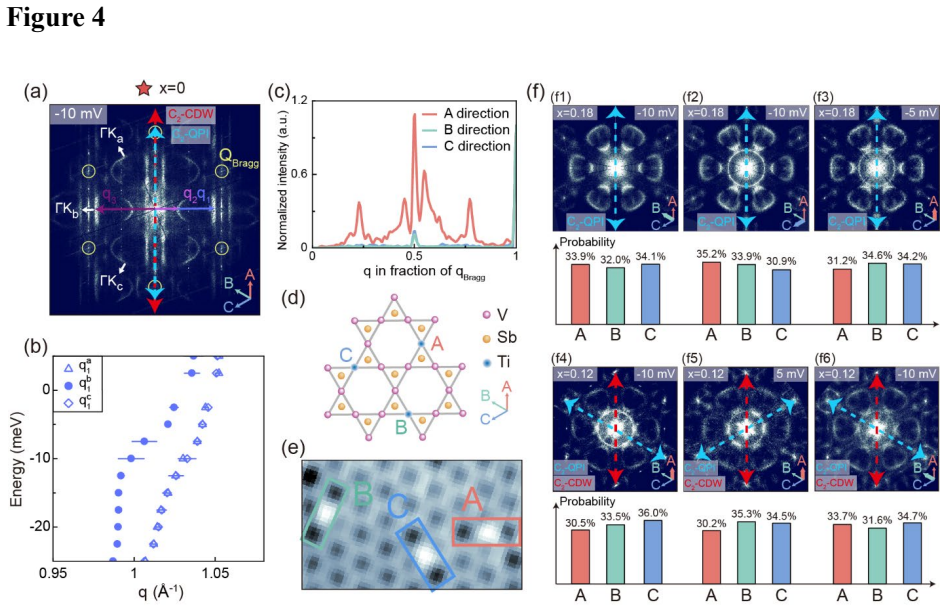
By using scanning tunneling microscopy to study the electronic structures of CsV3Sb5 as a function of temperature and Ti doping, we disentangle the interrelation between two distinct nematic order parameters, one associated with the CDW and the other manifested as C2 distortion of the V-dx2-y2 Fermi pockets without breaking transition symmetry. The latter persists to high doping levels and high temperatures where the long-range CDW is fully suppressed. Moreover, its nematic director is oriented in a lattice direction distinct from that of the CDW-induced nematicity at intermediate doping, and eventually aligns with the strong nematic CDW order in the pristine compound where the quasiparticle
What carries the argument
Dual nematic order parameters assigned to distinct kagome-lattice orbitals, distinguished by STM through their doping-temperature dependence and director orientations.
If this is right
- The second nematic order from orbital distortion can exist without the long-range CDW.
- The two nematic directors are oriented differently at intermediate doping levels.
- The directors align in the pristine compound below the vanadium quasiparticle coherence temperature.
- The orders arise from different orbitals on the kagome lattice and their coupling produces unusual phenomena.
Where Pith is reading between the lines
- This could provide a way to tune the dominant nematic order by doping to study their interactions.
- Similar dual nematic orders may be found in other materials with geometric frustration.
- The persistence of the second order suggests it could influence superconductivity in the doped regime.
Load-bearing premise
The observed C2 distortion of the V-dx2-y2 Fermi pockets is a genuine distinct nematic order parameter that can be clearly separated from CDW-induced effects by STM without significant surface or artifact issues.
What would settle it
If the C2 distortion of the Fermi pockets disappears at the same temperature as the CDW even when doping suppresses the CDW, or if the director orientations always match regardless of doping level.
Figures


read the original abstract
Kagome superconductor AV$_3$Sb$_5$ (A stands for K, Rb, and Cs) hosts a wealth of intertwined electronic orders driven by geometric frustration and electron correlations. Among them, the breaking of rotational and/or time-reversal symmetry, observed within the triple-$Q$ charge density wave (CDW) phase yet exhibiting a more complex temperature dependence, remains a central puzzle. Here, by using scanning tunneling microscopy to study the electronic structures of CsV$_3$Sb$_5$ as a function of temperature and Ti doping, we disentangle the interrelation between two distinct nematic order parameters, one associated with the CDW and the other manifested as $C_2$ distortion of the V-$d_{x^{2}-y^{2}}$ Fermi pockets without breaking transition symmetry. The latter persists to high doping levels and high temperatures where the long-range CDW is fully suppressed. Moreover, its nematic director is oriented in a lattice direction distinct from that of the CDW-induced nematicity at intermediate doping, and eventually aligns with the strong nematic CDW order in the pristine compound where the quasiparticles of vanadium orbitals become coherent below a lower characteristic temperature. These observations, combined with Ginzburg-Landau analysis, reveal a rich interplay between two nematic orders that can be assigned to distinct kagome-lattice orbitals. Our results shed new light on the enigmatic intertwined orders in this family and establish a rare material platform in which dual nematic orders coexist and couple to give rise to unusual correlated phenomena.
Editorial analysis
A structured set of objections, weighed in public.
Referee Report
Summary. The manuscript uses scanning tunneling microscopy (STM) to investigate the electronic structures of CsV₃Sb₅ as a function of temperature and Ti doping. It disentangles two distinct nematic order parameters: one associated with the triple-Q CDW and the other as a C₂ distortion of the V-d_{x²-y²} Fermi pockets that persists without breaking transition symmetry even when the long-range CDW is suppressed. The nematic director reorients with doping, and Ginzburg-Landau analysis is employed to describe their interplay, assigning them to distinct kagome-lattice orbitals.
Significance. If the experimental distinction between the two nematic orders is robust, this work would be significant for the field of kagome superconductors. It provides direct visualization of dual electronic nematicities coexisting and coupling, which could explain the complex temperature dependence of symmetry breaking in AV₃Sb₅. The doping-tuned suppression of CDW while observing the persistent C2 distortion offers a rare platform to study orbital-specific correlated phenomena.
major comments (3)
- The central claim that the C2 distortion represents a distinct nematic order independent of CDW-induced nematicity is load-bearing for the paper's conclusions. However, the STM data interpretation lacks quantitative LDOS simulations for the two scenarios or cross-checks with bulk probes to exclude surface effects or residual short-range CDW order, as noted in the skeptic's assessment of the weakest assumption.
- The Ginzburg-Landau analysis is phenomenological with assumptions on the coupling between the two orders not fully specified. This limits the ability to derive the observed director reorientation and characteristic temperatures from first principles, making the analysis more descriptive than predictive.
- The assignment of the two nematic orders to distinct kagome-lattice orbitals is based on the STM observations and GL analysis, but without supporting microscopic calculations or additional experimental evidence, this assignment remains tentative and central to the significance claim.
Simulated Author's Rebuttal
We thank the referee for their careful reading of our manuscript and for highlighting both its potential significance and areas where the evidence could be strengthened. We address each major comment below with specific responses and indicate where revisions will be made.
read point-by-point responses
-
Referee: The central claim that the C2 distortion represents a distinct nematic order independent of CDW-induced nematicity is load-bearing for the paper's conclusions. However, the STM data interpretation lacks quantitative LDOS simulations for the two scenarios or cross-checks with bulk probes to exclude surface effects or residual short-range CDW order, as noted in the skeptic's assessment of the weakest assumption.
Authors: We agree that quantitative LDOS simulations would provide stronger support and that cross-checks with bulk probes help address potential surface or short-range order concerns. The distinction in our data rests on the orthogonal doping and temperature dependencies of the two features, the reorientation of the nematic director at intermediate doping, and the spatial uniformity of the C2 distortion across large areas. In the revised manuscript we will add an expanded discussion section that references existing ARPES and transport data showing C2 symmetry breaking persisting above the CDW transition temperature and at doping levels where long-range CDW order is absent. We will also include qualitative arguments, based on the observed coherence of quasiparticles and lack of domain fragmentation, against residual short-range CDW as the sole origin. Full quantitative LDOS simulations for the doped, multi-orbital case are computationally intensive and beyond the present scope, but we will note this limitation explicitly. revision: partial
-
Referee: The Ginzburg-Landau analysis is phenomenological with assumptions on the coupling between the two orders not fully specified. This limits the ability to derive the observed director reorientation and characteristic temperatures from first principles, making the analysis more descriptive than predictive.
Authors: We acknowledge that the Ginzburg-Landau treatment is phenomenological, as is standard when modeling competing symmetry-breaking orders whose microscopic origins are not yet fully established. The coupling terms were selected according to the point-group symmetries of the kagome lattice and the experimentally observed director reorientation with doping. In the revised manuscript we will explicitly list all assumed coupling constants, show the free-energy minimization steps that reproduce the director switch and the two distinct onset temperatures, and clarify that the model is intended to organize the observations rather than to predict them ab initio. We will also add a brief statement that first-principles derivation of the coupling strengths remains an open theoretical task. revision: partial
-
Referee: The assignment of the two nematic orders to distinct kagome-lattice orbitals is based on the STM observations and GL analysis, but without supporting microscopic calculations or additional experimental evidence, this assignment remains tentative and central to the significance claim.
Authors: The orbital assignment follows directly from the STM observation that the persistent C2 distortion selectively affects the V d_{x²-y²} Fermi pockets while the CDW-linked nematicity involves a different set of states, combined with the symmetry-allowed couplings in the GL model. We agree that this remains an interpretation rather than a first-principles result. In the revised text we will rephrase the relevant sections to present the assignment as a data-consistent hypothesis, cite existing theoretical works that anticipate orbital-selective nematicity in kagome lattices, and explicitly state that microscopic calculations are needed for confirmation. No new calculations are added because they lie outside the experimental focus of the present study. revision: no
Circularity Check
No significant circularity; experimental STM data and standard post-hoc GL analysis are independent of inputs.
full rationale
The paper's derivation chain begins with direct STM measurements of electronic structure versus temperature and Ti doping in CsV3Sb5, which constitute independent experimental inputs. These data are used to identify C2 distortions of V-dx2-y2 pockets and their director orientations. The subsequent Ginzburg-Landau analysis is a standard phenomenological tool applied after data collection to interpret the interplay of two nematic orders; it does not fit parameters to a subset and rename them as predictions, nor does it rely on self-definitional loops or load-bearing self-citations for uniqueness. No equations or claims reduce by construction to the input observations, and the central distinction between CDW-induced and orbital nematicities is assigned from the measured features rather than derived tautologically. The work is self-contained against external benchmarks via the raw STM spectra and doping series.
Axiom & Free-Parameter Ledger
free parameters (2)
- Ti doping levels
- Characteristic temperatures
axioms (2)
- domain assumption Ginzburg-Landau theory applies to the coupling of the two nematic orders
- domain assumption STM images reflect bulk electronic structure without dominant surface reconstruction
Reference graph
Works this paper leans on
-
[1]
E. Fradkin, S. A. Kivelson, and J. M. Tranquada, Colloquium: Theory of intertwined orders in high- temperature superconductors, Rev. Mod. Phys. 87, 457 (2015)
work page 2015
-
[2]
R. M. Fernandes, P. P. Orth, and J. Schmalian, Intertwined vestigial order in quantum materials: Nematicity and beyond, Annu. Rev. Condens. Matter Phys. 10, 133 (2019)
work page 2019
-
[3]
D. F. Agterberg, J. C. S. Davis, S. D. Edkins, E. Fradkin, D. J. V an Harlingen, S. A. Kivelson, P. A. Lee, L. Radzihovsky, J. M. Tranquada, and Y . Wang, The physics of pair-density waves: Cuprate superconductors and beyond, Annu. Rev. Condens. Matter Phys. 11, 231 (2020)
work page 2020
-
[4]
Balents, Spin liquids in frustrated magnets, Nature 464, 199 (2010)
L. Balents, Spin liquids in frustrated magnets, Nature 464, 199 (2010)
work page 2010
-
[5]
W.-H. Ko, P. A. Lee, and X.- G. Wen, Doped kagome system as exotic superconductor, Phys. Rev. B 79, 214502 (2009)
work page 2009
-
[6]
R. Nandkishore, L. S. Levitov, and A. V . Chubukov, Chiral superconductivity from repulsive interactions in doped graphene, Nat. Phys. 8, 158 (2012)
work page 2012
-
[7]
Syôzi, Statistics of kagomé lattice, Prog
I. Syôzi, Statistics of kagomé lattice, Prog. Theor. Phys. 6, 306 (1951)
work page 1951
-
[8]
J.-X. Yin, B. Lian, and M. Z. Hasan, Topological kagome magnets and superconductors, Nature 612, 647 (2022)
work page 2022
-
[9]
S.-L. Y u and J.-X. Li, Chiral superconducting phase and chiral spin-density-wave phase in a Hubbard model on the kagome lattice, Phys. Rev. B 85, 144402 (2012). 7
work page 2012
-
[10]
M. L. Kiesel and R. Thomale, Sublattice interference in the kagome Hubbard model, Phys. Rev. B 86, 121105 (2012)
work page 2012
-
[11]
M. L. Kiesel, C. Platt, and R. Thomale, Unconventional Fermi surface instabilities in the kagome Hubbard model, Phys. Rev. Lett. 110, 126405 (2013)
work page 2013
-
[12]
W.-S. Wang, Z.-Z. Li, Y .-Y . Xiang, and Q.-H. Wang, Competing electronic orders on kagome lattices at van Hove filling, Phys. Rev. B 87, 115135 (2013)
work page 2013
-
[13]
B. R. Ortiz et al., New kagome prototype materials: Discovery of KV 3Sb5, RbV3Sb5, and CsV3Sb5, Phys. Rev. Materials 3, 094407 (2019)
work page 2019
-
[14]
B. R. Ortiz et al., CsV3Sb5: A Z2 topological kagome metal with a superconducting ground state, Phys. Rev. Lett. 125, 247002 (2020)
work page 2020
-
[15]
T. Neupert, M. M. Denner, J.-X. Yin, R. Thomale, and M. Z. Hasan, Charge order and superconductivity in kagome materials, Nat. Phys. 18, 137 (2022)
work page 2022
- [16]
-
[17]
S. D. Wilson and B. R. Ortiz, A V3Sb5 kagome superconductors, Nat. Rev. Mater. 9, 420 (2024)
work page 2024
-
[18]
M. Kang et al., Twofold van Hove singularity and origin of charge order in topological kagome superconductor CsV 3Sb5, Nat. Phys. 18, 301 (2022)
work page 2022
-
[19]
Hu et al., Rich nature of van Hove singularities in kagome superconductor CsV3Sb5, Nat
Y . Hu et al., Rich nature of van Hove singularities in kagome superconductor CsV3Sb5, Nat. Commun. 13, 2220 (2022)
work page 2022
-
[20]
Y . Hu, X. Wu, A. P. Schnyder, and M. Shi, Electronic landscape of kagome superconductors A V3Sb5 (A = K, Rb, Cs) from angle-resolved photoemission spectroscopy, npj Quantum Mater. 8, 67 (2023)
work page 2023
-
[21]
M. H. Christensen, T. Birol, B. M. Andersen, and R. M. Fernandes, Theory of the charge density wave in AV3Sb5 kagome metals, Phys. Rev. B 104, 214513 (2021)
work page 2021
-
[22]
M. M. Denner, R. Thomale, and T. Neupert, Analysis of charge order in the kagome metal A V3Sb5 (A = K, Rb, Cs), Phys. Rev. Lett. 127, 217601 (2021)
work page 2021
-
[23]
X. Wu et al., Nature of unconventional pairing in the kagome superconductors A V 3Sb5 (A = K, Rb, Cs), Phys. Rev. Lett. 127, 177001 (2021)
work page 2021
-
[24]
S. Zhou and Z. Wang, Chern Fermi pocket, topological pair -density wave, and charge -4e and charge -6e superconductivity in kagome superconductors, Nat. Commun. 13, 7288 (2022)
work page 2022
- [25]
-
[26]
H. Li, Y . B. Kim, and H.-Y . Kee, Intertwined van Hove singularities as a mechanism for loop current order in kagome metals, Phys. Rev. Lett. 132, 146501 (2024)
work page 2024
-
[27]
X. Han, A. P. Schnyder, and X. Wu, Enhanced nematicity emerging from higher -order Van Hove singularities, Phys. Rev. B 107, 184504 (2023)
work page 2023
-
[28]
R. Fu, J. Zhan, M. Dürrnagel, H. Hohmann, R. Thomale , J. Hu, Z. Wang, S. Zhou, and X. Wu, Exotic charge-density waves and superconductivity on the kagome lattice, Natl. Sci. Rev. 12, nwaf414 (2025)
work page 2025
-
[29]
J. Zhan, H. Hohmann, M. Dürrnagel, R. Fu, S. Zhou, Z. Wang, R. Thomale, X. Wu, and J. Hu, Loop current order on the kagome lattice, Phys. Rev. Lett. 136, 126001 (2026)
work page 2026
-
[30]
Jiang et al., Unconventional chiral charge order in kagome superconductor KV 3Sb5, Nat
Y.-X. Jiang et al., Unconventional chiral charge order in kagome superconductor KV 3Sb5, Nat. Mater. 20, 1353 (2021). 8
work page 2021
-
[31]
C. Mielke III et al., Time -reversal symmetry-breaking charge order in a kagome superconductor, Nature 602, 245 (2022)
work page 2022
-
[32]
C. Guo et al., Switchable chiral transport in charge-ordered kagome metal CsV3Sb5, Nature 611, 461 (2022)
work page 2022
-
[33]
Y . Xu, Z. Ni, Y . Liu, B. R. Ortiz, Q. Deng, S. D. Wilson, B. Yan, L. Balents, and L. Wu, Three -state nematicity and magneto-optical Kerr effect in the charge density waves in kagome superconductors, Nat. Phys. 18, 1470 (2022)
work page 2022
-
[34]
Xing et al., Optical manipulation of the charge-density-wave state in RbV3Sb5, Nature 631, 60 (2024)
Y . Xing et al., Optical manipulation of the charge-density-wave state in RbV3Sb5, Nature 631, 60 (2024)
work page 2024
-
[35]
Y . Hu et al., Time-reversal symmetry breaking in charge density wave of CsV 3Sb5 detected by polar Kerr effect, arXiv:2208.08036 (2022)
-
[36]
Gui et al., Probing orbital magnetism of a kagome metal CsV 3Sb5 by a tuning fork resonator, Nat
H. Gui et al., Probing orbital magnetism of a kagome metal CsV 3Sb5 by a tuning fork resonator, Nat. Commun. 16, 4275 (2025)
work page 2025
-
[37]
H. Zhao, H. Li, B. R. Ortiz, S. M. Teicher, T. Park, M. Ye, Z. Wang, L. Balents, S. D. Wilson, and I. Zeljkovic, Cascade of correlated electron states in the kagome superconductor CsV3Sb5, Nature 599, 216 (2021)
work page 2021
- [38]
-
[39]
L. Nie et al., Charge -density-wave-driven electronic nematicity in a kagome superconductor, Nature 604, 59 (2022)
work page 2022
-
[40]
H. Li, H. Zhao, B. R. Ortiz, T. Park, M. Ye, L. Balents, Z. Wang, S. D. Wilson, and I. Zeljkovic, Rotation symmetry breaking in the normal state of a kagome superconductor KV3Sb5, Nat. Phys. 18, 265 (2022)
work page 2022
-
[41]
H. Li, H. Zhao, B. R. Ortiz, Y . Oey, Z. Wang, S. D. Wilson, and I. Zeljkovic, Unidirectional coherent quasiparticles in the high -temperature rotational symmetry broken phase of A V3Sb5 kagome superconductors, Nat. Phys. 19, 637 (2023)
work page 2023
-
[42]
P. Wu et al., Unidirectional electron–phonon coupling in the nematic state of a kagome superconductor, Nat. Phys. 19, 1143 (2023)
work page 2023
-
[43]
H. Chen et al., Roton pair density wave in a strong- coupling kagome superconductor, Nature 599, 222 (2021)
work page 2021
-
[44]
H. Deng et al., Chiral kagome superconductivity modulations with residual Fermi arcs, Nature 632, 775 (2024)
work page 2024
-
[45]
D. Chen et al., Anomalous thermoelectric effects and quantum oscillations in the kagome metal CsV 3Sb5, Phys. Rev. B 105, L201109 (2022)
work page 2022
-
[46]
Guo et al., Correlated order at the tipping point in the kagome metal CsV3Sb5, Nat
C. Guo et al., Correlated order at the tipping point in the kagome metal CsV3Sb5, Nat. Phys. 20, 579 (2024)
work page 2024
-
[48]
H. Li et al., Small Fermi pockets intertwined with charge stripes and pair density wave order in a kagome superconductor, Phys. Rev. X 13, 031030 (2023)
work page 2023
-
[49]
Yang et al., Titanium doped kagome superconductor CsV3−xTixSb5 and two distinct phases, Sci
H. Yang et al., Titanium doped kagome superconductor CsV3−xTixSb5 and two distinct phases, Sci. Bull. 67, 2176 (2022)
work page 2022
-
[50]
Y . Liu et al., Doping evolution of superconductivity, charge order, and band topology in hole -doped topological kagome superconductors Cs(V1−xTix)3Sb5, Phys. Rev. Materials 7, 064801 (2023)
work page 2023
-
[51]
Wu et al., Competitive charge density waves in the doped kagome superconductor CsV3−xTixSb5, Phys
Z. Wu et al., Competitive charge density waves in the doped kagome superconductor CsV3−xTixSb5, Phys. Rev. B 112, 144512 (2025). 9
work page 2025
-
[52]
Z. Huang et al., Revealing the orbital origins of exotic electronic states with Ti substitution in kagome superconductor CsV3Sb5, Phys. Rev. Lett. 134, 056001 (2025)
work page 2025
-
[53]
Li et al., Electronic nematicity without charge density waves in titanium-based kagome metal, Nat
H. Li et al., Electronic nematicity without charge density waves in titanium-based kagome metal, Nat. Phys. 19, 1591 (2023)
work page 2023
-
[54]
H. Yang et al., Superconductivity and nematic order in a new titanium-based kagome metal CsTi3Bi5 without charge density wave order, Nat. Commun. 15, 9626 (2024)
work page 2024
-
[55]
Y . Hu et al., Non- trivial band topology and orbital -selective electronic nematicity in a titanium- based kagome superconductor, Nat. Phys. 19, 1827 (2023)
work page 2023
-
[56]
See Supplemental Material at : for transport characterization, a table of Ti concentration by counting, more QPI data for x=0.12 and 0.18, more data showing misalignment between the nematic axes of the CDW and the q=0 nematic state in x=0.12 samples , QPI linecuts for x=0.12 and 0.18, a Ginzburg- Landau analysis of intertwined CDW and electronic nematic o...
-
[57]
Guo et al., Many-body interference in kagome crystals, Nature 647, 68 (2025)
C. Guo et al., Many-body interference in kagome crystals, Nature 647, 68 (2025)
work page 2025
-
[58]
Z. Huang et al., The parent state in kagome metals and superconductors: Chiral-nematic Fermi liquid state, arXiv:2511.09402 (2025)
-
[59]
M. Xu et al., Pervasive electronic nematicity as the parent state of kagome superconductors, arXiv:2511.22002 (2025). Acknowledgements We thank Yingying Peng and Hui Chen for valuable discussions. This work is supported by the National Natural Science Foundation of China (Grant Nos. 52261135638, 12488201, 52373309), the Quantum Science and Technology-Nati...
discussion (0)
Sign in with ORCID, Apple, or X to comment. Anyone can read and Pith papers without signing in.