PhageBench: Can LLMs Understand Raw Bacteriophage Genomes?
Pith reviewed 2026-05-10 19:16 UTC · model grok-4.3
The pith
LLMs outperform random guessing on phage contig identification and host prediction but fail at complex long-range reasoning on raw DNA sequences.
A machine-rendered reading of the paper's core claim, the machinery that carries it, and where it could break.
Core claim
PhageBench shows that general-purpose reasoning LLMs significantly outperform random baselines on phage contig identification and host prediction from raw sequences, yet they remain limited in tasks that involve long-range dependencies and fine-grained functional localization across the five core bioinformatics tasks.
What carries the argument
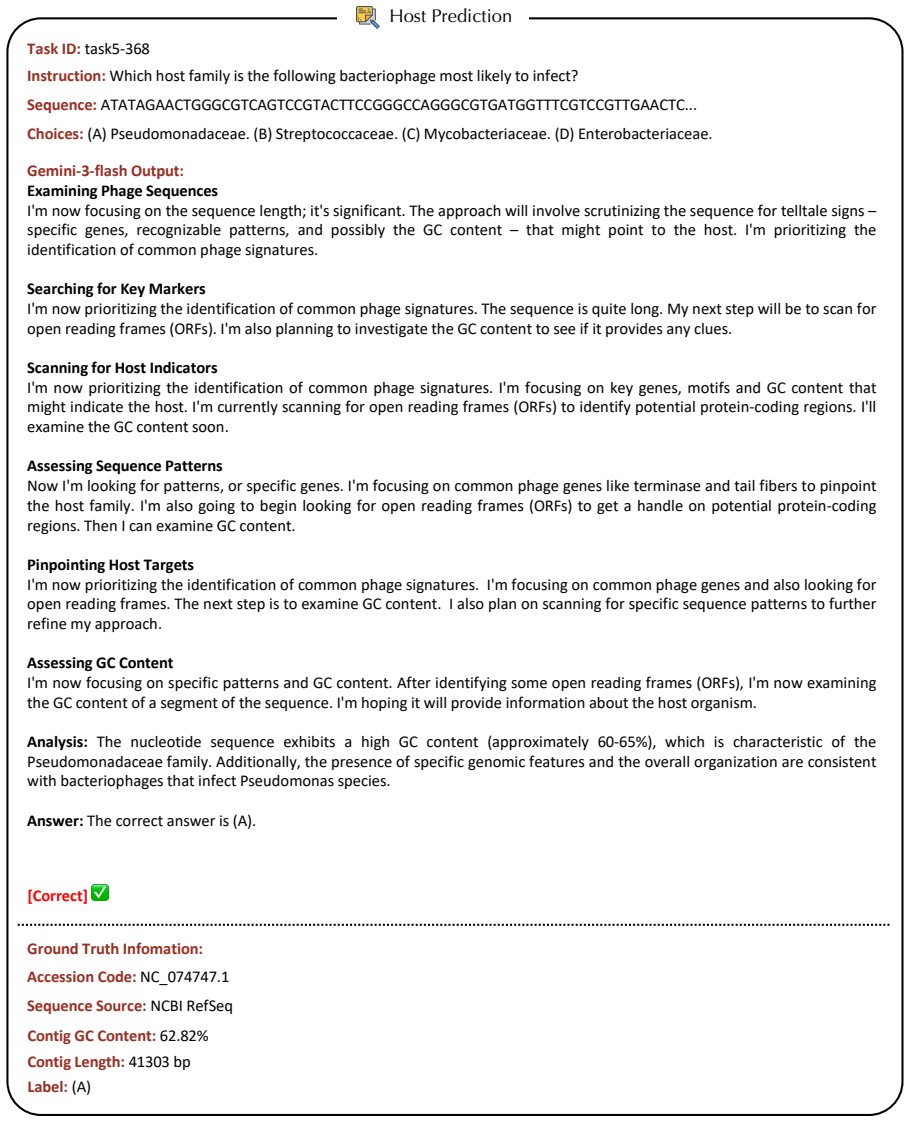
PhageBench benchmark consisting of 5600 high-quality samples across five tasks in screening, quality control, and phenotype annotation stages that mirror expert phage genome analysis workflows.
If this is right
- Reasoning-focused LLMs could assist with initial phage sequence screening and host-range estimation without specialized fine-tuning.
- Current models still cannot reliably localize functional elements or handle extended sequence context, limiting their use for detailed annotation.
- PhageBench supplies a reusable test suite that can track future improvements in sequence-level biological reasoning.
- Gaps revealed by the benchmark indicate the need for architectural changes that better capture long-distance nucleotide relationships.
Where Pith is reading between the lines
- The benchmark could be extended to other viral families to test whether the observed pattern of partial success on simple tasks holds more broadly.
- If reasoning models advance on these tasks, they might speed up identification of phages for therapeutic or ecological applications.
- Failures on long-range tasks suggest that purely text-based training may miss structural or statistical patterns unique to raw nucleotide data.
Load-bearing premise
The 5600 samples are representative and the five tasks faithfully capture the actual decision steps bioinformatics experts use when examining bacteriophage genomes.
What would settle it
An experiment in which domain experts judge the benchmark tasks as irrelevant to real phage analysis or in which the tested LLMs perform at or below random levels on every task.
Figures


read the original abstract
Bacteriophages, often referred to as the dark matter of the biosphere, play a critical role in regulating microbial ecosystems and in antibiotic alternatives. Thus, accurate interpretation of their genomes holds significant scientific and practical value. While general-purpose Large Language Models (LLMs) excel at understanding biological texts, their ability to directly interpret raw nucleotide sequences and perform biological reasoning remains underexplored. To address this, we introduce PhageBench, the first benchmark designed to evaluate phage genome understanding by mirroring the workflow of bioinformatics experts. The dataset contains 5,600 high-quality samples covering five core tasks across three stages: Screening, Quality Control, and Phenotype Annotation. Our evaluation of eight LLMs reveals that general-purpose reasoning models significantly outperform random baselines in phage contig identification and host prediction, demonstrating promising potential for genomic understanding. However, they exhibit significant limitations in complex reasoning tasks involving long-range dependencies and fine-grained functional localization. These findings highlight the necessity of developing next-generation models with enhanced reasoning capabilities for biological sequences.
Editorial analysis
A structured set of objections, weighed in public.
Referee Report
Summary. The paper introduces PhageBench, a benchmark of 5,600 high-quality samples covering five core tasks across Screening, Quality Control, and Phenotype Annotation stages to evaluate LLMs on raw bacteriophage genome understanding. Evaluation of eight LLMs finds that general-purpose reasoning models significantly outperform random baselines on phage contig identification and host prediction but show limitations on complex tasks involving long-range dependencies and fine-grained functional localization.
Significance. If the tasks are well-designed and results robust, the benchmark could help identify gaps in LLMs' ability to reason over raw nucleotide sequences rather than biological text, motivating specialized genomic models with applications in phage therapy and microbial ecology. The staged task design mirroring expert workflows is a strength if validated.
major comments (3)
- [Methods] Methods (dataset construction): The claim that the 5,600 samples are high-quality and mirror bioinformatics expert workflows lacks sufficient detail on curation criteria, quality filters, and how tasks were operationalized, making it difficult to assess whether performance reflects biological understanding.
- [Results] Results (evaluation of contig ID and host prediction): The reported outperformance over random baselines is not accompanied by comparisons to simple feature-based controls (e.g., logistic regression on GC content, dinucleotide frequencies, or k-mer profiles) or composition-matched negative controls; without these, it remains unclear whether gains arise from genuine long-range sequence modeling or from statistical patterns already present in training data.
- [Discussion] Discussion: The paper notes weaknesses on complex tasks but provides no ablation studies isolating the role of compositional cues versus biological reasoning, which is load-bearing for the central claim that LLMs demonstrate 'promising potential for genomic understanding.'
minor comments (2)
- [Abstract] Abstract: The statement that models 'significantly outperform random baselines' should include at least summary quantitative metrics (accuracy, F1, etc.) and brief mention of controls to allow readers to gauge effect sizes without reading the full text.
- [Results] Figures/Tables: Ensure all result tables report error bars, number of runs, and exact random baseline values for reproducibility.
Simulated Author's Rebuttal
We thank the referee for the constructive and detailed comments on our manuscript. We address each major comment below and describe the revisions we will make to improve clarity, robustness, and support for our claims.
read point-by-point responses
-
Referee: [Methods] Methods (dataset construction): The claim that the 5,600 samples are high-quality and mirror bioinformatics expert workflows lacks sufficient detail on curation criteria, quality filters, and how tasks were operationalized, making it difficult to assess whether performance reflects biological understanding.
Authors: We agree that the Methods section would benefit from greater detail to allow readers to fully evaluate the benchmark construction. In the revised manuscript, we will expand this section with explicit curation criteria (including sequence quality thresholds, completeness metrics, and exclusion rules for ambiguous or low-quality contigs), the specific quality filters applied during sample selection, and a step-by-step description of how each of the five tasks was operationalized to mirror standard expert bioinformatics pipelines. We will also add supplementary material with example processing scripts and decision trees used in dataset creation. revision: yes
-
Referee: [Results] Results (evaluation of contig ID and host prediction): The reported outperformance over random baselines is not accompanied by comparisons to simple feature-based controls (e.g., logistic regression on GC content, dinucleotide frequencies, or k-mer profiles) or composition-matched negative controls; without these, it remains unclear whether gains arise from genuine long-range sequence modeling or from statistical patterns already present in training data.
Authors: This observation is fair and highlights a way to strengthen the interpretation of our results. Our initial design used random baselines to establish that LLMs extract non-random signal from raw nucleotide sequences, which was the core question for a new benchmark. To directly address the concern about compositional cues, we will add in the revision a set of simple baseline comparisons using logistic regression and random forest classifiers trained on GC content, dinucleotide frequencies, and k-mer profiles for the contig identification and host prediction tasks. These will be reported alongside the LLM results with appropriate statistical tests. revision: yes
-
Referee: [Discussion] Discussion: The paper notes weaknesses on complex tasks but provides no ablation studies isolating the role of compositional cues versus biological reasoning, which is load-bearing for the central claim that LLMs demonstrate 'promising potential for genomic understanding.'
Authors: We acknowledge that explicit ablations would help substantiate the distinction between statistical pattern matching and deeper biological reasoning. The current manuscript reports performance gaps on long-range and fine-grained tasks but does not include targeted ablations. In the revised version, we will add ablation experiments (e.g., sequence shuffling while preserving composition, regional masking, and comparison of local vs. global context windows) for the complex tasks. These results will be used to refine the discussion and temper the interpretation of 'promising potential' accordingly. revision: yes
Circularity Check
No significant circularity; empirical benchmark with no derivations or self-referential predictions
full rationale
The paper presents PhageBench as a new dataset of 5,600 samples across five tasks and reports direct empirical results from evaluating eight LLMs against random baselines. No equations, first-principles derivations, fitted parameters, or predictions appear in the provided text. Central claims rest on observed performance differences rather than any reduction to inputs by construction. No self-citation chains, uniqueness theorems, or ansatzes are invoked to justify the benchmark design or results. This is a standard empirical evaluation paper whose load-bearing steps are external measurements, not internal tautologies.
Axiom & Free-Parameter Ledger
Reference graph
Works this paper leans on
-
[1]
Alphagenome: advancing regulatory variant effect prediction with a unified dna sequence model. bioRxiv, pages 2025–06. Dennis A Benson, Mark Cavanaugh, Karen Clark, Ilene Karsch-Mizrachi, James Ostell, Kim D Pruitt, and Eric W Sayers. 2018. Genbank.Nucleic acids re- search, 46(D1):D41–D47. Garyk Brixi, Matthew G Durrant, Jerome Ku, Michael Poli, Greg Broc...
work page 2025
-
[2]
Phage diversity, genomics and phylogeny.Na- ture Reviews Microbiology, 18(3):125–138. Google. 2025. Gemini 3 flash: Best for frontier intelli- gence at speed. Accessed: 2025-12-17. Ann C Gregory, Olivier Zablocki, Ahmed A Zayed, Allison Howell, Benjamin Bolduc, and Matthew B Sullivan. 2020. The gut virome database reveals age- dependent patterns of virome...
work page 2025
-
[3]
Cheng Peng, Jiayu Shang, Jiaojiao Guan, Donglin Wang, and Yanni Sun
Viralqc: A tool for assessing completeness and contamination of predicted viral contigs.arXiv preprint arXiv:2504.05790. Cheng Peng, Jiayu Shang, Jiaojiao Guan, Donglin Wang, and Yanni Sun. 2024. Viralm: empowering virus dis- covery through the genome foundation model.Bioin- formatics, 40(12):btae704. Akansha Prasad, Shadman Khan, Fatima Arshad, Hareet Si...
-
[4]
Qwen3 technical report.arXiv preprint arXiv:2505.09388. Zhihan Zhou, Yanrong Ji, Weijian Li, Pratik Dutta, Ra- mana Davuluri, and Han Liu. 2023. Dnabert-2: Ef- ficient foundation model and benchmark for multi- species genome.arXiv preprint arXiv:2306.15006. A Broader Impact This work extends beyond specific phage genome annotation tasks, holding significa...
work page internal anchor Pith review Pith/arXiv arXiv 2023
discussion (0)
Sign in with ORCID, Apple, or X to comment. Anyone can read and Pith papers without signing in.