Overview of Bayesian Solvers in EEG Distributed Source Models: Prior Selection, Algorithmic Implementation, and Depth Bias Reduction
Pith reviewed 2026-05-10 18:34 UTC · model grok-4.3
The pith
Depth-weighted priors from an extended SNR framework reduce systematic bias against deeper sources in Bayesian EEG source imaging.
A machine-rendered reading of the paper's core claim, the machinery that carries it, and where it could break.
Core claim
By extending the statistical signal-to-noise ratio framework, depth-weighted priors can be derived that explicitly compensate for the weaker contribution of deeper sources to scalp measurements; hierarchical Bayesian models equipped with these priors therefore produce more balanced reconstructions across cortical depths, as verified in simulation studies that vary source location while holding noise levels constant.
What carries the argument
Depth-weighted priors obtained by extending the statistical signal-to-noise ratio (SNR) framework, which rescales the prior variance for each source location according to how strongly that location projects onto the measurement electrodes.
If this is right
- Prior selection and depth weighting directly control the spatial accuracy of reconstructed source distributions.
- Hierarchical models that promote sparsity become more reliable for sources at varying depths once depth weighting is incorporated.
- Expectation-maximization and alternating optimization algorithms remain applicable after the priors are depth-weighted.
- Informed model design that accounts for depth-dependent signal strength is required for accurate depth-sensitive EEG source localization.
Where Pith is reading between the lines
- The same SNR-based weighting principle could be transferred to other linear inverse problems that exhibit depth or distance-dependent attenuation, such as MEG or diffuse optical tomography.
- If the derived weights prove stable across subjects, they could reduce the need for per-session hyperparameter searches in clinical pipelines.
- Real-data validation would require comparing reconstructions against intracranial recordings or known epileptic foci at different depths.
- The analytical connections drawn between hierarchical priors and classical regularizers suggest that depth weighting can be retrofitted into many existing non-Bayesian solvers.
Load-bearing premise
The depth weights obtained from the extended SNR framework will reduce bias in actual EEG recordings without introducing new artifacts or requiring data-specific retuning.
What would settle it
A controlled simulation or phantom experiment that places identical-strength sources at shallow and deep locations, then measures whether localization error and amplitude bias drop when the SNR-derived depth weights are included versus when they are omitted.
Figures




read the original abstract
Electroencephalography (EEG) source imaging aims to reconstruct the spatial distribution of neural activity within the brain from non-invasive scalp measurements. This inverse problem is severely ill-posed due to the low spatial resolution of EEG and the presence of measurement noise, necessitating robust regularization techniques. Bayesian approaches provide a principled framework for incorporating prior knowledge into the solution, where regularization naturally arises through prior distributions and their associated hyperparameters. In this work, we provide an overview of key Bayesian methods for EEG source imaging based on Gaussian, Laplace, and group Laplace priors, with particular emphasis on hierarchical models that promote sparsity. We analyze the connections between these hierarchical formulations and classical optimization techniques, and provide an analytical description of their implementation using expectation -maximization and alternating optimization algorithms. To address the issue of depth bias where deeper sources are systematically underestimated or mislocalized - we extend a statistical signal-to-noise ratio (SNR) framework to derive depth-weighted priors that account for differences in how strongly sources at different depths are reflected in the measurements. Finally, we illustrate the behaviour of the considered models through simulation studies involving sources at varying depths. The results highlight the impact of prior selection and depth weighting on reconstruction accuracy and demonstrate the importance of informed model design for depth-sensitive EEG source localization.
Editorial analysis
A structured set of objections, weighed in public.
Referee Report
Summary. The manuscript provides an overview of Bayesian approaches to the EEG distributed source localization inverse problem. It reviews Gaussian, Laplace, group Laplace, and hierarchical sparsity priors; analyzes their connections to classical optimization; supplies analytical EM and alternating-optimization implementations; extends a statistical SNR framework to construct depth-weighted priors that compensate for depth-dependent lead-field scaling; and illustrates the resulting reconstruction behavior via simulation studies with sources placed at varying cortical depths.
Significance. If the derivations and simulations hold, the work supplies a consolidated reference that links prior formulations to implementable algorithms and offers a concrete, literature-grounded method for depth-bias mitigation. The SNR-based weighting is a methodological increment that could be adopted by practitioners once its robustness is confirmed; the simulation illustrations usefully demonstrate sensitivity to prior choice.
major comments (2)
- [§4] §4 (SNR extension): the derivation of the depth weights from the per-source SNR statistic must be stated with an explicit formula (e.g., how the diagonal weighting matrix W_d is obtained from the lead-field columns and noise covariance) so that readers can reproduce the priors without additional assumptions; the current description leaves open whether the weights remain parameter-free or inherit tuning from the SNR threshold.
- [§5] §5 (simulation studies): the reported accuracy improvements for depth-weighted versus unweighted priors are presented qualitatively; quantitative metrics (localization error, dipole-moment correlation, or RMSE with standard deviations over repeated noise realizations) are required to substantiate the claim that depth weighting reliably reduces bias without introducing new artifacts.
minor comments (3)
- The abstract states that the implementations are 'analytical'; the main text should verify that every EM update and alternating step is fully closed-form or that any numerical sub-routine is clearly identified.
- [§2-3] Notation for the source covariance matrices in the hierarchical models should be aligned with the most common EEG literature (e.g., explicit distinction between the prior covariance and the posterior covariance) to ease cross-referencing.
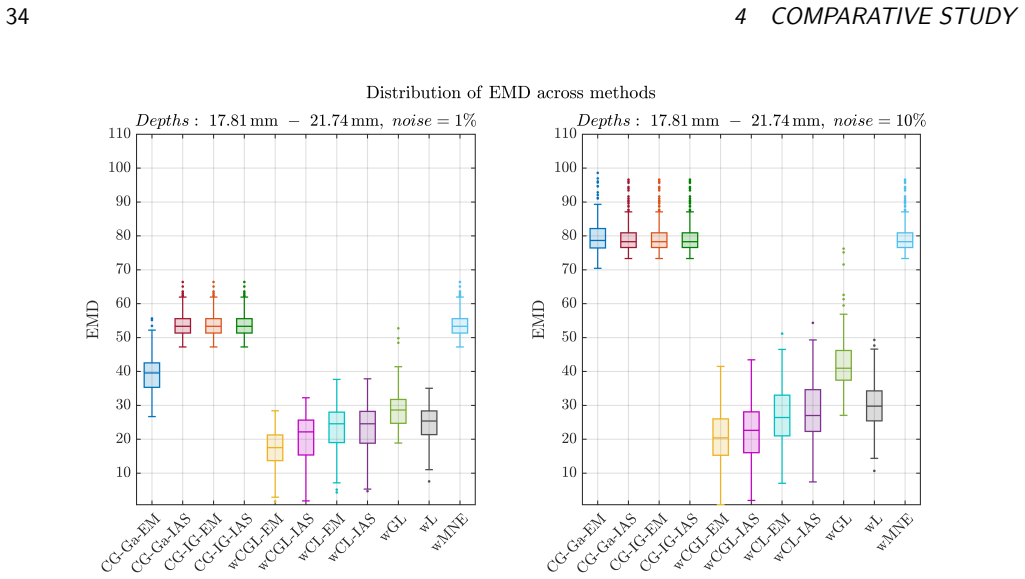
- [§5] Figure captions for the simulation results should include the exact depth values, SNR levels, and number of Monte-Carlo trials so that the visual comparisons can be interpreted quantitatively.
Simulated Author's Rebuttal
We thank the referee for the positive evaluation and the specific, constructive comments. We address each major point below and will revise the manuscript to incorporate the requested clarifications and quantitative analyses.
read point-by-point responses
-
Referee: [§4] §4 (SNR extension): the derivation of the depth weights from the per-source SNR statistic must be stated with an explicit formula (e.g., how the diagonal weighting matrix W_d is obtained from the lead-field columns and noise covariance) so that readers can reproduce the priors without additional assumptions; the current description leaves open whether the weights remain parameter-free or inherit tuning from the SNR threshold.
Authors: We agree that an explicit formula is required for full reproducibility. In the revised manuscript we will expand §4 with the complete derivation: the per-source SNR statistic is computed as SNR_j = ||L_{:j}||_2^2 / σ^2 (where L_{:j} denotes the j-th column of the lead-field matrix and σ^2 is the estimated noise variance), after which the diagonal depth-weighting matrix is obtained as W_d = diag(SNR_j^{-1/2}). This construction uses only the lead-field columns and the noise covariance; no additional SNR threshold or free parameters are introduced. The revised text will state this explicitly and confirm that the resulting priors remain parameter-free once the noise covariance has been estimated from the data. revision: yes
-
Referee: [§5] §5 (simulation studies): the reported accuracy improvements for depth-weighted versus unweighted priors are presented qualitatively; quantitative metrics (localization error, dipole-moment correlation, or RMSE with standard deviations over repeated noise realizations) are required to substantiate the claim that depth weighting reliably reduces bias without introducing new artifacts.
Authors: We acknowledge that the current simulation section emphasizes qualitative illustration. To provide rigorous substantiation, the revised §5 will report quantitative metrics: mean localization error, dipole-moment correlation coefficient, and RMSE, each accompanied by standard deviations computed over 50 independent noise realizations. These statistics will be tabulated for both depth-weighted and unweighted versions of the Gaussian, Laplace, and group-Laplace priors, allowing direct assessment of bias reduction and the absence of introduced artifacts. revision: yes
Circularity Check
No significant circularity identified
full rationale
The paper provides an overview of established Bayesian priors (Gaussian, Laplace, group Laplace, hierarchical sparsity) and their links to classical optimization, supplies analytical EM/alternating-optimization implementations, extends a pre-existing statistical SNR framework to derive depth-weighted priors, and uses simulations only to illustrate behavior on sources at varying depths. None of these steps reduce by construction to self-defined inputs, fitted parameters renamed as predictions, or load-bearing self-citations; the SNR extension and all core descriptions remain grounded in external literature and independent of the paper's own fitted values or simulation outcomes. The scoped claims are therefore self-contained.
Axiom & Free-Parameter Ledger
axioms (2)
- domain assumption Gaussian, Laplace, and group Laplace distributions serve as valid priors for promoting sparsity in distributed source models
- standard math Expectation-maximization and alternating optimization correctly implement the hierarchical Bayesian inference
Reference graph
Works this paper leans on
-
[1]
Abramowitz, M., & Stegun, I. A. (2002). Handbook of mathematical functions with formulas, graphs, and mathematical tables (partially mathcad-enabled) . U.S. Department of Commerce, NIST. Antonakakis, M., Schrader, S., Wollbrink, A., Oostenveld, R., Rampp, S., Haueisen, J., & Wolters, C. H. (2019). The effect of stimulation type, head modeling, and combine...
work page 2002
-
[2]
The method of the approximate inverse for atmo- spheric tomography
Badia, A. E., & Duong, T. H. (1998). Some remarks on the problem of source identification from boundary measurements. Inverse Problems , 14(4), 883–891. https://doi.org/10.1088/0266- 5611/14/4/008 Baillet, S., Mosher, J. C., & Leahy, R. M. (2001). Electromagnetic brain mapping. IEEE Signal Processing Magazine, 18, 14–30. https://doi.org/10.1109/79.962275 ...
-
[3]
A., Strohmeier, D., Brodbeck, C., Parkkonen, L., & Hämäläinen, M
https://doi.org/10.1088/0031-9155/57/7/1937 Gramfort, A., Luessi, M., Larson, E., Engemann, D. A., Strohmeier, D., Brodbeck, C., Parkkonen, L., & Hämäläinen, M. S. (2014). Mne software for processing meg and eeg data. NeuroImage, 86, 446–460. https://doi.org/10.1016/j.neuroimage.2013.10.027 Hämäläinen, M., Hari, R., Ilmoniemi, R. J., Knuutila, J., & Louna...
-
[4]
Springer Science & Business Media. Joergensen, B. (1982). Statistical properties of the generalized inverse gaussian distribution (1st ed., Vol. 9). Springer. Kaipio, J. P., & Somersalo, E. (2004). Statistical and computational inverse problems . Springer. Kaipio, J., & Somersalo, E. (2007). Statistical inverse problems: Discretization, model reduction an...
-
[5]
Proceedings of the 18th Annual International Conference of the IEEE , 2, 812–813 vol.2
Bridging Disciplines for Biomedicine. Proceedings of the 18th Annual International Conference of the IEEE , 2, 812–813 vol.2. https://doi.org/10.1109/IEMBS.1996.651989 Koulouri, A. (2015). Reconstruction of bio-electric fields and source distributions in eeg brain imaging [Doctoral dissertation, Imperial College London]. https://spiral.imperial.ac.uk/hand...
-
[6]
Skudlarski, P., Jagannathan, K., Calhoun, V. D., Hampson, M., Skudlarska, B. A., & Pearlson, G. (2008). Measuring brain connectivity: Diffusion tensor imaging validates resting state temporal correlations. NeuroImage (Orlando, Fla.) , 43(3), 554–561. Sorrentino, A., Luria, G., & Aramini, R. (2014). Bayesian multi-dipole modelling of a single topography in...
discussion (0)
Sign in with ORCID, Apple, or X to comment. Anyone can read and Pith papers without signing in.