The 't Hooft loop from a center-vortex wave functional
Pith reviewed 2026-05-10 19:40 UTC · model grok-4.3
The pith
The center-vortex peaked infrared vacuum wave functional yields a perimeter law for the spatial 't Hooft loop.
A machine-rendered reading of the paper's core claim, the machinery that carries it, and where it could break.
Core claim
Using the infrared vacuum wave functional peaked at thin center vortices, the authors evaluate the spatial 't Hooft loop and obtain a perimeter law, in accordance with 't Hooft's criterion for confinement.
What carries the argument
The infrared vacuum wave functional for SU(N) Yang-Mills theory peaked at thin center vortices, applied to the expectation value of the spatial 't Hooft loop operator.
Load-bearing premise
The infrared vacuum wave functional previously proposed and peaked at thin center vortices remains a sufficiently accurate approximation when applied to the 't Hooft loop observable.
What would settle it
A computation with this wave functional that instead produces an area law for the spatial 't Hooft loop would falsify the claimed perimeter-law result.
Figures
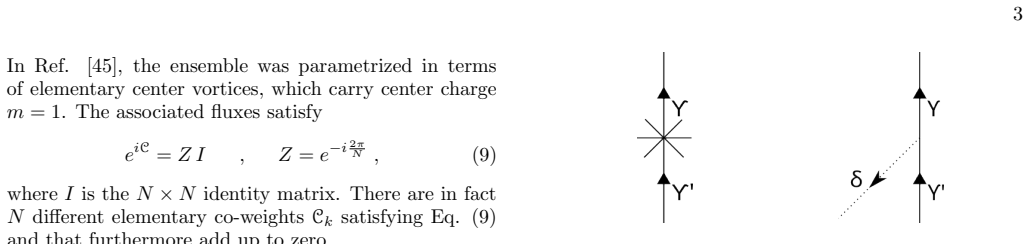
read the original abstract
Previously, we proposed an infrared vacuum wave functional for $SU(N)$ Yang-Mills theory peaked at thin center vortices and showed that it yields an area law for the Wilson loop. In this work, we use this wave functional to calculate the spatial 't Hooft loop, for which we find a perimeter law, in accordance with 't Hooft's criterion for confinement.
Editorial analysis
A structured set of objections, weighed in public.
Referee Report
Summary. The manuscript extends the authors' prior proposal of an infrared vacuum wave functional for SU(N) Yang-Mills theory peaked at thin center vortices. Using this functional, the spatial 't Hooft loop is evaluated and found to obey a perimeter law, consistent with 't Hooft's confinement criterion and complementary to the area law previously obtained for the Wilson loop with the same ansatz.
Significance. If the calculation is accurate, the result supplies direct evidence that a single center-vortex-peaked variational wave functional can simultaneously reproduce the infrared behaviors required by 't Hooft's criterion for both the Wilson loop (area law) and the 't Hooft loop (perimeter law). This strengthens the center-vortex picture of confinement within a controlled variational framework and offers a concrete, parameter-free realization of the expected loop behaviors. The approach is noteworthy for its direct reuse of the earlier functional without introducing new fitting parameters.
minor comments (2)
- [Abstract] Abstract: the statement that a perimeter law is obtained would benefit from a one-sentence indication of the main technical step (e.g., the form of the expectation value or the approximation employed) so that readers can immediately gauge the scope of the derivation.
- [Introduction or Section 2] The wave functional is referenced repeatedly from prior work; a brief self-contained recap of its explicit functional form (including any cutoff or smearing parameters) in the present manuscript would improve readability without lengthening the text substantially.
Simulated Author's Rebuttal
We thank the referee for their positive assessment of the manuscript, including the summary of our results on the spatial 't Hooft loop and the significance attributed to the center-vortex wave functional. The recommendation for minor revision is noted. No specific major comments were provided in the report.
Circularity Check
Minor self-citation for input model; new calculation is independent
full rationale
The paper takes its infrared vacuum wave functional (peaked at thin center vortices) from prior work by the same authors, where it was shown to produce an area law for the Wilson loop, and applies it to evaluate the spatial 't Hooft loop operator, obtaining a perimeter law. This constitutes a direct computation of a new observable using the established model rather than any redefinition, refitting, or reduction of the output to the input by construction. The self-citation supplies the starting wave functional but does not bear the load of the perimeter-law result itself; the derivation chain for the new claim consists of the explicit operator evaluation in the given state. No self-definitional steps, fitted-input predictions, ansatz smuggling, or uniqueness theorems imported from the authors' own prior work are present in the abstract or described structure. The paper is therefore self-contained in its new derivation against the external benchmark of 't Hooft's confinement criterion.
Axiom & Free-Parameter Ledger
Lean theorems connected to this paper
-
IndisputableMonolith/Foundation/AlexanderDuality.leanalexander_duality_circle_linking unclear?
unclearRelation between the paper passage and the cited Recognition theorem.
we use this wave functional to calculate the spatial 't Hooft loop, for which we find a perimeter law, in accordance with 't Hooft's criterion for confinement
-
IndisputableMonolith/Cost/FunctionalEquation.leanwashburn_uniqueness_aczel unclear?
unclearRelation between the paper passage and the cited Recognition theorem.
effective field theory representation ... scalar fields ϕ_k ... V(Φ) = λ/2 Tr(Φ†Φ−a²I)² ...
What do these tags mean?
- matches
- The paper's claim is directly supported by a theorem in the formal canon.
- supports
- The theorem supports part of the paper's argument, but the paper may add assumptions or extra steps.
- extends
- The paper goes beyond the formal theorem; the theorem is a base layer rather than the whole result.
- uses
- The paper appears to rely on the theorem as machinery.
- contradicts
- The paper's claim conflicts with a theorem or certificate in the canon.
- unclear
- Pith found a possible connection, but the passage is too broad, indirect, or ambiguous to say the theorem truly supports the claim.
Reference graph
Works this paper leans on
-
[1]
we introduced a scalar potentialζ, which contributes to the magnetic field in the form B=∇ ×A− ∇ζ .(14) We constructed then a wave functional that is peaked at the possible realizations of oriented and nonoriented collimated magnetic fluxes and is explicitly given by Ψ(A, ζ) = X {γ} ψ{γ}δ(A−a({γ}))δ(ζ−b({γ})).(15) Here b(x,{γ}) = (−∆) −1∇ · B(x,{γ}) (16) ...
work page 2023
- [2]
- [4]
- [5]
- [6]
- [7]
- [8]
- [9]
- [10]
-
[11]
H. B. Nielsen and P. Olesen, Nucl. Phys. B 160 (1979) 380
work page 1979
- [12]
- [13]
-
[14]
K. Langfeld, H, Reinhardt and O. Tennert, Phys. Lett. B 419 (1998) 317
work page 1998
- [15]
-
[16]
J. Gattnar, C. Gattringer, K. Langfeld, H. Reinhardt, A. Schafer, S. Solbrig and T. Tok, Nucl. Phys. B 716 (2005) 105
work page 2005
-
[17]
R. H¨ ollwieser, T. Schweigler, M. Faber, and U. M. Heller, Phys. Rev. D 88 (2013) 114505
work page 2013
- [18]
- [19]
- [20]
- [21]
- [22]
-
[23]
M Engelhardt,K. Langfeld, H. Reinhardt, O Tennert, Phys. Rev. D 61 (2000) 054504
work page 2000
- [24]
- [25]
-
[26]
J. A. Mickley, W. Kamleh, D. B. Leinweber, Phys. Rev. D 110 (2024) 034516
work page 2024
-
[27]
L. E. Oxman, Phys. Rev. D 98 (2018) 036018
work page 2018
-
[28]
L. E. Oxman and D. Vercauteren, Phys. Rev. D 95 (2017) 025001
work page 2017
-
[29]
D. R. Junior, L. E. Oxman and G. M. Sim˜ oes, Phys. Rev. D 102 (2020) 074005
work page 2020
-
[30]
D. R. Junior, L. E. Oxman and G. M. Sim˜ oes, Phys. Rev. D 108 (2023) 094021
work page 2023
-
[31]
L. E. Oxman and G. M. Sim˜ oes, Phys. Rev. D 99 (2019) 016011
work page 2019
-
[32]
P. Cea, L. Cosmai, and A. Papa, Phys. Rev. D 95 (2017) 114511
work page 2017
-
[33]
R. Yanagihara, T. Iritani, M. Kitazawa, M. Asakawa, and T. Hatsuda, Phys. Lett. B 789 (2019) 210
work page 2019
-
[34]
R. Yanagihara and M. Kitazawa, Prog. Theor. Exp. Phys. 9 (2019) 093B02; Erratum in Prog. Theor. Exp. Phys. 7 (2020) 079201
work page 2019
- [35]
- [36]
-
[37]
D. R. Junior, L. E. Oxman, and G. M. Sim˜ oes, J. High Energ. Phys. 2020 (2020) 180
work page 2020
- [38]
- [39]
- [40]
- [41]
-
[42]
G. S. Bali, Phys. Rev. D 62 (2000) 114503
work page 2000
- [43]
-
[44]
J. Greensite, K. Langfeld, S. Olejn´ ık, H. Reinhardt, and T. Tok, Phys. Rev. D 75 (2007) 034501
work page 2007
-
[45]
D. R. Junior, L. E. Oxman, and G. M. Sim˜ oes, Universe 7 (2021) 253
work page 2021
-
[46]
D. R. Junior, L. E. Oxman, and H. Reinhardt, Phys. Rev. D 106 (2022) 114021
work page 2022
-
[47]
D. R. Junior and L. E. Oxman, Phys. Rev. D 111 (2025) 054036
work page 2025
-
[48]
J. Ambjorn, J. Giedt, and J. Greensite, J. High Energy Phys. 02 (2000) 033
work page 2000
-
[49]
L. E. Oxman, JHEP 03 (2013) 038
work page 2013
- [50]
-
[51]
M. Engelhardt, K. Langfeld, H. Reinhardt, O. Tennert, Phys. Lett. B 431 (1998) 141
work page 1998
-
[52]
L. E. Oxman, H. Reinhardt, Eur. Phys. J. C 78 (2018) 177
work page 2018
-
[54]
H. Kleinert, Path Integrals in Quantum Mechanics, Stat- ics, Polymer Physics, and Financial Markets (World Sci- entific, Singapore, 2006)
work page 2006
- [55]
- [56]
-
[57]
A. M. Polyakov, Nucl. Phys. B 164 (1980) 171
work page 1980
-
[58]
A. L. L. de Lemos, L. E. Oxman, and B. F. I. Teixeira, Phys. Rev. D 85 (2012) 125014
work page 2012
- [59]
discussion (0)
Sign in with ORCID, Apple, or X to comment. Anyone can read and Pith papers without signing in.