The Evolution of Star-Forming Gas in STARFORGE: From Clouds, to Cores, to Stars
Pith reviewed 2026-05-10 18:42 UTC · model grok-4.3
The pith
Once a protostar forms, the remaining gas lifetime scales directly with the star's final mass, from under 1 Myr for low-mass stars to over 3 Myr for high-mass ones.
A machine-rendered reading of the paper's core claim, the machinery that carries it, and where it could break.
Core claim
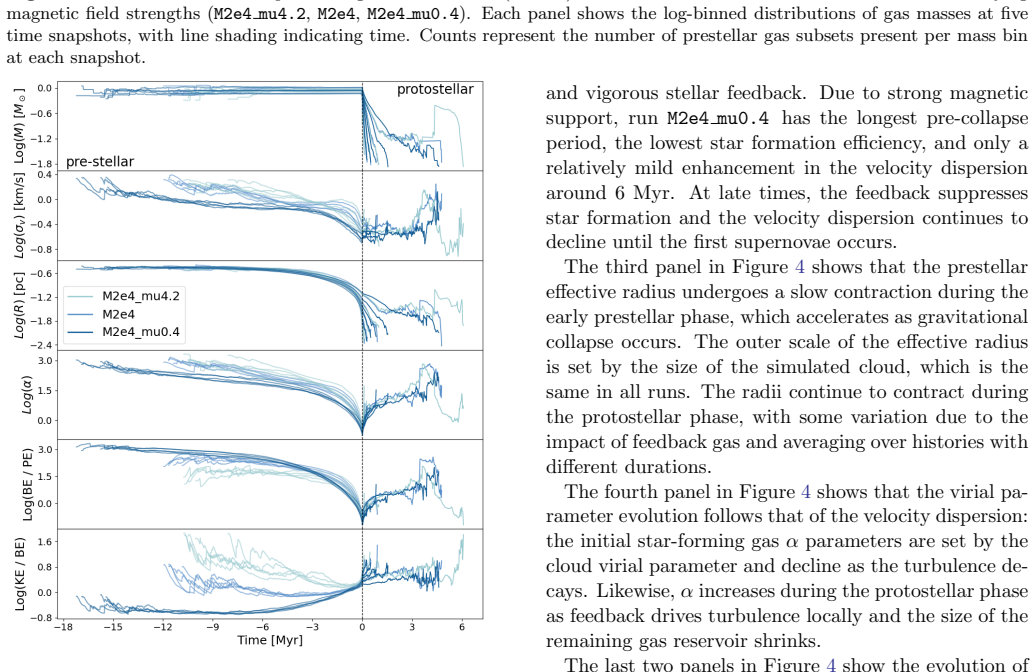
Once a protostar forms, the lifetime of the unaccreted gas correlates with the final stellar mass: low-mass stars (M_* < 0.5 M_⊙) accrete for 0.5-0.6 Myr from a relatively local reservoir, while high-mass stars (M_* > 2 M_⊙) accrete over 3.3-4.7 Myr from a much larger volume. The radii, velocity dispersions, virial parameters, and magnetic energy ratios of the accreting gas remain largely insensitive to the global cloud properties, including magnetic field strength. At protostar formation the gas already obeys linewidth-size and mass-size relations characteristic of turbulently regulated dense cores, and low- to intermediate-mass accretion histories fit standard models while many high-mass,
What carries the argument
Lagrangian cell tracking that follows individual gas parcels from giant molecular clouds through dense cores and onto protostars in the STARFORGE simulation suite.
If this is right
- Low- and intermediate-mass stars show relatively continuous accretion that matches isothermal-sphere, turbulent-core, or competitive-accretion models.
- Many high-mass stars exhibit intermittent accretion that fits none of the standard models.
- The star-forming gas obeys the same linewidth-size relation and mass-size relation as observed dense cores even though it is more spatially extended than classically defined cores.
- Accretion time increases only weakly with magnetic field strength while other gas properties stay insensitive to it.
Where Pith is reading between the lines
- The mass-dependent accretion timescales suggest that the final stellar mass is already encoded in the spatial extent of the reservoir available at protostar formation.
- Because gas properties are regulated by turbulence and feedback rather than global cloud parameters, core observations might be used to predict whether a forming star will remain low-mass or grow into a high-mass object.
- The mismatch for high-mass accretion histories implies that additional physics such as episodic outflows or dynamical interactions must be included in analytic models to describe massive-star growth.
Load-bearing premise
The Lagrangian tracking accurately follows the physical motion and state of gas parcels without major numerical artifacts, and the three chosen clouds with different magnetic fields are representative of typical conditions.
What would settle it
An observation or higher-resolution simulation in which the unaccreted gas around high-mass protostars is depleted on timescales shorter than 3 Myr or drawn from volumes no larger than those around low-mass protostars would contradict the reported mass-dependent lifetimes and volume scaling.
Figures




read the original abstract
Star formation occurs within dense regions of giant molecular clouds (GMCs), however, exactly how gas collects and evolves to form individual stars and what role dense cores play remains unclear. We use the Lagrangian cell information in the STARFORGE simulation suite to track star-forming gas in three GMCs with varying magnetic field strengths. We find that, once a protostar forms, the lifetime of the unaccreted gas correlates with the final stellar mass, where low-mass stars ($M_*$ < 0.5 M$_\odot$) accrete for 0.5-0.6 Myr from a relatively local reservoir of gas, and high-mass stars ($M_*$ > 2 M$_\odot$) accrete over 3.3-4.7 Myr from a much larger volume. Although the protostellar accretion time increases weakly with magnetic field strength, the accreting gas radii, velocity dispersions, virial parameters, and magnetic energy ratios are largely insensitive to the global cloud properties. At the time of protostar formation, the unaccreted gas exhibits linewidth-size and mass-size relations characteristic of turbulently regulated, isothermal dense cores, following $\sigma_v \propto R^{0.47-0.55}$ and $M \propto R^{1.0-1.1}$, respectively. Low- and intermediate-mass stars undergo relatively continuous accretion and their accretion histories are well-fit by either isothermal sphere, turbulent core, or competitive accretion models, where no one model fits all masses. However, many high-mass stars experience intermittent accretion and their accretion histories are not well-fit by any of these models. While the distribution of accreting gas is more extended than typically-defined dense cores, the physical properties and structure of the star-forming gas resemble those of observed cores and are largely regulated by turbulence and feedback.
Editorial analysis
A structured set of objections, weighed in public.
Referee Report
Summary. The manuscript uses Lagrangian cell tracking in the STARFORGE simulation suite to follow star-forming gas across three giant molecular clouds with varying initial magnetic field strengths. It reports a correlation between the lifetime of unaccreted gas after protostar formation and final stellar mass: low-mass stars (M_* < 0.5 M_⊙) accrete over 0.5-0.6 Myr from a local reservoir, while high-mass stars (M_* > 2 M_⊙) accrete over 3.3-4.7 Myr from a larger volume. Accreting gas properties (radii, velocity dispersions, virial parameters, magnetic energy ratios) are largely insensitive to global cloud conditions. At protostar formation, the gas follows linewidth-size (σ_v ∝ R^{1.0-1.1}) and mass-size (M ∝ R^{0.47-0.55}) relations characteristic of turbulently regulated isothermal dense cores. Accretion histories for low- and intermediate-mass stars are well-fit by isothermal sphere, turbulent core, or competitive accretion models, but high-mass stars show intermittent accretion not captured by these models. The distribution of accreting gas is more extended than typical dense cores, yet its properties are regulated by turbulence and feedback.
Significance. If the central results hold after addressing the noted limitations, the work would provide a valuable direct link between cloud-scale simulations and the properties of star-forming gas at core scales. The Lagrangian tracking approach is a clear strength, enabling measurement of accretion timescales and histories without reliance on fitted parameters that could introduce circularity. The finding that local gas properties are largely insensitive to magnetic field variations (within the explored range) and the mass-dependent differences in accretion continuity offer concrete, observationally testable predictions. The reproduction of observed core scaling relations from the simulations further strengthens the connection to empirical data.
major comments (2)
- The claim that accreting gas radii, velocity dispersions, virial parameters, and magnetic energy ratios are largely insensitive to global cloud properties (stated in the abstract and results) rests on simulations that vary only the initial magnetic field strength across three otherwise similar GMCs. No independent variations of initial turbulence, density profile, or total cloud mass are performed, so the broader conclusion of insensitivity to global conditions is not fully supported and risks overgeneralization from the limited parameter space explored.
- The analysis depends on Lagrangian cell tracking to define the unaccreted gas reservoir, its lifetime, and accretion history, yet the manuscript provides no resolution study or validation against numerical artifacts such as diffusion, outflow entrainment, cell splitting/merging, or feedback-induced mixing. This is especially relevant for the intermittent accretion reported in high-mass stars, where such effects could systematically affect the measured timescales, volumes, and derived properties.
minor comments (2)
- The abstract quotes specific numerical ranges for accretion times (0.5-0.6 Myr and 3.3-4.7 Myr) and scaling exponents without referencing the figures or tables that display the underlying distributions, sample sizes, or uncertainties; adding these cross-references would improve traceability.
- The exact operational definition of the 'unaccreted gas' reservoir (e.g., how the volume is delimited in the Lagrangian tracking and what density or velocity thresholds are applied) should be stated more explicitly in the methods to allow reproducibility.
Simulated Author's Rebuttal
We thank the referee for their detailed and constructive report. We address the major comments below and have made revisions to the manuscript to clarify the scope of our conclusions and to discuss potential numerical limitations.
read point-by-point responses
-
Referee: The claim that accreting gas radii, velocity dispersions, virial parameters, and magnetic energy ratios are largely insensitive to global cloud properties (stated in the abstract and results) rests on simulations that vary only the initial magnetic field strength across three otherwise similar GMCs. No independent variations of initial turbulence, density profile, or total cloud mass are performed, so the broader conclusion of insensitivity to global conditions is not fully supported and risks overgeneralization from the limited parameter space explored.
Authors: We agree that our simulations vary only the initial magnetic field strength while keeping other GMC properties similar. The original wording in the abstract and results sections could be interpreted as claiming insensitivity to all global properties, which overgeneralizes our findings. We have revised the abstract to state that these properties 'are largely insensitive to variations in the initial magnetic field strength' and added a sentence in the discussion noting that exploring other parameters like turbulence or cloud mass would be valuable for future work. This revision maintains the validity of our results within the explored parameter space. revision: partial
-
Referee: The analysis depends on Lagrangian cell tracking to define the unaccreted gas reservoir, its lifetime, and accretion history, yet the manuscript provides no resolution study or validation against numerical artifacts such as diffusion, outflow entrainment, cell splitting/merging, or feedback-induced mixing. This is especially relevant for the intermittent accretion reported in high-mass stars, where such effects could systematically affect the measured timescales, volumes, and derived properties.
Authors: This is a valid concern. While the STARFORGE suite has undergone extensive resolution and convergence tests in prior publications regarding overall star formation outcomes, we did not include a specific resolution study for the Lagrangian tracking analysis in this work. We have added a paragraph in the Methods section acknowledging potential numerical effects, including diffusion and mixing due to feedback, and noting that the intermittent accretion in high-mass stars may be influenced by these. We emphasize that the core trends (mass-dependent lifetimes and core-like scaling relations) are robust, but future higher-resolution runs could further validate the details of accretion histories. revision: partial
Circularity Check
No circularity: direct Lagrangian tracking yields empirical measurements of accretion lifetimes and gas properties without reduction to fitted inputs or self-definitions.
full rationale
The paper extracts accretion timescales, radii, velocity dispersions, virial parameters, and scaling relations directly from Lagrangian cell tracking in the STARFORGE simulation outputs. These are post-processing measurements on existing simulation data, not quantities derived by fitting parameters that are then re-used as predictions. The insensitivity to global conditions is a direct comparison across the three runs (varying only B-field), and the model comparisons for accretion histories are goodness-of-fit tests rather than derivations. Self-citations to prior STARFORGE work describe the simulation setup and are not load-bearing for the new tracking results. No step reduces a claimed result to a definition or input by construction.
Axiom & Free-Parameter Ledger
free parameters (1)
- Initial magnetic field strength
axioms (2)
- domain assumption The STARFORGE simulations correctly capture the relevant physics of star formation including turbulence, magnetic fields, and stellar feedback.
- domain assumption Lagrangian cell information accurately follows the physical motion and accretion of gas parcels without significant numerical diffusion.
Lean theorems connected to this paper
-
IndisputableMonolith/Cost/FunctionalEquation.leanwashburn_uniqueness_aczel unclear?
unclearRelation between the paper passage and the cited Recognition theorem.
the accreting gas radii, velocity dispersions, virial parameters, and magnetic energy ratios are largely insensitive to the global cloud properties... σ_v ∝ R^{1.0-1.1} and M ∝ R^{0.47-0.55}
-
IndisputableMonolith/Foundation/AbsoluteFloorClosure.leanabsolute_floor_iff_bare_distinguishability unclear?
unclearRelation between the paper passage and the cited Recognition theorem.
Lagrangian cell information in the STARFORGE simulation suite to track star-forming gas in three GMCs with varying magnetic field strengths
What do these tags mean?
- matches
- The paper's claim is directly supported by a theorem in the formal canon.
- supports
- The theorem supports part of the paper's argument, but the paper may add assumptions or extra steps.
- extends
- The paper goes beyond the formal theorem; the theorem is a base layer rather than the whole result.
- uses
- The paper appears to rely on the theorem as machinery.
- contradicts
- The paper's claim conflicts with a theorem or certificate in the canon.
- unclear
- Pith found a possible connection, but the passage is too broad, indirect, or ambiguous to say the theorem truly supports the claim.
discussion (0)
Sign in with ORCID, Apple, or X to comment. Anyone can read and Pith papers without signing in.