Scoring Edit Impact in Grammatical Error Correction via Embedded Association Graphs
Pith reviewed 2026-05-10 18:28 UTC · model grok-4.3
The pith
An embedded association graph scores the impact of each edit in grammatical error correction by grouping dependent changes and measuring their effect on sentence fluency via perplexity.
A machine-rendered reading of the paper's core claim, the machinery that carries it, and where it could break.
Core claim
The central claim is that constructing an embedded association graph captures latent dependencies among edits and syntactically related edits, enabling their grouping into coherent clusters whose perplexity-based scores reliably estimate each edit's contribution to sentence fluency, yielding more accurate automatic impact scoring than existing approaches.
What carries the argument
The embedded association graph, which models latent dependencies among edits to form groups for perplexity-based scoring of individual edit contributions.
If this is right
- The framework supplies a scalable automatic alternative to human meta-evaluation for assessing GEC edit quality across diverse correction scenarios.
- It delivers consistent performance gains over baselines on four datasets, four languages, and four GEC systems.
- Further checks demonstrate that the graph identifies structural dependencies among edits that hold across languages.
Where Pith is reading between the lines
- GEC system developers could prioritize training data or model attention on edit types the scores flag as high-impact for fluency.
- The grouping and scoring approach could transfer to measuring edit effects in related tasks such as machine translation post-editing or text style transfer.
- Educational tools might incorporate these scores to give learners targeted feedback on which corrections matter most.
Load-bearing premise
The graph correctly identifies groups of dependent edits so that perplexity differences accurately reflect each edit's real contribution to fluency.
What would settle it
Human raters independently ranking edit importance on a held-out set of GEC outputs where the method's perplexity scores show no better correlation with those rankings than random baselines.
Figures


read the original abstract
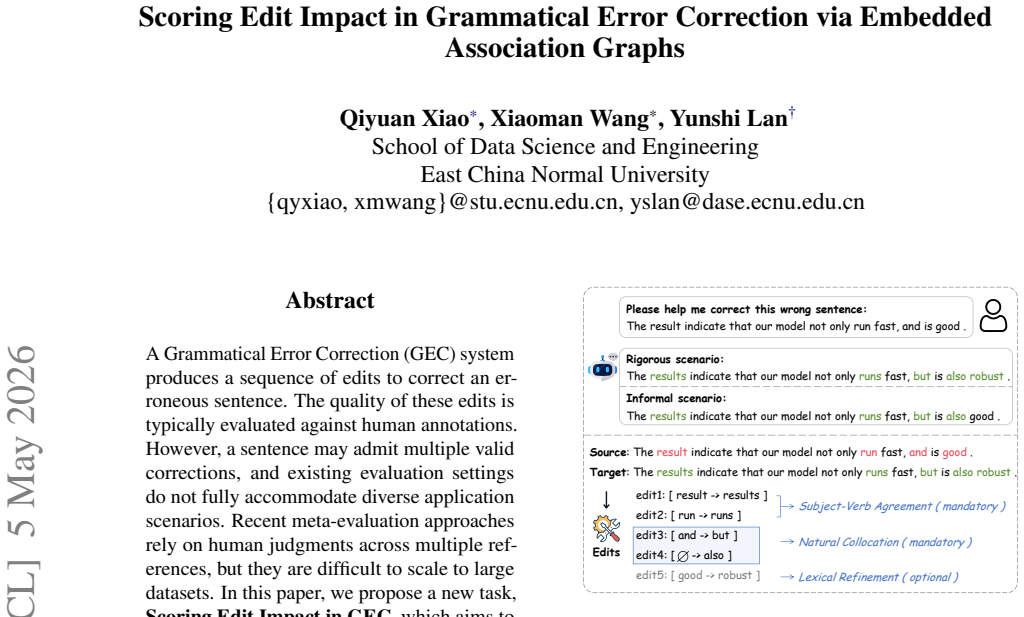
A Grammatical Error Correction (GEC) system produces a sequence of edits to correct an erroneous sentence. The quality of these edits is typically evaluated against human annotations. However, a sentence may admit multiple valid corrections, and existing evaluation settings do not fully accommodate diverse application scenarios. Recent meta-evaluation approaches rely on human judgments across multiple references, but they are difficult to scale to large datasets. In this paper, we propose a new task, Scoring Edit Impact in GEC, which aims to automatically estimate the importance of edits produced by a GEC system. To address this task, we introduce a scoring framework based on an embedded association graph. The graph captures latent dependencies among edits and syntactically related edits, grouping them into coherent groups. We then perform perplexity-based scoring to estimate each edit's contribution to sentence fluency. Experiments across 4 GEC datasets, 4 languages, and 4 GEC systems demonstrate that our method consistently outperforms a range of baselines. Further analysis shows that the embedded association graph effectively captures cross-linguistic structural dependencies among edits.
Editorial analysis
A structured set of objections, weighed in public.
Referee Report
Summary. The paper introduces a new task of Scoring Edit Impact in Grammatical Error Correction (GEC), which aims to automatically estimate the importance of individual edits produced by GEC systems. It proposes a framework based on an embedded association graph that captures latent dependencies among edits and syntactically related edits, grouping them into coherent clusters, followed by perplexity-based scoring using external language models to quantify each edit's contribution to overall sentence fluency. The authors report experiments across 4 GEC datasets, 4 languages, and 4 GEC systems demonstrating consistent outperformance over baselines, along with analysis indicating that the graph effectively captures cross-linguistic structural dependencies.
Significance. If the experimental claims hold and the method proves reproducible, this work could be significant for the GEC field by offering a scalable, reference-free approach to meta-evaluation that accommodates multiple valid corrections without relying on extensive human judgments. The dependency-capturing aspect via association graphs may also enable finer-grained analysis of how edits interact to affect fluency, potentially informing better GEC system design.
major comments (2)
- Abstract: the claim that experiments 'demonstrate that our method consistently outperforms a range of baselines' is presented without any quantitative results, tables, ablation studies, statistical significance tests, or error analysis, which are load-bearing for the central empirical claim and prevent verification of the reported gains.
- Abstract: the embedded association graph, grouping procedure, and perplexity-based scoring are described at a high level with no equations, pseudocode, implementation details, or parameter specifications, making it impossible to assess the technical soundness or reproducibility of the core method.
Simulated Author's Rebuttal
We thank the referee for their constructive feedback. We address each major comment below and outline revisions to the abstract that strengthen support for our empirical claims while preserving its conventional role as a concise overview.
read point-by-point responses
-
Referee: Abstract: the claim that experiments 'demonstrate that our method consistently outperforms a range of baselines' is presented without any quantitative results, tables, ablation studies, statistical significance tests, or error analysis, which are load-bearing for the central empirical claim and prevent verification of the reported gains.
Authors: We agree that the abstract would benefit from quantitative support for the outperformance claim. The full manuscript already contains the requested elements—detailed results tables, ablation studies, statistical significance tests, and error analysis—in the Experiments and Analysis sections. We will revise the abstract to incorporate brief quantitative highlights (e.g., average gains across the four datasets, languages, and systems) to better ground the claim without violating length conventions. revision: yes
-
Referee: Abstract: the embedded association graph, grouping procedure, and perplexity-based scoring are described at a high level with no equations, pseudocode, implementation details, or parameter specifications, making it impossible to assess the technical soundness or reproducibility of the core method.
Authors: We acknowledge the abstract's high-level presentation. Abstracts are designed for accessibility and conventionally omit equations, pseudocode, and full implementation details. The complete technical specification—including graph construction, embedding, grouping procedure, perplexity scoring, equations, pseudocode, and parameter values—is provided in the Proposed Method section. We will revise the abstract to include a slightly more precise description of the framework components and add explicit pointers to the detailed sections for reproducibility. revision: partial
Circularity Check
No significant circularity in the derivation chain
full rationale
The scoring framework constructs an embedded association graph from latent edit dependencies and syntactically related edits as an independent modeling step, then applies perplexity scoring drawn from external language models to estimate fluency contributions. No equations, procedures, or self-citations in the provided description reduce the edit impact scores to quantities defined by parameters fitted inside the same experiment or by construction. The graph grouping and perplexity evaluation are presented as separate from the final validation against baselines, with no self-definitional loops, fitted-input predictions, or load-bearing self-citations. The derivation remains self-contained against external benchmarks.
Axiom & Free-Parameter Ledger
axioms (1)
- domain assumption Edits produced by GEC systems exhibit latent dependencies and syntactic relations that can be represented by an embedded association graph and grouped into coherent clusters.
invented entities (1)
-
Embedded association graph
no independent evidence
Lean theorems connected to this paper
-
IndisputableMonolith/Cost/FunctionalEquation.leanwashburn_uniqueness_aczel unclear?
unclearRelation between the paper passage and the cited Recognition theorem.
embedded association graph … Apriori … Jaccard … classifier Φ(x_ij) … connected components … Δ(e_i) = FLUE(T∖e_i) − FLUE(T)
-
IndisputableMonolith/Foundation/AlphaCoordinateFixation.leanJ_uniquely_calibrated_via_higher_derivative unclear?
unclearRelation between the paper passage and the cited Recognition theorem.
perplexity-based scoring … marginal fluency gain
What do these tags mean?
- matches
- The paper's claim is directly supported by a theorem in the formal canon.
- supports
- The theorem supports part of the paper's argument, but the paper may add assumptions or extra steps.
- extends
- The paper goes beyond the formal theorem; the theorem is a base layer rather than the whole result.
- uses
- The paper appears to rely on the theorem as machinery.
- contradicts
- The paper's claim conflicts with a theorem or certificate in the canon.
- unclear
- Pith found a possible connection, but the passage is too broad, indirect, or ambiguous to say the theorem truly supports the claim.
Reference graph
Works this paper leans on
-
[1]
Automatic annotation and evaluation of error types for grammatical error correction. InProceed- ings of the 55th Annual Meeting of the Association for Computational Linguistics, ACL 2017, Vancouver, Canada, July 30 - August 4, Volume 1: Long Pa- pers, pages 793–805. Association for Computational Linguistics. Mateusz Buda, Atsuto Maki, and Maciej A. Mazuro...
work page 2017
-
[2]
Rethinking the roles of large language models in Chinese grammatical error correction. InProceed- ings of the 63rd Annual Meeting of the Association for Computational Linguistics (Volume 6: Industry Track). Koki Maeda, Masahiro Kaneko, and Naoaki Okazaki
-
[3]
IMPARA: Impact-based metric for GEC us- ing parallel data. InProceedings of the 29th Inter- national Conference on Computational Linguistics, pages 3578–3588, Gyeongju, Republic of Korea. In- ternational Committee on Computational Linguistics. Eric Malmi, Sebastian Krause, Sascha Rothe, Daniil Mirylenka, and Aliaksei Severyn. 2019. Encode, tag, realize: H...
work page 2019
-
[4]
InPro- ceedings of the 2018 Conference on Empirical Meth- ods in Natural Language Processing
Label-free distant supervision for relation ex- traction via knowledge graph embedding. InPro- ceedings of the 2018 Conference on Empirical Meth- ods in Natural Language Processing. Linting Xue, Noah Constant, Adam Roberts, Mihir Kale, Rami Al-Rfou, Aditya Siddhant, Aditya Barua, and Colin Raffel. 2021. mT5: A massively multilingual pre-trained text-to-te...
-
[5]
indicates a stable ranking, while a lowτ suggests that the ranking is highly sensitive to the prompt’s phrasing. B.2 Results and Analysis The quantitative results are summarised in Table 4. Our analysis reveals several critical drawbacks of LLM-based scoring: Model EnvironmentτLatency (s/sent) Qwen3-8B Local0.6709 4.83 DeepSeek-V3.2 Remote0.6752 5.91 GPT-...
-
[6]
Language is flexible. If the suggestion makes the expres- sion more idiomatic/neat (even if not a hard error), choose agree
-
[7]
Output:Directly outputagreeordisagreefor each task
Choosedisagreeonly if the assistant makes a low-level error (e.g., creating a new error or ignoring obvious logical chaos). Output:Directly outputagreeordisagreefor each task. Table 10: Prompt for cross-model label validation and consistency auditing. F.2 Prompt Design for GEC We use GPT-4o as an off-the-shelf, zero-shot base- line for grammatical error c...
discussion (0)
Sign in with ORCID, Apple, or X to comment. Anyone can read and Pith papers without signing in.