Recognition: unknown
WeatherRemover: All-in-one Adverse Weather Removal with Multi-scale Feature Map Compression
Pith reviewed 2026-05-10 18:38 UTC · model grok-4.3
The pith
A lightweight UNet-like model with gating and multi-scale transformers removes rain, snow, and fog from images while using fewer parameters and less memory than prior methods.
A machine-rendered reading of the paper's core claim, the machinery that carries it, and where it could break.
Core claim
The central claim is that a UNet-like network equipped with a multi-scale pyramid vision Transformer, channel-wise attention, and gating mechanisms placed in feed-forward and downsampling phases, together with linear spatial reduction, can selectively suppress redundant features and deliver high-quality removal of rain, snow, and fog effects across diverse conditions while achieving lower parameter size, computational overhead, and memory usage than other all-in-one models.
What carries the argument
Gating mechanisms placed in feed-forward and downsampling phases inside a multi-scale pyramid vision Transformer within a UNet-like structure; these gates selectively address redundancy in feature maps while linear spatial reduction limits attention costs.
If this is right
- The model offers a single network that handles rain, snow, and fog removal without needing separate specialized models for each condition.
- Resource savings in parameters, computation, and memory make deployment feasible on edge devices and in real-time applications.
- Gating enables adaptive selection of essential data during processing, which supports consistent performance across varied weather inputs.
- Linear spatial reduction directly lowers the computational load of attention operations without sacrificing the multi-scale feature extraction.
Where Pith is reading between the lines
- The same feature-compression approach could be tested on other single-image restoration problems such as denoising or low-light enhancement to check if the efficiency gains transfer.
- Adding temporal modeling might allow the architecture to process short video clips while keeping weather effects consistent across frames.
- If the multi-scale pyramid proves robust, the model could be evaluated on images that combine weather degradation with additional issues like motion blur.
- The lightweight footprint suggests direct integration into smartphone camera pipelines for on-device correction before storage.
Load-bearing premise
The gating mechanisms combined with the multi-scale transformer and channel-wise attention will reliably filter redundancy and improve quality on unseen weather conditions without creating artifacts or dropping important image details.
What would settle it
Running the model on a standard multi-weather benchmark dataset and finding either lower PSNR or SSIM scores than existing all-in-one methods or higher parameter count and memory usage would show the claimed efficiency-quality balance does not hold.
Figures


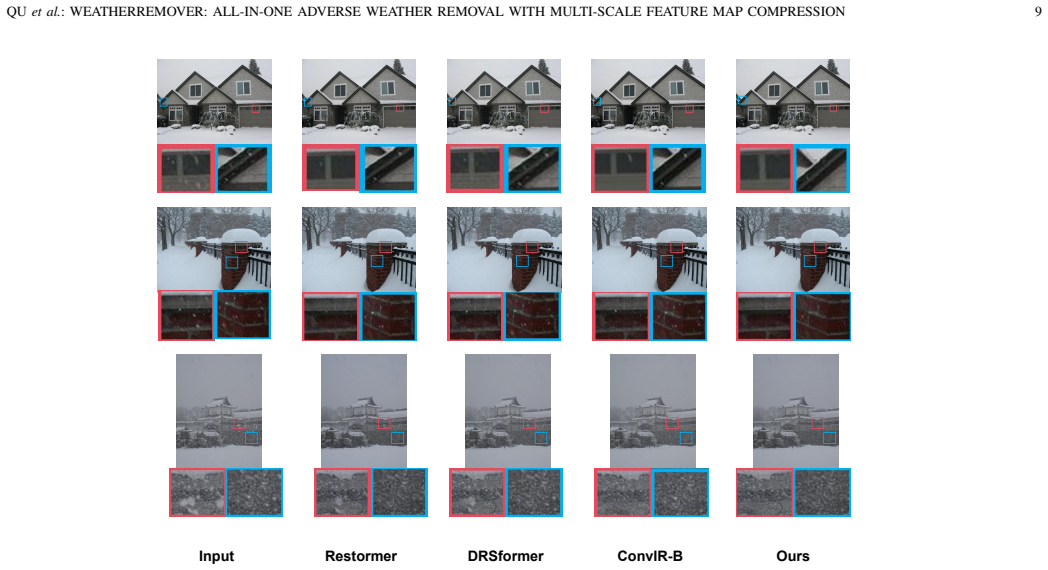


read the original abstract
Photographs taken in adverse weather conditions often suffer from blurriness, occlusion, and low brightness due to interference from rain, snow, and fog. These issues can significantly hinder the performance of subsequent computer vision tasks, making the removal of weather effects a crucial step in image enhancement. Existing methods primarily target specific weather conditions, with only a few capable of handling multiple weather scenarios. However, mainstream approaches often overlook performance considerations, resulting in large parameter sizes, long inference times, and high memory costs. In this study, we introduce the WeatherRemover model, designed to enhance the restoration of images affected by various weather conditions while balancing performance. Our model adopts a UNet-like structure with a gating mechanism and a multi-scale pyramid vision Transformer. It employs channel-wise attention derived from convolutional neural networks to optimize feature extraction, while linear spatial reduction helps curtail the computational demands of attention. The gating mechanisms, strategically placed within the feed-forward and downsampling phases, refine the processing of information by selectively addressing redundancy and mitigating its influence on learning. This approach facilitates the adaptive selection of essential data, ensuring superior restoration and maximizing efficiency. Additionally, our lightweight model achieves an optimal balance between restoration quality, parameter efficiency, computational overhead, and memory usage, distinguishing it from other multi-weather models, thereby meeting practical application demands effectively. The source code is available at https://github.com/RICKand-MORTY/WeatherRemover.
Editorial analysis
A structured set of objections, weighed in public.
Referee Report
Summary. The paper introduces WeatherRemover, a lightweight UNet-like architecture for all-in-one removal of adverse weather effects (rain, snow, fog) from images. It incorporates gating mechanisms in the feed-forward and downsampling phases, a multi-scale pyramid vision Transformer, channel-wise attention derived from CNNs, and linear spatial reduction to selectively remove redundancy, claiming an optimal balance of restoration quality with low parameter count, FLOPs, inference time, and memory usage that outperforms prior multi-weather models for practical applications. Source code is released.
Significance. If the quantitative claims hold with proper validation, the work could provide a deployable all-in-one solution for real-world image restoration, improving downstream CV tasks under diverse weather without the overhead of specialized models. The open-source code is a clear strength for reproducibility.
major comments (2)
- [Model Architecture and Experimental Results] The central claim that the gating mechanisms 'selectively address redundancy' and enable 'superior restoration and maximizing efficiency' (Abstract) is load-bearing but unsupported without ablation studies. No tables compare the full model against variants without gating or without linear spatial reduction on metrics such as PSNR/SSIM across rain/snow/fog datasets or on parameter/FLOP counts.
- [Abstract and Results] The assertion of achieving an 'optimal balance' distinguishing it from other multi-weather models lacks any reported quantitative results, baselines, or comparisons (e.g., parameter counts, inference time, memory usage, or restoration metrics) in the abstract or visible experimental support, preventing verification of the efficiency-quality tradeoff.
minor comments (1)
- [Abstract] The abstract is lengthy and repetitive; condensing the description of components while retaining the core claims would improve readability.
Simulated Author's Rebuttal
We thank the referee for the constructive feedback on our manuscript. We have reviewed the major comments carefully and provide point-by-point responses below. We agree that additional experiments and clarifications will strengthen the paper and will incorporate revisions accordingly.
read point-by-point responses
-
Referee: [Model Architecture and Experimental Results] The central claim that the gating mechanisms 'selectively address redundancy' and enable 'superior restoration and maximizing efficiency' (Abstract) is load-bearing but unsupported without ablation studies. No tables compare the full model against variants without gating or without linear spatial reduction on metrics such as PSNR/SSIM across rain/snow/fog datasets or on parameter/FLOP counts.
Authors: We acknowledge that explicit ablation studies would provide stronger empirical support for the role of the gating mechanisms in addressing redundancy and for the linear spatial reduction in improving efficiency. The current manuscript describes these components in the architecture and reports overall performance gains, but does not include direct variant comparisons. In the revised manuscript, we will add a new ablation subsection with tables evaluating the full model against versions without gating and without linear spatial reduction. These will include PSNR/SSIM results across the rain, snow, and fog datasets along with parameter counts and FLOPs to quantify the contributions. revision: yes
-
Referee: [Abstract and Results] The assertion of achieving an 'optimal balance' distinguishing it from other multi-weather models lacks any reported quantitative results, baselines, or comparisons (e.g., parameter counts, inference time, memory usage, or restoration metrics) in the abstract or visible experimental support, preventing verification of the efficiency-quality tradeoff.
Authors: We agree that the abstract would benefit from explicit quantitative support for the efficiency-quality tradeoff claim. While the experimental results section already presents comparisons against prior multi-weather models on restoration metrics (PSNR/SSIM), parameter counts, FLOPs, inference time, and memory usage, these are not summarized in the abstract. In the revision, we will update the abstract to include key numerical highlights of these comparisons, thereby making the 'optimal balance' assertion directly verifiable from the abstract while retaining the detailed tables in the main text. revision: yes
Circularity Check
No circularity: empirical architecture proposal with independent experimental validation
full rationale
The paper describes a UNet-like model incorporating gating mechanisms, multi-scale pyramid vision Transformer, channel-wise attention, and linear spatial reduction for multi-weather image restoration. All load-bearing claims concern empirical performance (PSNR, parameter count, FLOPs, memory) after standard training on weather datasets. No equations, predictions, or first-principles results are presented that reduce to fitted inputs by construction. Design choices are motivated by stated goals of redundancy removal and efficiency but are not derived from or equivalent to the target metrics. No self-citation chains, uniqueness theorems, or ansatz smuggling appear in the abstract or described structure. The work is self-contained as an architecture proposal evaluated externally via benchmarks.
Axiom & Free-Parameter Ledger
free parameters (1)
- model hyperparameters and training settings
axioms (1)
- domain assumption Gating mechanisms strategically placed within feed-forward and downsampling phases refine information processing by selectively addressing redundancy
Reference graph
Works this paper leans on
-
[1]
Transweather: Transformer-based restoration of images degraded by adverse weather conditions,
J. M. Jose Valanarasu, R. Yasarla, and V . M. Patel, “Transweather: Transformer-based restoration of images degraded by adverse weather conditions,” inProc. IEEE/CVF Conf. Comput. Vis. Pattern Recognit. (CVPR), 2022, pp. 2343–2353
work page 2022
-
[2]
Focal network for image restoration,
Y . Cui, W. Ren, X. Cao, and A. Knoll, “Focal network for image restoration,” inProc. IEEE/CVF Int. Conf. Comput. Vis. (ICCV), 2023, pp. 12 955–12 965
work page 2023
-
[3]
Progressive rain removal based on the combination network of cnn and transformer,
T. Wang, K. Wang, and Q. Li, “Progressive rain removal based on the combination network of cnn and transformer,”Comput. Intell. Neurosci., vol. 2022, no. 1, p. 5067175, 2022
work page 2022
-
[4]
An image is worth 16x16 words: Transformers for image recognition at scale,
A. Dosovitskiy, L. Beyer, A. Kolesnikov, D. Weissenborn, X. Zhai, T. Unterthiner, M. Dehghani, M. Minderer, G. Heigold, S. Gelly, J. Uszkoreit, and N. Houlsby, “An image is worth 16x16 words: Transformers for image recognition at scale,” inProc. Int. Conf. Learn. Representations (ICLR), 2021
work page 2021
-
[5]
Swin transformer: Hierarchical vision transformer using shifted windows,
Z. Liu, Y . Lin, Y . Cao, H. Hu, Y . Wei, Z. Zhang, S. Lin, and B. Guo, “Swin transformer: Hierarchical vision transformer using shifted windows,” inProc. IEEE/CVF Int. Conf. Comput. Vis. (ICCV), 2021, pp. 9992–10 002
work page 2021
-
[6]
Restormer: Efficient transformer for high-resolution image restoration,
S. W. Zamir, A. Arora, S. Khan, M. Hayat, F. S. Khan, and M. Yang, “Restormer: Efficient transformer for high-resolution image restoration,” inProc. IEEE/CVF Conf. Comput. Vis. Pattern Recognit. (CVPR), 2022, pp. 5718–5729
work page 2022
-
[7]
Pyramid vision transformer: A versatile backbone for dense prediction without convolutions,
W. Wang, E. Xie, X. Li, D.-P. Fan, K. Song, D. Liang, T. Lu, P. Luo, and L. Shao, “Pyramid vision transformer: A versatile backbone for dense prediction without convolutions,” inProc. IEEE/CVF Int. Conf. Comput. Vis. (ICCV), 2021, pp. 548–558
work page 2021
-
[8]
Pvt v2: Improved baselines with pyramid vision transformer,
W. Wang, E. Xie, X. Li, D.-P. Fan, K. Song, D. Liang, T. Lu, P. Luo, and L. Shao, “Pvt v2: Improved baselines with pyramid vision transformer,” Comput. Vis. Media, vol. 8, no. 3, pp. 415–424, 2022
work page 2022
-
[9]
All in one bad weather removal using architectural search,
R. Li, R. T. Tan, and L.-F. Cheong, “All in one bad weather removal using architectural search,” inProc. IEEE/CVF Conf. Comput. Vis. Pattern Recognit. (CVPR), 2020, pp. 3172–3182
work page 2020
-
[10]
U-net: Convolutional networks for biomedical image segmentation,
O. Ronneberger, P. Fischer, and T. Brox, “U-net: Convolutional networks for biomedical image segmentation,” inProc. Int. Conf. Med. Image Comput. Comput.-Assist. Intervention (MICCAI), vol. 9351, 2015, pp. 234–241
work page 2015
-
[11]
Learning a sparse transformer network for effective image deraining,
X. Chen, H. Li, M. Li, and J. Pan, “Learning a sparse transformer network for effective image deraining,” inProc. IEEE/CVF Conf. Comput. Vis. Pattern Recognit. (CVPR), 2023, pp. 5896–5905
work page 2023
-
[12]
A. Vaswani, N. Shazeer, N. Parmar, J. Uszkoreit, L. Jones, A. N. Gomez, L. u. Kaiser, and I. Polosukhin, “Attention is all you need,” inProc. Adv. Neural Inf. Process. Syst. (NeurIPS), vol. 30, 2017
work page 2017
-
[13]
Single image haze removal using dark channel prior,
K. He, J. Sun, and X. Tang, “Single image haze removal using dark channel prior,”IEEE Trans. Pattern Anal. Mach. Intell. (TPAMI), vol. 33, no. 12, pp. 2341–2353, 2011
work page 2011
-
[14]
Dual residual networks leveraging the potential of paired operations for image restoration,
X. Liu, M. Suganuma, Z. Sun, and T. Okatani, “Dual residual networks leveraging the potential of paired operations for image restoration,” in Proc. IEEE/CVF Conf. Comput. Vis. Pattern Recognit. (CVPR), 2019, pp. 7000–7009
work page 2019
-
[15]
Deep residual learning for image recognition,
K. He, X. Zhang, S. Ren, and J. Sun, “Deep residual learning for image recognition,” inProc. IEEE/CVF Conf. Comput. Vis. Pattern Recognit. (CVPR), 2016, pp. 770–778
work page 2016
-
[16]
Lmqformer: A laplace-prior-guided mask query transformer for lightweight snow removal,
J. Lin, N. Jiang, Z. Zhang, W. Chen, and T. Zhao, “Lmqformer: A laplace-prior-guided mask query transformer for lightweight snow removal,”IEEE Trans. Circuits Syst. Video Technol., vol. 33, no. 11, pp. 6225–6235, 2023
work page 2023
-
[17]
Restoring vision in adverse weather conditions with patch-based denoising diffusion models,
O. ¨Ozdenizci and R. Legenstein, “Restoring vision in adverse weather conditions with patch-based denoising diffusion models,”IEEE Trans. Pattern Anal. Mach. Intell. (TPAMI), vol. 45, no. 8, pp. 10 346–10 357, 2023
work page 2023
-
[18]
Denoising diffusion probabilistic models,
J. Ho, A. Jain, and P. Abbeel, “Denoising diffusion probabilistic models,” inProc. Adv. Neural Inf. Process. Syst. (NeurIPS), vol. 33, 2020, pp. 6840–6851
work page 2020
-
[19]
Revitalizing convolutional network for image restoration,
Y . Cui, W. Ren, X. Cao, and A. Knoll, “Revitalizing convolutional network for image restoration,”IEEE Trans. Pattern Anal. Mach. Intell. (TPAMI), pp. 1–16, 2024
work page 2024
-
[20]
Is space-time attention all you need for video understanding?
G. Bertasius, H. Wang, and L. Torresani, “Is space-time attention all you need for video understanding?” inProc. Int. Conf. Mach. Learn. (ICML),, ser. Proceedings of Machine Learning Research, vol. 139, 2021, pp. 813–824
work page 2021
-
[21]
A. Kirillov, E. Mintun, N. Ravi, H. Mao, C. Rolland, L. Gustafson, T. Xiao, S. Whitehead, A. C. Berg, W.-Y . Lo, P. Dolla’r, and R. Girshick, “Segment anything,” inProc. IEEE/CVF Int. Conf. Comput. Vis. (ICCV), 2023, pp. 3992–4003
work page 2023
-
[22]
End-to-end object detection with transformers,
N. Carion, F. Massa, G. Synnaeve, N. Usunier, A. Kirillov, and S. Zagoruyko, “End-to-end object detection with transformers,” inProc. Eur . Conf. Comput. Vis. (ECCV), 2020, pp. 213–229
work page 2020
-
[23]
Y . Sun, Z. Chen, H. Zheng, W. Deng, J. Liu, W. Min, A. Elazab, X. Wan, C. Wang, and R. Ge, “Bs-ldm: Effective bone suppression in high- resolution chest x-ray images with conditional latent diffusion models,” 2025,arXiv:2412.15670
-
[24]
Gaussian Error Linear Units (GELUs)
D. Hendrycks and K. Gimpel, “Gaussian error linear units (gelus),” 2023, arXiv:1606.08415
work page internal anchor Pith review Pith/arXiv arXiv 2023
-
[25]
W. Shi, J. Caballero, F. Husz ´ar, J. Totz, A. P. Aitken, R. Bishop, D. Rueckert, and Z. Wang, “Real-time single image and video super- resolution using an efficient sub-pixel convolutional neural network,” in Proc. IEEE/CVF Conf. Comput. Vis. Pattern Recognit. (CVPR), 2016, pp. 1874–1883
work page 2016
-
[26]
Improved techniques for training consistency models,
Y . Song and P. Dhariwal, “Improved techniques for training consistency models,” inProc. Int. Conf. Learn. Representations (ICLR), 2024
work page 2024
-
[27]
Desnownet: Context-aware deep network for snow removal,
Y .-F. Liu, D.-W. Jaw, S.-C. Huang, and J.-N. Hwang, “Desnownet: Context-aware deep network for snow removal,”IEEE Trans. Image Process., vol. 27, no. 6, pp. 3064–3073, 2018
work page 2018
-
[28]
Attentive generative adversarial network for raindrop removal from a single image,
R. Qian, R. T. Tan, W. Yang, J. Su, and J. Liu, “Attentive generative adversarial network for raindrop removal from a single image,” inProc. IEEE/CVF Conf. Comput. Vis. Pattern Recognit. (CVPR), 2018, pp. 2482–2491
work page 2018
-
[29]
Heavy rain image restoration: Integrating physics model and conditional adversarial learning,
R. Li, L.-F. Cheong, and R. T. Tan, “Heavy rain image restoration: Integrating physics model and conditional adversarial learning,” inProc. IEEE/CVF Conf. Comput. Vis. Pattern Recognit. (CVPR), 2019, pp. 1633–1642
work page 2019
-
[30]
DAWN: Vehicle detection in adverse weather nature dataset,
M. A. Kenk and M. Hassaballah, “Dawn: Vehicle detection in adverse weather nature dataset,” 2020,arXiv:2008.05402
-
[31]
Adam: A method for stochastic optimization,
D. P. Kingma and J. Ba, “Adam: A method for stochastic optimization,” inProc. Int. Conf. Learn. Representations (ICLR), 2015
work page 2015
-
[32]
Scope of validity of psnr in im- age/video quality assessment,
Q. Huynh-Thu and M. Ghanbari, “Scope of validity of psnr in im- age/video quality assessment,”Electron. Lett., vol. 44, no. 13, pp. 800– 801, 2008
work page 2008
-
[33]
Image quality assessment: from error visibility to structural similarity,
Z. Wang, A. C. Bovik, H. R. Sheikh, and E. P. Simoncelli, “Image quality assessment: from error visibility to structural similarity,”IEEE Trans. Image Process., vol. 13, no. 4, pp. 600–612, 2004
work page 2004
-
[34]
S. Hochreiter and J. Schmidhuber, “Long short-term memory,”Neural Comput., vol. 9, no. 8, pp. 1735–1780, 1997
work page 1997
-
[35]
Iterative image rain removal network using consecutive residual long short-term memory,
S. Y . Park, T. H. Park, and I. K. Eom, “Iterative image rain removal network using consecutive residual long short-term memory,”Neuro- computing, vol. 589, p. 127752, 2024
work page 2024
-
[36]
Deep learning for seeing through window with raindrops,
Y . Quan, S. Deng, Y . Chen, and H. Ji, “Deep learning for seeing through window with raindrops,” inProc. IEEE/CVF Int. Conf. Comput. Vis. (ICCV), 2019, pp. 2463–2471
work page 2019
-
[37]
J. Xiao, X. Fu, A. Liu, F. Wu, and Z.-J. Zha, “Image de-raining transformer,”IEEE Trans. Pattern Anal. Mach. Intell. (TPAMI), vol. 45, no. 11, pp. 12 978–12 995, 2023
work page 2023
-
[38]
Rain-free and residue hand-in-hand: A progressive coupled network for real-time image deraining,
K. Jiang, Z. Wang, P. Yi, C. Chen, Z. Wang, X. Wang, J. Jiang, and C.-W. Lin, “Rain-free and residue hand-in-hand: A progressive coupled network for real-time image deraining,”IEEE Trans. Image Process., vol. 30, pp. 7404–7418, 2021
work page 2021
-
[39]
Multi-stage progressive image restoration,
S. W. Zamir, A. Arora, S. Khan, M. Hayat, F. S. Khan, M.-H. Yang, and L. Shao, “Multi-stage progressive image restoration,” inProc. IEEE/CVF Conf. Comput. Vis. Pattern Recognit. (CVPR), 2021, pp. 14 816–14 826
work page 2021
-
[40]
Z. Li and D. Hoiem, “Learning without forgetting,”IEEE Trans. Pattern Anal. Mach. Intell. (TPAMI), vol. 40, no. 12, pp. 2935–2947, 2018
work page 2018
-
[41]
AIR: Ana- lytic imbalance rectifier for continual learning,
D. Fang, Y . Zhu, Z. Lin, C. Chen, Z. Zeng, and H. Zhuang, “AIR: Ana- lytic imbalance rectifier for continual learning,” 2024,arXiv.2408.10349
discussion (0)
Sign in with ORCID, Apple, or X to comment. Anyone can read and Pith papers without signing in.