UV-enhanced SEM: towards orientation and electron work function imaging
Pith reviewed 2026-05-10 18:31 UTC · model grok-4.3
The pith
Deep-UV tilted illumination inside an SEM enables coating-free imaging of surface orientation and electron work function.
A machine-rendered reading of the paper's core claim, the machinery that carries it, and where it could break.
Core claim
Deep-UV ~250 nm (4.96 eV) tilted in-situ co-illumination of the sample under SEM imaging is implemented with external mechanical control of LED position and tilt, plus an adjustable linear polarizer for s-polarized light; numerical modeling confirms the resulting E-field enhancement supports directional secondary-electron emission from uncoated surfaces, opening orientation and work-function contrast modes.
What carries the argument
External mechanical control of UV-C LED position and tilt combined with an adjustable linear polarizer that tunes tangential and normal electric-field components at the sample surface.
If this is right
- Secondary-electron emission can be directed and enhanced by tuning the incident polarization and angle without metal coatings.
- New contrast mechanisms become available for mapping surface orientation and local electron work function in the SEM.
- Sample integrity is preserved, allowing the same specimen to undergo subsequent non-SEM analyses.
- Linearly polarized UV-C light with azimuthal control in the (s,p) plane is feasible and can be modeled for optimized emission.
Where Pith is reading between the lines
- The method could be adapted to map work-function variations across heterogeneous or polycrystalline materials at nanoscale resolution.
- Polarization tuning might permit selective enhancement of emission from specific surface states or crystal faces.
- Integration into routine SEM workflows would shorten sample-preparation time for beam-sensitive or coating-intolerant specimens.
- Further wavelength or angle optimization could improve contrast selectivity for particular classes of inorganic or organic surfaces.
Load-bearing premise
External mechanical adjustments of the UV source position and tilt can be performed without breaking vacuum integrity or degrading SEM image resolution, and the modeled field enhancements will produce measurable gains in secondary-electron yield or directional contrast.
What would settle it
A side-by-side comparison of secondary-electron images acquired with and without the UV illumination, showing either no increase in yield or no new orientation-dependent contrast features while the vacuum and beam resolution remain unchanged.
Figures


read the original abstract
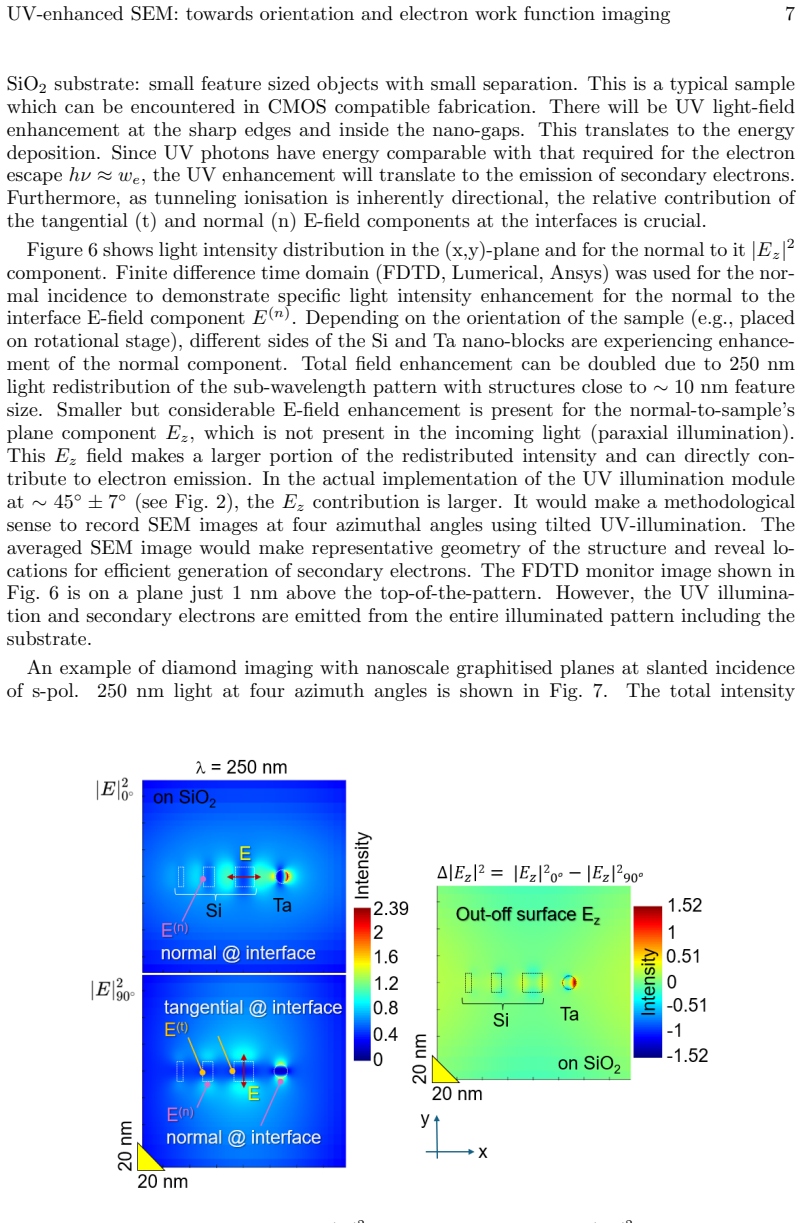
Deep-UV ~ 250 nm (4.96 eV) tilted in-situ co-illumination of the sample under imaging by scanning electron microscope (SEM) is developed at a robust and practical instrument level. Precise mechanical control of the lateral position and tilt angle (within 6.5$^\circ$ from a 42$^\circ$ baseline) of the UV-C LED source is achieved using mechanisms external to the vacuum chamber. The incorporated linear polariser (for s-pol. mode illumination) with external polarisation plane adjustment allows for modulation and tuning of tangential $E^{(t)}$ and normal $E^{(n)}$ electric field components and their enhancement for controlled directional electron emission from the surface of the sample. Numerical modelling of E-field enhancement corroborates the expected enhancement in the production of secondary electrons. This modality of SEM imaging does not require metal coatings, preserving sample integrity for subsequent analysis. The feasibility of having linearly polarised incident UV-C light with azimuthal orientation control in $(s,p)$-plane is modeled and discussed.
Editorial analysis
A structured set of objections, weighed in public.
Referee Report
Summary. The manuscript describes the development of an in-situ deep-UV (~250 nm) co-illumination system for SEM, featuring external mechanical controls for LED lateral position and tilt (within 6.5° of a 42° baseline) plus an adjustable linear polarizer for s-polarized illumination. Numerical modeling of tangential and normal E-field components is presented to support expected enhancement of secondary electron yield, enabling potential orientation and work-function contrast imaging without metal coatings.
Significance. If the modeled E-field enhancements translate to measurable imaging gains, the external-control architecture could offer a practical, non-destructive SEM modality for surface characterization. The emphasis on vacuum-compatible external mechanisms is a clear engineering strength that addresses integration challenges.
major comments (2)
- [Abstract] Abstract and modeling discussion: the central claim that numerical E-field modeling 'corroborates the expected enhancement in the production of secondary electrons' and enables a 'new modality of SEM imaging' is unsupported by any experimental secondary-electron yield data, image contrast measurements, or polarization-dependent results; no test-sample images under 250 nm s-polarized illumination versus baseline are shown.
- [Instrument description] The manuscript asserts that external mechanical control of UV-C LED position and tilt 'is achieved' at a 'robust and practical instrument level' without compromising SEM performance, yet provides no vacuum-integrity tests, imaging-resolution comparisons, or interference data to substantiate this load-bearing assumption for the proposed modality.
minor comments (1)
- [Abstract] Notation for electric-field components (E^(t) and E^(n)) is introduced without explicit definition of the coordinate system relative to the sample surface and incidence plane.
Simulated Author's Rebuttal
We thank the referee for the constructive review and recommendation for major revision. We address each major comment below with our response and planned revisions to the manuscript.
read point-by-point responses
-
Referee: [Abstract] Abstract and modeling discussion: the central claim that numerical E-field modeling 'corroborates the expected enhancement in the production of secondary electrons' and enables a 'new modality of SEM imaging' is unsupported by any experimental secondary-electron yield data, image contrast measurements, or polarization-dependent results; no test-sample images under 250 nm s-polarized illumination versus baseline are shown.
Authors: We agree that the manuscript presents numerical E-field modeling to support the anticipated enhancement of secondary electron production but does not include experimental secondary-electron yield data, contrast measurements, or comparative images. The scope of this work is the development of the deep-UV co-illumination instrument with external controls and polarization tuning, together with modeling of the tangential and normal field components. We will revise the abstract and modeling discussion sections to explicitly state that the enhancement is predicted by the numerical results and that experimental validation of imaging contrast and yield improvements constitutes planned future work. This revision will ensure the claims accurately reflect the presented content without overstating current experimental evidence. revision: partial
-
Referee: [Instrument description] The manuscript asserts that external mechanical control of UV-C LED position and tilt 'is achieved' at a 'robust and practical instrument level' without compromising SEM performance, yet provides no vacuum-integrity tests, imaging-resolution comparisons, or interference data to substantiate this load-bearing assumption for the proposed modality.
Authors: The instrument description is based on the implemented external mechanical system for LED positioning, tilt, and polarization control. We acknowledge that explicit supporting data on vacuum integrity, SEM resolution comparisons before and after integration, and potential interference effects are not included. We will add a dedicated subsection or supplementary information describing the vacuum compatibility verification, any resolution and image quality checks performed during integration, and observations regarding interference with the SEM electron optics. These additions will provide the requested substantiation for the robustness claim. revision: yes
Circularity Check
No circularity: experimental instrument paper with independent numerical modeling
full rationale
The paper is a description of an experimental UV-SEM setup with external mechanical controls and a linear polarizer, plus standard numerical E-field modeling to illustrate expected secondary-electron enhancement. No derivation chain, fitted parameters renamed as predictions, or self-citation load-bearing steps exist. The modeling is presented as corroborative illustration rather than a self-referential prediction; no equations reduce to inputs by construction. This matches the default non-circular case for instrument-development work.
Axiom & Free-Parameter Ledger
Reference graph
Works this paper leans on
-
[1]
author author G. Gervinskas , author G. Seniutinas ,\ and\ author S. Juodkazis ,\ title title Control of surface charge for high-fidelity nanostructuring of materials , \ https://doi.org/https://doi.org/10.1002/lpor.201300093 journal journal Laser & Photonics Reviews \ volume 7 ,\ pages 1049--1053 ( year 2013 ) ,\ https://arxiv.org/abs/https://onlinelibra...
-
[2]
author author G. Seniutinas , author A. Balčytis ,\ and\ author S. Juodkazis ,\ title title Ultraviolet-photoelectric effect for augmented contrast and resolution in electron microscopy , \ https://doi.org/10.1063/1.4945357 journal journal APL Photonics \ volume 1 ,\ pages 021301 ( year 2016 ) ,\ https://arxiv.org/abs/https://pubs.aip.org/aip/app/article-...
-
[3]
author author L. S. \ Ikhsan , author Y. Masuda , author M. Kretkowski , author W. Inami ,\ and\ author Y. Kawata ,\ title title Contrast enhancement of sem image using photoelectric effect under UV LED irradiation , \ https://doi.org/10.3390/app152413250 journal journal Applied Sciences \ volume 15 ( year 2025 ),\ 10.3390/app152413250 NoStop
-
[4]
author author G. D. \ Danilatos ,\ title title An atmospheric scanning electron microscope (ASEM) , \ https://doi.org/https://doi.org/10.1002/sca.4950030314 journal journal Scanning \ volume 3 ,\ pages 215--217 ( year 1980 ) ,\ https://arxiv.org/abs/https://onlinelibrary.wiley.com/doi/pdf/10.1002/sca.4950030314 https://onlinelibrary.wiley.com/doi/pdf/10.1...
-
[5]
author author K. Teramoto , author H. Nishiyama , author Y. Maruyama , author Y. Konyuuba , author Y. Abe , author D. Guarrera , author M. Suga ,\ and\ author C. Sato ,\ title title Morphological characterization of bacteria using the atmospheric scanning electron microscope (asem) , \ https://doi.org/10.1017/S1431927610055625 journal journal Microscopy a...
-
[6]
author author S. Kleindiek , author M. Dadras , author K. Schock , author A. Lieb ,\ and\ author G. Renka ,\ title Combining SEM with AFM for in situ correlative microscopy , \ in\ https://doi.org/https://doi.org/10.1002/9783527808465.EMC2016.5289 booktitle European Microscopy Congress 2016: Proceedings \ ( publisher John Wiley & Sons, Ltd ,\ year 2016 )\...
-
[7]
author author M. Kretkowski , author K. Hosomi , author H. Futamata , author W. Inami ,\ and\ author Y. Kawata ,\ title title Fast sample switching mechanism for atmospheric scanning electron microscopy and electron beam irradiation systems of living cells , \ https://doi.org/10.12693/APhysPolA.146.382 journal journal Acta Physica Polonica A \ volume 146 ...
-
[8]
author author M. Kretkowski , author J. Katai , author H. Futamata , author W. Inami ,\ and\ author Y. Kawata ,\ title title Vacuum gripper-based practical method of gentle deposition of living cells and its filter substrates onto sin films for electron beam irradiation experiments , \ in\ @noop booktitle Recent Advances in Technology Research and Educati...
work page 2024
-
[9]
author author M. Guaita , author S. C. \ Watters ,\ and\ author S. Loerch ,\ title title Recent advances and current trends in cryo-electron microscopy , \ https://doi.org/https://doi.org/10.1016/j.sbi.2022.102484 journal journal Current Opinion in Structural Biology \ volume 77 ,\ pages 102484 ( year 2022 ) NoStop
-
[10]
author author B. Liu , author Z. Hu , author P. Ruterana , author E. J. \ Olivier , author L. Gu ,\ and\ author Y. Wang ,\ title title Recent research progress of 4d-stem from methodology to application in materials science , \ https://doi.org/https://doi.org/10.1016/j.mattod.2025.12.029 journal journal Materials Today \ volume 92 ,\ pages 906--924 ( year...
-
[11]
author author M. Troyon , author D. Pastré , author J. Pierre Jouart ,\ and\ author J. Louis Beaudoin ,\ title title Scanning near-field cathodoluminescence microscopy , \ https://doi.org/https://doi.org/10.1016/S0304-3991(98)00049-7 journal journal Ultramicroscopy \ volume 75 ,\ pages 15--21 ( year 1998 ) NoStop
-
[12]
author author J. Jirak , author P. Čudek ,\ and\ author V. Nedela ,\ title title Scintillation secondary electron detector for esem and sem , \ https://doi.org/10.1017/S1431927612008185 journal journal Microscopy and Microanalysis \ volume 18 ,\ pages 1266--1267 ( year 2012 ) NoStop
-
[13]
author author N. Raptis , author E. Pikasis ,\ and\ author D. Syvridis ,\ title title Power losses in diffuse ultraviolet optical communications channels , \ https://doi.org/10.1364/OL.41.004421 journal journal Opt. Lett. \ volume 41 ,\ pages 4421--4424 ( year 2016 ) NoStop
-
[14]
author author J. Kim , author H. Ha , author G. H. \ Gu , author S.-G. \ Heo , author Y. Kim , author G.-H. \ Jeong ,\ and\ author H. S. \ Kim ,\ title title Argon plasma–induced compressive residual stress for simultaneous strength–ductility enhancement in a cocrfemnni high-entropy alloy , \ https://doi.org/https://doi.org/10.1016/j.msea.2026.150062 jour...
-
[15]
Sathiyamoorthi \ and\ author H
author author P. Sathiyamoorthi \ and\ author H. S. \ Kim ,\ title title High-entropy alloys with heterogeneous microstructure: Processing and mechanical properties , \ https://doi.org/https://doi.org/10.1016/j.pmatsci.2020.100709 journal journal Progress in Materials Science \ volume 123 ,\ pages 100709 ( year 2022 ) ,\ note a Festschrift in Honor of Bri...
-
[16]
author author S.-G. \ Jung , author Y. Han , author J. H. \ Kim , author R. Hidayati , author J.-S. \ Rhyee , author J. M. \ Lee , author W. N. \ Kang , author W. S. \ Choi , author H.-R. \ Jeon , author J. Suk ,\ and\ author T. Park ,\ title title High critical current density and high-tolerance superconductivity in high-entropy alloy thin films , \ @noo...
work page 2022
-
[17]
author author N. Zhang , author J. Xu , author Z. Feng , author Y. Sun , author J. Huang , author X. Zhao , author X. Yao , author S. Chen , author L. Lu ,\ and\ author S. Luo ,\ title title Shock compression and spallation damage of high-entropy alloy al0.1cocrfeni , \ @noop journal journal Journal of Materials Science & Technology \ volume 128 ,\ pages ...
work page 2022
-
[18]
author author M. Takenaka , author Y. Hashimoto , author T. Iwasa , author T. Taketsugu , author G. Seniutinas , author A. Balčytis , author S. Juodkazis ,\ and\ author Y. Nishijima ,\ title title First principles calculations toward understanding sers of 2,2'-bipyridyl adsorbed on Au, Ag, and Au–Ag nanoalloy , \ https://doi.org/https://doi.org/10.1002/jc...
-
[19]
author author Y. Hashimoto , author G. Seniutinas , author A. Balcytis , author S. Juodkazis ,\ and\ author Y. Nishijima ,\ title title Au-Ag-Cu nano-alloys: tailoring of permittivity , \ @noop journal journal Scientific Reports \ volume 6 ,\ pages 25010 ( year 2016 ) NoStop
work page 2016
-
[20]
author author Y. Nishijima , author T. Sudo , author Y. Matsuo ,\ and\ author S. Juodkazis ,\ title title A noble metal high-entropy alloy for mid-infrared metasurfaces , \ https://doi.org/https://doi.org/10.1016/j.eng.2025.01.017 journal journal Engineering \ volume 49 ,\ pages 81--89 ( year 2025 ) NoStop
-
[21]
author author L. Grineviciute , author H.-H. \ Huang , author H. Mu , author J. Nikitina , author N. H. A. \ Le , author T. Katkus , author A. S. M. \ Ang ,\ and\ author S. Juodkazis ,\ title title Surface texturing and localized oxidation of tantalum nano-film by fs-laser , \ https://doi.org/https://doi.org/10.1016/j.optlastec.2026.115018 journal journal...
-
[22]
author author C. Gassner , author J. Vongsvivut , author M. Ryu , author S. H. \ Ng , author M. Toplak , author V. Anand , author P. Takkalkar , author M. L. \ Fac , author N. A. \ Sims , author B. R. \ Wood , author M. J. \ Tobin , author S. Juodkazis ,\ and\ author J. Morikawa ,\ title title Bridging spectroscopy and advanced molecular orientation analy...
-
[23]
author author M. Ryu , author H.-H. \ Huang , author J. Vongsvivut , author S. H. \ Ng , author I. Dumbrytė , author D. Narbutis , author M. Malinauskas , author S. Juodkazis ,\ and\ author J. Morikawa ,\ title title Anisotropy analysis of bamboo and tooth using 4-angle polarization micro-spectroscopy , \ https://doi.org/https://doi.org/10.1002/nano.70099...
-
[24]
+ command, where the argument is the citation key mentioned above. +
-
[26]
+ command with the same argument as the + #1 + command. +
-
[27]
+ commands may be crafted by hand or, preferably, generated by Bib . REV 4.2 includes Bib \ style files +apsrev4-2.bst+, +apsrmp4-2.bst+ appropriate for Physical Review and Reviews of Modern Physics, respectively. Example references This sample file employs the + + command, which formats the .bbl file and specifies which bibliographic databases are to be ...
-
[28]
+ commands may be crafted by hand or, preferably, generated by using Bib . The AIP styles for REV 4 include Bib \ style files +aipnum.bst+ and +aipauth.bst+, appropriate for numbered and author-year bibliographies, respectively. REV 4 will automatically choose the style appropriate for the document's selected class options: the default is numerical, and y...
discussion (0)
Sign in with ORCID, Apple, or X to comment. Anyone can read and Pith papers without signing in.