Tag-based Physical-Layer Authentication Against Message Interference
Pith reviewed 2026-05-10 18:37 UTC · model grok-4.3
The pith
SCA and TBCR schemes achieve ideal detection in tag-based physical-layer authentication by avoiding message decoding interference.
A machine-rendered reading of the paper's core claim, the machinery that carries it, and where it could break.
Core claim
By superimposing tags on a forwarded challenge signal in the TBCR scheme or by using well-designed series signal generation and cancellation modules in the SCA scheme, the receiver can estimate the authentication tags without first decoding the message. This removes the message interference that arises from decoding errors. The resulting closed-form expressions for optimal thresholds and detection probability show that the SCA scheme always achieves the ideal detection performance, while the TBCR scheme achieves it in the absence of noise at Alice. The TBCR scheme further provides enhanced security at high SNR regions with fewer keys.
What carries the argument
The series signal generation and cancellation modules that produce authentication signals and extract tags without decoding the message or introducing residual noise.
If this is right
- The SCA scheme delivers the ideal detection probability for any noise level at the receiver.
- The TBCR scheme reaches ideal detection when the transmitter experiences no noise and supplies stronger security at high SNR with fewer keys.
- Both schemes produce closed-form expressions for robustness and security that allow exact performance evaluation.
- Time complexity is reduced relative to traditional decoding-based tag estimation.
Where Pith is reading between the lines
- The same interference-avoidance principle could be tested in multi-user or relay-assisted wireless networks to reduce authentication latency.
- Hardware implementations would need to quantify how close real cancellation modules come to the zero-residual ideal assumed in the analysis.
- The security advantage of TBCR at high SNR suggests a possible trade-off study between key length and SNR operating region.
Load-bearing premise
The challenge signal is perfectly known and forwarded without distortion, and the series signal generation and cancellation modules can be implemented without residual interference.
What would settle it
An experiment or simulation in which the SCA scheme is run with the claimed perfect modules yet the measured detection probability falls below the derived ideal value of 1.
Figures




read the original abstract
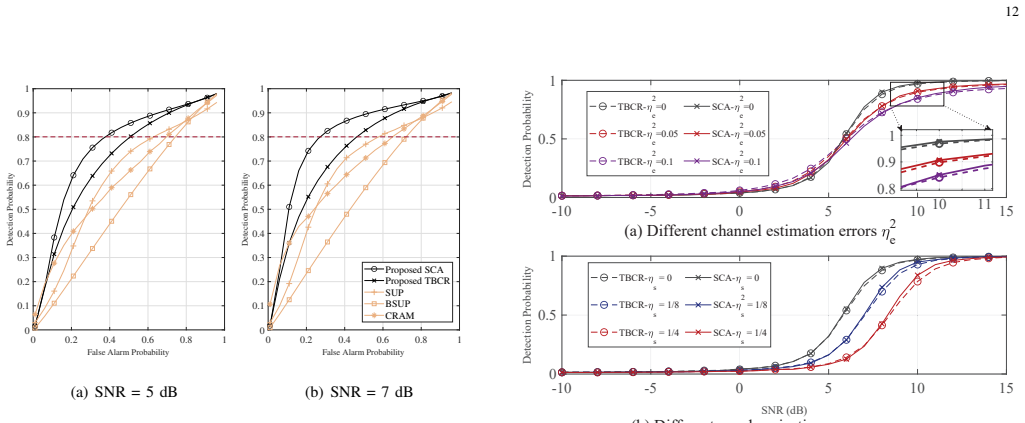
Tag-based Physical-Layer Authentication (PLA) has attracted significant attention in recent years due to its low complexity, high security, and low latency. Traditional tag-based PLA schemes typically estimate tags by decoding the message and then subtracting the estimation of the message from the received signal. However, these approaches suffer from two main limitations. First, decoding errors introduce message interference that degrades authentication performance. Second, the analytical complexity of decoding errors leads to sub-optimal threshold settings, thereby limiting detection probability. To address these limitations, this paper proposes a Tag-Based Challenge-Response (TBCR) scheme and a Series Cancellation Authentication (SCA) scheme. Specifically, in the TBCR scheme, the tags are superimposed on a forwarded challenge signal, enabling the receiver to estimate tags by removing the known challenge signal rather than relying on decoding. However, the challenge-response mechanism introduces extra noise. Here, we propose the SCA scheme without the noise interference, where both the series signal generation and cancellation modules are well-designed to generate authentication signals and estimate tags, respectively. Furthermore, we derive the closed-form expressions to evaluate the robustness and security of both proposed schemes. Notably, on one hand, the optimal threshold and detection probability are derived, which theoretically reveal that the SCA scheme always achieves the ideal detection performance, while the TBCR scheme does so in the absence of noise at Alice. On the other hand, the TBCR scheme provides enhanced security at high Signal-to-Noise Ratio (SNR) regions with fewer keys. Theoretical analysis and simulation demonstrate that both proposed schemes significantly outperform the benchmarks in detection probability with reduced time complexity.
Editorial analysis
A structured set of objections, weighed in public.
Referee Report
Summary. The paper proposes two schemes for tag-based physical-layer authentication to mitigate message interference from decoding errors in traditional approaches: the Tag-Based Challenge-Response (TBCR) scheme, which superimposes tags on a forwarded challenge signal to enable tag estimation without decoding, and the Series Cancellation Authentication (SCA) scheme, which uses specially designed series signal generation and cancellation modules to avoid noise. Closed-form expressions are derived for detection probability, optimal thresholds, robustness, and security; the central claims are that SCA always achieves ideal detection performance while TBCR does so in the absence of noise at Alice, both schemes enhance security at high SNR with fewer keys, and simulations show outperformance over benchmarks in detection probability and time complexity.
Significance. If the zero-residual cancellation assumption holds and the closed-form derivations are rigorous, the work would be significant for physical-layer security, as it offers schemes with theoretically guaranteed ideal detection performance and reduced analytical complexity compared to error-prone decoding-based methods. The provision of closed-form expressions for optimal thresholds and security metrics, along with the challenge-response and series-cancellation designs, could provide useful analytical tools and performance benchmarks for wireless authentication systems.
major comments (3)
- [Abstract] Abstract: The central claim that 'the SCA scheme always achieves the ideal detection performance' is load-bearing on the series signal generation and cancellation modules achieving exactly zero residual message interference (no noise or distortion). The abstract asserts the modules are 'well-designed' to remove interference without noise but provides no explicit construction, mathematical definition of the modules, or bound proving residuals remain zero under imperfect channel estimates, which would be required for the closed-form detection probability to reduce to the ideal case.
- [Abstract] Abstract and derivations section: The paper states that closed-form expressions for optimal thresholds and detection probabilities are derived, theoretically revealing the ideal performance of SCA and conditional performance of TBCR. However, no derivation steps, intermediate equations, or error analysis are shown, making it impossible to verify how the expressions account for (or eliminate) residuals and whether the 'always' result follows directly from the module designs.
- [Simulation results] Simulation results: The abstract and text reference simulation results demonstrating outperformance, but without details on channel models, SNR ranges, number of Monte Carlo trials, specific baselines, or error bars, the empirical validation of the theoretical claims (including the ideal detection for SCA) cannot be assessed.
minor comments (2)
- [Abstract] Abstract: The phrase 'the challenge-response mechanism introduces extra noise' is stated without quantifying the noise variance or its impact on the closed-form expressions for TBCR.
- [Abstract] The abstract claims 'reduced time complexity' for both schemes but does not compare explicit complexity orders (e.g., O(·)) against the traditional decoding-based benchmarks.
Simulated Author's Rebuttal
We thank the referee for the constructive and detailed comments, which have helped us identify areas where the manuscript can be strengthened. We address each major comment point by point below and will revise the manuscript accordingly.
read point-by-point responses
-
Referee: [Abstract] Abstract: The central claim that 'the SCA scheme always achieves the ideal detection performance' is load-bearing on the series signal generation and cancellation modules achieving exactly zero residual message interference (no noise or distortion). The abstract asserts the modules are 'well-designed' to remove interference without noise but provides no explicit construction, mathematical definition of the modules, or bound proving residuals remain zero under imperfect channel estimates, which would be required for the closed-form detection probability to reduce to the ideal case.
Authors: We agree that the abstract's claim relies on zero-residual cancellation and that the current wording does not include an explicit construction or proof. In the revised manuscript, we will add a dedicated subsection in Section III that provides the mathematical definitions of the series signal generation and cancellation modules, including the signal model and the cancellation operation. We will also include a rigorous proof showing that the residual interference is exactly zero (not merely bounded) even under imperfect channel estimates at Bob, which directly supports the reduction of the detection probability to the ideal case. revision: yes
-
Referee: [Abstract] Abstract and derivations section: The paper states that closed-form expressions for optimal thresholds and detection probabilities are derived, theoretically revealing the ideal performance of SCA and conditional performance of TBCR. However, no derivation steps, intermediate equations, or error analysis are shown, making it impossible to verify how the expressions account for (or eliminate) residuals and whether the 'always' result follows directly from the module designs.
Authors: We acknowledge that the manuscript presents the final closed-form expressions without showing the full derivation steps or intermediate equations. In the revision, we will expand the derivations in Section IV to include all intermediate steps, the error analysis for residual terms, and the explicit substitution of the zero-residual condition from the module designs. This will demonstrate how the detection probability expression simplifies to the ideal case for SCA and the noise-dependent case for TBCR. revision: yes
-
Referee: [Simulation results] Simulation results: The abstract and text reference simulation results demonstrating outperformance, but without details on channel models, SNR ranges, number of Monte Carlo trials, specific baselines, or error bars, the empirical validation of the theoretical claims (including the ideal detection for SCA) cannot be assessed.
Authors: We agree that additional simulation details are needed for reproducibility and assessment. In the revised manuscript, we will expand Section V to specify the channel model (Rayleigh fading with path loss), SNR range (0–30 dB), number of Monte Carlo trials (10^5 per point), the exact baseline schemes (traditional decoding-based tag authentication and random tag methods), and include error bars on all performance curves. These additions will allow direct verification of the theoretical claims. revision: yes
Circularity Check
SCA ideal detection claim requires zero-residual cancellation in series modules
specific steps
-
self definitional
[Abstract]
"the optimal threshold and detection probability are derived, which theoretically reveal that the SCA scheme always achieves the ideal detection performance... both the series signal generation and cancellation modules are well-designed to generate authentication signals and estimate tags, respectively."
The derived probability expression yields ideal performance only when the model sets residual message interference to zero after cancellation. The paper asserts the modules achieve this by design but provides no separate proof or bound; thus the 'always ideal' claim is equivalent to the input assumption of perfect cancellation rather than a derived property.
full rationale
The paper derives closed-form detection probability and threshold for SCA, claiming it 'always achieves the ideal detection performance' because the series cancellation modules are 'well-designed' to remove message interference. This reduces the result to the modeling assumption of exactly zero residual message component (no explicit construction or bound is given for imperfect channel estimates or noise). The 'always ideal' outcome therefore holds by construction of the signal model rather than independent verification of the modules under realistic conditions.
Axiom & Free-Parameter Ledger
axioms (1)
- standard math Closed-form expressions for detection probability and security metrics can be derived from the signal models under standard assumptions.
Lean theorems connected to this paper
-
IndisputableMonolith/Cost/FunctionalEquation.leanwashburn_uniqueness_aczel unclear?
unclearRelation between the paper passage and the cited Recognition theorem.
the SCA scheme always achieves the ideal detection performance... closed-form expressions... optimal threshold and detection probability
-
IndisputableMonolith/Foundation/RealityFromDistinction.leanreality_from_one_distinction unclear?
unclearRelation between the paper passage and the cited Recognition theorem.
Series Signal Generation (SSG) and Series Signal Cancellation (SSC) modules... folding strategy
What do these tags mean?
- matches
- The paper's claim is directly supported by a theorem in the formal canon.
- supports
- The theorem supports part of the paper's argument, but the paper may add assumptions or extra steps.
- extends
- The paper goes beyond the formal theorem; the theorem is a base layer rather than the whole result.
- uses
- The paper appears to rely on the theorem as machinery.
- contradicts
- The paper's claim conflicts with a theorem or certificate in the canon.
- unclear
- Pith found a possible connection, but the passage is too broad, indirect, or ambiguous to say the theorem truly supports the claim.
Reference graph
Works this paper leans on
-
[1]
The road towards 6G: A comprehensive survey,
W. Jiang, B. Han, M. A. Habibi, and H. D. Schotten, “The road towards 6G: A comprehensive survey,” IEEE Open J. Commun. Soc. , vol. 2, pp. 334–366, 2021
work page 2021
-
[2]
Effective capacity analysis of STAR-RIS-assisted NOMA networks,
H. Liu, G. Li, X. Li, Y . Liu, G. Huang, and Z. Ding, “Effective capacity analysis of STAR-RIS-assisted NOMA networks,” IEEE Wirel. Commun. Lett., vol. 11, no. 9, pp. 1930–1934, Jul. 2022
work page 1930
-
[3]
Passive secure communica- tions based on reconfigurable intelligent surface,
Y . Wu, J. Luo, W. Chen, and S. Wang, “Passive secure communica- tions based on reconfigurable intelligent surface,” IEEE Commun. Lett. , vol. 27, no. 2, pp. 472–476, Feb. 2023
work page 2023
-
[4]
Revolution of wireless signal recognition for 6G: Recent advances, challenges and future directions,
H. Zhang, F. Zhou, H. Du, Q. Wu, and C. Y uen, “Revolution of wireless signal recognition for 6G: Recent advances, challenges and future directions,” IEEE Commun. Surv. Tutor ., pp. 1–1, May 2025
work page 2025
-
[5]
A survey of man in the middle attacks,
M. Conti, N. Dragoni, and V . Lesyk, “A survey of man in the middle attacks,” IEEE Commun. Surv. Tutor . , vol. 18, no. 3, pp. 2027–2051, Mar. 2016
work page 2027
-
[6]
A novel PHY-layer spoofing attack detection scheme based on WGAN-encoder model,
W. Xie, H. Wang, Z. Feng, and C. Ma, “A novel PHY-layer spoofing attack detection scheme based on WGAN-encoder model,” IEEE Trans. Inf. F orensic Secur ., vol. 19, pp. 8616–8629, Sep. 2024
work page 2024
-
[7]
A modular quantum compila- tion framework for distributed quantum computing,
D. Ferrari, S. Carretta, and M. Amoretti, “A modular quantum compila- tion framework for distributed quantum computing,” IEEE Trans. Quant. Eng., vol. 4, pp. 1–13, Aug. 2023
work page 2023
-
[8]
A survey of physical-layer authentication in wireless communications,
N. Xie, Z. Li, and H. Tan, “A survey of physical-layer authentication in wireless communications,” IEEE Commun. Surv. Tutor ., vol. 23, no. 1, pp. 282–310, 2021
work page 2021
-
[9]
E. Illi, M. Qaraqe, S. Althunibat, A. Alhasanat, M. Alsafasfeh, M. de Ree, G. Mantas, J. Rodriguez, W. Aman, and S. Al-Kuwari, “Physical layer security for authentication, confidentiality, and malicious node detection: A paradigm shift in securing iot networks,” IEEE Commun. Surv. Tutor ., vol. 26, no. 1, pp. 347–388, Oct. 2024
work page 2024
-
[10]
Physical layer authentication and security design in the machine learning era,
T. M. Hoang, A. V ahid, H. D. Tuan, and L. Hanzo, “Physical layer authentication and security design in the machine learning era,” IEEE Commun. Surv. Tutor ., vol. 26, no. 3, pp. 1830–1860, Feb. 2024
work page 2024
-
[11]
Cooperative specific emitter identification via multiple distorted receivers,
B. He and F. Wang, “Cooperative specific emitter identification via multiple distorted receivers,” IEEE Trans. Inf. F orensic Secur ., vol. 15, pp. 3791–3806, Jun. 2020
work page 2020
-
[12]
Physical layer authentication in OFDM systems based on hypothesis testing of CFO estimates,
W. Hou, X. Wang, and J.-Y . Chouinard, “Physical layer authentication in OFDM systems based on hypothesis testing of CFO estimates,” in Proc. Int. Conf. Commun. (ICC) , Ottawa, ON, Canada, Jun. 2012, pp. 3559–3563
work page 2012
-
[13]
An RF-DNA verification process for ZigBee networks,
C. K. Dubendorfer, B. W. Ramsey, and M. A. Temple, “An RF-DNA verification process for ZigBee networks,” in Proc. Military Commun. Conf. (MILCOM) , Orlando, FL, USA, Oct. 2013, pp. 1–6
work page 2013
-
[14]
Remote physical device finger- printing,
T. Kohno, A. Broido, and K. Claffy, “Remote physical device finger- printing,” IEEE Trans. Dependable Secur . Comput. , vol. 2, no. 2, pp. 93–108, Feb. 2005
work page 2005
-
[15]
P . Hao, X. Wang, and A. Behnad, “Performance enhancement of I/Q imbalance based wireless device authentication through collaboration of multiple receivers,” in Proc. Int. Conf. Commun. (ICC) , Sydney, NSW, Australia, Jun. 2014, pp. 939–944
work page 2014
-
[16]
On radio frequency fingerprint identification for DSSS systems in low SNR scenarios,
Y . Xing, A. Hu, J. Zhang, L. Peng, and G. Li, “On radio frequency fingerprint identification for DSSS systems in low SNR scenarios,” IEEE Commun. Lett. , vol. 22, no. 11, pp. 2326–2329, Nov. 2018
work page 2018
-
[17]
Physical-layer authentication based on channel phase responses for multi-carriers transmission,
X. Lu, J. Lei, Y . Shi, and W. Li, “Physical-layer authentication based on channel phase responses for multi-carriers transmission,” IEEE Trans. Inf. F orensic Secur ., vol. 18, pp. 1734–1748, 2023
work page 2023
-
[18]
Spoofing detection with reinforcement learning in wireless networks,
L. Xiao, Y . Li, G. Liu, Q. Li, and W. Zhuang, “Spoofing detection with reinforcement learning in wireless networks,” in Proc. Global Commun. Conf. (GLOBECOM) , San Diego, CA, USA, Dec. 2015, pp. 1–5
work page 2015
-
[19]
K. Zeng, K. Govindan, and P . Mohapatra, “Non-cryptographic authen- tication and identification in wireless networks [security and privacy in emerging wireless networks],” IEEE Wireless Commun. , vol. 17, no. 5, pp. 56–62, Oct. 2010
work page 2010
-
[20]
Wireless physical- layer identification: Modeling and validation,
W. Wang, Z. Sun, S. Piao, B. Zhu, and K. Ren, “Wireless physical- layer identification: Modeling and validation,” IEEE Trans. Inf. F orensic Secur ., vol. 11, no. 9, pp. 2091–2106, Sep. 2016
work page 2091
-
[21]
Physical-layer authentication,
P . L. Y u, J. S. Baras, and B. M. Sadler, “Physical-layer authentication,” IEEE Trans. Inf. F orensic Secur ., vol. 3, no. 1, pp. 38–51, 2008
work page 2008
-
[22]
PHY-layer authentication using duobinary signaling for spectrum enforcement,
V . Kumar, J.-M. J. Park, and K. Bian, “PHY-layer authentication using duobinary signaling for spectrum enforcement,” IEEE Trans. Inf. F orensic Secur ., vol. 11, no. 5, pp. 1027–1038, May. 2016
work page 2016
-
[23]
N. Xie, C. Chen, and Z. Ming, “Security model of authentication at the physical layer and performance analysis over fading channels,” IEEE Trans. Dependable Secur . Comput. , vol. 18, no. 1, pp. 253–268, Jan. 2021
work page 2021
-
[24]
Blind tag-based physical-layer authentication,
C. Wang, M. Sha, W. Xiong, N. Xie, R. Mao, P . Zhang, and L. Huang, “Blind tag-based physical-layer authentication,” IEEE-ACM Trans. Netw., pp. 1–14, 2024
work page 2024
-
[25]
Blind authentication at the physical layer under time-varying fading channels,
N. Xie and S. Zhang, “Blind authentication at the physical layer under time-varying fading channels,” IEEE J. Sel. Areas Commun. , vol. 36, no. 7, pp. 1465–1479, Jul. 2018
work page 2018
-
[26]
Slope authentication at the physical layer,
N. Xie and C. Chen, “Slope authentication at the physical layer,” IEEE Trans. Inf. F orensic Secur ., vol. 13, no. 6, pp. 1579–1594, Jun. 2018
work page 2018
-
[27]
PHY -CRAM: Physical layer challenge-response authentication mechanism for wireless networks,
D. Shan, K. Zeng, W. Xiang, P . Richardson, and Y . Dong, “PHY -CRAM: Physical layer challenge-response authentication mechanism for wireless networks,” IEEE J. Sel. Areas Commun. , vol. 31, no. 9, pp. 1817–1827, Sep. 2013
work page 2013
-
[28]
Hybrid physical-layer authentication,
N. Xie, J. Zhang, Q. Zhang, H. Tan, A. X. Liu, and D. Niyato, “Hybrid physical-layer authentication,” IEEE. Trans. Mob. Comput. , vol. 23, no. 2, pp. 1295–1311, 2024
work page 2024
-
[29]
I. Sason and S. Shamai, “Improved upper bounds on the ML decoding error probability of parallel and serial concatenated turbo codes via their ensemble distance spectrum,” IEEE Trans. Inf. Theory , vol. 46, no. 1, pp. 24–47, Jan. 2000
work page 2000
-
[30]
Improved tangential sphere bound on the bit- error probability of concatenated codes,
J. Zangl and R. Herzog, “Improved tangential sphere bound on the bit- error probability of concatenated codes,” IEEE J. Sel. Areas Commun. , vol. 19, no. 5, pp. 825–830, May. 2001
work page 2001
-
[31]
Fer estimation in a memoryless bsc with variable frame length and unreliable ack/nak feedback,
A. Rico-Alvariño, R. López-V alcarce, C. Mosquera, and R. W. Heath, “Fer estimation in a memoryless bsc with variable frame length and unreliable ack/nak feedback,” IEEE Trans. Wireless Commun. , vol. 16, no. 6, pp. 3661–3673, Jun 2017
work page 2017
-
[32]
Physical layer procedures for control,
3rd Generation Partnership Project; Technical Specification Group Radio Access Network; NR, “Physical layer procedures for control,” 3GPP , TS 38.213 Release 15, Mar. 2019
work page 2019
-
[33]
Robust analysis of full-duplex two-way space shift keying with RIS systems,
X. Zhu, W. Chen, Q. Wu, W. Fang, C. Huang, and J. Li, “Robust analysis of full-duplex two-way space shift keying with RIS systems,” IEEE Trans. Commun., vol. 72, no. 11, pp. 7233–7249, May 2024
work page 2024
-
[34]
Physical- layer authentication in the presence of cooperative adversarial attacks,
J. Liang, Y . Li, Y . Cai, Y . Chen, N. Xie, W. Sun, and H. Li, “Physical- layer authentication in the presence of cooperative adversarial attacks,” IEEE Trans. Wireless Commun. , vol. 24, no. 4, pp. 2910–2924, Apr. 2025
work page 2025
-
[35]
LLR-based successive cancellation list decoding of polar codes,
A. Balatsoukas-Stimming, M. B. Parizi, and A. Burg, “LLR-based successive cancellation list decoding of polar codes,” IEEE Trans. Signal Process., vol. 63, no. 19, pp. 5165–5179, Jun. 2015
work page 2015
-
[36]
Base station (BS) radio transmission and reception,
3rd Generation Partnership Project; Technical Specification Group Ra- dio Access Network; NR, “Base station (BS) radio transmission and reception,” 3GPP , TS 38.104 Release 17, Mar. 2021
work page 2021
-
[37]
S. D. D. Anton, D. Fraunholz, D. Krohmer, D. Reti, D. Schneider, and H. D. Schotten, “The global state of security in industrial control systems: An empirical analysis of vulnerabilities around the world,” IEEE Internet Things J. , vol. 8, no. 24, pp. 17 525–17 540, May 2021
work page 2021
-
[38]
Security threats analysis of the unmanned aerial vehicle system,
R. H. Jacobsen and A. Marandi, “Security threats analysis of the unmanned aerial vehicle system,” in MILCOM 2021-2021 IEEE Military Communications Conference (MILCOM) , 2021, pp. 316–322
work page 2021
-
[39]
Anti-jamming broadcast com- munication using uncoordinated spread spectrum techniques,
C. Popper, M. Strasser, and S. Capkun, “Anti-jamming broadcast com- munication using uncoordinated spread spectrum techniques,” IEEE J. Sel. Areas Commun. , vol. 28, no. 5, pp. 703–715, Jun. 2010
work page 2010
-
[40]
E. Arikan, “Channel polarization: A method for constructing capacity- achieving codes for symmetric binary-input memoryless channels,” IEEE Trans. Inf. Theory , vol. 55, no. 7, pp. 3051–3073, Jul. 2009
work page 2009
-
[41]
M. Abramowitz and I. A.Stegun, Handbook of Mathematical Functions with F ormulas, Graphs and Mathematical Tables. Washington, DC, USA: U.S. Govt. Print. Office, 1972
work page 1972
discussion (0)
Sign in with ORCID, Apple, or X to comment. Anyone can read and Pith papers without signing in.