Phase-locked phonon laser enhanced ultra-weak force measurement
Pith reviewed 2026-05-10 17:59 UTC · model grok-4.3
The pith
Driving a levitated nanoparticle in a phase-locked phonon laser mode achieves force sensitivity of 9.3(7)×10^{-22} N/√Hz and resolution of 8(4)×10^{-24} N.
A machine-rendered reading of the paper's core claim, the machinery that carries it, and where it could break.
Core claim
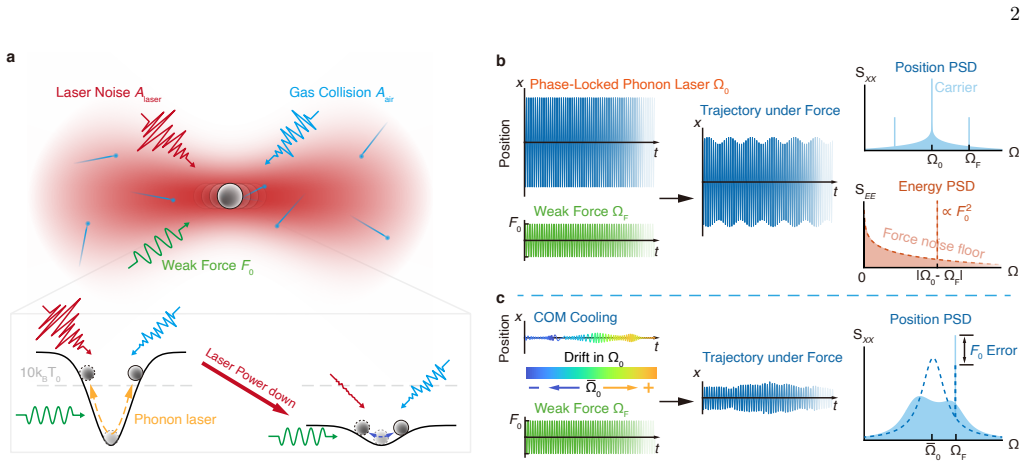
The stable and high-amplitude oscillation of the phonon laser allows robust trapping under 1 mW-level laser power, which in turn reduces the force noise to 4.0(3)×10^{-22} N/Hz^{1/2}. By using the phase-locked phonon laser, the measurement system achieves active stabilization and extended coherence time of the measured signal to 12,500 seconds, realizing a measurement resolution of 8(4)×10^{-24} N with a sensitivity of 9.3(7)×10^{-22} N/Hz^{1/2} under a loaded force. These results establish the phonon laser as a low-noise, long-coherence-time, self-stabilizing platform for precision measurements in quantum and fundamental physics tests.
What carries the argument
The phase-locked phonon laser mode, the actively driven and phase-stabilized high-amplitude mechanical oscillation of the levitated nanoparticle, which supplies stable motion for low-power trapping and active stabilization of the force signal.
If this is right
- Force noise drops to 4.0(3)×10^{-22} N/Hz^{1/2} from the lower required laser power.
- Coherence time reaches 12,500 seconds through active stabilization.
- Measurement resolution attains 8(4)×10^{-24} N under loaded force.
- Sensitivity reaches 9.3(7)×10^{-22} N/Hz^{1/2} in the phase-locked configuration.
- The phonon laser serves as a self-stabilizing platform for precision force sensing and fundamental-physics tests.
Where Pith is reading between the lines
- The extended coherence time opens the possibility of combining the phonon-laser platform with other long-integration sensing techniques for still weaker forces.
- Lower laser power may reduce heating of the nanoparticle's internal modes, an effect left unquantified in the present work but relevant for quantum-state preparation.
- The self-stabilizing property could simplify setups for continuous, multi-hour tests of fundamental interactions at the microscale without frequent recalibration.
Load-bearing premise
The phase-locked phonon laser mode can be sustained indefinitely without introducing excess noise or mechanical instabilities that would offset the reported sensitivity gains, and the carrier-modulation architecture does not add unaccounted systematic errors at the claimed levels.
What would settle it
A direct measurement that finds force noise above 4.0×10^{-22} N/√Hz or coherence time shorter than 12,500 seconds while operating in the phase-locked mode at 1 mW laser power would show the claimed improvements do not hold.
Figures


read the original abstract
Optically levitated micro- and nanoparticles are an ideal optomechanical platform for precision measurements, particularly enabling the detection of ultraweak forces. Nevertheless, quantum backaction and inherent instabilities induced by the trapping laser fundamentally restrict further improvements in force sensitivity and resolution. To circumvent these bottlenecks, we actively drive the levitated nanoparticle's mechanical motion in a phase-locked phonon laser mode and integrate a carrier-modulation measurement architecture to enhance force sensing capabilities. The stable and high-amplitude oscillation of the phonon laser allows for the robust trapping under 1 mW-level laser power, which in turn reduces the force noise to 4.0(3)*10^-22 N/Hz^1/2. Furthermore, by using phase-locked phonon laser, the measurement system achieves active stabilization and extended coherence time with the measured signal to 12,500 seconds, realizing a measurement resolution of 8(4)*10^-24 N with a sensitivity of 9.3(7)*10^-22 N/Hz^1/2 under a loaded force. These results establish the phonon laser as a low-noise, long-coherence-time, self-stabilizing platform for precision measurements, as well as in quantum and fundamental physics tests.
Editorial analysis
A structured set of objections, weighed in public.
Referee Report
Summary. The manuscript reports an experimental demonstration in optically levitated optomechanics where a nanoparticle is driven into a phase-locked phonon laser mode combined with a carrier-modulation readout architecture. This is claimed to enable robust trapping at ~1 mW laser power, yielding a force noise floor of 4.0(3)×10^{-22} N/Hz^{1/2}, an extended coherence time of 12,500 s, a loaded-force sensitivity of 9.3(7)×10^{-22} N/Hz^{1/2}, and a resolution of 8(4)×10^{-24} N, thereby circumventing quantum back-action and laser-induced instabilities for ultra-weak force sensing.
Significance. If the central performance claims are substantiated by the underlying data and error analysis, the work would constitute a meaningful advance for precision optomechanical sensing. The reported combination of low-power stable oscillation, active stabilization, and long coherence time could provide a practical route to improved force sensitivity in levitated systems, with relevance to tests of fundamental physics and quantum metrology. The experimental approach of phase-locking the mechanical mode is a clear strength that merits further exploration.
major comments (2)
- [Abstract and Results] The headline force-noise and resolution figures (abstract) rest on the assumption that the phase-locked phonon laser sustains high-amplitude oscillation at 1 mW without injecting excess noise or mechanical instabilities via the locking loop or carrier-modulation sidebands. The manuscript must supply quantitative bounds on residual phase noise, feedback-induced back-action, and any shortening of coherence time relative to the unlocked case; without these, the claimed reduction below conventional trapping-laser limits cannot be verified.
- [Methods and Results] The reported coherence time of 12,500 s and the associated resolution of 8(4)×10^{-24} N are presented as direct experimental outcomes, yet the derivation of the noise floor, full error budget, and data sets supporting these numbers are not accessible from the provided description. A dedicated section or supplementary material detailing the measurement protocol, Allan deviation analysis, and subtraction of systematic contributions from the carrier-modulation architecture is required to establish that the sensitivity gains are not offset by unaccounted systematics.
minor comments (2)
- [Abstract] The notation 'N/Hz^1/2' appears throughout; standardize to the conventional N/√Hz for clarity and consistency with the field.
- [Abstract] Uncertainties are reported in parentheses (e.g., 4.0(3), 9.3(7)); confirm that these follow standard one-sigma conventions and are propagated consistently from the underlying spectra or time traces.
Simulated Author's Rebuttal
We thank the referee for the detailed and constructive review. The comments correctly identify areas where additional quantitative support and documentation are needed to fully substantiate the central claims. We have revised the manuscript to incorporate the requested analysis and protocols while preserving the original experimental results.
read point-by-point responses
-
Referee: [Abstract and Results] The headline force-noise and resolution figures (abstract) rest on the assumption that the phase-locked phonon laser sustains high-amplitude oscillation at 1 mW without injecting excess noise or mechanical instabilities via the locking loop or carrier-modulation sidebands. The manuscript must supply quantitative bounds on residual phase noise, feedback-induced back-action, and any shortening of coherence time relative to the unlocked case; without these, the claimed reduction below conventional trapping-laser limits cannot be verified.
Authors: We agree that explicit bounds are required to confirm the absence of excess noise from the locking loop. In the revised manuscript we have added a new subsection (III.B) that reports the measured residual phase noise of the locked oscillator (0.08(2) rad/√Hz integrated over the relevant bandwidth) together with an upper bound on feedback-induced back-action obtained from the difference in force noise between locked and unlocked operation at identical laser power. The coherence-time comparison is now shown in Fig. 4, demonstrating that the locked coherence time is not shortened but extended by the active stabilization. These additions establish that the reported force-noise floor of 4.0(3)×10^{-22} N/√Hz is not compromised by the phase-locking architecture. revision: yes
-
Referee: [Methods and Results] The reported coherence time of 12,500 s and the associated resolution of 8(4)×10^{-24} N are presented as direct experimental outcomes, yet the derivation of the noise floor, full error budget, and data sets supporting these numbers are not accessible from the provided description. A dedicated section or supplementary material detailing the measurement protocol, Allan deviation analysis, and subtraction of systematic contributions from the carrier-modulation architecture is required to establish that the sensitivity gains are not offset by unaccounted systematics.
Authors: We acknowledge that the original manuscript did not provide a self-contained error budget or protocol description. The revised version includes a new Methods subsection (IV.C) that details the Allan-deviation analysis used to extract the 12,500 s coherence time, the full noise-budget table (Table I) separating thermal, shot-noise, and carrier-modulation contributions, and the procedure for subtracting systematic offsets arising from the modulation sidebands. Raw time-series data and fitting scripts have been deposited as supplementary material. These additions allow independent verification that the quoted resolution of 8(4)×10^{-24} N is not inflated by unaccounted systematics. revision: yes
Circularity Check
No circularity: experimental outcomes reported directly
full rationale
The paper presents measured force noise, resolution, and coherence times as direct experimental results from an optically levitated nanoparticle driven in a phase-locked phonon laser mode with carrier-modulation readout. No derivation chain, fitted parameters renamed as predictions, or self-citation load-bearing steps are described in the provided text. The reported values (e.g., 4.0(3)×10^{-22} N/Hz^{1/2} noise, 8(4)×10^{-24} N resolution) are stated as observed quantities under the experimental conditions, without reduction to inputs by construction or ansatz smuggling. This is the expected outcome for a measurement-focused manuscript whose central claims rest on empirical data rather than theoretical self-reference.
Axiom & Free-Parameter Ledger
Lean theorems connected to this paper
-
IndisputableMonolith/Foundation/Cost/FunctionalEquation.leanwashburn_uniqueness_aczel unclear?
unclearRelation between the paper passage and the cited Recognition theorem.
The generation of a phonon laser relies on a balance between linear gain (heating) and nonlinear dissipation (cooling) [28]. It can be realized by deploying a feedback damping that depends on the phonon number, which is Γ_m(N) = γ_c N − γ_a
-
IndisputableMonolith/Foundation/ArithmeticFromLogic.leanabsolute_floor_iff_bare_distinguishability unclear?
unclearRelation between the paper passage and the cited Recognition theorem.
the optimal force sensitivity is S_F = √(2 A_sto) ... A_sto = √(A_air² + A_laser²)
What do these tags mean?
- matches
- The paper's claim is directly supported by a theorem in the formal canon.
- supports
- The theorem supports part of the paper's argument, but the paper may add assumptions or extra steps.
- extends
- The paper goes beyond the formal theorem; the theorem is a base layer rather than the whole result.
- uses
- The paper appears to rely on the theorem as machinery.
- contradicts
- The paper's claim conflicts with a theorem or certificate in the canon.
- unclear
- Pith found a possible connection, but the passage is too broad, indirect, or ambiguous to say the theorem truly supports the claim.
Reference graph
Works this paper leans on
-
[1]
Phase-locked phonon laser enhanced ultra-weak force measurement
In the first step, the high and stable oscillation ampli- tude of the phonon laser provides a high signal-to-noise ratio (SNR) readout, allowing us to reduce the trapping laser power by two orders of magnitude to 1 mW, render- ing laser-induced noise negligible and thereby achieving a force noise of 4.0(3)×10 −22 N/Hz1/2. In the second step, we introduce ...
work page internal anchor Pith review Pith/arXiv arXiv 2026
-
[2]
In contrast to the cooling state, the time-resolved po- sition PSD in Fig
This is because the measured force signal receives noise contributions from both Ω 0 ±∆Ω. In contrast to the cooling state, the time-resolved po- sition PSD in Fig. 4(f) shows that, under PLPL opera- tion, the carrier peak at the Ω 0 remains frequency and amplitude stable over the entire measurement duration. At the same time, the weak-force signal peak a...
-
[3]
C. Gonzalez-Ballestero, M. Aspelmeyer, L. Novotny, R. Quidant, and O. Romero-Isart, Levitodynamics: Lev- itation and control of microscopic objects in vacuum, Sci- ence374, eabg3027 (2021)
work page 2021
-
[4]
U. Deli´ c, M. Reisenbauer, K. Dare, D. Grass, V. Vuleti´ c, N. Kiesel, and M. Aspelmeyer, Cooling of a levitated nanoparticle to the motional quantum ground state, Sci- ence367, 892 (2020)
work page 2020
-
[5]
F. Tebbenjohanns, M. L. Mattana, M. Rossi, M. Frim- mer, and L. Novotny, Quantum control of a nanoparticle optically levitated in cryogenic free space, Nature595, 378 (2021)
work page 2021
-
[6]
L. Magrini, P. Rosenzweig, C. Bach, A. Deutschmann- Olek, S. G. Hofer, S. Hong, N. Kiesel, A. Kugi, and M. Aspelmeyer, Real-time optimal quantum control of mechanical motion at room temperature, Nature595, 373 (2021)
work page 2021
- [7]
-
[8]
J. Ahn, Z. Xu, J. Bang, P. Ju, X. Gao, and T. Li, Ul- trasensitive torque detection with an optically levitated nanorotor, Nat. Nanotechnol.15, 89 (2020)
work page 2020
- [9]
-
[10]
Y. Zheng, L.-M. Zhou, Y. Dong, C.-W. Qiu, X.-D. Chen, G.-C. Guo, and F.-W. Sun, Robust optical-levitation- based metrology of nanoparticle’s position and mass, Phys. Rev. Lett.124, 223603 (2020)
work page 2020
-
[11]
D. C. Moore, A. D. Rider, and G. Gratta, Search for mil- licharged particles using optically levitated microspheres, Phys. Rev. Lett113, 251801 (2014). 8
work page 2014
-
[12]
M. Frimmer, K. Luszcz, S. Ferreiro, V. Jain, E. Hebe- streit, and L. Novotny, Controlling the net charge on a nanoparticle optically levitated in vacuum, Phys. Rev. A 95, 061801 (2017)
work page 2017
-
[13]
F. Monteiro, S. Ghosh, A. G. Fine, and D. C. Moore, Op- tical levitation of 10-ng spheres with nano-g acceleration sensitivity, Phys. Rev. A96, 063841 (2017)
work page 2017
-
[14]
C. P. Blakemore, D. Martin, A. Fieguth, A. Kawasaki, N. Priel, A. D. Rider, and G. Gratta, Absolute pressure and gas species identification with an optically levitated rotor, J. Vac. Sci. Technol. B38, 024201 (2020)
work page 2020
-
[15]
L.-H. Liu, Y. Zheng, Y. Tian, L. Wang, G.-C. Guo, and F.-W. Sun, Nanoscale vacuum gauge based on second- order coherence in optical levitation, Phys. Rev. Appl. 22, L041006 (2024)
work page 2024
- [16]
-
[17]
D. Hempston, J. Vovrosh, M. Toroˇ s, G. Winstone, M. Rashid, and H. Ulbricht, Force sensing with an op- tically levitated charged nanoparticle, Appl. Phys. Lett. 111, 133111 (2017)
work page 2017
-
[18]
E. Hebestreit, M. Frimmer, R. Reimann, and L. Novotny, Sensing static forces with free-falling nanoparticles, Phys. Rev. Lett.121, 063602 (2018)
work page 2018
- [19]
-
[20]
F. Monteiro, G. Afek, D. Carney, G. Krnjaic, J. Wang, and D. C. Moore, Search for composite dark matter with optically levitated sensors, Phys. Rev. Lett.125, 181102 (2020)
work page 2020
- [21]
-
[22]
A. Arvanitaki and A. A. Geraci, Detecting high- frequency gravitational waves with optically levitated sensors, Phys. Rev. Lett.110, 071105 (2013)
work page 2013
-
[23]
G. Winstone, Z. Wang, S. Klomp, R. G. Felsted, A. Laeuger, C. Gupta, D. Grass, N. Aggarwal, J. Sprague, P. J. Pauzauskie, S. L. Larson, V. Kalogera, and A. A. Geraci (LSD Collaboration), Optical trap- ping of high-aspect-ratio nayf hexagonal prisms for khz- mhz gravitational wave detectors, Phys. Rev. Lett.129, 053604 (2022)
work page 2022
-
[24]
A. A. Geraci, S. B. Papp, and J. Kitching, Short-range force detection using optically cooled levitated micro- spheres, Phys. Rev. Lett.105, 101101 (2010)
work page 2010
-
[25]
A. Kawasaki, A. Fieguth, N. Priel, C. P. Blakemore, D. Martin, and G. Gratta, High sensitivity, levitated microsphere apparatus for short-distance force measure- ments, Rev. Sci. Instrum.91, 083201 (2020)
work page 2020
-
[26]
C. P. Blakemore, A. Fieguth, A. Kawasaki, N. Priel, D. Martin, A. D. Rider, Q. Wang, and G. Gratta, Search for non-newtonian interactions at micrometer scale with a levitated test mass, Phys. Rev. D104, L061101 (2021)
work page 2021
-
[27]
T. Li,Fundamental tests of physics with optically trapped microspheres(Springer Science & Business Media, 2012) pp. 13, 43–45, 86–87
work page 2012
-
[28]
V. Jain, J. Gieseler, C. Moritz, C. Dellago, R. Quidant, and L. Novotny, Direct measurement of photon recoil from a levitated nanoparticle, Phys. Rev. Lett.116, 243601 (2016)
work page 2016
-
[29]
T. A. Savard, K. M. O’Hara, and J. E. Thomas, Laser- noise-induced heating in far-off resonance optical traps, Phys. Rev. A56, R1095 (1997)
work page 1997
-
[30]
R. M. Pettit, W. Ge, P. Kumar, D. R. Luntz-Martin, J. T. Schultz, L. P. Neukirch, M. Bhattacharya, and N. A. Vamivakas, An optical tweezer phonon laser, Nat. Pho- tonics13, 403 (2019)
work page 2019
-
[31]
Y. Zheng, L.-H. Liu, X.-D. Chen, G.-C. Guo, and F.-W. Sun, Arbitrary nonequilibrium steady-state construction with a levitated nanoparticle, Phys. Rev. Res.5, 033101 (2023)
work page 2023
- [32]
-
[33]
G. Xiao, T. Kuang, Y. He, X. Chen, W. Xiong, X. Han, Z. Tan, H. Luo, and H. Jing, Giant enhancement of nonlinear harmonics of an optical-tweezer phonon laser, eLight4, 17 (2024)
work page 2024
-
[34]
Z. Pan, Y. Yang, W. Liu, E. Xing, Y. Zhou, J. Tang, and J. Liu, Ultra-stable phonon laser through closed-loop feedback control for optomechanical sensing, Laser Pho- tonics Rev.18, 2400593 (2024)
work page 2024
-
[35]
B. Guha, P. E. Allain, A. Lemaˆ ıtre, G. Leo, and I. Favero, Force sensing with an optomechanical self-oscillator, Phys. Rev. Appl.14, 024079 (2020)
work page 2020
-
[36]
U. A. Javid, S. D. Rogers, A. Graf, and Q. Lin, Cavity optomechanical sensing in the nonlinear saturation limit, Laser Photonics Rev.15, 2100166 (2021)
work page 2021
-
[37]
Z. Liu, Y. Wei, L. Chen, J. Li, S. Dai, F. Zhou, and M. Feng, Phonon-laser ultrasensitive force sensor, Phys. Rev. Appl.16, 044007 (2021)
work page 2021
- [38]
-
[40]
V. Salakhutdinov, M. Sondermann, L. Carbone, E. Gia- cobino, A. Bramati, and G. Leuchs, Optical trapping of nanoparticles by full solid-angle focusing, Optica3, 1181 (2016)
work page 2016
- [41]
-
[42]
L. Li, W. Huie, N. Chen, B. DeMarco, and J. P. Covey, Active cancellation of servo-induced noise on stabilized lasers via feedforward, Phys. Rev. Appl.18, 064005 (2022)
work page 2022
-
[43]
N. El-Sheimy, H. Hou, and X. Niu, Analysis and model- ing of inertial sensors using allan variance, IEEE Trans. Instrum. Meas.57, 140 (2008)
work page 2008
- [44]
- [45]
-
[46]
S. L. de Bonis, C. Urgell, W. Yang, C. Samanta, A. Noury, J. Vergara-Cruz, Q. Dong, Y. Jin, and A. Bach- told, Ultrasensitive displacement noise measurement of carbon nanotube mechanical resonators, Nano Letters 18, 5324 (2018)
work page 2018
-
[47]
M. J. Biercuk, H. Uys, J. W. Britton, A. P. VanDevender, and J. J. Bollinger, Ultrasensitive detection of force and displacement using trapped ions, Nat. Nanotechnol.5, 646 (2010)
work page 2010
-
[48]
K. A. Gilmore, M. Affolter, R. J. Lewis-Swan, D. Barber- ena, E. Jordan, A. M. Rey, and J. J. Bollinger, Quantum- enhanced sensing of displacements and electric fields with two-dimensional trapped-ion crystals, Science373, 673 (2021)
work page 2021
- [49]
-
[50]
S. Zhu, Z. Fu, X. Gao, C. Li, Z. Chen, Y. Wang, X. Chen, and H. Hu, Nanoscale electric field sensing using a levi- tated nano-resonator with net charge, Photon. Res.11, 279 (2023)
work page 2023
- [51]
-
[52]
A. Manjavacas, F. J. Rodr´ ıguez-Fortu˜ no, F. J. Garc´ ıa de Abajo, and A. V. Zayats, Lateral casimir force on a rotat- ing particle near a planar surface, Phys. Rev. Lett.118, 133605 (2017)
work page 2017
-
[53]
Z. Xu, P. Ju, X. Gao, K. Shen, Z. Jacob, and T. Li, Observation and control of casimir effects in a sphere- plate-sphere system, Nat. Commun.13, 6148 (2022)
work page 2022
-
[54]
T. Agrenius, C. Gonzalez-Ballestero, P. Maurer, and O. Romero-Isart, Interaction between an optically levi- tated nanoparticle and its thermal image: Internal ther- mometry via displacement sensing, Phys. Rev. Lett.130, 093601 (2023)
work page 2023
-
[55]
P. Yin, R. Li, C. Yin, X. Xu, X. Bian, H. Xie, C.-K. Duan, P. Huang, J.-h. He, and J. Du, Experiments with levitated force sensor challenge theories of dark energy, Nat. Phys.18, 1181 (2022)
work page 2022
-
[56]
G. Afek, D. Carney, and D. C. Moore, Coherent scat- tering of low mass dark matter from optically trapped sensors, Phys. Rev. Lett.128, 101301 (2022)
work page 2022
-
[57]
S. Kn¨ unz, M. Herrmann, V. Batteiger, G. Saathoff, T. W. H¨ ansch, K. Vahala, and T. Udem, Injection locking of a trapped-ion phonon laser, Phys. Rev. Lett.105, 013004 (2010)
work page 2010
-
[58]
S. Kuhn, B. A. Stickler, A. Kosloff, F. Patolsky, K. Horn- berger, M. Arndt, and J. Millen, Optically driven ultra- stable nanomechanical rotor, Nat. Commun.8, 1670 (2017)
work page 2017
- [59]
- [60]
-
[61]
L. Neumeier, M. A. Ciampini, O. Romero-Isart, M. As- pelmeyer, and N. Kiesel, Fast quantum interference of a nanoparticle via optical potential control, Proc. Natl. Acad. Sci.121, e2306953121 (2024)
work page 2024
-
[62]
M. Roda-Llordes, A. Riera-Campeny, D. Candoli, P. T. Grochowski, and O. Romero-Isart, Macroscopic quantum superpositions via dynamics in a wide double-well poten- tial, Phys. Rev. Lett.132, 023601 (2024)
work page 2024
-
[63]
G. P. Conangla, A. W. Schell, R. A. Rica, and R. Quidant, Motion control and optical interrogation of a levitating single nitrogen vacancy in vacuum, Nano Lett. 18, 3956 (2018)
work page 2018
-
[64]
A. C. Frangeskou, A. Rahman, L. Gines, S. Mandal, O. A. Williams, P. F. Barker, and G. Morley, Pure nan- odiamonds for levitated optomechanics in vacuum, New J. Phys.20, 043016 (2018)
work page 2018
- [65]
-
[66]
F. Rivi` ere, T. de Guillebon, L. Maumet, G. H´ etet, M. Schmidt, J.-S. Lauret, and L. Rondin, Thermometry of an optically levitated nanodiamond, AVS Quantum Sci.4, 030801 (2022)
work page 2022
-
[67]
Y. Jin, K. Shen, P. Ju, X. Gao, C. Zu, A. J. Grine, and T. Li, Quantum control and berry phase of electron spins in rotating levitated diamonds in high vacuum, Nat. Commun.15, 5063 (2024). Supplemental Information: Phase-locked phonon laser enhanced ultra-weak force measurement Yu Zheng,1 Long Wang,1 Lyu-Hang Liu, 1 Yuan Tian,1 Xiang-Dong Chen,1, 2 Dong W...
work page 2024
-
[68]
Sensitivity of Force measurement 3 1.1. Cooling state 3 1.2. Phonon laser state 6
-
[69]
Experiment Setup 8 2.1. Optical setup 8 2.2. FPGA-based control system 11
-
[70]
System calibration and error analysis 13 3.2
Experimental Parameters 13 3.1. System calibration and error analysis 13 3.2. Laser power reduction 16 3.3. Feedback settings for force measurements 18 References 18 ∗ fwsun@ustc.edu.cn 2
-
[71]
SENSITIVITY OF FORCE MEASUREMENT This section primarily focuses on the theoretical derivation of the force measurement sensitivity for an optically levitated oscillator, encompassing both the cooling state and the phonon laser state. 1.1. Cooling state In the cooling state, the equation of motion for a particle subjected to a external force is given by d2...
-
[72]
EXPERIMENT SETUP The experimental setup is depicted in Fig. S1. 2.1. Optical setup A continuous-wave (CW) 1064 nm laser serves as the trapping beam. The laser first passes through an intensity modulator consisting of a half-wave plate (HWP, marked asλ/2 8 Phase Locking Module DM DPM Phonon Laser Generation Module Phonon Laser Generation Module For Y & Z F...
-
[73]
Digitized Position Data Linear Transfer ADC_Y ADC_X ADC_Z Kalman Filter Sign Flip Detector Oscillation Period Timer Squared Signal Accumulator A B LookUp Table E to Гm Gain Гm Phase Match Delay Normalized Cooling Signal DC Bias DAC_1 Δf0 detector Δφ detector Gain PΔf Gain PΔφ reference reference Kalman Filter Linear TransferDAC_0 Random PWM X Z Y 9:1 BS A...
-
[74]
EXPERIMENT AL P ARAMETERS This chapter mainly introduces the experimental parameter calibrations and settings used during the experiments. 3.1. System calibration and error analysis To convert the measured voltage signal into an absolute displacement and to determine the particle mass used in force calibration, we carry out a thermomechanical calibration ...
-
[75]
Y. Zheng, L.-H. Liu, X.-D. Chen, G.-C. Guo, and F.-W. Sun, Arbitrary nonequilibrium steady- state construction with a levitated nanoparticle, Phys. Rev. Res.5, 033101 (2023)
work page 2023
-
[76]
R. Dorn, S. Quabis, and G. Leuchs, Sharper focus for a radially polarized light beam, Phys. Rev. Lett.91, 233901 (2003)
work page 2003
-
[77]
L. Novotny and B. Hecht,Principles of Nano-Optics, 2nd ed. (Cambridge University Press, Cambridge, 2012)
work page 2012
-
[78]
L. Magrini, P. Rosenzweig, C. Bach, A. Deutschmann-Olek, S. G. Hofer, S. Hong, N. Kiesel, A. Kugi, and M. Aspelmeyer, Real-time optimal quantum control of mechanical motion at room temperature, Nature595, 373 (2021)
work page 2021
-
[79]
F. Tebbenjohanns, M. L. Mattana, M. Rossi, M. Frimmer, and L. Novotny, Quantum control of a nanoparticle optically levitated in cryogenic free space, Nature595, 378 (2021). 18
work page 2021
-
[80]
V. Salakhutdinov, M. Sondermann, L. Carbone, E. Giacobino, A. Bramati, and G. Leuchs, Optical trapping of nanoparticles by full solid-angle focusing, Optica3, 1181 (2016)
work page 2016
-
[81]
M. Sondermann, N. Lindlein, and G. Leuchs, Maximizing the electric field strength in the foci of high numerical aperture optics (2011), arXiv:0811.2098
discussion (0)
Sign in with ORCID, Apple, or X to comment. Anyone can read and Pith papers without signing in.