AdaBoost Does Not Always Cycle: A Computer-Assisted Counterexample
Pith reviewed 2026-05-10 18:51 UTC · model grok-4.3
The pith
AdaBoost does not always converge to a finite cycle, as a block-product construction forces an irrational asymptotic frequency in its burst-winner sequence.
A machine-rendered reading of the paper's core claim, the machinery that carries it, and where it could break.
Core claim
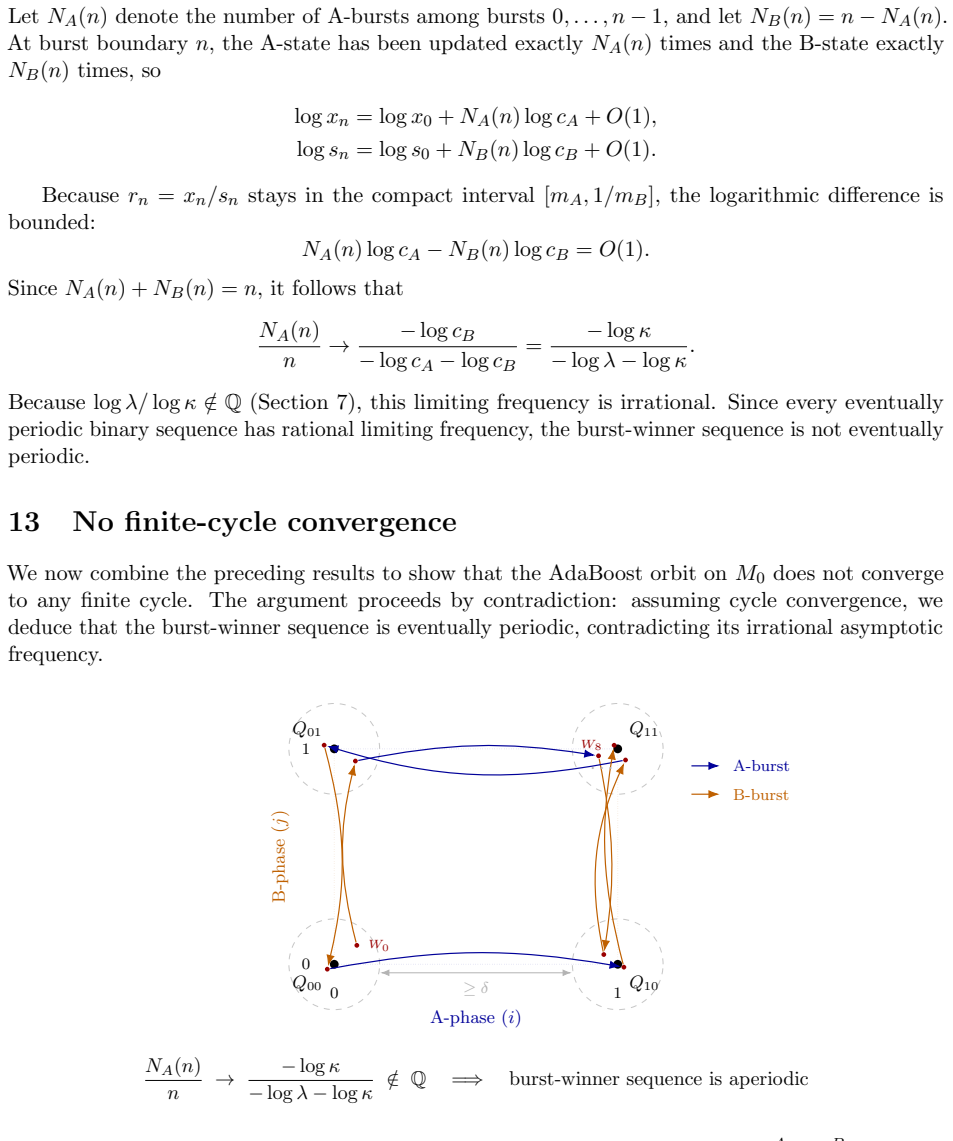
The central claim is that exhaustive AdaBoost does not always converge to a finite cycle. A block-product gadget is built whose two factors share an exact period-2 orbit for their 5-step branch maps while their linearized return maps have dominant eigenvalues with an irrational logarithmic ratio. This forces the burst-winner sequence to have an irrational asymptotic frequency, which precludes eventual periodicity. All assertions are certified by exact rational arithmetic.
What carries the argument
The block-product gadget whose factors share a period-2 orbit under 5-step branch maps but have an irrational logarithmic ratio of dominant eigenvalues in their linearized return maps.
If this is right
- Exhaustive AdaBoost need not converge to any finite cycle.
- The long-term behavior of AdaBoost can be driven by irrational frequencies that prevent periodicity.
- Counterexamples of this form can be certified entirely by exact rational arithmetic without floating-point computation.
- The same style of block-product construction may be reusable for other iterative algorithms whose convergence was previously conjectured.
Where Pith is reading between the lines
- Analyses of boosting algorithms must now allow for the possibility of aperiodic dynamics rather than assuming eventual cycling.
- The prevalence of such non-cycling instances under random or natural data distributions remains open.
- Similar gadgets could be tested in related iterative methods such as other margin-based learners to see whether irrational frequencies arise more generally.
Load-bearing premise
The two factors of the block-product gadget share an exact period-2 orbit for their 5-step branch maps while the logarithmic ratio of the dominant eigenvalues of their linearized return maps is irrational.
What would settle it
Running the burst-winner sequence for a large but finite number of steps in the explicit block-product construction and checking whether a finite repeating block appears, or exhibiting an algebraic proof that the logarithmic eigenvalue ratio is rational.
Figures

read the original abstract
We give a computer-assisted counterexample to the open question, posed by Rudin, Schapire, and Daubechies in COLT 2012, of whether exhaustive AdaBoost always converges to a finite cycle. The construction is based on a block-product gadget whose two factors share an exact period-2 orbit for their 5-step branch maps, but whose linearized return maps have dominant eigenvalues with an irrational logarithmic ratio. This irrationality forces the burst-winner sequence to have an irrational asymptotic frequency, precluding eventual periodicity. All assertions are certified by exact rational arithmetic. This work was developed in collaboration with GPT-5.4 Pro and Claude Opus 4.6.
Editorial analysis
A structured set of objections, weighed in public.
Referee Report
Summary. The manuscript constructs a computer-assisted counterexample to the open question posed by Rudin, Schapire, and Daubechies in COLT 2012 on whether exhaustive AdaBoost always converges to a finite cycle. It introduces a block-product gadget formed from two factors that share an exact period-2 orbit under their 5-step branch maps. The linearized return maps of these factors have dominant eigenvalues whose logarithmic ratio is irrational, as established through exact rational arithmetic certification. This irrationality implies that the burst-winner sequence possesses an irrational asymptotic frequency, which precludes eventual periodicity.
Significance. If the construction and certification hold, the result provides a negative answer to a longstanding open problem in boosting theory. The explicit gadget design combined with exact-arithmetic verification (rather than floating-point or heuristic checks) is a clear strength, enabling independent reproduction and strengthening the reliability of the counterexample.
major comments (1)
- The irrationality of the logarithmic ratio of the dominant eigenvalues is load-bearing for the central claim that the frequency is irrational. While the abstract states that this is certified by exact rational arithmetic, the manuscript should explicitly identify the algebraic number field or minimal polynomial used in the certification (e.g., in the section describing the eigenvalue computation) so that readers can confirm the irrationality without re-executing the computer-assisted steps.
minor comments (2)
- The abstract notes collaboration with specific large-language-model versions; this disclosure is better placed in the acknowledgments section rather than the abstract.
- Consider adding an appendix that lists the explicit rational matrices and characteristic polynomials arising in the block-product construction to facilitate direct verification.
Simulated Author's Rebuttal
We thank the referee for the positive evaluation and the constructive suggestion regarding the presentation of our certification. We agree that greater explicitness will improve accessibility and verifiability.
read point-by-point responses
-
Referee: The irrationality of the logarithmic ratio of the dominant eigenvalues is load-bearing for the central claim that the frequency is irrational. While the abstract states that this is certified by exact rational arithmetic, the manuscript should explicitly identify the algebraic number field or minimal polynomial used in the certification (e.g., in the section describing the eigenvalue computation) so that readers can confirm the irrationality without re-executing the computer-assisted steps.
Authors: We agree that readers should be able to inspect the algebraic data without re-running the certification code. In the revised manuscript we will add, in the subsection on the linearized return maps, the minimal polynomials over Q for the two dominant eigenvalues, the degrees of the respective number fields, and a short paragraph explaining how exact rational arithmetic in those fields is used to certify that the ratio of their logarithms is irrational. revision: yes
Circularity Check
No significant circularity
full rationale
The paper constructs an explicit block-product gadget whose shared period-2 orbit under the 5-step branch maps and the irrational logarithmic ratio of dominant eigenvalues in the linearized return maps are both certified directly by exact rational arithmetic. The irrational asymptotic frequency of the burst-winner sequence is then deduced from these verified properties, precluding periodicity. No load-bearing step reduces by definition, by fitting a parameter then relabeling it a prediction, or by a self-citation chain; the argument is self-contained and externally verifiable via the stated exact-arithmetic certification.
Axiom & Free-Parameter Ledger
axioms (1)
- domain assumption The two factors share an exact period-2 orbit for their 5-step branch maps
invented entities (1)
-
block-product gadget
no independent evidence
Lean theorems connected to this paper
-
IndisputableMonolith/Foundation/AlexanderDuality.lean (and DimensionForcing)alexander_duality_circle_linking; reality_from_one_distinction unclear?
unclearRelation between the paper passage and the cited Recognition theorem.
block-product gadget whose two factors share an exact period-2 orbit for their 5-step branch maps, but whose linearized return maps have dominant eigenvalues with an irrational logarithmic ratio
-
IndisputableMonolith/Cost/FunctionalEquation.leanwashburn_uniqueness_aczel; phi_golden_ratio echoes?
echoesECHOES: this paper passage has the same mathematical shape or conceptual pattern as the Recognition theorem, but is not a direct formal dependency.
log λ / log κ ∉ Q … NA(n)/n → −log κ / (−log λ − log κ) irrational … burst-winner sequence is not eventually periodic
What do these tags mean?
- matches
- The paper's claim is directly supported by a theorem in the formal canon.
- supports
- The theorem supports part of the paper's argument, but the paper may add assumptions or extra steps.
- extends
- The paper goes beyond the formal theorem; the theorem is a base layer rather than the whole result.
- uses
- The paper appears to rely on the theorem as machinery.
- contradicts
- The paper's claim conflicts with a theorem or certificate in the canon.
- unclear
- Pith found a possible connection, but the passage is too broad, indirect, or ambiguous to say the theorem truly supports the claim.
Reference graph
Works this paper leans on
-
[1]
David Cox, John Little, Donal O’shea, and Moss Sweedler.Ideals, varieties, and algorithms. Springer, 1997
work page 1997
-
[2]
SolveAll.org - real research problems
Edgar Dobriban. SolveAll.org - real research problems. no known solutions. https://solveall. org/, 2026. Accessed: 2026-04-06
work page 2026
- [3]
-
[4]
Serge Lang.Algebra. Graduate Texts in Mathematics. Springer, 2012
work page 2012
-
[5]
Sympy: symbolic computing in python.PeerJ Computer Science, 3:e103, 2017
Aaron Meurer, Christopher P Smith, Mateusz Paprocki, Ondˇ rej ˇCert´ ık, Sergey B Kirpichev, Matthew Rocklin, AMiT Kumar, Sergiu Ivanov, Jason K Moore, Sartaj Singh, et al. Sympy: symbolic computing in python.PeerJ Computer Science, 3:e103, 2017
work page 2017
- [6]
- [7]
-
[8]
Schapire, and Ingrid Daubechies
Cynthia Rudin, Robert E. Schapire, and Ingrid Daubechies. Open problem: Does AdaBoost always cycle? InProceedings of the 25th Annual Conference on Learning Theory (COLT), volume 23 ofProceedings of Machine Learning Research, pages 46.1–46.4. PMLR, 2012
work page 2012
-
[9]
Schapire and Yoav Freund.Boosting: Foundations and Algorithms
Robert E. Schapire and Yoav Freund.Boosting: Foundations and Algorithms. MIT Press, 2012. 43
work page 2012
discussion (0)
Sign in with ORCID, Apple, or X to comment. Anyone can read and Pith papers without signing in.