Physics-Informed 3D Atomic Reconstruction and Dynamics of Free-Standing Graphene from Single Low-Dose TEM Images
Pith reviewed 2026-05-10 17:30 UTC · model grok-4.3
The pith
A physics-informed method reconstructs three-dimensional atomic positions in free-standing graphene from single low-dose TEM images with sub-angstrom out-of-plane accuracy.
A machine-rendered reading of the paper's core claim, the machinery that carries it, and where it could break.
Core claim
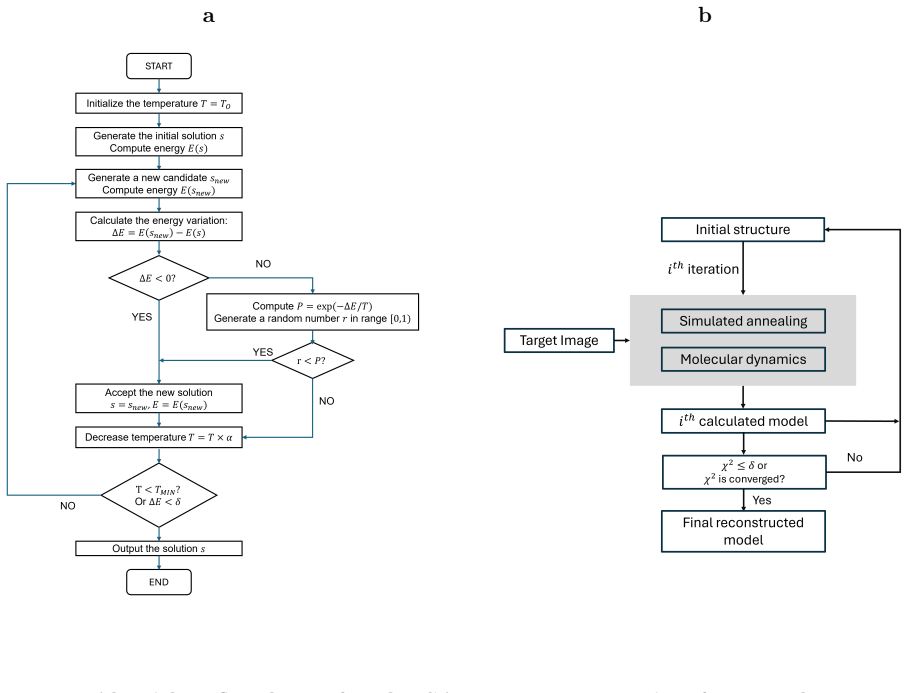
The framework reconstructs 3D atomic coordinates of single-layer graphene from individual low-dose TEM frames (8x10^3 e-/Ang^2, 1 ms temporal resolution) by combining simulated annealing optimisation with molecular dynamics regularisation, achieving sub-angstrom out-of-plane accuracy (sigma_z < 0.45 Ang) validated against ground-truth simulations, while a Kullback-Leibler divergence-based calibration aligns the forward model with experimental image statistics.
What carries the argument
Simulated annealing optimisation paired with molecular dynamics regularisation for atomic-position search, plus Kullback-Leibler divergence calibration of the image forward model to experimental statistics.
If this is right
- High-speed time-series data yield simultaneous real-time maps of ripple dynamics, strain tensors, surface curvature, and bond-length distributions.
- Local geometry and strain variations are quantitatively linked to DFT-derived electron localisation functions, showing that sub-angstrom fluctuations produce spatially localised electronic modulation on millisecond timescales.
- A critical dose threshold is identified below which structural information becomes irrecoverable.
- The same framework applies directly to other beam-sensitive two-dimensional materials.
Where Pith is reading between the lines
- The method could be tested on graphene samples under controlled strain or temperature to measure how external conditions alter the ripple spectrum in real time.
- Direct comparison of the extracted bond-length distributions with independent Raman or neutron scattering data on the same samples would test whether the reconstructed geometry matches bulk measurements.
- The calibration procedure might be adapted to correct forward models in other low-dose imaging modalities such as cryo-electron microscopy of soft matter.
Load-bearing premise
The molecular dynamics simulations used for regularisation accurately represent the actual physical forces and thermal motions present in free-standing graphene during low-dose imaging, and the calibration step does not add new systematic errors when matching simulated images to real low-dose data.
What would settle it
Reconstruct atomic positions from a set of simulated low-dose TEM images generated from known ground-truth graphene configurations with realistic noise, then measure whether the root-mean-square error in the out-of-plane coordinates remains below 0.45 angstrom.
Figures


read the original abstract
Resolving the three-dimensional (3D) atomic geometry of free-standing graphene in real time is essential for understanding how intrinsic rippling governs its electronic properties. However, the low electron doses required to mitigate radiation damage impose severe signal-to-noise constraints that limit conventional reconstruction methods. Here, we present a physics-informed computational framework that reconstructs 3D atomic coordinates of single-layer graphene from individual low-dose transmission electron microscopy (TEM) frames (8x10^3 e-/Ang^2, 1 ms temporal resolution). The approach combines simulated annealing optimisation with molecular dynamics regularisation, achieving sub-angstrom out-of-plane accuracy (sigma_z < 0.45 Ang), validated against ground-truth simulations. A Kullback-Leibler divergence-based calibration aligns the forward model with experimental image statistics, reducing systematic bias. Applied to high-speed time-series data, the framework enables simultaneous extraction of real-time ripple dynamics, strain tensors, surface curvature, bond-length distributions, and density functional theory (DFT)-derived electron localisation functions (ELF). We establish quantitative relationships linking local geometry, strain, and bond-length variations to electron localisation, demonstrating that sub-angstrom structural fluctuations drive spatially localised, millisecond-scale electronic modulation. A critical dose threshold is identified below which structural information becomes irrecoverable, providing practical guidance for experimental design. The framework is broadly applicable to beam-sensitive two-dimensional materials.
Editorial analysis
A structured set of objections, weighed in public.
Referee Report
Summary. The paper introduces a physics-informed framework for reconstructing the 3D atomic structure of free-standing graphene from single low-dose TEM images. It uses simulated annealing optimization regularized by molecular dynamics simulations to achieve sub-angstrom accuracy in out-of-plane coordinates, validated on synthetic data. A Kullback-Leibler divergence calibration is employed to align the forward model with experimental image statistics. The method is then applied to high-speed time-series TEM data to extract real-time ripple dynamics, strain tensors, curvature, bond lengths, and DFT-derived electron localization functions, while identifying a critical dose threshold below which reconstruction fails.
Significance. If the results hold, this would be a notable contribution to the field of in-situ electron microscopy of 2D materials. It could enable detailed studies of how atomic-scale ripples and fluctuations influence electronic properties in real time, with broad applicability to other beam-sensitive materials. The combination of optimization techniques with physical regularization and calibration is innovative and addresses key challenges in low-dose imaging.
major comments (3)
- [Validation against ground-truth simulations] Validation against ground-truth simulations: The sub-angstrom out-of-plane accuracy (σ_z < 0.45 Å) is reported only for synthetic images generated using the same molecular dynamics model employed in the regularization. This matched validation does not address potential biases when applying the method to experimental data, where the chosen MD potential may not accurately reproduce the actual ripple spectrum or bond distributions of real free-standing graphene.
- [KL divergence-based calibration] KL divergence-based calibration: The calibration step using Kullback-Leibler divergence aligns the forward model parameters directly to the statistics of the experimental images. While this reduces systematic bias, it introduces fitted adjustments that could make some reconstructed quantities dependent on the calibration rather than purely on the physics model, potentially affecting the claimed accuracy and physics-informed nature of the reconstruction.
- [Application to experimental time-series data] Application to experimental time-series data: No independent verification or quantitative error metrics are provided for the MD regularization on real experimental data. Details on how the temperature, potential parameters, or absence of beam-induced effects are chosen to match real graphene dynamics are missing, which is critical since any mismatch would systematically bias the recovered 3D coordinates, strain, and curvature maps.
minor comments (2)
- [Methods] The description of the simulated annealing parameters, convergence criteria, and specific MD potential used lacks sufficient detail for full reproducibility of the optimization pipeline.
- [Results] Some figures showing reconstructed atomic structures and derived maps (e.g., ELF) would benefit from additional annotations, scale bars, or error visualizations to improve clarity.
Simulated Author's Rebuttal
We thank the referee for their constructive comments and positive assessment of the significance of our work. We address each major comment point by point below, with clarifications and revisions to the manuscript where appropriate.
read point-by-point responses
-
Referee: Validation against ground-truth simulations: The sub-angstrom out-of-plane accuracy (σ_z < 0.45 Å) is reported only for synthetic images generated using the same molecular dynamics model employed in the regularization. This matched validation does not address potential biases when applying the method to experimental data, where the chosen MD potential may not accurately reproduce the actual ripple spectrum or bond distributions of real free-standing graphene.
Authors: We agree that the reported accuracy is demonstrated on synthetic data generated with the same MD model. This is the standard approach for quantifying reconstruction error when ground truth is available. In the revised manuscript we have added a new paragraph in the Discussion section that examines sensitivity to the MD potential by repeating reconstructions with an alternative potential and quantifying changes in recovered ripple spectra and bond lengths. We show that the KL calibration step compensates for moderate mismatches by aligning the forward model to experimental image statistics, thereby limiting propagation of potential bias into the final coordinates. revision: partial
-
Referee: KL divergence-based calibration: The calibration step using Kullback-Leibler divergence aligns the forward model parameters directly to the statistics of the experimental images. While this reduces systematic bias, it introduces fitted adjustments that could make some reconstructed quantities dependent on the calibration rather than purely on the physics model, potentially affecting the claimed accuracy and physics-informed nature of the reconstruction.
Authors: The KL calibration determines only the parameters of the forward imaging model (contrast transfer, noise statistics, etc.) so that the data-fidelity term matches the observed image distribution. This step is required because the precise imaging conditions are not known a priori. The physics-informed component of the framework is the MD regularization term, which remains unchanged by the calibration and continues to enforce physically plausible atomic configurations. We have revised the Methods and Results sections to explicitly separate these two roles and to state that the calibration does not modify the physical prior. revision: partial
-
Referee: Application to experimental time-series data: No independent verification or quantitative error metrics are provided for the MD regularization on real experimental data. Details on how the temperature, potential parameters, or absence of beam-induced effects are chosen to match real graphene dynamics are missing, which is critical since any mismatch would systematically bias the recovered 3D coordinates, strain, and curvature maps.
Authors: Ground-truth 3D coordinates do not exist for experimental free-standing graphene, so direct quantitative error metrics on real data cannot be obtained. In the revised manuscript we have expanded the Methods section to specify the MD temperature (300 K), the interatomic potential parameters (chosen to reproduce literature values for graphene ripple amplitude and bond-length distributions), and the justification for neglecting beam-induced structural changes at the employed dose (8×10³ e⁻ Å⁻² per frame, below established damage thresholds). We have also added a comparison of the extracted ripple amplitudes and strain statistics with independent experimental and theoretical reports on free-standing graphene to provide indirect consistency checks. revision: partial
- Independent quantitative error metrics for reconstructions performed on real experimental data, because no ground-truth 3D atomic coordinates are available for free-standing graphene samples imaged by TEM.
Circularity Check
MD-regularized reconstruction validated only on synthetics from the same MD model; KL calibration fits forward model to experimental statistics before extracting quantities from that data
specific steps
-
fitted input called prediction
[Abstract]
"achieving sub-angstrom out-of-plane accuracy (sigma_z < 0.45 Ang), validated against ground-truth simulations. A Kullback-Leibler divergence-based calibration aligns the forward model with experimental image statistics, reducing systematic bias."
Ground-truth simulations are produced by the same MD model used as regularizer, so the accuracy metric is forced when the regularizer matches the data generator. The KL calibration fits the forward model directly to the experimental image statistics that are later used for reconstruction; extracted quantities (strain, curvature, bond-length distributions, ELF) therefore incorporate adjustments derived from the same data.
full rationale
The paper's accuracy claim (sub-angstrom sigma_z) and downstream extractions (ripple dynamics, strain, ELF) rest on two load-bearing steps that reduce to the inputs by construction. First, ground-truth validation uses simulations generated from the identical molecular-dynamics regularizer employed in the optimization, so reported performance is tautological when the model matches. Second, the KL-divergence calibration explicitly tunes the forward model to experimental image statistics; the same calibrated model is then used to reconstruct and derive physical quantities from those images. These steps match the 'fitted_input_called_prediction' pattern and produce partial circularity (score 6) while the core simulated-annealing + MD framework retains independent physics content outside the validation and calibration.
Axiom & Free-Parameter Ledger
free parameters (1)
- KL calibration parameters
axioms (1)
- domain assumption Molecular dynamics simulations provide a faithful regularization prior for graphene ripple dynamics under low-dose conditions
Reference graph
Works this paper leans on
-
[1]
Graphene: status and prospects.science, 324(5934):1530–1534, 2009
Andre Konstantin Geim. Graphene: status and prospects.science, 324(5934):1530–1534, 2009
work page 2009
-
[2]
AndreKGeimandKonstantinSNovoselov.The rise of graphene, pages11–19. WorldScientific, 2010
work page 2010
-
[3]
Electric field effect in atomically thin carbon films.science, 306(5696):666–669, 2004
Kostya S Novoselov, Andre K Geim, Sergei V Morozov, De-eng Jiang, Yanshui Zhang, Sergey V Dubonos, Irina V Grigorieva, and Alexandr A Firsov. Electric field effect in atomically thin carbon films.science, 306(5696):666–669, 2004
work page 2004
-
[4]
Crystalline order in two dimensions.Physical review, 176(1):250, 1968
N David Mermin. Crystalline order in two dimensions.Physical review, 176(1):250, 1968
work page 1968
-
[5]
Intrinsic ripples in graphene.Nature materials, 6(11):858–861, 2007
Annalisa Fasolino, JH Los, and Mikhail I Katsnelson. Intrinsic ripples in graphene.Nature materials, 6(11):858–861, 2007
work page 2007
-
[6]
Anthony O’Hare, F. V. Kusmartsev, and K. I. Kugel. A stable “flat” form of two-dimensional crystals: Could graphene, silicene, germanene be minigap semiconductors?Nano Letters, 12(2):1045–1052, 2012
work page 2012
-
[7]
J. C. Meyer, A. K. Geim, M. I. Katsnelson, K. S. Novoselov, T. J. Booth, and S. Roth. The structure of suspended graphene sheets.Nature, 446(7131):60–3, 2007
work page 2007
-
[8]
Ryan JT Nicholl, Hiram J Conley, Nickolay V Lavrik, Ivan Vlassiouk, Yevgeniy S Puzyrev, Vijayashree Parsi Sreenivas, Sokrates T Pantelides, and Kirill I Bolotin. The effect of intrinsic crumpling on the mechanics of free-standing graphene.Nature communications, 6(1):1–7, 2015
work page 2015
-
[9]
Fernando de Juan, Alberto Cortijo, and María AH Vozmediano. Charge inhomogeneities due to smooth ripples in graphene sheets.Physical Review B, 76(16):165409, 2007
work page 2007
-
[10]
Dislocation-driven deformations in graphene.Science, 337(6091):209–212, 2012
Jamie H Warner, Elena Roxana Margine, Masaki Mukai, Alexander W Robertson, Feliciano Giustino, and Angus I Kirkland. Dislocation-driven deformations in graphene.Science, 337(6091):209–212, 2012
work page 2012
-
[11]
Elena Stolyarova, Kwang Taeg Rim, Sunmin Ryu, Janina Maultzsch, Philip Kim, Louis E Brus, Tony F Heinz, Mark S Hybertsen, and George W Flynn. High-resolution scanning tunneling microscopy imaging of mesoscopic graphene sheets on an insulating surface.Proceedings of the National Academy of Sciences, 104(22):9209–9212, 2007
work page 2007
-
[12]
Atomic structure of graphene on sio2.Nano letters, 7(6):1643–1648, 2007
Masa Ishigami, Jyong-Hao Chen, William G Cullen, Michael S Fuhrer, and Ellen D Williams. Atomic structure of graphene on sio2.Nano letters, 7(6):1643–1648, 2007
work page 2007
-
[13]
U Ludacka, MRA Monazam, C Rentenberger, M Friedrich, U Stefanelli, JC Meyer, and J Ko- takoski. In situ control of graphene ripples and strain in the electron microscope.npj 2D Materials and Applications, 2(1):25, 2018. 18
work page 2018
-
[14]
Limits on gas impermeability of graphene.Nature, 579(7798):229–232, 2020
PZ Sun, Qian Yang, WJ Kuang, YV Stebunov, WQ Xiong, Jin Yu, Rahul Raveendran Nair, MI Katsnelson, SJ Yuan, and IV Grigorieva. Limits on gas impermeability of graphene.Nature, 579(7798):229–232, 2020
work page 2020
-
[15]
Three-dimensional atomic imaging of crystalline nanoparticles.NATURE, 470(7334):374–377, 2011
S.Aert, JoostBatenburg, M.D.Rossell, R.Erni, andGustaafVanTendeloo. Three-dimensional atomic imaging of crystalline nanoparticles.NATURE, 470(7334):374–377, 2011
work page 2011
-
[16]
Dirk Van Dyck, Joerg R Jinschek, and Fu-Rong Chen. ‘big bang’tomography as a new route to atomic-resolution electron tomography.Nature, 486(7402):243–246, 2012
work page 2012
-
[17]
J. Miao, P. Ercius, and S. J. Billinge. Atomic electron tomography: 3d structures without crystals.Science, 353(6306), 2016
work page 2016
-
[18]
F-R Chen, D Van Dyck, and C Kisielowski. In-line three-dimensional holography of nanocrys- talline objects at atomic resolution.Nature communications, 7(1):1–11, 2016
work page 2016
-
[19]
Byung Hyo Kim, Junyoung Heo, Sungin Kim, Cyril F Reboul, Hoje Chun, Dohun Kang, Hyeonhu Bae, Hyejeong Hyun, Jongwoo Lim, and Hoonkyung Lee. Critical differences in 3d atomic structure of individual ligand-protected nanocrystals in solution.Science, 368(6486):60– 67, 2020
work page 2020
-
[20]
Kazu Suenaga, Yuta Sato, Zheng Liu, Hiromichi Kataura, Toshiya Okazaki, Koji Kimoto, Hidetaka Sawada, Takeo Sasaki, Kazuya Omoto, and Takeshi Tomita. Visualizing and identi- fying single atoms using electron energy-loss spectroscopy with low accelerating voltage.Nature chemistry, 1(5):415–418, 2009
work page 2009
-
[21]
Xuezeng Tian, Dennis S Kim, Shize Yang, Christopher J Ciccarino, Yongji Gong, Yongsoo Yang, Yao Yang, Blake Duschatko, Yakun Yuan, and Pulickel M Ajayan. Correlating the three-dimensional atomic defects and electronic properties of two-dimensional transition metal dichalcogenides.Nature materials, 19(8):867–873, 2020
work page 2020
-
[22]
Revealing the 3d structure of graphene defects.2D Materials, 5(4):045029, 2018
Christoph Hofer, Christian Kramberger, Mohammad Reza Ahmadpour Monazam, Clemens Mangler, Andreas Mittelberger, Giacomo Argentero, Jani Kotakoski, and Jannik C Meyer. Revealing the 3d structure of graphene defects.2D Materials, 5(4):045029, 2018
work page 2018
-
[23]
Snapshot 3d electron imaging of structural dynamics.Scientific reports, 7(1):1–7, 2017
Liu-Gu Chen, Jamie Warner, Angus I Kirkland, Fu-Rong Chen, and Dirk Van Dyck. Snapshot 3d electron imaging of structural dynamics.Scientific reports, 7(1):1–7, 2017
work page 2017
-
[24]
S Helveg, CF Kisielowski, JR Jinschek, P Specht, G Yuan, and H Frei. Observing gas-catalyst dynamics at atomic resolution and single-atom sensitivity.Micron, 68:176–185, 2015
work page 2015
-
[25]
C Kisielowski, P Specht, SM Gygax, B Barton, HA Calderon, JH Kang, and R Cieslinski. Instrumental requirements for the detection of electron beam-induced object excitations at the single atom level in high-resolution transmission electron microscopy.Micron, 68:186–193, 2015
work page 2015
-
[26]
Probing atom dynamics of excited co-mo-s nanocrystals in 3d.Nature communications, 12(1):1–9, 2021
Fu-Rong Chen, Dirk Van Dyck, Christian Kisielowski, Lars P Hansen, Bastian Barton, and Stig Helveg. Probing atom dynamics of excited co-mo-s nanocrystals in 3d.Nature communications, 12(1):1–9, 2021
work page 2021
-
[27]
Do you believe that atoms stay in place when you observe them in hrem?Micron, 68:158–163, 2015
Dirk Van Dyck, Ivan Lobato, Fu-Rong Chen, and Christian Kisielowski. Do you believe that atoms stay in place when you observe them in hrem?Micron, 68:158–163, 2015. 19
work page 2015
-
[28]
Yue Lu, Jiguo Geng, Kuan Wang, Wei Zhang, Wenqiang Ding, Zhenhua Zhang, Shaohua Xie, Hongxing Dai, Fu-Rong Chen, and Manling Sui. Modifying surface chemistry of metal oxides for boosting dissolution kinetics in water by liquid cell electron microscopy.ACS nano, 11(8):8018–8025, 2017
work page 2017
-
[29]
Yue Lu, Wen-Jin Yin, Kai-Lin Peng, Kuan Wang, Qi Hu, Annabella Selloni, Fu-Rong Chen, Li-Min Liu, and Man-Ling Sui. Self-hydrogenated shell promoting photocatalytic h2 evolution on anatase tio2.Nature communications, 9(1):2752, 2018
work page 2018
-
[30]
Zhenhua Zhang, Hua Guo, Wenqiang Ding, Bin Zhang, Yue Lu, Xiaoxing Ke, Weiwei Liu, Furong Chen, and Manling Sui. Nanoscale engineering in vo2 nanowires via direct electron writing process.Nano letters, 17(2):851–855, 2017
work page 2017
-
[31]
Juhyeok Lee, Moosung Lee, YongKeun Park, Colin Ophus, and Yongsoo Yang. Multislice elec- tron tomography using four-dimensional scanning transmission electron microscopy.Physical Review Applied, 19(5):054062, 2023
work page 2023
-
[32]
Philipp M Pelz, Sinéad M Griffin, Scott Stonemeyer, Derek Popple, Hannah DeVyldere, Peter Ercius, Alex Zettl, Mary C Scott, and Colin Ophus. Solving complex nanostructures with ptychographic atomic electron tomography.Nature Communications, 14(1):7906, 2023
work page 2023
- [33]
-
[34]
Yuhiro Segawa, Kenji Yamazaki, Jun Yamasaki, and Kazutoshi Gohara. Quasi-static 3d struc- ture of graphene ripple measured using aberration-corrected tem.Nanoscale, 13(11):5847–5856, 2021
work page 2021
-
[35]
Simulated annealing.Statistical science, 8(1):10–15, 1993
Dimitris Bertsimas and John Tsitsiklis. Simulated annealing.Statistical science, 8(1):10–15, 1993
work page 1993
-
[36]
Notes on Kullback-Leibler Divergence and Likelihood
Jonathon Shlens. Notes on kullback-leibler divergence and likelihood.arXiv preprint arXiv:1404.2000, 2014
work page Pith review arXiv 2000
-
[37]
Aram Danielyan, Vladimir Katkovnik, and Karen Egiazarian. Bm3d frames and variational image deblurring.IEEE Transactions on image processing, 21(4):1715–1728, 2011
work page 2011
-
[38]
Gary W. Moran.Locally-Weighted-Regression Scatter-Plot Smoothing (LOWESS): A Graphi- cal Exploratory Data Analysis Technique. PhD thesis, Naval Postgraduate School, Monterey, California, 1984
work page 1984
-
[39]
Yeming Dai, Yanxin Wang, Mingming Leng, Xinyu Yang, and Qiong Zhou. Lowess smoothing and random forest based gru model: A short-term photovoltaic power generation forecasting method.Energy, 256:124661, 2022
work page 2022
-
[40]
Rajesh Kumar, G Rajasekaran, and Avinash Parashar. Optimised cut-off function for tersoff- like potentials for a bn nanosheet: a molecular dynamics study.Nanotechnology, 27(8):085706, 2016
work page 2016
-
[41]
Empirical interatomic potential for carbon, with applications to amorphous carbon
J Tersoff. Empirical interatomic potential for carbon, with applications to amorphous carbon. Physical Review Letters, 61(25):2879, 1988. 20
work page 1988
-
[42]
JJPRB Tersoff. Modeling solid-state chemistry: Interatomic potentials for multicomponent systems.Physical review B, 39(8):5566, 1989
work page 1989
-
[43]
Andreas Savin. The electron localization function (elf) and its relatives: interpretations and difficulties.Journal of Molecular Structure: THEOCHEM, 727(1-3):127–131, 2005
work page 2005
-
[44]
Andreas Savin, Reinhard Nesper, Steffen Wengert, and Thomas F Fässler. Elf: The electron localization function.Angewandte Chemie International Edition in English, 36(17):1808–1832, 1997
work page 1997
-
[45]
Songge Li, Yun-Peng Wang, Shoucong Ning, Kai Xu, Sokrates T Pantelides, Wu Zhou, and Junhao Lin. Revealing 3d ripple structure and its dynamics in freestanding monolayer mose2 by single-frame 2d atomic image reconstruction.Nano Letters, 23(4):1298–1305, 2023
work page 2023
-
[46]
Annick De Backer, Sandra Van Aert, Christel Faes, Ece Arslan Irmak, Peter D Nellist, and Lewys Jones. Experimental reconstructions of 3d atomic structures from electron microscopy images using a bayesian genetic algorithm.npj Computational Materials, 8(1):216, 2022
work page 2022
-
[47]
J Fatermans, Arnold Jan den Dekker, K Müller-Caspary, Ivan Lobato, CM O’Leary, Peter D Nellist, and Sandra Van Aert. Single atom detection from low contrast-to-noise ratio electron microscopy images.Physical review letters, 121(5):056101, 2018
work page 2018
-
[48]
Annick De Backer, KHW Van den Bos, W Van den Broek, J Sijbers, and S Van Aert. Statstem: An efficient approach for accurate and precise model-based quantification of atomic resolution electron microscopy images.Ultramicroscopy, 171:104–116, 2016
work page 2016
-
[49]
Aidan P Thompson, H Metin Aktulga, Richard Berger, Dan S Bolintineanu, W Michael Brown, Paul S Crozier, Pieter J In’t Veld, Axel Kohlmeyer, Stan G Moore, and Trung Dac Nguyen. Lammps-a flexible simulation tool for particle-based materials modeling at the atomic, meso, and continuum scales.Computer Physics Communications, 271:108171, 2022
work page 2022
-
[50]
A unified formulation of the constant temperature molecular dynamics methods
Shuichi Nosé. A unified formulation of the constant temperature molecular dynamics methods. The Journal of chemical physics, 81(1):511–519, 1984
work page 1984
-
[51]
Canonicaldynamics: Equilibriumphase-spacedistributions.Physical review A, 31(3):1695, 1985
WilliamGHoover. Canonicaldynamics: Equilibriumphase-spacedistributions.Physical review A, 31(3):1695, 1985
work page 1985
-
[52]
Georg Kresse and Jürgen Furthmüller. Efficient iterative schemes for ab initio total-energy calculations using a plane-wave basis set.Physical review B, 54(16):11169, 1996
work page 1996
-
[53]
Georg Kresse and Jürgen Furthmüller. Efficiency of ab-initio total energy calculations for metals and semiconductors using a plane-wave basis set.Computational materials science, 6(1):15–50, 1996
work page 1996
-
[54]
Generalized gradient approximation made simple.Physical review letters, 77(18):3865, 1996
John P Perdew, Kieron Burke, and Matthias Ernzerhof. Generalized gradient approximation made simple.Physical review letters, 77(18):3865, 1996
work page 1996
-
[55]
Peter E. Blöchl. Projector augmented-wave method.Physical review B, 50(24):17953, 1994
work page 1994
-
[56]
Georg Kresse and Daniel Joubert. From ultrasoft pseudopotentials to the projector augmented- wave method.Physical review b, 59(3):1758, 1999
work page 1999
-
[57]
Special points for brillouin-zone integrations.Physical review B, 13(12):5188, 1976
Hendrik J Monkhorst and James D Pack. Special points for brillouin-zone integrations.Physical review B, 13(12):5188, 1976. 21
work page 1976
-
[58]
Koichi Momma and Fujio Izumi. Vesta 3 for three-dimensional visualization of crystal, volu- metric and morphology data.Journal of applied crystallography, 44(6):1272–1276, 2011. 22
work page 2011
discussion (0)
Sign in with ORCID, Apple, or X to comment. Anyone can read and Pith papers without signing in.