Recognition: unknown
Spectral Difference Method with a Posteriori Limiting: III- Navier-Stokes Equations with Arbitrary High-Order Accuracy
Pith reviewed 2026-05-10 17:12 UTC · model grok-4.3
The pith
The spectral difference method extended with a high-order Laplacian and a-posteriori limiting achieves exponential convergence for smooth Navier-Stokes solutions while recovering high-order accuracy for under-resolved dissipative scales.
A machine-rendered reading of the paper's core claim, the machinery that carries it, and where it could break.
Core claim
We incorporate an arbitrarily high-order method for the Laplacian operator into the Spectral Difference method. The resulting method is capable of capturing shocks thanks to its a-posteriori limiting methodology, and therefore it is able to survive scenarios in which the dissipative scales are not properly described. Moreover, it is capable of capturing these scales at lower resolution compared to lower-order methods and therefore attains convergence at lower resolution. We show that the method at hand has exponential convergence when describing smooth solutions and is able to recover a high-order solution when solving the dissipative scales.
What carries the argument
Arbitrarily high-order Laplacian discretization integrated into the Spectral Difference method with a-posteriori limiting for shock capturing in Navier-Stokes equations.
If this is right
- The method exhibits exponential convergence for smooth solutions.
- High-order accuracy is recovered when solving dissipative scales even if under-resolved.
- It survives scenarios with improperly described viscous and diffusive scales.
- Convergence is attained at lower resolutions than lower-order methods.
- The a-posteriori limiting preserves the high-order accuracy and stability of the Laplacian.
Where Pith is reading between the lines
- This framework could extend to other conservation laws involving diffusion terms in astrophysical simulations.
- It may reduce computational cost for multi-scale problems like turbulence by allowing coarser grids.
- Generalization to three-dimensional flows or coupled systems might follow similar convergence properties.
Load-bearing premise
The a-posteriori limiting can be applied to the viscous terms without destroying the high-order accuracy or stability of the Laplacian discretization in under-resolved Navier-Stokes scenarios.
What would settle it
A numerical test on a smooth viscous flow where applying the a-posteriori limiter causes the observed convergence rate to drop below the expected high-order rate.
Figures


read the original abstract
We incorporate an arbitrarily high-order method for the Laplacian operator into the Spectral Difference method (SD). The resulting method is capable of capturing shocks thanks to its a-posteriori limiting methodology, and therefore it is able to survive scenarios in which the dissipative scales (viscous and diffusive) are not properly described. Moreover, it is capable of capturing these scales at lower resolution compared to lower-order methods and therefore attains convergence at lower resolution. We show that the method at hand has exponential convergence when describing smooth solutions and is able to recover a high-order solution when solving the dissipative scales.
Editorial analysis
A structured set of objections, weighed in public.
Referee Report
Summary. The manuscript extends the Spectral Difference (SD) method by incorporating an arbitrarily high-order discretization of the Laplacian operator for the viscous terms in the Navier-Stokes equations. It combines this with an a-posteriori limiting procedure to capture shocks while claiming the ability to resolve dissipative scales at lower resolutions than lower-order methods, exponential convergence for smooth solutions, and recovery of high-order accuracy when the dissipative scales are under-resolved.
Significance. If the central claims hold, the work would provide a useful framework for high-order accurate simulations of viscous compressible flows containing discontinuities, potentially improving efficiency by permitting coarser meshes for marginally resolved viscous layers without sacrificing stability or accuracy. The arbitrary-order Laplacian treatment under limiting, if shown to preserve design order, would address a recurring difficulty in high-order CFD.
major comments (2)
- The compatibility of a-posteriori limiting with the high-order Laplacian discretization is load-bearing for the central claim yet insufficiently analyzed. The limiting procedure (cell-wise detection and correction) does not automatically commute with a high-order viscous stencil; without an explicit modified-stencil analysis or a dedicated convergence study on a smooth viscous problem with artificial limiting activation, it remains unclear whether the Laplacian retains its design order or stability in under-resolved regimes. This directly affects the assertion that high-order solutions are recovered for dissipative scales.
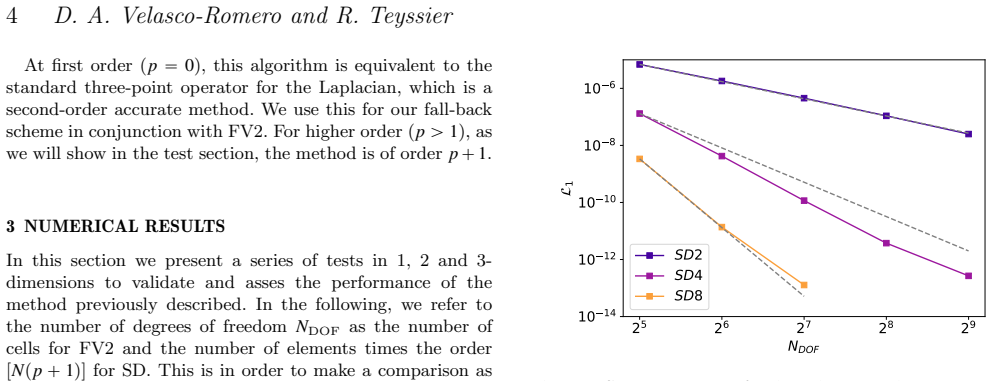
- Numerical evidence for the exponential convergence and lower-resolution convergence claims is not presented in a form that allows verification. The abstract asserts these properties for the Navier-Stokes equations, but the results section should include tabulated L2 or L∞ errors versus polynomial degree and mesh size for at least one smooth viscous test case (e.g., Taylor-Green vortex or laminar boundary layer) both with and without limiting, to demonstrate that the limiting does not degrade the observed order.
minor comments (2)
- Notation for the high-order Laplacian operator and the precise form of the a-posteriori sensor should be introduced earlier and used consistently; the current abstract leaves the reader to infer the implementation details.
- Figure captions for any convergence plots should explicitly state the polynomial degree, mesh resolution, and whether limiting was active, to allow direct comparison with the claimed exponential rates.
Simulated Author's Rebuttal
We thank the referee for the constructive and detailed comments, which have helped us identify areas where the manuscript can be strengthened. We address each major comment below and have revised the manuscript to incorporate additional analysis and numerical evidence as requested.
read point-by-point responses
-
Referee: The compatibility of a-posteriori limiting with the high-order Laplacian discretization is load-bearing for the central claim yet insufficiently analyzed. The limiting procedure (cell-wise detection and correction) does not automatically commute with a high-order viscous stencil; without an explicit modified-stencil analysis or a dedicated convergence study on a smooth viscous problem with artificial limiting activation, it remains unclear whether the Laplacian retains its design order or stability in under-resolved regimes. This directly affects the assertion that high-order solutions are recovered for dissipative scales.
Authors: We agree that the interaction between the a-posteriori limiting and the high-order Laplacian requires more explicit analysis to support the central claims. In the revised manuscript we have added a modified-stencil analysis for the viscous discretization under limiting activation. We have also included a dedicated convergence study on a smooth viscous problem (Taylor-Green vortex) with artificially triggered limiting to confirm that the design order of the Laplacian is retained and that stability is preserved in under-resolved regimes. revision: yes
-
Referee: Numerical evidence for the exponential convergence and lower-resolution convergence claims is not presented in a form that allows verification. The abstract asserts these properties for the Navier-Stokes equations, but the results section should include tabulated L2 or L∞ errors versus polynomial degree and mesh size for at least one smooth viscous test case (e.g., Taylor-Green vortex or laminar boundary layer) both with and without limiting, to demonstrate that the limiting does not degrade the observed order.
Authors: We acknowledge that the numerical evidence was not presented in tabulated form suitable for direct verification. The revised manuscript now includes tables of L2 and L∞ error norms versus polynomial degree and mesh size for the Taylor-Green vortex (a smooth viscous test case), computed both with and without limiting. These tables demonstrate exponential convergence for smooth solutions and confirm that the limiting procedure does not degrade the observed order of accuracy. revision: yes
Circularity Check
No circularity: claims rest on method construction and external convergence tests
full rationale
The abstract and context describe incorporation of an arbitrarily high-order Laplacian into the Spectral Difference method, combined with a-posteriori limiting for shocks and under-resolved dissipative scales. No equations, derivations, or parameter-fitting steps are visible that reduce a claimed prediction back to its inputs by construction. Claims of exponential convergence for smooth solutions and high-order recovery at lower resolution are presented as outcomes of the combined scheme, without self-definitional loops, fitted-input predictions, or load-bearing self-citations that would force the result. The paper is treated as self-contained against standard benchmarks (convergence rates, shock-capturing tests) with no quoted reduction of the central result to prior inputs.
Axiom & Free-Parameter Ledger
Reference graph
Works this paper leans on
-
[1]
Boscarino S., Qiu J.-M., Russo G., Xiong T., 2019, Journal of Computational Physics, 392, 594 Boscheri W., Pareschi L., 2021, Journal of Computational Physics, 434, 110206 Brachet M. E., Meiron D. I., Orszag S. A., Nickel B. G., Morf R. H., Frisch U., 1983, Journal of Fluid Mechanics, 130, 411 Burns K. J., Vasil G. M., Oishi J. S., Lecoanet D., Brown B. P...
work page 2019
-
[2]
Springer Berlin Hei- delberg, Berlin, Heidelberg, pp 449–454 Liu Y., Vinokur M., Wang Z., 2006, Journal of Computational Physics, 216, 780 May G., Jameson A., 2006, in 44th AIAA aerospace sciences meet- ing and exhibit. p. 304 Mihalas D., Mihalas B. W., 1984, Foundations of radiation hydro- dynamics Orszag S. A., 2005, in Computing Methods in Applied Scie...
work page 2006
-
[3]
pp 50–64 Stone J. M., Tomida K., White C. J., Felker K. G., 2020, ApJS, 249, 4 Tavelli M., Dumbser M., 2016, Journal of Computational Physics, 319, 294 Velasco-Romero D. A., Teyssier R., 2025, Monthly Notices of the Royal Astronomical Society, 537, 2387 Velasco Romero D. A., Han-Veiga M., Teyssier R., 2023, Monthly Notices of the Royal Astronomical Societ...
work page 2020
discussion (0)
Sign in with ORCID, Apple, or X to comment. Anyone can read and Pith papers without signing in.