Systematics of characteristics of pygmy dipole resonances in medium-heavy and heavy atomic nuclei with neutron excess
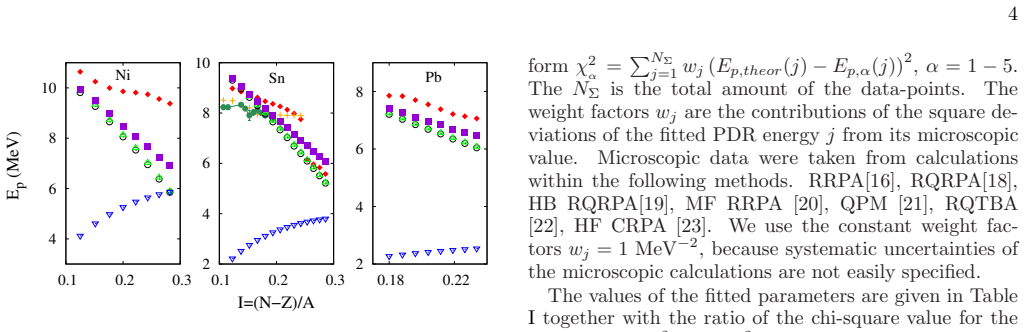
Pith reviewed 2026-05-10 17:02 UTC · model grok-4.3
The pith
A modified macroscopic model reproduces pygmy dipole resonance energies in neutron-rich nuclei when the neutron-proton interaction strength is tripled.
A machine-rendered reading of the paper's core claim, the machinery that carries it, and where it could break.
Core claim
Within the PR INW approach the dependence of pygmy dipole resonance energies on neutron excess agrees rather well with experimental data and microscopic calculations for chains of Ni, Sn and Pb isotopes provided the absolute value of the neutron-proton interaction strength is nearly three times as large as that obtained by Isacker-Nagarajan-Warner. The PR MSR approach supplies analytical expressions for the PDR fraction of the E1 energy-weighted sum rule by treating the number of surface neutrons as a function of neutron skin thickness. The macroscopic model captures the main features of the PDR, yet the required adjustment in interaction strength does not allow the conclusion that the PDR 1
What carries the argument
The PR INW approach, which scales the number of surface neutrons directly with neutron skin thickness according to the Pethick-Ravenhall expression inside the modified Isacker-Nagarajan-Warner model, together with the PR MSR approach that yields closed-form expressions for the PDR share of the E1 energy-weighted sum rule.
If this is right
- PDR energies rise with neutron excess according to a trend that the adjusted macroscopic model reproduces for the studied isotopic chains.
- Closed analytical formulas give the PDR fraction of the E1 EWSR once the surface-neutron scaling is inserted.
- Fitted parameters from the PR MSR expressions supply ready estimates of the PDR contribution for other medium-heavy and heavy nuclei.
- The macroscopic description supplies a computationally light alternative to full microscopic calculations for estimating PDR properties in nuclei with large neutron excess.
Where Pith is reading between the lines
- If the tripling of interaction strength is required, it may signal stronger surface isovector coupling in neutron-rich nuclei than volume-integral estimates capture.
- The explicit tie between skin thickness and surface neutrons suggests that improved neutron-skin measurements could be used to refine PDR predictions.
- Applying the same scaling to unmeasured exotic isotopes could generate testable forecasts for upcoming radioactive-beam experiments.
Load-bearing premise
That tripling the neutron-proton interaction strength and scaling surface neutrons with neutron skin thickness supplies a physically justified description rather than an adjustment that compensates for missing microscopic physics.
What would settle it
A precise measurement of the pygmy dipole resonance energy in an isotope such as 132Sn that lies significantly outside the narrow band predicted by the PR INW model with the tripled interaction strength.
Figures




read the original abstract
The systematics of energies and the contribution of pygmy dipole resonance (PDR) to the energy-weighted sum rule of dipole gamma transitions in medium-heavy and heavy nuclei with an excess of neutrons are considered. The modified macroscopic model of Isacker-Nagarajan-Warner was used for calculating PDR energies with the number of surface neutrons proportional to the thickness of the neutron skin according to the Pethick- Ravenhall expression (PR INW approach). Such modification of the macroscopic approach by Isacker-Nagarajan-Warner enables to take into account microscopic evidence of direct relationship between skin thickness and low-energy dipole response. The results are compared with the microscopic calculations for the chains of Ni, Sn and Pb isotopes. It was demonstrated that the dependence of the magnitudes of the energies within the PR INW approach on neutron excess is in rather good agreement with experimental data and microscopic calculations if the absolute value of the strength of the neutron-proton interaction is nearly three times as large as that obtained by Isacker-Nagarajan-Warner by the volume integral of the nucleon-nucleon interaction. While the macroscopic INW PR model can describe the main features of the PDR, above mentioned discrepancy of the strength values doesn't not provide reason enough for the conclusion that PDR is pure collective state. The analytical expressions for the PDR fraction of the energy-weighted sum rule for electric dipole transitions (E1 EWSR) are used. They are based on the "molecular" energy-weighted E1 sum rule considering the number of surface neutrons as a function of the neutron thickness (PR MSR approach). Systematics for the PDR fraction of E1 EWSR are proposed with parameters obtained by fitting the experimental data and microscopic calculations.
Editorial analysis
A structured set of objections, weighed in public.
Referee Report
Summary. The manuscript proposes a modified macroscopic Isacker-Nagarajan-Warner (INW) model for pygmy dipole resonances (PDR) in neutron-rich nuclei. By scaling the number of surface neutrons with neutron-skin thickness via the Pethick-Ravenhall expression (PR INW approach), it computes PDR energies and reports that the neutron-excess dependence agrees with experimental data and microscopic calculations for Ni, Sn, and Pb chains only when the neutron-proton interaction strength is increased by a factor of approximately three relative to the original INW volume-integral value. Analytical expressions for the PDR fraction of the E1 energy-weighted sum rule (EWSR) are also derived within a 'molecular' sum-rule framework (PR MSR), with parameters fitted to data and calculations.
Significance. If the large rescaling of the interaction strength can be independently justified, the PR INW approach could supply a simple macroscopic route to PDR energy systematics that incorporates microscopic evidence linking skin thickness to low-energy dipole strength. The EWSR expressions similarly aim to provide practical systematics. However, the necessity of the factor-of-three adjustment and post-hoc fitting reduces the model's predictive power and raises questions about whether missing physics (e.g., collective-single-particle mixing or surface isovector terms) is being compensated rather than captured.
major comments (3)
- [Abstract / Results] Abstract and main results: The central claim of 'rather good agreement' for the neutron-excess dependence of PDR energies holds only after increasing the absolute value of the neutron-proton interaction strength by a factor of ~3 relative to the original INW value. No derivation, external constraint, or physical motivation is supplied for this rescaling; it is introduced solely to restore agreement. The manuscript should explicitly compare results obtained with the original INW strength to quantify how much of the reported agreement is attributable to the PR skin-thickness scaling alone versus the additional free parameter.
- [EWSR systematics] EWSR section: The parameters entering the PR MSR analytical expressions for the PDR fraction of the E1 EWSR are obtained by fitting experimental data and microscopic calculations. The fitting procedure (number of free parameters, functional form, data sets used, and resulting uncertainties) is not detailed, making it impossible to assess whether the proposed systematics are robust or overfitted.
- [Discussion / Conclusions] Discussion: The paper correctly notes that the strength discrepancy precludes concluding that the PDR is a pure collective state, yet the abstract and conclusions still present the scaled model as successfully describing the main features. A quantitative sensitivity analysis (e.g., variation of the strength factor by ±20 %) is needed to substantiate how load-bearing the PR modification remains once the ad-hoc scaling is removed.
minor comments (3)
- [Abstract] Abstract contains a clear grammatical error: 'doesn't not provide' should read 'does not provide'.
- [Methods] Notation for the interaction strength (volume integral vs. absolute value) and the precise definition of the factor-of-three rescaling should be stated explicitly in the methods section for reproducibility.
- [Figures] If figures compare PR INW results to data and microscopic calculations, they should include a panel or table showing the same quantities computed with the original (unscaled) INW strength to illustrate the effect of the adjustment.
Simulated Author's Rebuttal
We thank the referee for the constructive and detailed report. The comments highlight important points regarding the presentation of the PR INW rescaling, the EWSR fitting procedure, and the balance between the model's achievements and limitations. We address each major comment below and indicate the revisions we will implement.
read point-by-point responses
-
Referee: [Abstract / Results] Abstract and main results: The central claim of 'rather good agreement' for the neutron-excess dependence of PDR energies holds only after increasing the absolute value of the neutron-proton interaction strength by a factor of ~3 relative to the original INW value. No derivation, external constraint, or physical motivation is supplied for this rescaling; it is introduced solely to restore agreement. The manuscript should explicitly compare results obtained with the original INW strength to quantify how much of the reported agreement is attributable to the PR skin-thickness scaling alone versus the additional free parameter.
Authors: We agree that the factor-of-three rescaling is an empirical adjustment introduced to restore quantitative agreement with data and microscopic calculations. The PR modification itself is motivated by the established microscopic connection between neutron-skin thickness and low-energy dipole strength, which is the central innovation of the approach. To quantify the separate contributions, we will add explicit comparisons in the revised manuscript: PDR energies computed with the original INW strength (both with and without the PR skin-thickness scaling) versus the scaled strength. This will show that the PR scaling improves the neutron-excess trend even before the overall strength adjustment, while the factor of three primarily corrects the absolute energy scale. We will also expand the discussion to note possible physical origins of the rescaling, such as the effective surface character of the interaction or missing isovector surface terms, although a first-principles derivation lies outside the macroscopic framework. revision: yes
-
Referee: [EWSR systematics] EWSR section: The parameters entering the PR MSR analytical expressions for the PDR fraction of the E1 EWSR are obtained by fitting experimental data and microscopic calculations. The fitting procedure (number of free parameters, functional form, data sets used, and resulting uncertainties) is not detailed, making it impossible to assess whether the proposed systematics are robust or overfitted.
Authors: We accept that the fitting details were not sufficiently documented. In the revised manuscript we will expand the relevant section to specify: (i) the exact data sets employed (experimental PDR EWSR fractions for Ni, Sn and Pb isotopes together with the corresponding microscopic results from the literature), (ii) the functional form derived from the molecular sum-rule framework with the PR neutron-skin dependence, (iii) the number of free parameters (two adjustable coefficients), and (iv) the uncertainties obtained from the least-squares fit. These additions will allow readers to judge the robustness of the proposed systematics. revision: yes
-
Referee: [Discussion / Conclusions] Discussion: The paper correctly notes that the strength discrepancy precludes concluding that the PDR is a pure collective state, yet the abstract and conclusions still present the scaled model as successfully describing the main features. A quantitative sensitivity analysis (e.g., variation of the strength factor by ±20 %) is needed to substantiate how load-bearing the PR modification remains once the ad-hoc scaling is removed.
Authors: We acknowledge the tonal inconsistency between the cautious discussion and the more affirmative statements in the abstract and conclusions. We will revise both the abstract and the conclusions to state more precisely that the neutron-excess dependence is reproduced once the interaction strength is scaled, while underscoring the remaining discrepancy in absolute strength. In addition, we will include a quantitative sensitivity study in which the interaction-strength factor is varied by ±20 % around the adopted value; the resulting PDR energy trends for the Ni, Sn and Pb chains will be shown to demonstrate that the qualitative neutron-excess dependence remains stable under the PR modification. revision: yes
Circularity Check
PDR energy dependence and EWSR systematics rely on fitted n-p strength and parameters
specific steps
-
fitted input called prediction
[Abstract]
"It was demonstrated that the dependence of the magnitudes of the energies within the PR INW approach on neutron excess is in rather good agreement with experimental data and microscopic calculations if the absolute value of the strength of the neutron-proton interaction is nearly three times as large as that obtained by Isacker-Nagarajan-Warner by the volume integral of the nucleon-nucleon interaction."
The reported agreement is shown only after explicitly scaling the interaction strength parameter by a factor of approximately three; without this tuning the model does not match, so the demonstration reduces to a fit of the adjustable input rather than a first-principles prediction.
-
fitted input called prediction
[Abstract]
"Systematics for the PDR fraction of E1 EWSR are proposed with parameters obtained by fitting the experimental data and microscopic calculations."
The proposed systematics and their parameters are obtained directly by fitting to the experimental data and microscopic results used for validation, rendering the systematics equivalent to a reparametrization of the inputs by construction.
full rationale
The paper modifies the INW model using the external Pethick-Ravenhall skin-thickness relation and reports agreement with data only after rescaling the neutron-proton interaction strength by a factor of three; the EWSR systematics are explicitly constructed by fitting parameters to the same data and calculations. These steps make the quantitative claims dependent on adjustments chosen to match inputs rather than independent derivations, producing partial circularity while the underlying macroscopic framework remains non-self-referential.
Axiom & Free-Parameter Ledger
free parameters (2)
- neutron-proton interaction strength =
approximately 3 times original INW value
- EWSR-fraction parameters =
fitted to data
axioms (2)
- domain assumption Number of surface neutrons is proportional to neutron-skin thickness according to the Pethick-Ravenhall expression
- domain assumption The modified macroscopic INW model remains applicable to PDR in medium-heavy and heavy nuclei with neutron excess
Reference graph
Works this paper leans on
-
[1]
The follow- ing microscopic methods were used: the relativistic RPA (RRPA)[16], the relativistic quasiparticle RPA (RQRPA) [18], mean-field (MF) plus the relativistic RPA (MF RRPA)[20], the quasiparticle-phonon model (QPM)[21], the relativistic quasiparticle time blocking approximation (RQTBA)[22], a self-consistent Hartree-Fock plus contin- uum RPA approa...
-
[2]
the number of surface neutrons Ns, and 2) the thick- ness y of the neutron skin for 2pF Fermi nuclear dis- 3 tributions ( A.4), i.e., a difference between neutron and proton radii of the distributions. We use expression by Pethick- Ravenhall ( A.19): Ns = 3 yN/R 0, for depen- dence thickness of surface neutron number on the neu- tron skin and Eq.( A.10) fo...
-
[3]
The beta-stability line is defined by Green formula [36, 37]: I = 0. 4A/ (200 + A). It can be seen from the figure that the values of the rms thicknesses with different parameters are in rather close agreement and they are not contradictory to exper- imental data. In what follows the expression for ∆ rnp with parameters ( A.15), ( A.18) is adopted, because i...
work page 1930
-
[4]
takes the form ¯sp, 1 ∼ = 1 2 − · √ 15 ·∆ rnp/R 0 √ 15 ·∆ rnp R0 ≈ ≈ 1. 68 · ∆ rnp A1/ 3 = ¯sp, 2. (10) We suppose, that E1 EWSR (integral cross-section σint) can be taken to be the sum of two components from excitations of the GDR and PDR. Therefore, the expression for the PDR fraction of the E1 EWSR within PR MSR is considered in the form sp = m1 L=1(PD...
-
[5]
The last column is the relative chi-squa re values for ¯sp,sys , ¯sp, 2 to the value χ 2 ¯sp, 1
(in brackets). The last column is the relative chi-squa re values for ¯sp,sys , ¯sp, 2 to the value χ 2 ¯sp, 1 . for PR MSR expres- sion given by Eq.(9). Expression Parameters ¯ χ 2 ¯sp,α / ¯χ 2 ¯sp, 1 ¯sp,sys , (12) δ = 0. 37, γ = 0. 55(δ = 0. 37, γ = 0. 78) 0.45(0.37) ¯sp, 2, (12) δ = 0. 435, γ = 1. 0(δ = 0. 435, γ = 1. 0) 0.85(1.45) As is seen from Tab...
-
[6]
than analytical expressions PR MSR. Figure 5 demonstrates the dependence of the ratio ¯sp of the PDR to GDR sum rules for isotopes of Ni, Sn, Pb on the parameter of neutron-proton asymmetry I = ( N − Z)/A . The results of the calculations by PR MSR expression Eq.(
-
[7]
and systematics ( 12) of micro- scopic calculations ( δ = 0 . 37, γ = 0 . 55) are presented in comparison with the microscopic results within RRPA [16], HB RQRPA [19], MF RRPA [20]. 2 6 10 0.1 0.3 Ni s− p (%) 2 4 6 8 0.1 0.3 Sn I=(N−Z)/A 2 4 6 0.1 0.3 Pb FIG. 5. The values ¯ sp, 1 (9) and ¯sp,sys (12) of the ratio of the PDR to GDR fractions in E1 EWSR fo...
-
[8]
Figure 5 shows that the ratio of the PDR to GDR sum rules in accordance with the PR MSR expression (
55), filled circle /CIRCLE- RRPA [16], circle ⊙ - HB RQRPA [19], cross + - MF RRPA [20]. Figure 5 shows that the ratio of the PDR to GDR sum rules in accordance with the PR MSR expression (
-
[9]
does not exceed ≈ 6-8% in neutron-rich nuclei with A ≥≈ 100. These values are less in ≈ 20-30% than the values of microscopic calculations and systematics ( 12) of the microscopic calculations. The values of the frac- tions of the PDR to GDR sum rules calculated by the PR MSR expression (
-
[10]
In microscopic calculations such behavior of ¯sp is demonstrated at a small neutron excess
and systematics ( 12) of micro- scopic data are monotonically increasing with an excess of neutrons. In microscopic calculations such behavior of ¯sp is demonstrated at a small neutron excess. Figure 6 shows the ratio ¯ sp,sys of systematics of the PDR to GDR sum rules of E1 EWSR along the beta- stability line as a function of the atomic mass number and p...
-
[11]
The beta- stability line is determined by the Green formula [36, 37]: I = 0
and systematics ( 12) with the pa- rameters from Table II of fitting the results of micro- scopic calculations and experimental data. The beta- stability line is determined by the Green formula [36, 37]: I = 0. 4A/ (200 + A) . It can be seen that along the beta-stability line, the values of the ratio ¯ sp of the PDR to GDR sum rules calculated within differ...
-
[12]
78), inverted triangle ▼ - systematics (12) of microscopic calculations ( δ = 0. 37, γ = 0. 55). of the systematics of microscopic calculations are placed higher than for the systematics of experimental data. Figure 7 compares the experimental data of the PDR fraction sp of E1 EWSR with calculations within both PR MSR, Eqs. ( 11), ( 9), and systematics ( ...
work page 2023
-
[13]
in Ref.[27] and the equation of the frequency of the neutron surface oscilla- tions relative to the nuclear core, and can be presented in the form E2 p = 4π |κ np| 3 ℏ2ρn0ρp0 µ p ∆ F (Rn, R p), ∆ F = F (Rn, R p) − F (Rp, R p). (A.1) Here, |κ np| is the absolute value of the strength of ef- fective neutron- proton interaction; µ p= mNsAc/A is the reduced m...
-
[14]
in Ref.[27] which can be presented in the form F (Rn, R p) = 1 4a csch2( y 2a )× × [ coth( y 2a ) cn − cp a − (c′ n + c′ p) ] . (A.3) Here, ci = ( R3 i + π 2a2Ri)/ 3, c′ i ≡ c′(Ri, a ) = ∂c i/∂R i=R2 i + π 2a2/ 3; and Rn, R p- radii of neutron and proton density distributions in the form of two parameter Fermi functions (2pF distribution), ρj(r) = ρ0,j · ...
-
[15]
105, r3 = − 0. 548. These values are rather close to those used in modified drop model [41] (in fm): r1 = 0. 891 ,r2 = 1 . 394,r3 = − 0. 930 . We have used the value of a = ap ∼ = 0. 57 fm [63] for the parameter of diffuseness. In accordance with theoretical studies and fitting ex- perimental data ([38–40, 69–72]), the rms thickness ∆ rnp of the neutron skin...
-
[16]
(A.22) As a result, the following value for the parameter rm is obtained: 10 rm ∼ = Rm/A 1/ 3 = 1
4A2/ (A + 200) [36, 37, 77], namely, Aj = 5 [ Zj + √ Z 2 j + 40Zj + 10000 − 100 ] / 3. (A.22) As a result, the following value for the parameter rm is obtained: 10 rm ∼ = Rm/A 1/ 3 = 1. 25 ± 0. 02 fm . (A.23) Note that, the dependence of the GDR energy on atomic mass number for the method by Isacker - Nagarajan-Warner [27] at constant rm is proportional t...
-
[17]
23 MeV ·fm3, the factor Kg in ( A.26) equals to Kg = 1. 40 √ |κ np|= 59. 9 MeV . (A.27) The expression for the PDR energy was first proposed by Suzuki-Ikeda-Sato in Ref.[26]. It can be presented in the following form (in MeV) Ep,SIS = 2. 082 A1/ 3 [ ℏ28asym m r2 0 ZN A2 ]1/ 2 [ Ns A − Ns Z N ]1/ 2 = = 79 [ 4ZN A2 ]1/ 2 [ Ns A − Ns Z N ]1/ 2 A− 1/ 3, (A.28)...
- [18]
-
[19]
Savran, Journal of Physics: Conference Series 590, 012011 (2015)
D. Savran, Journal of Physics: Conference Series 590, 012011 (2015)
work page 2015
- [20]
- [21]
-
[22]
E. Lanza and A. Vitturi, in Handbook of Nuclear Physics , edited by I. Tanihata, H. Toki, and T. Kajino (Springer Nature Singapore, 2023)
work page 2023
- [23]
- [24]
-
[25]
J. Brzosko, E. Gierlik, A. J. Soltan, and Z. Wilhelmi, Canadian Journal of Physics 47, 2850 (1969)
work page 1969
-
[26]
M. Igashira, H. Kitazawa, M. Shimizu, H. Komano, and N. Yamamuro, Nucl. Phys. A 457, 301 (1986)
work page 1986
- [27]
- [28]
-
[29]
Goriely, European Physical Journal A 59, 16 (2023)
S. Goriely, European Physical Journal A 59, 16 (2023)
work page 2023
-
[30]
Aumannet al., Low-energy dipole response of exotic nuclei, Eur
T. Aumann, European Physical Journal A 55, 10.1140/epja/i2019-12862-7 (2019)
- [31]
-
[32]
J. Chambers, E. Zaremba, J. Adams, and B. Castel, Phys. Rev. C 50, R2671 (1994)
work page 1994
-
[33]
D. Vretenar, N. Paar, P. Ring, and G. Lalazissis, Nucl. Phys. A 692, 496 (2001)
work page 2001
- [34]
-
[35]
N. Paar, T. Niksic, D. Vretenar, and P. Ring, Phys. Lett. B 606, 288 (2005)
work page 2005
-
[36]
N. Paar, P. Ring, T. Niksic, and D. Vretenar, Phys. Rev. C 67, 034312 (2003)
work page 2003
- [37]
- [38]
-
[39]
E. Litvinova, P. Ring, V. Tselyaev, and K. Langanke, Phys. Rev. C 79, 054312 (2009)
work page 2009
-
[40]
G. Co, V. De Donno, M. Anguiano, and A. Lallena, Phys. Rev. C 87, 034305 (2013)
work page 2013
- [41]
-
[42]
V. Abrosimov and O. Davidovskaya, Ukrainian Journal of Physics 54, 1069 (2009)
work page 2009
- [43]
-
[44]
P. Van Isacker, M. Nagarajan, and D. Warner, Phys. Rev. C 45, R13 (1992)
work page 1992
- [45]
- [46]
-
[47]
A. Croitoru, V. Baran, T. Isdraila, M. Colonna, M. Di Toro, and M. Marciu, Romanian Journal of Physics 60, 748 (2015)
work page 2015
- [48]
-
[49]
O. Gorbachenko, V. Plujko, A. Kucher, and V. Petrenko, Nucl. Phys. and Atomic Energy 24, 17 (2023)
work page 2023
- [50]
- [51]
-
[52]
M. Markova, P. Von Neumann-Cosel, and E. Litvinova, Phys. Lett. B 860, 139216 (2025)
work page 2025
- [53]
- [54]
-
[55]
A. Trzci´ nska, J. Jastrzebski, P. Lubinski, F. Hart- man, R. Schmidt, T. von Egidy, and B. Klos, Phys. Rev. Lett. 87, 082501 (2001)
work page 2001
-
[56]
J. Jastrzebski, A. Trzci´ nska, P. Lubinski, B. K/suppress los, F. Hartmann, T. von Egidy, and S. Wycech, Int. J. Mod. Phys. E 13, 343–351 (2004)
work page 2004
-
[57]
J. T. Zhang, X. L. Tu, P. Sarriguren, K. Yue, Q. Zeng, Z. Y. Sun, M. Wang, Y. H. Zhang, X. H. Zhou, and Y. A. Litvinov, Phys. Rev. C 104, 034303 (2021)
work page 2021
- [58]
-
[59]
S. Goriely, F. Tondeur, and J. Pearson, At. Data Nucl. Data Tabl. 77, 311–381 (2001)
work page 2001
- [60]
-
[61]
Y. Alhassid, M. Gai, and G. Bertsch, Phys. Rev. Lett. 49, 1482–1485 (1982)
work page 1982
- [62]
-
[63]
K. Govaert, F. Bauwens, J. Bryssinck, D. D. Frenne, E. Jacobs, W. Mondelaers, L. Govor, and V. Y. Pono- marev, Phys. Rev. C 57, 2229 (1998)
work page 1998
- [64]
- [65]
-
[66]
T. Hartmann, M. Babilon, S. Kamerdzhiev, E. Litvinova, D. Savran, S. Volz, and A. Zilges, Phys. Rev. Lett. 93, 192501 (2004)
work page 2004
-
[67]
A. Klimkiewicz, N. Paar, P. Adrich, M. Fallot, K. Boret- zky, T. Aumann, D. Cortina-Gil, U. D. Pramanik, T. W. Elze, et al. , Phys. Rev. C 76, 051603 (2007)
work page 2007
-
[68]
R. Schwengner, G. Rusev, N. Benouaret, R. Beyer, M. Erhard, E. Grosse, A. R. Junghans, J. Klug, K. Ko- sev, L. Kostov, et al. , Phys. Rev. C 76, 034321 (2007)
work page 2007
-
[69]
R. Schwengner, G. Rusev, N. Tsoneva, N. Benouaret, R. Beyer, M. Erhard, E. Grosse, A. R. Junghans, J. Klug, K. Kosev, et al. , Phys. Rev. C 78, 064314 (2008)
work page 2008
- [70]
-
[71]
S. Volz, N. Tsoneva, M. Babilon, M. Elvers, J. Hasper, R.-D. Herzberg, H. Lenske, K. Lindenberg, D. Savran, and A. Zilges, Nuclear Phys. A 779, 1 (2006)
work page 2006
-
[72]
A. Makinaga, R. Schwengner, G. Rusev, F. D¨ onau, S. Frauendorf, D. Bemmerer, R. Beyer, P. Cre- spo, M. Erhard, A. R. Junghans, et al. , Phys. Rev. C 82, 024314 (2010)
work page 2010
-
[73]
R. Schwengner, R. Massarczyk, B. A. Brown, R. Beyer, F. D¨ onau, M. Erhard, E. Grosse, A. R. Junghans, K. Ko- sev, C. Nair, et al. , Phys. Rev. C 81, 054315 (2010)
work page 2010
-
[74]
G. Schramm, R. Massarczyk, A. R. Junghans, T. Belgya, R. Beyer, E. Birgersson, E. Grosse, M. Kempe, Z. Kis, K. Kosev, et al. , Phys. Rev. C 85, 014311 (2012)
work page 2012
-
[75]
O. Wieland, A. Bracco, F. Camera, G. Benzoni, N. Blasi, S. Brambilla, F. Crespi, S. Leoni, B. Million, R. Nicolini, et al. , Phys. Rev. Lett. 102, 092502 (2009)
work page 2009
-
[76]
I. Poltoratska, P. von Neumann-Cosel, A. Tamii, T. Adachi, C. A. Bertulani, J. Carter, M. Do- zono, H. Fujita, K. Fujita, Y. Fujita, et al. , Phys. Rev. C 85, 041304 (2012)
work page 2012
-
[77]
C. Iwamoto, H. Utsunomiya, A. Tamii, H. Akimune, H. Nakada, T. Shima, T. Yamagata, T. Kawabata, Y. Fujita, H. Matsubara, et al. , Phys. Rev. Lett. 108, 262501 (2012)
work page 2012
-
[78]
H. K. Toft, A. C. Larsen, A. B¨ urger, M. Guttormsen, A. G¨ orgen, H. T. Nyhus, T. Renstrøm, S. Siem, G. M. Tveten, and A. Voinov, Phys. Rev. C 83, 044320 (2011)
work page 2011
- [79]
-
[80]
Elton, Nuclear Sizes (Oxford University Press, Ox- ford, 1961)
L. Elton, Nuclear Sizes (Oxford University Press, Ox- ford, 1961)
work page 1961
discussion (0)
Sign in with ORCID, Apple, or X to comment. Anyone can read and Pith papers without signing in.